From the category archives:

Academia

I have a long piece up at The Chronicle Review on public intellectuals. It’s an adaptation of the keynote address I gave last fall at the Society of US Intellectual History. Here are some excerpts…

What is a public intellectual?

As an archetype, the public intellectual is a conflicted being, torn in two competing directions.

On the one hand, he’s supposed to be called by some combination of the two vocations Max Weber set out in his lectures in Munich: that of the scholar and that of the statesman. Neither academic nor activist but both, the public intellectual is a monkish figure of austere purpose and unadorned truth. Think Noam Chomsky.

On the other hand, the public intellectual is supposed to possess a distinct and self-conscious sense of style, calling attention to itself and to the stylist. More akin to a celebrity, this public intellectual bears little resemblance to Weber’s man of knowledge or man of action. He lacks the integrity and intensity of both. He makes us feel as if we are in the presence of an actor too attentive to his audience, a mind too mindful of its reception. Think Bernard-Henri Lévy.

Yet that attention to image and style, audience and reception, may not only be not antithetical to the vocation of the public intellectual; it may actually serve it. The public intellectual stands between Weber’s two vocations because he wants his writing to do something in the world. “He never wrote a sentence that has any interest in itself,” Ezra Pound said of Lenin, “but he evolved almost a new medium, a sort of expression halfway between writing and action.”

The public intellectual is not simply interested in a wide audience of readers, in shopping her ideas on the op-ed page to sell more books. She’s not looking for markets or hungry for a brand. She’s not an explainer or a popularizer. She is instead the literary equivalent of the epic political actor, who sees her writing as a transformative mode of action, a thought-deed in the world. The transformation she seeks may be a far-reaching change of policy, an education of manners and morals, or a renovation of the human estate. Her watch may be wound for tomorrow or today. But whatever her aim or time frame, the public intellectual wants her writing to have an effect, to have all the power of power itself.

To have that effect, however, she must be attuned to the sensitivities of her audience. Not because she wishes to massage or assuage them but because she wants to tear them apart. Her aim is to turn her readers from what they are into what they are not, to alienate her readers from themselves….

Though the public intellectual is a political actor, a performer on stage, what differentiates her from the celebrity or publicity hound is that she is writing for an audience that does not yet exist. Unlike the ordinary journalist or enterprising scholar, she is writing for a reader she hopes to bring into being. She never speaks to the reader as he is; she speaks to the reader as he might be. Her common reader is an uncommon reader.

[click to continue…]

Sunday photoblogging: Washington Monument

by Chris Bertram on January 24, 2016

Washington Monument

In the current Los Angeles Review of Books Quarterly Journal Michael W. Clune1 writes about odd small episodes, “particularly ephemeral perceptual experiences” we have that may alert us to the gap between how things seem and what they are. Riffing on Rei Terada’s Looking Away, he lists mirages, after-images; “clouds taken for mountains … looking at a landscape with one’s eyes half-closed so that it appears underwater.” He notes that we have nothing to say to each other about these experiences even if we share them, but that they remain with us. They remind us that if we pay too much attention to the mechanism by which we draw meaning from appearance we attenuate that meaning. One of Clune’s examples is an imaginary exchange with a sales clerk about money.

[click to continue…]

We haven’t had much commentary here on the Clinton/Sanders campaign for the Democratic nomination. I hate to disrupt the preternatural calm, but here goes…

For the last two weeks or so, I have been trying to stay focused on my work on Clarence Thomas, but all the liberal commentary on the Democratic primary has gotten me so irritated that I keep finding myself back on social media, posting, tweeting, commenting, and the like. So I figured I’d bring everything that I’ve been saying about the election campaign there, here. In no particular order. And with no effort to be scholarly or scientific. Just my random observations and musings…

1. Clintonite McCarthyism

According to The Guardian:

The dossier, prepared by opponents of Sanders and passed on to the Guardian by a source who would only agree to be identified as “a Democrat”, alleges that Sanders “sympathized with the USSR during the Cold War” because he went on a trip there to visit a twinned city while he was mayor of Burlington. Similar “associations with communism” in Cuba are catalogued alongside a list of quotes about countries ranging from China to Nicaragua in a way that supporters regard as bordering on the McCarthyite rather than fairly reflecting his views.

This is becoming a straight-up rerun of the 1948 campaign against Henry Wallace. Except that Clinton is running well to the right of Truman and even, in some respects, Dewey. It seems as if Clinton is campaigning for the vote of my Grandpa Nat. There’s only one problem with this strategy: he’s been dead for nearly a quarter-century.

As was true of McCarthyism, it’s not really Sanders’s communism or his socialism that has got today’s McCarthyites in the Democratic Party worried; it’s actually his liberalism. As this article in the Times makes clear: [click to continue…]

A year from today, the US will inaugurate a new president. But inauguration day has not always been thus fixed.

In the early years of the Republic, habit (rather than statute) placed the date of inauguration at March 4—though even that convention was not quite firm. In 1821, with the incumbent President James Monroe about to take the oath of office for his second term, March 4 fell on a Sunday. Monroe asked of Chief Justice John Marshall whether he could take the oath on the following day, rather than sully the Lord’s day with secular business.

[click to continue…]

On the inadequacy of “Great Recession”

by Eric on January 19, 2016

I dislike the term “Great Recession” to describe our times, for technical and political reasons alike. Technically, the severe recession ended in June 2009. But, as the NBER says there,

In determining that a trough occurred in June 2009, the committee did not conclude that economic conditions since that month have been favorable or that the economy has returned to operating at normal capacity.

And indeed it still hasn’t, six and a half years after the recession ended. In fact, as Kevin O’Rourke noted, in August of 2015

the inevitable happened: measured in terms of industrial output, our current recovery was overtaken by that of the interwar period. Pretty dismal stuff.

So now, having avoided quite so severe a contraction as the 1930s, we are suffering a less impressive recovery. What do we call this ongoing period?

“Malaise” is taken, and rather ruined, by Carter-related discourse. I’ve lately been suggesting “the great economic unpleasantness” but without, I confess, really expecting it to catch on. Krugman’s old “Lesser Depression” is looking depressingly correct.

Sunday photoblogging: Llanberis

by Chris Bertram on January 17, 2016

Llanberis,  Snowdonia

Ellen Meiksins Wood, 1942-2016

by Corey Robin on January 14, 2016

I came to Ellen Meiksins Wood’s work late in life. I had known about her for years; she was a good friend of my friend Karen Orren, the UCLA political scientist, who was constantly urging me to read Wood’s work. But I only finally did that two years ago, at the suggestion of, I think it was, Paul Heideman​. I read her The Origins of Capitalism. It was one of those Aha! moments. Wood was an extraordinarily rigorous and imaginative thinker, someone who breathed life into Marxist political theory and made it speak—not to just to me but to many others—at multiple levels: historical, theoretical, political. She ranged fearlessly across the canon, from the ancient Greeks to contemporary social theory, undaunted by specialist claims or turf-conscious fussiness. She insisted that we look to all sorts of social and economic contexts, thereby broadening our sense of what a context is. She actually had a theory of capitalism and what distinguished it from other social forms: that it was not merely commercial exchange, that it did not evolve out of a natural penchant for barter and trade, that it was not a creation of urban markets. Hers was a political theory of capitalism: capitalism was created through acts of force and was maintained as a mode of force (albeit, a mode of force that was exercised primarily through the economy). She was also a remarkably clear writer: unpretentious, jargon-free, straightforward. Just last week, I had started reading Citizens to Lords, and I’d been slowly accumulating a list of questions that I hoped to ask her one day on the off-chance that we might meet in person. Now she’s gone. The work continues.

Non-specific plot details discussed herein.

[click to continue…]

Sunday photoblogging: Washington Monument with plane

by Chris Bertram on January 10, 2016

Washington Monument with plane

The Greatest Conman of the 20th Century

by Corey Robin on January 3, 2016

Like many, I’ve long had a fascination with Albert Speer. Mine was awakened by Gitta Sereny’s Albert Speer: His Battle with the Truth, which I read during a weeklong trip to Guatemala in 1997 and have since taught several times. More recently, Adam Tooze’s The Wages of Destruction, which I also recommend, gave me reason to go back to Speer.

Now I’m knee-deep in Martin Kitchen’s new biography of Speer. Which paints a dramatically different picture from that which you get from Sereny. Where Sereny depicts a man heroically, if often self-deceptively, struggling with the truth, Speer comes off, in Kitchen’s biography, as arguably the greatest conman of the 20th century, as someone who threw the cultural pixie dust of the age—anxiety about technology, technocracy, and collective guilt (rather than personal responsibility)—over his past and thereby managed to save his hide and his reputation. The truth is that he was a ruthless and remorseless slave-driver, a cynical striver and careerist of the worst sort, draping himself in midcentury conceits about modernity.

Kitchen also has a couple of brilliant nuggets about the politics of taste in Nazi Germany, and the disjunction between the regime’s ideology and its henchmen’s practices.

Like this one, on Hitler, Speer, and furniture:

The style of furniture that was extolled in the professional journals of the day as ‘furniture for the German people’ that reflected ‘the honesty, solidity and directness of a natural lifestyle’ was not to be found in the new chancellery [designed by Speer to Hitler’s specifications]. Aping the style of bygone ages, particularly if foreign and essentially aristocratic, was roundly condemned. Such gaudy luxury and ostentatious grandeur had no place in the new Germany….Speer’s approach was radically different. His was the exact reverse of the Werkbund’s. He had no taste for furniture that was designed somehow to reflect German’s racial characteristics….

Ideologically sound National Socialist furniture makers, true to the ‘Blood and Soil’ ideology, insisted that Germans should have furniture made of German woods such as pine, beech or elm. For special occasions walnut, ash or larch might be considered. Hitler and Speer wanted nothing to do with such nonsense. Only mahogany, ebony, rosewood and other tropical woods, for which scarce foreign exchange was needed, were good enough for them. This at a time when the average German had increasingly to make do with plywood, laminates and hardboard as the Four-Year Plan extended its control over civilian production….Even in furniture there was a marked contrast between that of the leadership and the masses that revealed the true nature of National Socialism and exposed the concept of the ‘racial community’ as an empty sham.

There’s also this little tidbit on art in Hitler’s chancellery:

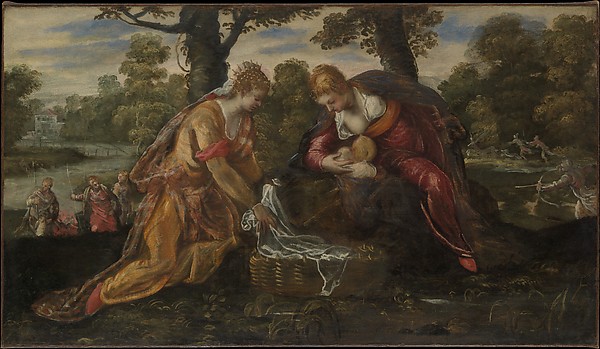
No one seemed to have the noticed the irony of Tintoretto’s painting of the discovery of Moses among the bulrushes hanging in the cabinet room.

Tintoretto

On a different note, the the AC in the chancellery seldom worked.

Another theme in Kitchen’s biography is the relationship between capitalism and Nazism, a fraught and contested topic of several old posts of mine. While not breaking any theoretical or historical new ground, Kitchen has an eye for revelatory architectural details about that question. Like this:

Speer’s plan for Berlin underlined the fact that the headquarters of the Armed Forces and of Germany’s leading companies did not merely share the same address, but lived together in harmony….Ernst Petersen’s project for the washing powder manufacturer Henkel was next door to Herbert Rimpl’s building for the Hermann Göring Works. IG Farben was placed opposite Hitler’s palace. AEG was across the street from the Ministry of Propaganda. This sense of togetherness and of monumentality was strengthened by bunching these huge buildings together along the north-south axis.

In his Wall Street Journal review of the Kitchen biography, Tooze offers further details:

[Speer styled] himself as a pioneer of European integration for having promoted the outsourcing of production to his collaborator friends in Vichy France….Reading the shopping lists of luxuries that Speer ordered from Spandau jail, including a Group One Dunhill pipe, foie gras with truffles, Beluga caviar and a Jaeger-LeCoultre watch, one is tempted to invoke instead “American Psycho,” Bret Easton Ellis’s deathless evocation of a murderous, product-obsessed Wall Street yuppie….It is hard to think of any major industrial corporation that did not employ forced foreign labor. A shockingly large proportion even contracted with the SS for the use of concentration-camp labor, including Jewish camp inmates. Nor were the businessmen merely narrow-minded profit maximizers “doing their job.” As part of Speer’s organization, they actively shaped and mobilized the German economy for war. Most were nationalists committed to German victory. Some were Nazi ideologues. They all had reason to fear Stalin’s Soviet Union. But the system that Speer organized melded these impulses with a more abstract ethic: Its participants lived and died by the standard of ‘performance’ (Leistung). Statistics and production records were their religion, technological improvement their mantra and disruptive innovation their magic.

One last detail, which Tooze reveals in his review. One of the last books that Hannah Arendt read just before she died in 1975 was Speer’s diaries from his time in Spandau. It’s hard to resist the desire to construct what she might have made of the man. In some ways, he was the perfect target for her, more perfect even than Eichmann. Because Speer hailed from the professional upper middle classes that were Arendt’s lifelong bête noire.

Sunday photoblogging: the centre of attention

by Chris Bertram on January 3, 2016

The centre of attention

Hitchens on the English and their history

by Eric on January 2, 2016

Peter Hitchens is less well known in the United States than his late brother, but when asked to write for the New York Times, he delivers his Mail columnist goods, full-strength. Regarding Robert Tombs’s English and their History:

Even in free countries it is sometimes necessary to alter the past to suit the present. For instance, I recall the day at my English boarding school in the early 1960s when our sober, patriotic old history books were gathered up and carted away to a storeroom. In their place we were handed bright, optimistic replacements, with a good deal less to say about the empire, the Protestant martyrs or what we had been taught without embarrassment to call the Glorious Revolution.… Older English people look back fondly on 1940, when we supposedly stood alone. In fact we were a major industrial and exporting power with a global navy, more or less self- sufficient, nationally cohesive and bolstered by the tribute of a still-great empire. Now all of that is gone. Is it possible that, after a thousand astonishing years, our island story has finally come to a full stop? Will the next great history of our nation and people be written in Chinese?

Now that George MacDonald Fraser has died, the sources for such views of the empire and its history seem fewer each day.

Happy Almost New Year, Timberteers

by Maria on December 30, 2015

Nothing welcomes you back to London after a soggy spell in the west of Ireland like a gold-plated (surely not real?) Lambourghini, vanity plate; F1 IRAK, whizzing past you on the Chelsea Embankment. Ah, world’s super-wealthy, with your love of obscene and ill-gotten goods and your disdain for pettifogging traffic rules, I have missed you.

Fear not. Plenty of riches are to be had here on CT. Having failed to post a timely Christmas picture of the Crooked Timber dog, and having also failed to post any recommended reads from 2015, I still have it in mind to share some wealth in the form of our own middle class intellectual status indicators. Here are some non-book gems I enjoyed this year. Maybe you have some of your own?

Milo and Fury, Christmas Day 2015

Milo and Fury, Christmas Day 2015

Podcasts
Philosophy Bites, by David Edmonds and Nigel Warburton, comprises well over 300 20-minute interviews with philosophers on everything from Stoicisim to inequality to Foucault and power. CT’s own Chris Bertram does a particularly good session on Rousseau, ranging over the life and works and making me wish – not for the first time – that I’d paid more attention in college. Philosophy Bites makes philosophers sound surprisingly chatty, collegial and willing to tackle questions we all puzzle over and never get very far with.

BBC Radio 4’s ‘In Our Time’ with Melvyn Bragg is fantastic, if you are in the UK or have a VPN to vouch for you. The format is that the slightly irritable and impossibly well-read host asks questions of three experts on a topic from history, literature, philosophy or science. Bragg is a national treasure on a level with Alan Bennett but has a more pleasing sympathy for the under-dog. The podcasts that include a few bonus minutes ‘with the cameras off’ are terrific, and show how much more interesting radio is when it can be less didactic and improving.

Entitled Opinions from Stanford Radio’s Robert Harrison can be a bit of a mixed bag. Sometimes the cultural theory gets a bit circular and obtuse – but that’s mostly when there are guest presenters. Each programme lasts an hour and the pace is expansive rather than quick. It’s what I love most about a good podcast – instead of me going ‘yeah yeah, I get it’ and skipping ahead to the end of the paragraph or the chapter, I have to stick with it and take in the ideas at the pace the presenter is willing to give them out. The bliss of being entirely in someone else’s power. Harrison’s interview with Colm Tóibín about The Master is wonderful, (also, I never knew James’ house in Rye was later lived in by the man who wrote Mapp and Lucia and used it as their respective fictional homes) though Harrison joins the rest of the anglo-sphere in being unable to pronounce Tóibín’s name.

The Royal Literary Fund’s ‘Writers Aloud’ series can be uneven but is often utterly brilliant, especially when Carole Angier is doing the interviewing. (Yes, the same Carole Angier who wrote the magnificent Primo Levi biography.) The stand-out interviews from the last year or so are with the poet Julia Copus and CT’s own favourite, Francis Spufford, who gives an inside track on the writing of Red Plenty.

Videos
OK, fair cop, my 2015 Youtube consumption has been driven by watching repeats of Graham Norton’s chat show (the one where Matt Damon, Bill Murray and Hugh Bonneville corpse laughing and go to pelt pineapples at the audience is a classic, though it actually happened in 2014) and also interviews with My Boyfriend Tom Hiddleston. The ideal is an interview of Tom Hiddleston by Graham Norton, which actually happened a couple of months ago. Hiddleston did an above average impression of Robert de Niro who was sitting nearby (celebrities’ lives are weird). For several minutes afterwards you can see Hiddleston going pinker and pinker and clearly regretting it, and I had an urge to jump into the screen and tell him what was obvious to anyone watching; ‘Don’t worry about it. You were great and are lovely. De Niro is clearly an arse.’

So, obviously I’m not proud of my Hiddleston crush, but it really is completely chaste. A few weeks ago, Ed and I were walking to a cafe for a weekend treat and, apparently, I was going along just smiling vacantly to myself. Ed asked what I was thinking about – at this stage he didn’t know about my little pash – and I said ‘I was just explaining the Tuisil Ginideach to Tom and saying how funny it is that it is both universal and nearly always irregular.’ Not everyone knows, I said to Ed, that the Irish language has a genitive case for nouns. It’s the Latin influence. (I personally hadn’t a clue that’s what it was until fifth year when a teacher mentioned it in passing.) And so then Ed had to ask who Tom was etc. etc. and why would he be interested in the grammatical structure of the Irish language. To which the answer could only be ‘Oh, Tom? He’s interested in everything I’m interested in.’ And then we ran into a neighbour in the cafe so that was the end of the (external) conversation. Tom. He’s dreamy.

Onward!

Crooked Timber people, and I’m especially looking at you, Kieran, you MUST watch Martin’s Life. (if you don’t know it already, which you probably do as it’s based in a small town near Cork city) Martin’s Life is a series of 2-3 minute animations about a young hipster and returned immigrant living with his parents in rural Ireland. It completely takes the piss out of the cultural cluelessness of the parents, but it’s really affectionate about them, too. One of my younger sisters played it for the extended family over the summer, and we were falling about in tears of laughter, parents included. If you do one thing today, watch Martin’s Life. Especially, for the season that’s in it, the one about Skype. Or the Christmas one. Or the old ESB ad one. This is literally every Irish expat’s life. Aithbhlian faoi mhaise duit, a Mháirtín.

OK, last orders. Have you no homes to go to?

The winner of Christmas was a Youtube video Henry put on on Stephen’s Day when we were all full of blueberry pancakes and sausages from Kilcullen (best in the world), and perhaps a little regret. The intro was unremarkable but when the singer began, the whole room changed. It was one of those moments when conversation fades away (rare in our house) and people drifted from the table towards the screen to listen and see. When this song finished, and amongst atheists, believers and fence-sitters alike, there was surreptitious nose-blowing, studied non-eye-catching and sudden impulses to be alone, outside, looking out over the bog and out to sea. Here, amongst all the seasonal oddities is the strangest wonder of all; Patti Smith singing Oh Holy Night to Pope Francis.


Silver Machine

by Harry on December 29, 2015

Lemmy is no longer with us.

But he’ll never really go away.