From the category archives:

Academia

Religious liberty and the Romance of Orthodoxy

by John Holbo on April 9, 2015

“This is the thrilling romance of Orthodoxy. People have fallen into a foolish habit of speaking of orthodoxy as something heavy, humdrum, and safe. There never was anything so perilous or so exciting as orthodoxy.” – G.K. Chesterton

Long post, hastily hammered. I’m hammering, specifically, a Rod Dreher post, since (I admit) I have become quite addicted to watching him chew the theological scenery re: the Indiana stuff. But, in criticizing, I’m not just piling on with more pizza parlor people snark, I hope. I think he’s confused, but what he says does raise interesting issues. I will attempt to be only mildly sarcastic around the edges, in the hopes of good conversation all round.

Dreher writes: [click to continue…]

The inevitability of red tape

by John Q on April 7, 2015

Following up on Eric’s response to the Paul Campos piece blaming administrative bloat for rising tuition, I thought I would repost this piece from my own blog (feel free to ignore, or respond to, the opening allusion to Oz politics).

I have a piece in The Guardian pointing out that the Abbott government’s Red Tape Reduction program is basically cover for a couple of big measures benefit the mining and gambling industries.

A bigger question raised by the piece: why does bureaucracy and red tape seem to grow without limits? Anyone who has ever worked as an academic, faced with a proliferation of pro-vice-chancellors, executive deans and multiple layers of hierarchy has certainly asked this question, and there’s nothing unusual about academics. The uselessness of administrators is the central theme of the comic strip Dilbert, popular in offices around the world.

The obvious explanations are
(a) stupidity; and
(b) administrative bloat benefits administrators and they are the ones who make the decisions

I don’t think either of these works adequately. Stupidity is certainly common, but the phenomenon is too pervasive to be explained in this way. As regards administrative self-interest, the problem is that senior executives could potentially gain a lot by cutting mid-level bureaucracy, and many have tried (remember ‘flatter organizations’ and ‘lean and mean’).

My own hypothesis is that every big mistake (for example, an undetected embezzlement or a mishandled episode of harassment) produces a permanent bureaucratic response designed to prevent a recurrence. This is very costly to reverse (who wants to deal with the first big embezzlement just after they downsized the accounting department) even if it would, in some sense, be less costly to put up with occasional failures. Moreover, for both good and bad reasons, I think we are, as a society, becoming less tolerant of institutional failures across a wide range of activities (systematic wrongdoing by financial institutions is a major counterexample but, I think, exceptional). So, we have more checks and balances, and more bureaucrats to enforce them.

Paul Campos writes in the New York Times about what he claims is the “real reason” for higher college tuition in the USA:

far from being caused by funding cuts, the astonishing rise in college tuition correlates closely with a huge increase in public subsidies for higher education.… a major factor driving increasing costs is the constant expansion of university administration

And he singles out the California State University (CSU) system as an example:

while the total number of full-time faculty members in the C.S.U. system grew from 11,614 to 12,019 between 1975 and 2008, the total number of administrators grew from 3,800 to 12,183 — a 221 percent increase

[click to continue…]

G(o)rrrr

by Eszter Hargittai on April 6, 2015

There is no shortage of stories about how uncomfortable things can be for women in tech, how hard it is for women to be taken as seriously as men, etc. Well, here is the nth installment of that saga. I attended GOR, the General Online Research conference, a couple of weeks ago hosted at the Cologne University of Applied Sciences. When I walked in, I was greeted by several women wearing the following T-shirt:

GORgeous

I found this rather curious. Why would the T-shirt for the staff/volunteers of a research conference on Internet use measurement and behavior have this word on it? I’m not so dense as to not get the GOR part, but it seemed completely out of place. Soon I started looking around the room for a male staff member, because I couldn’t help but wonder whether he would be wearing the same shirt. What do you think, dear reader? After the jump, I show you what the male volunteers were wearing.

[click to continue…]

Passover goes geeky

by Eszter Hargittai on April 3, 2015

Lots of nice little details in this. How would you part the sea for a Rube Goldberg Passover Seder machine?

If you’re looking for a humanist feminist Haggadah, the one I compiled in 2001 is still available. To this day I get emails about people coming across it and finding it helpful, which is nice to know.

RomancR.

Do the Jews Really Not Belong in the United States?

by Corey Robin on March 29, 2015

Last September, Joe Biden spoke to a group of invited guests, including leading American Jews, about Israel as a haven for American Jews:

Folks, there is no place else to go, and you understand that in your bones. You understand in your bones that no matter how hospitable, no matter how consequential, no matter how engaged, no matter how deeply involved you are in the United States … there’s only one guarantee. There is really only one absolute guarantee, and that’s the state of Israel.

I found that a rather stunning comment from a sitting vice president. So I wrote about it for my column at Salon.


Yet no one has remarked upon the fact of a sitting vice president telling a portion of the American citizenry that they cannot count on the United States government as the ultimate guarantor of their freedom and safety. The Constitution, which the vice president is sworn to uphold, guarantees to American citizens the “Blessings of Liberty” and equal protection of the law. Despite that, despite “how deeply involved” Jews “are in the United States,” the occupant of the second-highest office in the land believes that American Jews should look to a foreign government as the foundation of their rights and security.

A country that once offered itself as a haven to persecuted Jews across the world now tells its Jews that in the event of some terrible outbreak of anti-Semitism they should… what? Plan on boarding the next plane to Tel Aviv? It’s like some crazy fiction from Philip Roth, except that when Roth contemplated an exodus in “Operation Shylock,” it was to imagine the Jews fleeing Israel for Poland.

I talk about JFK on the Irish, Bernard Williams and Hobbes on the state, and Malcolm X on the UN. And begin my conclusion thus: “The reason no one has been ruffled by his statement, I suspect, has less to do with any special sensitivity to Jewish experience than with an ancient, not altogether wholesome, notion that the Jews are somehow different.” Read on here.

One of the things that makes me crazy about the media’s discussion of higher education is that so much of it is driven and framed by elite schools. During the 90s, when it seemed like every college and university was fighting over whether Shakespeare should give way to Toni Morrison on the syllabus, it occurred to few pundits to look at what was happening in community colleges or lower-tier public universities, where most students get their education. And where the picture can look quite different.

The same goes today for the wars over trigger warnings and safe spaces: on both sides of the debate, this is primarily an argument at and about elite schools. Which has little to do with a place like Brooklyn College, where I teach. Seriously: just check out Judith Shulevitz’s recent piece on the topic in the Times, which got so much notice. In a 2100-word oped, here are all the institutions that make an appearance: Brown, Columbia, Northwestern, Oxford, Smith, Hampshire, Barnard, and the University of Chicago. There are fewer students in all of these institutions combined than there are at CUNY alone; between them, these institutions enroll less than .4% of all students in America (not counting Oxford, of course, though it wouldn’t really change the numbers).

This is all a long windup to a piece in this morning’s Washington Post by a Columbia philosophy professor who is teaching at a prison in New York. [click to continue…]

Hullo again … delayed by a frankly inexcusable three weeks, this episode brings together some of the things I noticed and wrote notes on while in New Zealand. It’s the longest one so far, and might have been a lot longer if I hadn’t just despaired of ever doing it justice. I don’t think I’m ever going to fall for a country as hard as I fell for Greece, but man, New Zealand is very nice. Next episode will cover Polynesia …

(PS: Attentive readers may note that the word “Maori” is consistently misspelt. This is because I don’t know how to do the flat line accent over the a. Sorry)

[click to continue…]

Some Responses to the Israeli Election

by Corey Robin on March 20, 2015

Yousef Munayyer in the New York Times:

This might seem counterintuitive, but the political dynamics in Israel and internationally mean that another term with Mr. Netanyahu at the helm could actually hasten the end of Israel’s apartheid policies. The biggest losers in this election were those who made the argument that change could come from within Israel. It can’t and it won’t.

Israelis have grown very comfortable with the status quo. In a country that oversees a military occupation that affects millions of people, the biggest scandals aren’t about settlements, civilian deaths or hate crimes but rather mundane things like the price of cottage cheese and whether the prime minister’s wife embezzled bottle refunds.

For Israelis, there’s currently little cost to maintaining the occupation and re-electing leaders like Mr. Netanyahu. Raising the price of occupation is therefore the only hope of changing Israeli decision making. Economic sanctions against South Africa in the 1980s increased its international isolation and put pressure on the apartheid regime to negotiate. Once Israelis are forced to decide between perpetual occupation and being accepted in the international community, they may choose a more moderate leader who dismantles settlements and pursues peace, or they may choose to annex rather than relinquish land — provoking a confrontation with America and Europe. Either way, change will have to come from the outside.

The re-election of Mr. Netanyahu provides clarity….The two-state solution, which has seen more funerals than a reverend, exists today only as a talking point for self-interested, craven politicians to hide behind — not as a realistic basis for peace.

Mr. Netanyahu’s re-election has convincingly proved that trusting Israeli voters with the fate of Palestinian rights is disastrous and immoral. His government will oppose any constructive change, placing Israel on a collision course with the rest of the world. And this collision has never been more necessary.

[click to continue…]

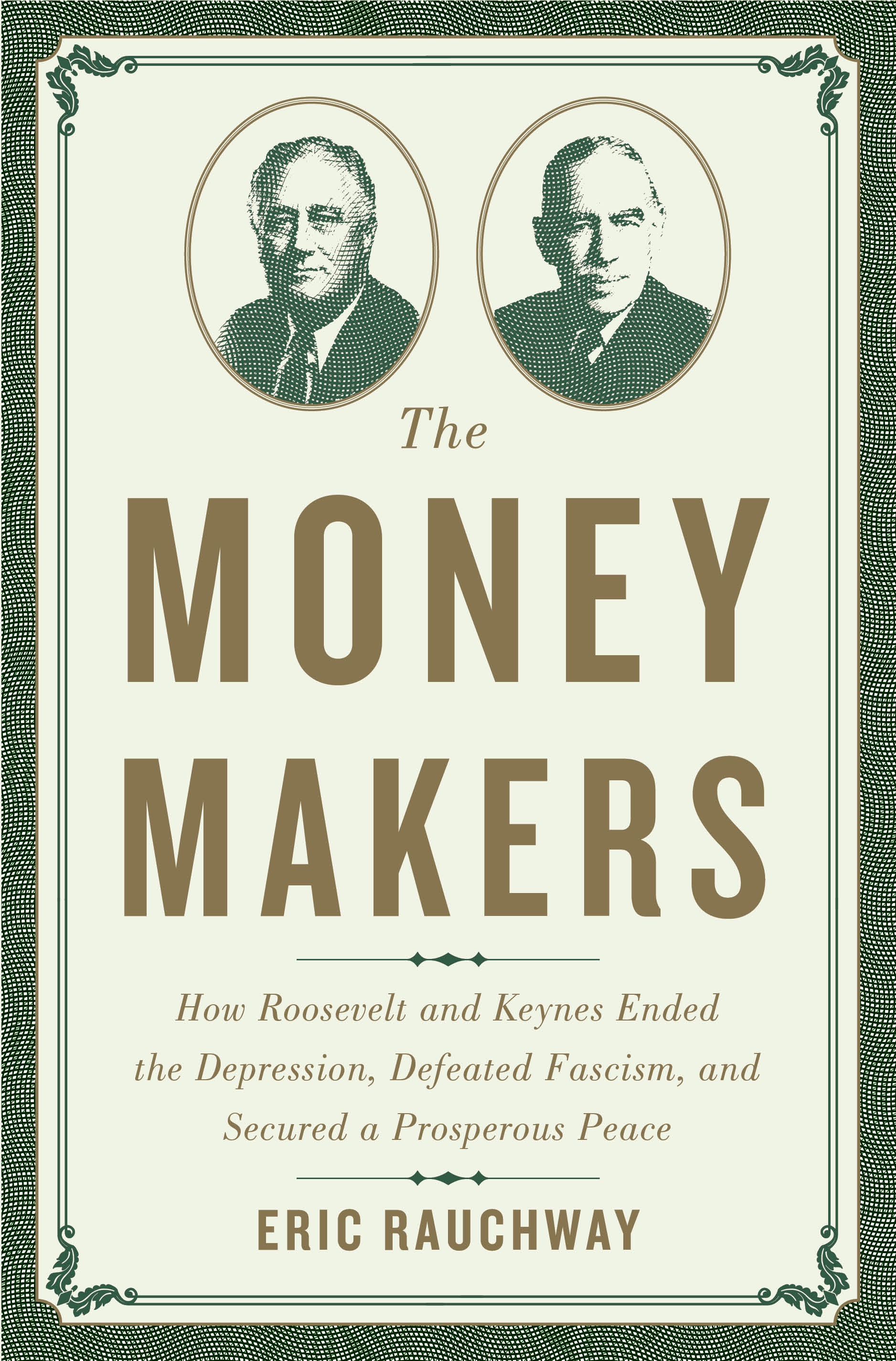
Money Makers
Forthcoming in September, from Basic Books

As readers of this blog know, Franklin Roosevelt declared he had taken the US off the gold standard on March 6, 1933, as the first substantial act of his presidency. But scholars have not been so quick to accept this date or, with firmness, any other.

When Roosevelt first said he had taken the US off the gold standard, he didn’t want to make too great a fuss about it because he was trying to quiet a panic that had nearly broken the Federal Reserve System. He hoped Americans would bring their gold back for deposit in the nation’s vaults. And they did. Even though the papers were reporting that the president might issue scrip for temporary currency; even though the Emergency Banking Act provided that Federal Reserve notes could be backed by commercial bank assets, people generally preferred paper money to gold, so long as they trusted the paper money – which, with Roosevelt’s assurances, they did, as you can see from the chart. [click to continue…]

Political philosophy now illegal in the UK

by Chris Bertram on March 13, 2015

Well, almost. The British government has just produced [the guidance for its “Prevent” scheme for education](http://blog.sghmartineau.com/archive/2015/03/13/final-version-of-prevent-guidance-published.aspx), which aims to stop young people from being drawn into “extremism”. The elite at Oxford and Cambridge have been granted a specific exemption, allowing them to hear dangerous ideas that might corrupt the ordinary youth, and universities haven’t been given specific guidance on what they may teach. Colleges of further education, on the other hand, have been told that “All relevant curriculum areas will need to be engaged, with a single contact point for delivery of Prevent-related activity.” This so that students are not exposed to arguments that involve

> “active opposition to fundamental British values, including democracy, the rule of law, individual liberty and the mutual tolerance of different faiths and beliefs.”

I suppose it will be news to some that these are “British” values, particularly if they are Irish or live in the former colonies. But leaving that aside, it looks like Plato is off the menu and to make sure:

> “Compliance with the duty will be monitored centrally via the Home Office and through appropriate inspection regimes in each sector.”

Well, that’s freedom for you.

Roosevelt’s money policy, 1933-1934

by Eric on March 10, 2015

Money Makers
Forthcoming in September, from Basic Books

On this day in 1933, it was the first Friday of Franklin Roosevelt’s administration, and the new president met reporters to talk to them about ending the bank holiday with which he had begun his term. The Federal Reserve Banks would open on Saturday so that member banks of the Federal Reserve System could open on Monday. A reporter asked if the banks would be open “[a]ll along the line, Mr. President; that is, all functions?” Roosevelt replied, “Yes, all functions. Except, of course, as to gold. That is a different thing. I am keeping my finger on gold.”

The president’s week had started with his inauguration on March 4, the previous Saturday, when he had told the American people they had only fear itself to fear, and promised them an “adequate but sound currency.” The next day Roosevelt worked all through the day with members of his team and holdovers from Herbert Hoover’s to draft orders to close the banks and halt all payouts of gold. They worked so hard that Sunday that it was late by the time the order was ready for presidential signature – so late that Federal Reserve counsel Walter Wyatt urged the president to wait a little longer to sign, so that it would be Monday, and not so sacrilegious. Roosevelt did wait, and then, on signing the order said – gleefully, according to one account – “We are now off the gold standard.” That was in the wee hours of March 6; later that morning, Americans began a week of doing business without access to banks.

[click to continue…]

The Lives They Lived, The Lives They Touched

by Corey Robin on March 9, 2015

The year after I graduated college, I lived out in the East Bay area. I was interning at a magazine, for free, and temping (among various other jobs) to support myself.

At one of my temping gigs I befriended a woman from Carbondale, Pennsylvania. Her name was Gloria. She had long black hair, wore lots of leather and makeup, and listened to hard rock and heavy metal. I think she had a son, though I can’t remember for sure. A working-class Italian-American from back East, we didn’t have much in common except a shared love for complaining about our job and trash-talking our boss. Even so, she wound up telling me a lot about her personal life (I have vague memories of  a problematic boyfriend on the scene). She also lent me a cookbook of Italian recipes that I never returned to her.

One day, Gloria furtively pulled out a folder of clippings and told me they were about her Aunt Viola. Viola had been a mother of five in Michigan who went south in the 1960s to march for voting rights for black Americans. Gloria told me she was shot and killed. Gloria was clearly proud of her aunt, but she also said that not everyone in her family felt the same way. I had never heard of her aunt or this story.

Viola_LiuzzoI forgot about both, until years later, when I learned the story of Viola Liuzzo. I put two and two together and realized that Gloria was Viola’s niece. For many years, Liuzzo was one of the forgotten heroes of the Civil Rights Movement. But apparently she now has received her due in the film Selma, which I haven’t seen yet.

Mary Stanton wrote a lovely piece on Liuzzo back in 1999, which was revived and posted this month, but before I provide some excerpts here, I want to come back to Gloria. As far I could tell, Gloria was not a political person. She was mostly a survivor—of bad jobs, bad relationships, bad luck. Even so, she had strong feelings about racism and racial equality, rooted in a sense of obligation to her murdered aunt. Just a small reminder of how many lives a radical movement of social change like the Civil Rights Movement can touch.

From Stanton’s piece: [click to continue…]

Car(te) Blanche

by Baptiste Coulmont on March 9, 2015

Readers might know Michel Maffesoli, the French sociologist famous for having been the PhD advisor of a socialite seer, Elizabeth Teissier (who did produce an astrological Ph.D). Maffesoli is the herald of a brand of postmodern, non-empirical sociology mixed with esoteric and masonic references. He was a student of Gilbert Durand (who himself was a promoter of academic astrology) and of far-right political scientist Julien Freund. But he was also full professor in one of the most important sociology department in France (at the Université Paris 5). And after the Teissier affair, he has been selected by several ministers of Higher Education to be a member of the Administrative Council of the CNRS, and to be a member of the prestigious *Institut Universitaire de France*. His colleagues and peers at the IUF awarded him the highest professorial rank (“Classe exceptionnelle”). He is the PhD advisor of more than 130 students (seriously, you can check the number on www.theses.fr). He is the Editor of two journals, *Sociétés* (published by De Boeck, a respectable academic press) and *Les cahiers européens de l’imaginaires* (published by the CNRS).

It has always been difficult to understand the coexistence of the deep contempt of mainstream French sociologists for Maffesoli (he is widely denigrated as a fraud) and of his academic and more wordly successes. One could point to his friendly acquaintance with post-gaullist politicians and to his masonic affiliations, as well as other forms of network connection, but that would not be a full explanation. Recently, Manuel Quinon and Arnaud Saint-Martin, two French sociologists, decided to “Sokal” the Maffesolian band of sociology. Adopting a pseudonym, they wrote an article in postmodern language submitted it to *Sociétés*. They wrote some gobbledegook and *Sociétés* very rapidly decided to publish it as “Automobilités postmodernes: quand l’Autolib’ fait sensation à Paris.”

The car in question

The article is about the Autolib, an electric car rental service available on a subscription basis in Paris.

In the article, the “transgender” Autolib is described as the turning point for the modern *episteme*, as the return to the protection of the primordial matrix, and so on. Being well-versed in maffesolese, they know that “modern” is bad, faustian, promethean, and that “postmodern” is good, comforting and dyonisian. In less than 10 pages, they use half a dozen languages: French, English, German, Latin, Greek (in Greek and Latin alphabets), and various typographic affectations (italics, parentheses, slashes in the middle of words). The vocabulary is often complex—”glyschomorphous”, “phallogocentric”, “diairetico-schizomorphous”—but lacking any particular definition. At the center of the article lies a pun. “Essence”, in French, is both essence (as in essential), and gasoline (as in oil). Thus our fictional author writes that the Autolib is “an open car, but not in essence because it is an electric car”. They also insist that postmodernity is “gaseous”, because Zygmunt Bauman’s modernity is “liquid”. The Autolib reveals itself in conclusion as the origin of a “new directing myth for a new epoch (postmodernity)”.

One month after the publication of their article Saint-Martin and Quinon disclosed their hoax in a long article Le maffesolisme, une sociologie en roue libre : Maffesolism, a freewheeling sociology, where they describe the planning of their article, the swift “evaluation” process and their goal (the ultimate academic destruction of Maffesoland). But their article is also a comprehensive and thorough analysis of Maffesoli’s texts and metaphysics. It is on the basis of this analysis that they have written their pastiche, which is, in some respects, better than what Maffesoli and his students write themselves.