From the category archives:
Audio/Video
Here.
Enjoy. It’s Sunday after all.
I don’t see why only Theory and Monday should have all the fun. Still, one comment from Michael’s thread caught my eye. Hidari:
I might also add that the ‘anti-relativist’ or (as I would prefer to put it) ‘anti-contextualist’ position is generally hopelessly confused in that they tend to use Positivist arguments to support Realist positions. But you can’t do that. The positivists were instrumentalists, as befitted their anti-metaphysical, pro-empiricist assumptions. Realism is a metaphysical position.
The rest of the comment suggests this is supposed to express a Nancy Cartwright-style view, which I don’t think is really quite properly described as anti-realist. (It is anti-Realist, for certain values of the self-important capital-R. But that is another kettle of fish. Or, possibly, Fish. I mention this out of scrupulosity because it just isn’t clear to me the positions Hidari is objecting to in the thread are Realist, as opposed to realist.) Anyway, the point is this. I’ve been watching the new They Might Be Giants Here Comes Science 
In the opening number, one of the Johns does exactly the thing that bothers Hidari (and Cartwright is indeed someone who scourges this particular move): offering positivist arguments on behalf of realism.
As I was saying, one of the Johns quotes Rudolf Carnap, “science is a system of statements based on direct experience and controlled by experimental verification.” And the other John then says: “Or as we say, Science Is Real!” And the song starts. But these two statements are hardly equivalent. Indeed, even the graphic for the song title is eloquently anti-Carnapian:
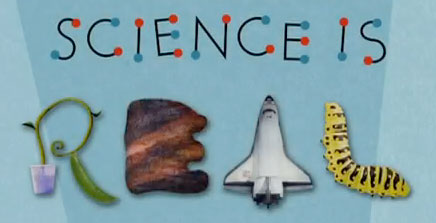
This clearly implies that science does not consist of sentences. It is a thing that itself contains the things that sentences about science are about. Or as we say: things! Reality! (Call it what you will. Place is thick with the stuff.)
Here’s a YouTube link to the video for TMBG “Science is Real”, complete with Carnapian intro. (You can also watch it as an Amazon preview, but they cut the Carnap bit! That was the best part!)
So your job, this Reality Thursday, is to write a song – or poem – expressing as clearly as you can, with extra style points for keeping it intelligible to an 8-year old – your favored philosophy of science. Does it consist of sentences, or does it consist of reality? You decide! The only thing I can think of that rhymes with ‘paradigm’ is ‘spare a dime’. As to the rest: I’m recovering from the flu myself and have 100+ papers to grade, so don’t ask me to dance you a little jig. I don’t have the time or energy.
You can also comment in prose.
Some amazing time lapse sequences of glacier retreat and a spectacular ice-shelf collapse:
YouTube provides:
John [and Faith!] Hubley’s 1959, Academy Award-Winning “Moonbird”. I don’t know much about it, except that they obviously constructed an ingenious and charming piece of animation on top of an audio recording of their two young sons, talking and singing.
Here’s a surprisingly progressive, “Brotherhood of Man” (part 1, part 2) educational cartoon from 1946, directed by Robert Cannon. (Scripted by Ring Lardner [jr.!], apparently.)
And another Hubley. “Soothing, instant money” – a classic Bank of America ad. Ironically, I take it this was done just a few years after Hubley was blacklisted for refusing to testify to the House Committee on Un-American Activities. So he had been forced to leave UPA and take work making commercials.
Hubley and Cannon, if you don’t know, are probably best known for their work together at UPA on such classics as “Gerald McBoingBoing” and “Mr. Magoo”.
Here’s a fun, if somewhat uncertainly-sourced story about how Hubley and co-creator Millard Kaufman invented Magoo, from Wikipedia:
The Magoo character was originally conceived as a mean-spirited McCarthy-like reactionary whose mumbling would include as much outrageous misanthropic ranting as the animators could get away with. Kaufman had actually been blacklisted, and Magoo was a form of protest. Hubley was an ex-communist who had participated in the 1941 [Disney] strike. Both he and Kaufman had participated in the blacklist front and perhaps due to the risk of coming under more scrutiny with a hit character, John Hubley, who had created Magoo, handed the series completely over to creative director, Pete Burness. Under Burness, Magoo would win two Oscars for the studio with When Magoo Flew (1955) and Magoo’s Puddle Jumper (1956). Burness scrubbed Magoo of his politicized mean-ness and left only a few strange unempathic comments that made him appear senile or somewhat mad. This however was not entirely out of line with the way McCarthy came to be perceived over that same era.
Horrible Histories (the best thing currently on television in Britain?) takes a less jingoistic view of Britain than the Ladybird Books — the 3 minutes history of the British Empire is, alas, not yet up on youtube, but there’s plenty else there: Witchfinders Direct; Christians versus Lions; Born 2 Rule; etc.
Btw, according to wikipedia, not only was Titus Oates not really called Titus (I always thought it was odd that there were two of them), but he disliked Scott intensely, which makes the whole thing seem even more tragic.
Having knocked Mark “digital barbarism” Helprin around in a trio of posts – in one of which I remarked that the guy should probably listen to EconTalk to learn that libertarians are actually skeptical about the merits of copyright extension – I am duty-bound to report that Helprin was just a guest on EconTalk. [click to continue…]
A 60 minute interview between rockumentarian Peter Curran and the boys, here, celebrating the release of their not-yet-posthumous, Back from the Dead
Those who enjoyed our reading group on Rescuing Justice and Equality
There are few philosophical issues or policy questions that are not also M.O.D.O.K jokes (as this round-up reminds me). For example, the gender issue raised, but hardly laid to rest, by my philosophy: mind and manners post is just the classic M.O.D.A.M. (Mental Organism Designed Only For Aggression) question. (What do we think an academic philosophy education is good for?) [click to continue…]
First: why aren’t you reading more Squid and Owl? Last week we had assassination by siege engine and undersea regicide. Now we are off on a thrilling mock-Kipling romp. You are a fool not to click.
Next: even more of those psychedelic biology scans up. This one for example: [click to continue…]
Dolly, a play by Christopher Douglas (aka Ed Reardon and Dave Podmore) about the events surrounding Basil D’Oliveira’s selection to play for England (described and analysed rivetingly in Peter Oborne’s Basil D’Oliveira: Cricket and Conspiracy: The Untold Story

Spike Jonze moves on to his next children’s book.