by Ingrid Robeyns on October 13, 2007
It’s Saturday noon and my toddler is taking a nap; I am not in the mood for doing academic work and by now too heavily pregnant to do any serious amount of housework. So here are two musing about books.
The first is a real book, with a wonderful 1970s smell. I finally could get hold of a copy of Amartya Sen’s Collective Choice and Social Welfare. I made photocopies of that book when I studied welfare economics in the mid-1990s, and subsequent attempts to buy the book always failed. It hasn’t been reprinted for yeeeeeeears, and the only second hand version that I once found was a few hundred dollars – too much for my budget. But purely by accident, I had another look earlier this week on the Amazon second hand market, and found one, for 50 dollars. A first edition, with the errata-page included. It arrived from California today – less than 5 days after I ordered it. It’s a first edition, previously owned by someone called David Owen Butcher. Thank you David, you made my day.
The other book is Facebook. It seems that the virus finally caught me. Last week a friend showed me the ‘inside’ of facebook, and tried to lure my into joining. I saw the phantom of the timesink in the close distance, so resisted the temptation. Yet Chris's post suddenly made me think that perhaps facebook can also be useful, and hey, the economist in me woke up, and earlier this week I joined. I even joined the Crooked Timber group (not sure what that implies, though). So, did those of you who joined Facebook in July after Henry set up the group, ever went back to work on your social facebookrelations there?
by Scott McLemee on October 4, 2007
Last week, I met Todd Gitlin in the studio at Inside Higher Ed’s world headquarters on K Street to record an interview about his new book, The Bulldozer and the Big Tent. (The “studio” is actually the publisher’s office, since it has the best acoustics. Podcasting has become a routine if not a regular thing for us; here’s the backlist. I’m still getting used to the format itself and trying to think about its potential as a way to supplement my column, since merely duplicating content of a written piece in audio (or vice versa) isn’t very interesting or appealing.
At TPM Cafe, Gitlin expresses what seems like surprised appreciation to his interviewer “for actually having read the book.” Given journalistic norms, that probably means I’ll never get a steady gig again, and certainly not in radio or TV.
But in consequence of this peculiar tendency, I have notes indicating that Henry’s netroots essay is quoted on page 184 and then again on page 185.
by Henry Farrell on October 4, 2007
“Anmik,” commenting on Kieran’s post below writes:
But then, what about the very real, very reasonable impulse to softpedal book reviews, to write overly generous tenure evaluations, and on and on? I only ask because the whole idea of peer review, and the review process more broadly, has begun to feel a bit, how to say this, corrupt of late. I noted yesterday some very minor flap in which Chris Matthews, the political “journalist,” admitted that it’s hard to cover the people he sees at cocktail parties. The same is true for scholars, no? And blogs only compound the problem, I suppose.
This is a real problem, albeit not one of recent vintage; mutual backscratching is especially endemic in academic book reviews. But it isn’t one that is very easy to fix. Some months ago, I wrote a quite negative review of a book that seemed lazy to me; I thought it only fair to signal this to potential buyers. But precisely because there’s a kind of pooling equilibrium going on here I worried a bit about whether or not I was sending out _too_ negative a signal to readers and colleagues about the book’s quality. If everyone says nice things about everyone else’s books, then a negative review will likely be overinterpreted as saying that this book _really_ stinks to high heaven, its author should be denied tenure etc. In this case, it wasn’t a major issue, because the book was written by a seniorish figure, who presumably wouldn’t be damaged too much by an asst. prof’s evaluation of his work. However, I would worry if I were writing a review of a more junior person’s work, to try to be sure that whatever signal I was sending out wasn’t misinterpreted.
I suspect that this is even more of an issue in tenure review letters, where, I understand, negative comments will receive far more attention than positive ones on the assumption that their informational content is much higher. Given this, someone who wants to give an honest assessment that is critical but basically favorable is going to have to choose her words very carefully indeed so that she says only what she wants to say and isn’t interpreted as saying more. So the problem isn’t simply one of corruption – it’s also one of signalling conventions that are quite hard to overturn once they become established. Anonymous peer review is different in my experience – negative signals by and large don’t receive undue weight, because there aren’t any obvious pressures to converge on an equilibrium where we say nice things about each other even though we don’t mean them.
by Henry Farrell on October 2, 2007
Charles Stross’s _Halting State_ (Powells, Amazon) should be on the shelves of yer local bookshop as of today; I thoroughly recommend it. It combines the intellectual fireworks of _Accelerando_ with a much less choppy plot and is a lot more fun to read – starting from a virtual bank raid by orcs and a dragon in a newly independent Scotland, and steadily getting more weirder and more interesting from there. It’s the first book I’ve seen that really begins to think through how distributed forms of collective action are likely to collide with more traditional kinds of state-based politics; the bit towards the end where you first figure out what is _really_ going on blew my mind.
Also very good, but a little more traditional is Paul McAuley’s SF thriller _Cowboy Angels_ (no US publisher but the import isn’t too expensive ). McAuley uses the many-worlds trope to think through US imperialism with a novel twist – a variety of alternative America’s located in different ‘sheaves’ that have split from each other since the 1920’s, one of which, the ‘Real’ America, has discovered how to build Turing Gates between sheaves, and is using them to introduce democracy by fair means or foul to the rest (our reality is referred to as the ‘Nixon sheaf,’ natch). While some of the spy-novel element is a little formulaic, the different Americas are well thought through and all feel real – they’re shot through with ambiguities rather than simply standing in for this or that political system. For some reason, the book didn’t find a US publisher a couple of years back when it was first on the market – this is a little surprising given its topicality (perhaps it was too politically awkward – my impression is that people who buy this kind of novel in the US tend (a) to be right of center and (b) not to enjoy having their priors challenged).
by Kieran Healy on September 20, 2007
So Laurie, the lucky duck, got a copy of the Atlas of Creation, the amazingly large-format, glossy-photo-laden, funtastic creationist slice of life, courtesy of whoever is bankrolling its author Adnan Oktar. It’s a fantastic educational resource for our three-year-old: she’s already excited about cutting out the photos of the bunnies and fishies, etc, and making them into collages, puppets and so on. Strongly recommended.
by John Holbo on September 10, 2007
I just finished The Professor’s Daughter [amazon], by Sfar and Guibert. My favorite panel:
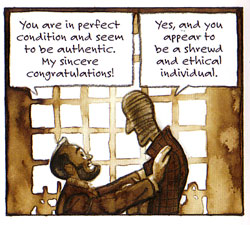
Imhotep IV takes refuge in the shop of an antiquarian, before resuming pursuit of his beloved – Lillian, daughter of renowned Egyptologist, Professor Bowell, who is owner of Imhotep IV. As the defense attorney sincerely declaims, a few pages on: “It was love that caused Pharaoh Imhotep IV to cross the centuries and attempt to breach the west wall of the central police station, and it was hastiness that caused Miss Bowell to confuse arsenic and chamomile.” Further complications ensue upon arrival of Imhotep III, who kidnaps Queen Victoria. Love conquers all, the watercolors are lovely.
You can read the first dozen pages at First Second books – purveyors of fine comic product all-around. (But Amazon will give you a better price. But maybe it’s better to buy from the publishers.)
In other art news, I just noticed that Hirst sold the skull:
Damien Hirst’s diamond-encrusted cast of a human skull has been bought by a group of anonymous investors for its asking price of £50 million, the artist’s representatives claimed yesterday.
It is, by a huge margin, the most paid for a work by a living artist.
Entitled For the Love of God, the skull was first displayed at the White Cube Gallery in Mayfair, Central London, in June where thousands queued for a two-minute viewing in a high-security darkened chamber.
Studded with more than 8,500 ethically sourced diamonds, it has been variously described as “an anthropomorphised disco ball”, “the first 21st-century work of art”, “a cosmic wonder”, “the vulgar embodiment of modern materialism” and, by Hirst himself, as “quite bling”.
And Texas can’t decide whether the grammar/penmanship is wrong enough for it to be $550,000 worth of right.
by Chris Bertram on September 3, 2007
I have very little time for blogging at the moment, so I’m going to abandon a plan I had to write an extended post about Byron Rogers’s The Man who Went into the West: The Life of R.S. Thomas . Thomas, referred to by Larkin as “Arsewipe Thomas” was, as most of you probably know, one of the very best poets in the English language in the twentieth century. He was also an Anglican vicar in a Wales where most of the population was chapel and a fierce advocate for the Welsh language despite speaking a variant so academic that his parishioners struggled to understand him. He sometimes refused to speak English at all (except through an interpreter), yet he wouldn’t let his own family learn Welsh and couldn’t write a decent poem in his adopted language. His son tells of being packed off to boarding school in the hated England and of listening to sermons in which Thomas denounced fridges and vacuum cleaners as the paraphenalia of modernity. He barely showed any affection for his talented artist wife but after he death composed supremely tender love poems. With her he lived a life of dour austerity in sub-arctic temperatures, but then he remarried a fox-hunting reactionary and was seen queuing for lottery tickets at Tescos. He was a priest with distinctly unorthodox views about the nature of the deity (of whom he had an almost Newtonian conception). He carried out the duties of a vicar with conventional conscientiousness, but felt awkward talking to parishioners and once vaulted over the churchyard wall after a funeral service to avoid conversation with the bereaved. He had a reputation for grim humourlessness with some, but at least one person compared him to Lenny Bruce and Ken Dodd. And then there’s his feeling for nature and landscape … I could go on and on about this extraordinary man with many many personas and a capacity for repeated personal reinvention. But you should buy the book, you really should.
by John Holbo on September 2, 2007
I’m enjoying Bryan Talbot’s new – not exactly a graphic novel, is it? Alice in Sunderland [amazon]. Subtitled: ‘an entertainment’. Visit the official site of this ‘dream documentary’, call it what you will.
Anyway, it is set in the Sunderland Empire – that is, a theater – and the rabbit onstage explains to the lout in the audience, who is, oddly, a George Formby fan:
George Formby played here, and his father before him, from whom Chaplin steals his stick-twirling routine. All great northern comedy is drawn from tragedy. One of the biggest ever Music Hall stars, George Formby Senior – the Wigan Nightingale – is born into dire poverty and learns his trade as a singing beggar. His songs and jokes are punctuated by a hacking cough – a symptom of the tuberculosis that kills him in his forties – which he cleverly works into his act.
That’s fairly black. To be a tubercular Music Hall performer, hacking away on stage. The book says Formby, Sr., invented ‘Wigan Pier’ – see also, George Orwell – as part of a running gag to the effect that Wigan was a classy seaside resort, as opposed to a landlocked mining town. I never knew that. (Is it true? Talbott warns us that everything in the book is true except for one, which will be revealed at the end. I haven’t got to the end yet.)
Anyway, YouTube has some fine George Formby (Jr.) material: “When I’m Cleaning Windows”; “Fanlight Fanny”. So that’s where the Beatles learned to sound like that.
by Kieran Healy on July 30, 2007
Tyler Cowen has a “secret” blog and he made a deal with his readers: pre-order my book and I’ll send you the URL. Don’t link to it, and don’t tell anyone. Inevitably, now, we have this request from this guy:
bq. DO YOU KNOW THE URL OF TYLER COWEN’S SECRET BLOG?? IF YES, PLEASE, SEND ITS URL TO CHRIS MASSE. ANONYMITY GUARANTEED. AND I PROMISE I WON’T PUBLISH IT.
YES I KNOW HE’S SHOUTING. I haven’t pre-ordered Tyler’s book, because pre-ordering things is for suckers. Nor have I been in touch with Tyler. So he didn’t send me the link. But I read Tyler’s secret blog, because it is trivially easy to find it using Google. It took me about 90 seconds when I looked for it. So now I have an interesting dilemma.
[click to continue…]
by Kieran Healy on July 29, 2007
Question: what is the latest — i.e., most recent — example you know of an academic’s first book where, in the acknowledgments, the author thanks his wife (or some other person’s wife, as in “the redoubtable Mrs Elizabeth Arbuthnot”) for typing and retyping the manuscript with great patience, forbearance, accuracy, and so on? The acknowledgments to academic books are a mini-institution with pretty clear rules that change only slowly over time and show a high degree of homogeneity, particularly for first books. Up until a certain point, the endlessly patient and also busily typing wife was a fixture in them. But no longer. How precisely, I wonder, can her extinction be dated?
My hypotheses are: (1) The typing wife disappeared earlier than the typing employee, but (1a), The typing employee has also now disappeared. (2) Things must have been in decline for a long time (typewriters are not exactly a new technology, and then women started going to graduate school on their own account), but the big drop-off comes some time in the 1980s, as cheap computers and word-processors arrive. I suspect specimens continued to appear into the 1990s, however. (3) The typing wife may have disappeared from acknowledgments faster than actual wives doing actual typing disappeared in practice. (4) I expect variance across fields due mostly for reasons of technological affinity. But I’m not sure how fine-grained this is.
As evidence for (2), as an undergraduate in 1993 not in possession of a computer, and not lucky enough to be attending a university with any decent computing facilities, I along with almost all others hand-wrote all my essays and regular coursework. But it was a requirement of both my honours theses that they be typed, so I had to marry pay someone to do that. The following year, though, I had saved up and bought a powerbook and typed my MA paper myself. So it seems reasonable to think that academic books published around this time might still have phantom typists working away – though maybe by then it was people who took a typewritten manuscript and retyped it on a wordprocessor. But I want specific examples. So the main question is, in whose set of acknowledgments is the most recent typing wife to be found?
by Kieran Healy on July 24, 2007
Quite dull for the most part, I thought. Should have been c. 300 pages long. Backstory inserted by way of newspaper articles and book excerpts or what have you is tedious. But you knew all that from Books 4, 5 and 6. Did I mention there are *spoilers* below the fold?
[click to continue…]
by Scott McLemee on July 18, 2007
From time to time, I think of winnowing down and revising my published work into a collection of essays. And then kicks in the memory of having a player in literary publishing in New York (fully “made,” as they say in the Mafia) tell me, in the tone one would use in explaining things to a child, “You can’t publish a book of essays until you are somebody.”
Well, now I’ll keep in mind the example of John Emerson, whose writings appear at Idiocentrism and who regularly intervenes in the CT comments section. He has launched the Éditions le Real imprint with a book of his poems and a volume of essays.
[click to continue…]
by Eszter Hargittai on July 17, 2007
The edited volume on research methods that I mentioned earlier is shaping up nicely and I’ll be shipping it off soon. However, I’m still not sure about the title and subtitle, and was hoping for some input from anyone who’s willing to give it some thought. This is what I’m working with now:
Research Methods from the Trenches:
The Nitty-Gritty of Empirical Social Science Research
However, having “research” in there twice doesn’t seem right. Any thoughts on either the first or the second part?
As a reminder, the chapters in this book provide helpful behind-the-scenes accounts of doing empirical social science research for a wide range of methods such as use of large-scale data sets, interviews, observations, experiments and historical documents. The unique contribution of this collection is that it provides readers with a realistic idea of what to expect when embarking on empirical investigations by offering richly detailed descriptions of the logistics of individual research projects. The volume draws on the experiences of recent successful dissertation writers and young scholars doing cutting edge research in their respective social scientific fields.
If someone comes up with a title I end up using, I’ll happily send the person a copy of the book and will think of some additional gesture of gratitude. (CT mug anyone?:) Thanks!
by Kieran Healy on July 11, 2007
 The other day David Brooks wrote a column which appeared to be a stock piece of standard conservative anxiety about what he called “hard-boiled, foul-mouthed, fedup, emotionally self-sufficient and unforgiving” young women. Matt Yglesias picks up on on the piece today, salvaging the key insight of Brooks’ piece from the muddled pop-culture framing. As Brooks says,
bq. Now young people face a social frontier of their own. They hit puberty around 13 and many don’t get married until they’re past 30. That’s two decades of coupling, uncoupling, hooking up, relationships and shopping around. This period isn’t a transition anymore. It’s a sprawling life stage, and nobody knows the rules.
Matt comments:
bq. The reality is that technological and economic change has raised the age at which people — particularly more upscale people — do things like get married and have children. But biology stays the same. Consequently, people in their teens and early twenties engage in a lot of courtship-related program activities that don’t really entail a good-faith search for a spouse.
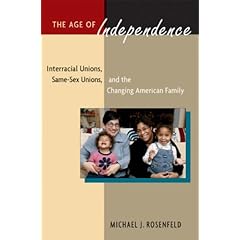
This point is basically correct. And for the past two months, a book exploring just this issue has been sitting on my shelf, waiting to be read properly, instead of skimmed. It’s Michael Rosenfeld’s The Age of Independence: Interracial Unions, Same-Sex Unions, and the Changing American Family.
[click to continue…]
by Eszter Hargittai on July 2, 2007
The link in my previous post is thanks to a new blog: No Caption Needed. It is both a book and a blog by my colleague Bob Hariman at Northwestern and his collaborator John Louis Lucaites at Indiana. This undertaking is “dedicated to discussion of the role that photojournalism and other visual practices play in a vital democratic society. No caption needed, but many are provided. . . .” The blog just started recently, but already offers all sorts of interesting images and commentary.