From the category archives:

Culture

More Congas, Less Crime

by Belle Waring on February 7, 2012

Answers to Questions No One Asked Me, Part 1 of n+1 where n > or = 0
Belle, what’s go-go music? Many a time I have heard that question not asked by someone moving to the DC area, or not asked by a person who hasn’t heard about go-go and knows I went to high school in DC. I have failed to be asked this question on literally countless occasions. That’s all over now. Go-go is a distinctive sub-genre of music popular only in the DC metro area (including Baltimore). It has always been dance music (as in “Going to a Go-Go”) and has always relied on this one beat. As far as beats go it sounds a distinctly Latin one, but there’s no Latin influence on any of the rest of the music ever. Wikipedia claims that “unique to Go-Go is an instrumentation with 3 standard Congas and 2 “Junior Congas”, 8″ and 9″ wide and about half as tall as the standard Congas, a size rare outside of Go-Go. They were introduced to Rare Essence by Tyrone Williams aka Jungle Boogie in the early days when they couldn’t afford enough full sized Congas, and are ubiquitous ever since.”

Yeah OK, but Chuck Brown, with or without The Soul Searchers, is considered the “Godfather of Go-Go,” did everybody change their kit later? And do all mostly black musical sub-genres have to have someone named “Brown” be the godfather of them? And “it was because they couldn’t afford bigger congas” has urban legend written all over it. Anyway, yeah, a whole bunch of congas and bells and whatnot. The only time a white DC audience ever heard that many drum solos was when Ozzy Osbourne’s “Crazy Train” concert was in town. (Before Randy Rhoads died in that tragic plane accident at Ozzy’s ranch. Who knows what magic might be flying off the fretboard of his distinctive “Flying V” right now. I’ll tell you all about my deep, deep love of “Tribute” and how I cry when I listen to “Goodbye to Romance” another time.)

Yeah, anyway, why two Rare Essence songs? OK, they’re my fave go-go band. But also I think this shows the evolution of the genre from something like funk to an intriguing version of hip-hop backed with live percussion and horns. It has continued to evolve, and is still popular in the DC metro area despite never making it anywhere else. Well, that’s not quite true, in that the music has been heavily sampled for other hip-hop songs which are then, perforce, go-go.

This is ye olde skuel, “Body Moves.” It’s special because it includes the DC slang word “sice” in the call and response at the end. “Sice” is more or less entirely equivalent to “psych,” (I’m siced for this party!) but can’t be negative (you can’t “sice someone out.”):

Back in the crack epidemic years go-go clubs were the site of lots of crime and shootings, and since the DC City Council is a bunch of morons, they decided to solve this problem by banning certain clubs from playing go-go. Ha ha pretend. NO RLY! One wonders whether, if such a club were to play, say, Nelly’s “Hot in Herre” (not that it would be a good idea, mind you) whether the club would be in violation, since the main loop is a sample from Chuck Brown’s “Busting Loose.” (Notice Chuck saying “give me the bridge now,” in 1978, that’s the oldest song I know that does that.) “It’s go-go!” “But it’s just a sample. It’s as if there are invisible quotes around the go-go that make it safe!” I could imagine the liquor license board debates getting pretty metaphysical. Next up is Rare Essence’s most popular ever song. It even made it to Yo! MTV Raps, as you can see (video way worth watching).

It is a testament to how not gentrified parts of DC are that I still don’t know where the hell Montana or Minnesota Avenues is. They’re getting the shout-outs, I assume they’re in S.E., but damn, that’s a lot of not knowing shit about your hometown. Go-go’s just weird in that none of its practitioners have ever hit the big time, even though it’s more or less next to New York. Even little old Savannah, GA has had more success in this regard (Outkast). I was originally going to defend disco from its detractors in the Don Cornelius thread who complained there was only one beat and the bass could never stray, and that was bad, by showing a) the bass can walk all over the damn place, and b) no harm in having generic constraints. Do you hate Loleatta Holloway and the SalSoul Orchestra, I intended to ask? Do you hate dancing (N.B. there is a go-go break in that song, “212 North 12th St.”)? Do you hate life itself? Then I got distracted. Squirrel! What? John insisted on the title. Brought to you by Stuff White People Like.

DISTURBING UPDATE: People born on the day Blackstreet’s “No Diggity” was at #1 are old enough to comment on youtube now. I mean, I know stray dogs comment on youtube, but still. Possibly more disturbing: I have a sweet-tooth weakness for this song.

NOT PARTICULARLY DISTURBING AT ALL UPDATE: If you find the openly proffered go-go unpalatable, then listen to the more funk-like Chuck Brown track linked above. You will probably like it more. If you like funk, which you probably do, because it’s funk, and all.
An atheist temple?

by Chris Bertram on January 27, 2012

Any spat between Alain de Botton and Richard Dawkins is one where I’m kind of rooting for both of them to lose. On the other hand, Dawkins has some genuine achievements to his name and has written some pretty decent books, so there’s some compensation when he acts like an arse, whereas in de Botton’s case ….

De Botton’s latest plans (h/t Alex):

bq. to build a £1m “temple for atheists” among the international banks and medieval church spires of the City of London have sparked a clash between two of Britain’s most prominent non-believers. The philosopher and writer Alain de Botton is proposing to build a 46-metre (151ft) tower to celebrate a “new atheism” as an antidote to what he describes as Professor Richard Dawkins’s “aggressive” and “destructive” approach to non-belief. Rather than attack religion, De Botton said he wants to borrow the idea of awe-inspiring buildings that give people a better sense of perspective on life.

Not a runner, I think. Though there’s at least one happy precedent: Auguste Comte’s Chapel of Humanity, which Maria blogged about in 2003.

Calvin and Hobbes

by Belle Waring on January 12, 2012

I have been meaning to blog about this for ages, though it’s sort of a personal reflection which I might have put on my personal blog had it not gone into a hibernation pod until we reach Alpha Centauri on our photon sail ship. At some point, let’s see, must have been…August 2010 or so, our younger daughter Violet, then 6, decided she was actually Calvin, and therefore a boy. Thus, her precious special stuffed animal Saki, probably the single least tiger-like toy in the universe, was Hobbes. She was in a phase of reading–well, being read to–a LOT of Calvin and Hobbes, which constantly reduced her to paroxysms of laughter. She is one of the laughingest children ever, so this isn’t hard, but her love of Calvin and Hobbes was special.

So, she insisted we all call her Calvin, and call Saki “Hobbes.” And refused to wear any of her dresses or skirts or girly T-shirts. And then a few months later she insisted she needed a boy’s haircut, and a boy bathing suit, and also boy underwear. Our reaction was to say: OK, as you like. I cut my children’s hair anyway (and my own!), so that was no problem. Her schoolmates and teacher were very supportive, calling her Calvin; she turned in all her homework and tests as Calvin. She still had girl friends, though; when I asked her if she wanted to play with the boys at school or have them over she rolled her eyes and said, “Mom, they’re all morons.” She also still played with her dolls, but more with Lego, and more Super Mario (both Wii–Super Mario Galaxy!–and Nintendo hand-held).
[click to continue…]

And did those feet?

by Chris Bertram on November 8, 2011

We went to see Jez Butterworth’s Jerusalem on Saturday, with Mark Rylance playing the role of “Rooster” Byron. It was one of the most overwhelming experiences I’ve had at the theatre. The production was superb, and Rylance extraordinary, inhabiting the character of drunk, drug-dealing outsider Byron with love and energy throughout. Englishness is the theme, but hardly the house-trained Englishness of which the Daily Mail would approve, since the action is set on Byron’s last day before eviction from his illegal encampment by Kennet and Avon council, and Byron is a “gippo” and a “pikey” (Americans might call him “trailer trash”). The inhabitants of the little box houses on the “new estate”, many of whom have hung around Rooster’s caravan as adolescents themselves, want him out. If I were being pretentious I might use terms like Dionysian (ok I just did). The play problematizes peace, “progress”, order and prosperity and projects a view of what matters that won’t appeal to Steven Pinker or the average economist. Well too bad for them. I hear the play was well-received on Broadway. I wonder how well the Wiltshire underlass travelled to New York? No spoilers here, but I have listened to Sandy Denny singing “Who Knows Where the Time Goes?” about 100 times in the past couple of days, often with tears running down my face.

Steve Jobs

by Kieran Healy on October 6, 2011

Steve Jobs has died. He was 56. Here is his 2005 Commencement Address at Stanford.

[click to continue…]

Money, sex, economics and stuff

by Chris Bertram on September 16, 2011

Aside from containing a brilliant exposition of how blogospherical “rebuttal” actually works — basically endless posts by halfwits repeating that X (an eminent scholar) is an ignoramus because X has contradicted the received wisdom of a tribe — this post by Dave Graeber at Naked Capitalism has to be one of the most informative and entertaining pieces I’ve read in a long while. What happens when the findings of anthropologists about earlier societies clash with the a priori assumptions of economists about how things _must_ have happened? Well, you can guess. The really interesting stuff is in the anthropological detail, so read the whole thing, as they say, but I’ll just quote Graeber on economics and scientific method:

bq. Murphy argues that the fact that there are no documented cases of barter economies doesn’t matter, because all that is really required is for there to have been some period of history, however brief, where barter was widespread for money to have emerged. This is about the weakest argument one can possibly make. Remember, economists originally predicted all (100%) non-monetary economies would operate through barter. The actual figure of observable cases is 0%. Economists claim to be scientists. Normally, when a scientist’s premises produce such spectacularly non-predictive results, the scientist begins working on a new set of premises. Saying “but can you prove it didn’t happen sometime long long ago where there are no records?” is a classic example of special pleading. In fact, I can’t prove it didn’t. I also can’t prove that money wasn’t introduced by little green men from Mars in a similar unknown period of history.

Haka Lámh, Lámh Eile

by Kieran Healy on September 12, 2011

The Rugby World Cup got under way last weekend, with no big surprises so far—although Wales were very unlucky against South Africa. Ireland sputtered along against the U.S., clearly in need of something to get them focused. So with that in mind—and in the hope that they can do it the next time they face New Zealand—I suggest they adopt this excellent haka. Some rudimentary knowledge of Irish is required for the full effect.

Pass the Ferrero Rocher

by Kieran Healy on June 13, 2011

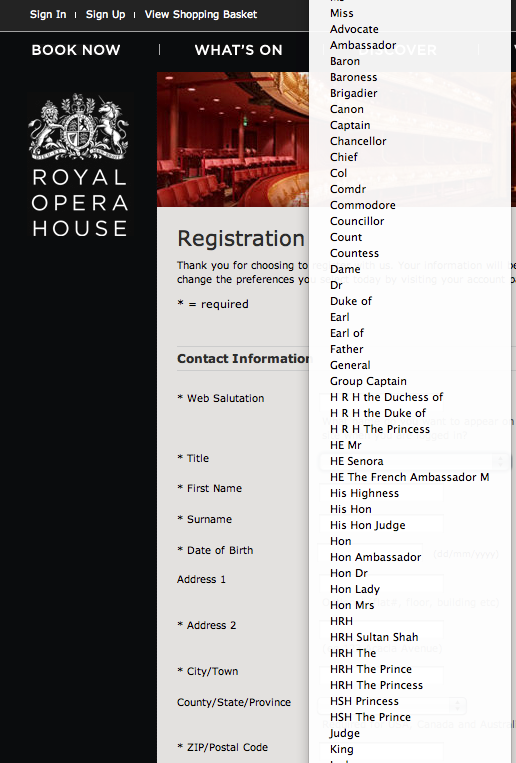
Via Jonathan Davis on the Twitter, the Registration form for the Royal Opera House, which comes with the best drop-down box ever devised. Choose your title! I fear “HE The French Ambassador M” may be taken, however.

Your Majesty

If you read this news story then you will probably want to sing along.

Dylan birthday open thread

by Chris Bertram on May 24, 2011

I’ve never really been into anything post Desire, but went through a period of intense Dylan fandom in my late teens. That’s faded, but he’s still special and I’ll never understand the haters. Personal favourites: Visions of Johanna and Absolutely Sweet Marie.

Noli me tangere!

by Chris Bertram on March 6, 2011

One of the weirder aspects of Arthur Ripstein’s recent book on Kant’s Political Philosophy, “Force and Freedom”:http://www.amazon.com/exec/obidos/ASIN/0674035062/junius-20, was the emphasis given to unwanted touching as a rights-violation. Now when a Canadian gives an exposition of a Prussian it isn’t altogether clear whose culturally-bounded norms might be infecting their normative intuitions. But I was immediately reminded of the discussion when I read “Simon Kuper’s column”:http://www.ft.com/cms/s/2/db51a45e-4472-11e0-931d-00144feab49a.html#axzz1Fp4ghsT3 in this weekend’s Financial Times. Kuper’s piece is based around Raymonde Carroll’s account of American and French cultural differences in her “Cultural Misunderstandings”:http://www.amazon.com/exec/obidos/ASIN/0226094987/junius-20 . Well, “read the whole thing”:http://www.ft.com/cms/s/2/db51a45e-4472-11e0-931d-00144feab49a.html#axzz1Fp4ghsT3 , as they say.

I recently had the pleasure of attending the “European Society for Philosophy and Psychology conference in Bochum, Germany”:http://www.ruhr-uni-bochum.de/philosophy/espp2010/index.html . The highlight for me was attending a talk by “Michael Tomasello”:http://email.eva.mpg.de/~tomas/ of the Max Planck Institute, Leipzig on pre-linguistic communication. Getting home, I ordered a copy of Tomasello’s “Why We Cooperate”:http://www.amazon.com/exec/obidos/ASIN/0262013592/junius-20 in which he argues, on the basis of detailed empirical work with young children and other primates, that humans are hard-wired with certain pro-social dispositions to inform, help, share etc and to engage in norm-guided behaviour of various kinds. Many of the details of Tomasello’s work are controversial (the book is essentially his Tanner Lectures and contains replies by Silk, Dweck, Skyrms and Spelke) and I lack the competence to begin to adjudicate some of the disputes. But this much is, I think, clear: that work in empirical psychology and evolutionary anthropolgy (and related fields) doesn’t – quelle surprise! – support anything like the Hobbesian picture of human nature that lurks at the foundations of microeconomics, rational choice theory and, indeed, in much contemporary and historical political philosophy.
[click to continue…]

The incomparable Terfel

by Chris Bertram on June 21, 2010

I used to blog about opera a fair bit here at CT, but I’ve tended to let that go over recent years, after all, I lack the competence of a proper music critic. Still, I would like to report that Saturday’s premiere of WNO’s production of Die Meistersinger, with Bryn Terfel as Hans Sachs, was the most stunning and energizing operatic performance I’ve ever attended. Started and 4, finished at 10, but those hours went awfully quickly. The music was wonderful, Terfel is an awesome presence on the stage, and the chorus – especially in the final act – was simply amazing. The staging, especially in Act 3, was also breathtaking. When you add in that the venue is probably the best one in the UK for opera, it all came together for a terrific evening capped by an energetic standing ovation from the audience. The production will be broadcast (a concert performance) as part of this year’s Proms (Radio 3 and BBC4) so if you are somewhere you can catch it, do so. If you can get hold of any tickets for the remaining performances in Cardiff or Birmingham, do so (and sell your most prized possessions to acquire them). Today’s papers have a couple of reviews: “Andrew Clark”:http://www.ft.com/cms/s/0/f878c258-7cca-11df-8b74-00144feabdc0.html in the FT and “Andrew Clements in the Guardian”:http://www.guardian.co.uk/music/2010/jun/20/die-meistersinger-von-nurnberg . What would you have to do to get unqualified enthusiasm from those guys? (UPDATE: Rupert Christiansen in the Telegraph, a much better judged review.)

This should really be a comment to Henry’s post, but I have the keys to this car, so I’m going to drive it, too. We have Zuckerberg’s remark:

[click to continue…]

All These Democratic Hoo-Hah Dreams of the Internet

by Scott McLemee on April 7, 2010

I first heard about David Lipsky’s Although Of Course You End Up Becoming Yourself: A Road Trip With David Foster Wallace from Mark Athitakis when we were on a panel in New York a few weeks ago. The book consists of transcripts from a prolonged interview with Wallace conducted just after Infinite Jest appeared. I’ve published some comments on the book elsewhere, but wanted to pluck out and pass along a long passage — one that Mark read during the panel discussion.

It spins out from a reference to the Interlace system in IJ, but you can skip the background without losing the point. (Ellipses in brackets are mine; otherwise they are sic from the text, as with much else.)
[click to continue…]