From the category archives:

European Politics

Eurofederalism

by Henry Farrell on May 20, 2010

getting interesting …

Wolfgang Schäuble in the “Financial Times”:http://www.ft.com/cms/s/0/b82f3e3c-6377-11df-a844-00144feab49a.html

bq. Indeed, far from reflecting a growing German Euroscepticism, Mr Schäuble and Ms Merkel have both revived calls for closer political union to underpin economic and monetary union. “When we introduced the euro in the 1990s, Germany wanted a political union and France did not. That is why we have an economic union without a political union,” he says. “Political union naturally means a bit of federalism in the German sense of federal. It means that one can no longer take certain decisions on a national level. That is very hard for the UK. It’s often not so simple for France, but France finds it easier to take European decisions.

bq. “Germany has a lot of experience with federalism, more than the UK or France. If you want to create a federal organisation, you must be ready to have a certain amount of redistribution within it. You can dismiss that by rudely calling it a “transfer union”. But strong and weaker states both have their responsibility. We are asking a lot of the weaker ones, but the strong also have their responsibility, and we must explain that as well.

bq. “We must say very clearly to Germany: we can play our role, but we must know that means there will be decisions taken against us. The weekend before last [in the negotiations over the eurozone stabilisation mechanism], we saw that it was not in the German interest to be standing alone. That is also a good learning process for the German public.”

Two points in lieu of an argument

by Henry Farrell on May 12, 2010

Have just finished writing two papers with hard deadlines – now in the throes of grading – so two quick points, which either sort-of-resonate-with or half-contradict each other in ways that I don’t have time to think or write about.

First: ungovernability. Or, rather, “ungovernability.” Chris got a lot of flak in comments for suggesting that centrists and center-right people in the media were going to come out with suggestions that a bit of dictatorship might not be a bad idea. As he pointed out, there used to be a lot of people on the right and center-right who made these arguments – and not just about countries in the developing world. Crouch and Pizzorno’s _The Resurgence of Class Conflict in Western Europe_ is particularly good on this, as I recall. That said, unlike Chris, I don’t have strong expectations that this set of rhetorical tropes is going to emerge in the very near future (although it may in the medium term). The old crop of center-right dictator-fanciers were fans of dictatorships not because they were opposed to democracy _tout court_, but because they were opposed to certain parts of the economy being subject to political control. This is not so much of an issue these days. From a certain point of view, the European Central Bank is a more-than-acceptable functional substitute for General Augusto Pinochet. Indeed, being less publicly embarrassing, it is arguably superior. One of these days soon, by the way, I’m going to write my post on the editorial policy of the _Economist_ during the Irish Famine – it wasn’t one of its finer moments.
[click to continue…]

A few thoughts on the euro crisis

by John Q on May 10, 2010

I’m rushing to prepare to go into a lockup to write reports on Australia’s government budget, brought down tomorrow, so this post is a bit scatty, but it might raise some points for discussion regarding the European debt crisis.

* First, a general observation. In a typical bailout, the biggest beneficiaries are not debtors, but creditors. So creditors ought to be “bailed-in” and made to bear some part of the cost

* The Greek case is misleading, in implying that government profligacy is the primary cause of the crisis. In most cases, the problem is the same as in earlier rounds of the crisis, most obviously in Iceland – bad loans by private banks which their national governments feel impelled to rescue, but can’t afford to

* The idea that the euro precludes devaluation as a way out is a relatively minor part of the story. Given that debts are denominated in euros, devaluation to improve the trade balance would be only marginally effective. The real effect of the eurozone so far, has been to raise the stakes regarding default.

* Resolving the crisis requires a couple of measures at the European level
– monetary expansion by the ECB
– co-ordinated action to strengthen government revenue, both by an acceleration of the attack on tax evasion and by discouragement of tax competition within the eurozone

[click to continue…]

Like PIIGS to the slaughter

by Chris Bertram on May 8, 2010

Just about every article in this morning’s _Financial Times_ seems to include a paragraph or two about how governments need to “deliver” debt reduction, to satisfy the markets, investor expectations etc. They then typically note that said investors are anxious about whether democratic politicians can “deliver” the austerity measures that the markets “require”. So here’s the question: how long before the _Economist_, the Murdoch press and similar give up on democracy on the grounds of its incapacity to “deliver” firm government? We’ve been here before, of course, in the 1970s, when the _Economist_ and the _Times_ backed the Pinochet coup in Chile. Of the PIIGS, only Ireland has escaped dictatorship in living memory and some of the southern European countries still contain contain authoritarian rumps (with special strength in the armed forces and law enforcement). My guess is that we’ll be reading op-eds pretty soon that raise the spectre of “ungovernability” and espouse “temporary” authoritarian solutions. Maybe such columns are already being written? Feel free to provide examples in comments.

Europe going forward

by Henry Farrell on May 6, 2010

I’ve been remiss in posting about the Greek crisis, thanks to other obligations (one paper, semi-half-arsed, just written for a workshop tomorrow; another paper, at best one quarter arsed, for a deadline next week), but here are a few points for discussion.

(1) On the “argument”:http://www.economist.com/blogs/charlemagne/2010/02/not_federal_union_yet argument that “got me drawn into this”:https://crookedtimber.org/2010/02/13/et-dona-ferentes/ in the first place, I think that Charlemagne’s criticism of Krugman was demonstrably wrong. As I summarized matters back then:
[click to continue…]

The EMF as camel’s nose

by Henry Farrell on March 10, 2010

“Charlemagne’s prediction”:http://www.economist.com/blogs/charlemagne/2010/02/not_federal_union_yet 1 that the Greek crisis would have no substantial effects for EU integration is looking “decidedly wobbly”:http://www.ft.com/cms/s/0/2b0933f4-2b1a-11df-93d8-00144feabdc0.html.

bq. Radical plans for a European version of the International Monetary Fund to bail out crisis-hit countries would need a new treaty and the agreement of all European Union member states, Angela Merkel, Germany’s chancellor, has warned. Throwing her weight behind the proposals from Wolfgang Schäuble, her finance minister, Ms Merkel admitted that the European Union had lacked the tools to deal with the Greek debt crisis: “The sanctions we have were not good enough.” But she added that a full-scale negotiation of the EU’s 27 member states would be needed to set up a European Monetary Fund, which would be able to bail out eurozone members subject to strict budgetary conditions. “Without treaty change we cannot found such a fund,” Ms Merkel told foreign correspondents in Berlin yesterday.

[click to continue…]

The Washington Post “runs an editorial”:http://www.washingtonpost.com/wp-dyn/content/article/2010/02/28/AR2010022803429.html on the topic of the financial data privacy controversy that I “blogged”:https://crookedtimber.org/2010/02/16/in-praise-of-the-european-parliament/ about a couple of weeks ago. Predictably, it’s an ill-informed harrumph.

bq. THE PROGRAM has been credited with helping to capture the mastermind of the 2002 Bali nightclub bombings that killed more than 200 people, including some 50 Europeans. … Yet almost 400 members of the European Parliament want nothing to do with it and have effectively and indefensibly shut it down. … The tool in question is the Terrorist Finance Tracking Program, which the United States created shortly after the 2001 terrorist attacks in hopes of using financial transactions to trace the whereabouts of suspects. … The European Commission hashed out an interim deal to allow the United States to continue operations, but the European Parliament objected, largely on the basis of bogus privacy concerns. … The Obama administration should work with E.U. leaders to push for reconsideration. If need be, additional oversight should be considered. But the administration must not go too far. Gutting a legal and effective program for the sake of imagined privacy gains would be as unwise and potentially dangerous as having no program at all.

I know that when the _WP_ editorial team sees the words ‘tracking terrorism,’ it responds with precisely that degree of judicious consideration which you apply when the doctor whacks your funny bone with a pointy rubber hammer. But the noxious guff about “bogus privacy concerns” and “imagined privacy gains” is just that – noxious guff. The program that the Washington Post is so fond of was implemented in blatant violation of EU law for years before the NYT had the guts to reveal its existence (despite strong pressure from the Bush administration not to do so). Nor are the European Parliament’s privacy concerns ‘bogus.’ The current administration has consistently refused to provide any guarantees whatsoever about how this data might, or might not, be shared with third countries. Given that many of our soi-disant allies in the war on terror have a distinctly robust attitude to the treatment and detention of possible terrorists, Europeans may very reasonably worry that any data they provide will be used to imprison and torture people, some innocent. I’ve talked about these issues with MEPs a lot over the last several years. Their memories of extraordinary rendition and the use of shared information (between the US and Canada in this instance) in the “Maher Arar case”:http://en.wikipedia.org/wiki/Maher_Arar left a very bad taste in their mouth. Nor is the US willing to talk about real redress or compensation for people unjustly targeted via this data.

In any event, like it or not, the editorial writers of the _Washington Post_ are going to have to learn to live with a transatlantic relationship where an actor which cares about privacy can veto security arrangements. Abe Newman and I recently wrote a “piece”:http://www.foreignpolicy.com/articles/2010/02/26/europes_parliament_takes_a_stand?page=full on Foreign Policy‘s website that talks to this.

bq. To build support for counterterrorism cooperation, the United States must explicitly accept that the European Parliament will play a key role in future negotiations. … The U.S. administration must treat the Parliament as a true negotiating partner, along with the EU member states, on information sharing and domestic security. The U.S. administration can also address the Parliament’s substantive worries by creating its own privacy oversight structures and extending its protection to European citizens…. If the United States wants to rebuild the transatlantic relationship and promote its own security interests, it must stop treating the European Parliament as an irrelevant afterthought.

And your mother’s a minger!

by Maria on February 25, 2010

Oh dear. Half of Greece is now protesting against the EU as the cause of budget cuts, and not, say, their own lying government(s), aversion to tax and an enormous black economy. They could even more logically protest about Goldman Sachs’ role in the affair. But no, it’s all the Germans’ fault.

Invoking the European statesman’s version of Godwin’s Law, Greece’s deputy prime minister Theodoros Pangalos says Germany never paid proper reparations following its occupation of Greece in 1941:

“They took away the Greek gold that was at the Bank of Greece, they took away the Greek money and they never gave it back. This is an issue that has to be faced sometime in the future,” Mr Pangalos told the BBC World Service.

“I don’t say they have to give back the money necessarily but they have at least to say ‘thanks’,” he added.
[click to continue…]

Google and Italy

by Maria on February 24, 2010

Three Google executives have been convicted of violating Italian privacy law because of a children’s bullying video posted briefly by Google in 2006. Although Google took down the offending video of several children in Turin cruelly taunting a mentally disabled boy, and subsequently helped authorities to identify and convict the person who posted the video, three executives were convicted today of violating privacy. A fourth employee who has since left the company had his charges dropped, which seems to indicate that a political point is being made. The executives in question are outraged, and former UK Information Commissioner Richard Thomas is quoted as saying the episode makes a mockery of privacy laws.

For years I’ve observed that Italy always pushes for the most extreme EU version of laws about privacy and security and then domestically gold-plates them into laws that would seem more at home in Turkmenistan. It makes other Europeans scratch their heads as the Italians generally aren’t willing or able to enforce their draconian laws. Several years ago over a pint in Brussels, an exasperated UK official told me ‘the Italians have no intention of ever implementing this stuff, but we’re a common law country and if it’s on the books, we actually have to do it’.

Update: Milton Mueller has an interesting take on the decision and makes the point that the E-Commerce Directive has not aged well in an era of user-generated content.
[click to continue…]

And whatever you do, don’t mention the war

by Henry Farrell on February 17, 2010

“Paul Krugman”:http://krugman.blogs.nytimes.com/2010/02/17/feldsteins-euro-holiday/, like “others before him”:https://crookedtimber.org/2009/06/02/still-all-quiet-on-the-western-front/, fails to do justice to Martin Feldstein’s perspicacity.

Today, Martin Feldstein suggests that Greece make a temporary return to the drachma, so as to regain cost competitiveness. In terms of the macroeconomics, this actually does make sense. But it’s also impossible; Feldstein needs to read Barry Eichengreen.

What he doesn’t realise is that Feldstein is playing a much deeper game here, and that his fundamental objections to the euro “have nothing to do with macroeconomic theory”:http://www.nber.org/feldstein/fa1197.html

War within Europe itself would be abhorrent but not impossible. The conflicts over economic policies and interference with national sovereignty could reinforce long-standing animosities based on history, nationality, and religion. Germany’s assertion that it needs to be contained in a larger European political entity is itself a warning. Would such a structure contain Germany, or tempt it to exercise hegemonic leadership?

A critical feature of the EU in general and EMU in particular is that there is no legitimate way for a member to withdraw. This is a marriage made in heaven that must last forever. But if countries discover that the shift to a single currency is hurting their economies and that the new political arrangements also are not to their liking, some of them will want to leave. The majority may not look kindly on secession, either out of economic self-interest or a more general concern about the stability of the entire union. The American experience with the secession of the South may contain some lessons about the danger of a treaty or constitution that has no exits.

Obviously, Feldstein can’t write about this in public; Germans have, after all, been known to “read the Financial Times”:http://www.ftd.de/. But perhaps if Greece extricates itself very, very carefully from EMU, and promises (however disingenuously) that it _really, really will_ return to the eurozone just as soon as it can, Angela Merkel will stand down the Panzertruppen she has amassed at the Greek border …

Update: “see also Colm McCarthy”:http://www.irisheconomy.ie/index.php/2010/02/17/a-bonzer-wheeze-by-martin-feldstein/.

Et Dona Ferentes

by Henry Farrell on February 13, 2010

The _Economist’s_ Charlemagne “argues”:http://www.economist.com/blogs/charlemagne/2010/02/not_federal_union_yet that any Greek bailout will have no long term implications for EU integration.

bq. THERE has been a lot of commentary, in the past couple of days, to the effect that Europe is on the brink of a great leap forward in political and economic integration. The theory goes: a bail-out of Greece, accompanied by intrusive monitoring by Eurocrats, would constitute an unprecedented level of EU interference in the fiscal affairs of a member country. … Paul Krugman … finds that logic dictates a swift move towards integration. … I fear I do not agree. Or rather, I think the siren lure of economic logic is blinding a lot of people to the political realities of this crisis. … I have watched the direction of EU travel head firmly away from closer federal integration, and towards a messy sort of intergovernmentalism … I don’t think a Greek default is a big enough crisis to change the political weather in the EU … cannot get that excited about intrusive, monthly monitoring of Greek government spending by officials from the European Commission and European Central Bank, matched by close scrutiny of Greece’s notoriously dodgy statistics by officials from Eurostat. … new territory for the EU … but the International Monetary Fund has been doing this kind of stuff for years. And nobody thinks that when the IMF meddles in the fiscal sovereignty of a country, it means that world government is about to break out …

bq. bailing out Greece is already proving so politically painful for leaders like Mrs Merkel that she would not tolerate any discussion of how such a bailout might take place … a message to voters in rich countries like Germany: do not fear, we are not about to establish a systematic series of transfers to countries in the euro zone … this stuff is toxic politics. … a golden lesson of politics is: political leaders only do really hard and painful things when they absolutely have to. Until then, they would much rather fudge things. … the prospect of a messy, ad-hoc fudge of a bail-out for Greece. … countries … like … Poland … likely to take it rather badly if future convergence flows are diverted away from them, and back to countries that have wasted so much EU cash like Greece … Add to that that newcomers outside the euro zone, like Hungary or Latvia have had to endure horrible austerity programmes in the last two years under IMF supervision, while countries inside the euro zone are to be spared IMF programmes.

But does this really amount to a proper counter-argument? I don’t see any real disagreement here with the basic propositions that (a) EMU isn’t working as it stands, and (b) that the only sustainable equilibrium outcomes here are complete collapse or regearing to allow substantial fiscal transfers (and, insofar as they will do any good, labour market reforms to make increased mobility easier). Saying that politicians will want to muddle through is stating the obvious – but the point is that muddling through is not a sustainable long term strategy. Either the muddling through will be insufficient, in which case EMU will finally succumb to one of the succession of crises that will almost certainly result, or it will be sufficient, in which case it will serve as the basis for a long term shift in the economic governance of the Eurozone towards coordinated fiscal policies and some degree of fiscal transfers in times of crisis, and perhaps more than that. As Adrienne Heritier and I have “argued”:http://www.henryfarrell.net/jepp.pdf, muddled looking informal deals very often lay the foundations for long term formal institutional changes in the EU.

Finally, the analogy to the IMF doesn’t really work at all. The IMF is not a notably clubby institution, and is particularly unclubby from the perspective of those countries unfortunate enough to need to seek its aid. The EU is quite clubby indeed (Greece will remain on the Council, and in the various eurozone coordination forums), so that whatever the final outcome, it will surely give rise to a lengthy decision making process involving the target countries, those giving aid, and those on the sidelines. This will almost certainly culminate in a set of general institutional mechanisms which applies to all the eurozone countries, including both those countries at risk of default _and_ those which are highly unlikely to get into trouble. That’s the way that the EU works – and this will be a quite significant step towards further integration. Of course – the rescue effort may fail (for example, Germany and Greece’s current spat may reflect irreconcilable political differences) – but if it does fail, so too will the euro project.
I posted recently on The paradoxical politics of credible commitment, noting the excellent analysis of Gordon Brown’s politics by Sebastian Dellepiane.  He argues that the Labour government did not make the Bank of England independent simply in order to defuse City suspicions of them. This self-binding policy was also in fact enabling, because it made it possible for Brown to adopt a classic Keynesian economic strategy by about 2000.

The Euro started out as a self-binding credibility-gaining mechanism for Eurozone member states. But the Euro also turned to have an ‘enabling’ side to it. It contributed to new kinds of instability by facilitating the extension of cheap credit and by permitting increasingly risky lending practices to spread throughout the European financial system, in Germany and France as well as in the weaker peripheral economies.

This has led me to think some more about the relevance of the logic of credibility gains in the current European crisis.

The self-binding austerity politics now under way in the Eurozone also has some paradoxical features. The crisis has produced an explosion of fiscal deficits and an accumulation of sovereign debt. The ECB favours fiscal austerity to restore stability, and so does German public opinion. This means that every other member state must adjust to low demand conditions and domestic deflation. But while Gordon Brown’s self-binding monetary policy proved to be enabling, Eurozone governments’ self-binding fiscal policy might be seen as self-disabling, because it involves commitment to a strategy that may prove self-defeating. There are two reasons for this.

[click to continue…]

“Contrary to the values of the republic”

by Chris Bertram on January 27, 2010

Sometimes a thought occurs about something that might make for an interesting blog post, but I realise that whilst I know enough to have the thought, I’d have to do a great deal of research to write something that would survive the scrutiny of people who know their stuff. Still, it may be that commenters who know more than me can say something of value, and that I could at least serve as a prompt. So here goes. An article on the BBC website discusses the recommendations of a French parliamentary committee which described the veil as :

bq. “contrary to the values of the republic” and called on parliament to adopt a formal resolution proclaiming “all of France is saying ‘no’ to the full veil”.

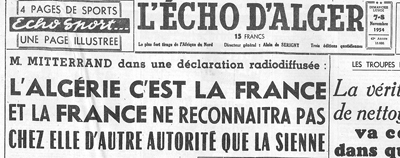
Hmm, I thought. It wasn’t so long ago that “all of France”, at least for some values of “all of France” had a more divided view about the veil. Roughly at this time, in fact:

(Picture nicked from the very excellent Images of France and Algeria blog, which has, incidentally, lots of interesting stuff on the 1961 Paris massacres of Algerians.)

But then I also remembered that official France had not, in fact, been very tolerant of the veiling of Algerian women. The photographer Marc Garanger is famous for his many pictures, taken during the war, of Muslim women forcibly unveiled so that they could be photographed for compulsory ID cards. There are some “here”:http://www.noorderlicht.com/eng/fest04/princessehof/garanger/index.html . So how did that all work out then? A little googling reveals that this very month, historian Neil MacMaster has a new book entitled _Burning the Veil: The Algerian war and the ’emancipation’ of Muslim women, 1954-62_ (Manchester University Press). I couldn’t find any reviews, as yet. The blurb writes about a campaign of forced modernisation followed by a post-revolutionary backlash involving a worsening of the position of women in Algeria.

So two thoughts then: (1) far from being an aberration in France, there was a very recent period when very many French women (or perhaps “French” women) were veiled; (2) attempts by the state to change that didn’t lead to female emancipation and the triumph of Enlightenment values.

Civil unions and straight marriage

by Henry Farrell on January 24, 2010

Arthur Goldhammer’s “excellent blog on French politics and society”:http://artgoldhammer.blogspot.com/2010/01/pacs-is-between-one-man-and-one-woman.html points to “this article”:http://www.insee.fr/fr/themes/document.asp?ref_id=ip1276#inter2 on the French _pact civil de solidarité_ – a kind of civil union introduced in 1999/2000, largely as an alternative to gay marriage. But the pacs has had very interesting consequences for straight couples (95% of couples with pacs are straight), as this chart shows.

The growth of the pacs’ popularity over its first decade is striking. There are now two pacs for every three marriages. Interestingly, this is because of both a significant decline in marriage, and a significant increase in the overall number of people willing to engage in some kind of state-sanctioned relationship. While you would obviously need more finely grained data to establish this properly, the obviously intuitive interpretation of this (at least to me) is that the pacs have grown _both_ by providing an option for people who would probably not have gotten married in the first place, _and_ attracted a number of people who otherwise would have gotten married, but who prefer the pacs’ lower level of formality (it is much easier to cancel a pacs relationship than to get divorced). Perhaps this provides grist for the mills of social conservatives (who could claim, stretching the data a bit, that gay-appeasing civil unions are undermining the sacred institution of marriage) – but it would oblige them to face up to the question of whether they should _prefer_ gay marriage to potentially corrosive civil unions that straight couples can take advantage of too. Liberals and leftwingers don’t face nearly the same dilemma, since they can reasonably assume that those who choose civil unions over marriage have good reason for doing so (and perhaps will get married later if they want to; obviously, you can’t tell from data like this how many partners in pacs decide to get married later on).

European conservatism

by Henry Farrell on January 19, 2010

This “NYT article”:http://www.nytimes.com/2010/01/18/world/europe/18iht-women.html on Germany is a useful book-end to the discussion on diversity of European models etc.

NEUÖTTING, GERMANY — Manuela Maier was branded a bad mother. A Rabenmutter, or raven mother, after the black bird that pushes chicks out of the nest. She was ostracized by other mothers, berated by neighbors and family, and screamed at in a local store.

She felt ostracized after signing up her 9-year-old for lunch and afternoon classess — and then returning to work. “I was told: ‘Why do you have children if you can’t take care of them?’” she said. Her crime? Signing up her 9-year-old son when the local primary school first offered lunch and afternoon classes last autumn — and returning to work. … Ten years into the 21st century, most schools in Germany still end at lunchtime, a tradition that dates back nearly 250 years. … Ten years into the 21st century, most schools in Germany still end at lunchtime, a tradition that dates back nearly 250 years. … For several mothers, their great-grandmothers’ maxim, “Kinder, Küche, Kirche” — children, kitchen, church — holds true, even if, as Mr. Haugeneder says, “increasingly it is a way of life people can’t afford.”

[click to continue…]