So is Tony Blair officially in the running to become President of the Council of member states of the European Union (a new job, that might or might not be quite powerful, depending on who gets it, that will come into being if the Lisbon Treaty passes)? The Financial Times “says yes”:http://www.ft.com/cms/s/0/d5313c12-7145-11de-877c-00144feabdc0,dwp_uuid=70662e7c-3027-11da-ba9f-00000e2511c8.html [click to continue…]
From the category archives:
European Politics
I’ve been a bit remiss in not covering the “recent shenanigans”:http://www.ft.com/cms/s/0/22acb81a-64f6-11de-a13f-00144feabdc0.html in Italy:
Appearing on a billionaire’s luxury ship in the Bay of Naples on Monday, nine days before he hosts a Group of Eight summit, Silvio Berlusconi, Italy’s prime minister, rejected reports that his government risked falling apart over his personal life. “My government is probably the most safe and secure in the west,” he said. He specifically rejected “foreign” press reports questioning its stability in the wake of allegations by escorts that they had been paid by a businessman to attend parties at the prime minister’s residences and that one had sex with him on the night of the US elections in November.
My acquaintance with Italian society and politics is mostly second-hand these days, and Berlusconi certainly been extraordinarily good at “turning bad publicity into good”:https://crookedtimber.org/2006/02/18/follies-berlesque/#more-4337 in the past, but I wouldn’t be surprised if this is the one that finally sinks him. Cavorting with eighteen year old starlet wannabes was probably a mild net positive for Berlusconi, allowing him to project an image of continued virility etc. Over-excited Czech prime ministers bedecked with young women at his private villa not so good – but more awkward than genuinely embarrassing. However the most recent allegation – that he had sex with a prostitute (who claims to have recorded the whole thing) seems to me to directly undermine the image that he wants to project of a debonair and charming, ladies’ man, making him sound like a bit of a loser. Certainly, Berlusconi himself “seems worried”:http://www.reuters.com/article/worldNews/idUSTRE55M5OH20090623.
“I have never paid a woman,” Berlusconi said in an interview with the Chi weekly owned by his Mondadori publishing empire. I’ve never understood what satisfaction there is other than that of conquering (a woman),” he told the magazine, according to excerpts sent to Reuters ahead of publication on Wednesday.
I’m predicting (cautiously, and with fingers crossed) that he will be gone within 3 months.
[As an aside, my favorite bit of the story is that the prostitute (who was allegedly paid by a businessman to attend the party), seems not to have asked Berlusconi himself for money “because she was more keen on favors to obtain building permits.”]
Via “Arthur Goldhammer”:http://artgoldhammer.blogspot.com/2009/06/new-blog-of-interest.html, this is a “very interesting post”:http://withoutbanisters.blogspot.com/2009/06/what-was-algerian-warwhy-should-you.html.
The French military tortured systematically from the beginning to the end of the war, most spectacularly during the “Battle of Algiers” in 1957. They used all the classic methods: electricity, simulated drowning, beatings, sexual torture and rape. …The FLN’s use of terrorism — in particular their targeting of European civilians at popular clubs, bars, and so on in urban bombing campaigns — served as the rationale for this “exhaustive interrogation” of “suspects.” … The Algerian War was a war of independence, a war of decolonization. In that sense, it cannot and should not be understood as analogous to, or a direct precursor to, the United States’ “war on terror.”
As an American today, what I find really significant about the use of torture in the Algerian War is what it did to *France*, which underwent a profound crisis of democracy as it attempted to hold on to Algeria. … what torture did do was poison the public sphere: to conceal the fact that the military was torturing, French governments turned to censorship, seizure of publications deemed deleterious to the honor and reputation of the Army, paralyzing control over the movements of journalists, and prosecution of those who nevertheless continued to publish evidence that torture was going on. … The reason all the government censorship was necessary was that a small but incredibly passionate, intellectually high-powered anti-torture movement developed in France from late 1956. … historical comparison can function as illuminating intellectual practice. … cell phone cameras really changed the world. Because the main reason the French torture-defenders didn’t argue that stuff like simulated drowning was no big deal was because *they didn’t have to: they didn’t have to admit simulated drowning was happening AT ALL.* In the absence of certain forms of highly-circulated, red-handed visual evidence, like the Abu Ghraib photos in Bush-era America, “deny, deny, deny” (even if massive, overwhelming proof actually does exist) remains a plausible public-relations strategy. … Denial that these things happened at all, which will always be the first line of defense, is no longer possible. And that is encouraging, despite everything.
I’ve got a long post in the works touching on some of the same issues as John’s “recent piece”:https://crookedtimber.org/2009/06/10/suicidally-strong-ip/, which began as a response to Larry Lessig’s recent silliness on socialism (which he has qualified in the meantime) but has since metastasized into something much shaggier and alarming. In the meantime, some speculation regarding a smaller question – is the Pirate Party’s presence in the European Parliament going to change anything? This is something that I wanted to talk about in a “bloggingheads debate”:http://bloggingheads.tv/diavlogs/20468 with Judah Grunstein yesterday, but we got stuck into more general questions of copyright good or bad. Anyway – my answer to the question is yes, plausibly – but around the margins, and depending on what alliances it strikes.
[click to continue…]
The _Financial Times_ isn’t the leftiest of newspapers, but it is hard to argue with their “verdict”:http://www.ft.com/cms/s/0/4cd4fc48-5460-11de-a58d-00144feabdc0.html on the European Parliament elections:
The centre-right held its ground or advanced, both where it is in power and where it is in opposition. The mainstream left was decimated. This election shows that the social democratic parties have lost the will to govern. At a time when “the end of capitalism” is raised as a serious prospect, the parties whose historical mission was to replace capitalism with socialism offer no governing philosophy. Their anti-crisis policies are barely distinguishable from those of their rivals. The leadership crisis in several European socialist parties suggests their outdated ideas are matched by oversized egos.
Greens triumphed where the traditional left failed. Daniel Cohn-Bendit, who knows a thing or two about critiques of capitalism, appealed to voters willing to consider fundamental social change. As one of few groups to fight on pan-European issues, the Greens also proved that not all voters are deaf to Europe-wide politics. But the crisis has most benefited the strand of the European right that was never against regulating the market economy. By arguing that the crisis is a result of excessive “Anglo-Saxon” policies, centre-right parties have presented themselves as the most trustworthy stewards of a safer, European-style capitalism. Voters agreed.
My own take on the failures of European social democracy a few months ago “was more or less identical”:https://crookedtimber.org/2009/02/18/social-democrats-and-capitalism/. I’d love to be convinced that I was wrong though. Or, in the absence of a compelling counter-claim, at least get a better sense of why European social democratic parties have become empty shells. One first-approximation guess is that this had to do with the largely successful efforts by social democrat ‘reformers’ to replace the old anti-capitalist ideas and language with more market-friendly stuff, which succeeded just in time to leave these parties completely unprepared to deal with the demise of actually existing capitalism. A second is that current day social democrats are much less able than their 1930s-1950s predecessors to meld nationalism and market constraints. Other possible explanations?
This “FT article”:http://www.ft.com/cms/s/0/f4d18748-5232-11de-b986-00144feabdc0.html?nclick_check=1 is the best piece I’ve seen on the intra-Europe battles over ECB policy, but it could go deeper still.
When Angela Merkel ended a long and otherwise unremarkable speech about economic policy this week with a vitriolic attack on the world’s three mightiest central banks, the German chancellor was writing a minor chapter of her country’s political history. No previous chancellor had dared attack their, and others’, central banks so frontally – saying the US Federal Reserve, Bank of England and European Central Bank should all row back on their unconventional recent ways of propping up economies. …
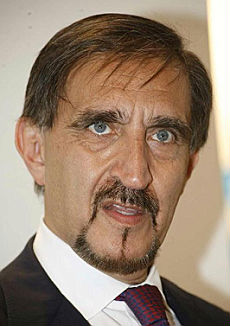
So I’ve been thinking that I ought to do more posts on stuff that is happening in Italy, Germany and France but that isn’t being covered well in the English language newspapers. Such as, for example, “this story”:http://www.repubblica.it/2009/05/sezioni/cronaca/immigrati-7/la-russa-boldrini/la-russa-boldrini.html about how Italy’s minister of defence, Ignazio La Russa, has gotten into trouble for saying some offensive things about the United Nations, and the UNHCR representative in Italy (who has been critical of the Berlusconi government’s nastiness to aliens). But I’m being distracted from this high minded mission by La Russa’s quite extraordinary resemblance to a left-over special effect from classic Rodenberry-era Star Trek. It’s juvenile of me, but there you go. I’m figuring him for a Romulan-Klingon hybrid, but I’m not really a Star Trek buff (haven’t seen the show in two decades or so), so am prepared to bow to superior wisdom should such exist out there on the Interwebs …
So, because I was in Europe last week, I didn’t post to my bloggingheads with Dan Drezner, talking about the joys (and limitations) of the European (for which read Dutch – EU member states differ dramatically in their provision of social services) welfare state. This was all riffing on a “piece in the NYT”:http://www.nytimes.com/2009/05/03/magazine/03european-t.html?pagewanted=1&em which talks about the kinds of stuff that insurance covers in the Netherlands.
insurance covered prenatal care, the birth of their children and after-care, which began with seven days of five-hours-per-day home assistance. “That means someone comes and does your laundry, vacuums and teaches you how to care for a newborn,” Julie said.
I thought that this sounded _great_ myself, having gone through the ‘oh my god, they’ve sent us home with a baby and what the hell are we supposed to do now’ panic with our firstborn. Dan, not so much. Matt Yglesias and Matthew Continetti discussed the same article a few days later. Diavlogs below …
I was at a conference in Italy last week, where I read as much as I can about last Saturday’s meeting, brokered by Giorgio Napolitano, Italy’s President, between the widows of Giuseppe Pinelli (who, after three days of interrogation without food or sleep, either fell to his death from a window in the Milan magistracy or was pushed) and Luigi Calabresi (the magistrate who was interrogating Pinelli, and who was himself murdered a couple of years later). This hasn’t gotten any attention in the English speaking press that I can see. Still, it was a very significant event in Italian politics – an attempt by some of the parties at least to draw a close to Italy’s ‘years of lead,’ in which leftist unrest, kidnappings and murders went together with brutal state repression and tacit state help for fascists who organized large scale terrorist bombings to create the enabling conditions for a coup.1 And it is particularly interesting to me because I’ve just finished reading Phil Edwards‘s fascinating account of one very poorly understood aspect of this period – “the birth of the Autonomist left”:http://www.manchesteruniversitypress.co.uk/catalogue/book.asp?id=1204381, and its relationship both with terrorist groups (my term, not Phil’s) and the Italian Communist Party. This is, to say the least, a very well timed publication (although Manchester University Press’s decision to print it only in an expensive and difficult-to-find hardback edition, is arguably rather less well judged). [click to continue…]
“This”:http://www.economist.com/blogs/charlemagne/2009/03/do_not_believe_this_talk_of_eu.cfm seems pretty plausible to me.
The opening hours of EU summits can often be a little slow (so can the closing and middle hours of some of them, to be frank). But the sense of calm, even drift, is a little eerie this time. … behind this time of phony war there lurks the prospect of a proper policy fight. Not about stimulus plans, but about future regulation of the financial sector. And, to simplify things, what is really, really going on is that the camp led by France and Germany are determined that Europe’s common position, going into the G20 summit, should be to bang the table and demand an end to light-touch regulation, of the sort that flourished for so long on Wall Street and in the City of London, and which they see as more or less the sole cause of the current mess. But the French and Germans do not trust the British to support that common position. Once the Americans are in the room in London, they fear the British will scuttle away from the European position, side with the Americans, and seek to defend the wheeler-dealers of the City.
The post finishes with some obligatory Economist-style harrumphs about how the unregulated bits of global capitalism aren’t really the problem &c &c, but its analysis of the underlying politics seems spot on. Differences between national regulatory systems are still enormously important, and help explain why we have seen so little international coordination on common frameworks for financial regulation. Not only are differences in regulation associated with different national interests, but also with very different analyses of what the underlying problem is (which of course in part stem from those interests). Abe Newman at Georgetown and I have a paper on historical institutionalism in international relations that talks a _lot_ about the persistence and importance of these national level differences in explaining international outcomes. Our framework (as others, such as Dan Drezner’s) would predict likely stalemate in negotiations of this sort. I honestly hope that we’re wrong (although I suspect that we are not). But even if we are, the problems that the EU faces in coordinating a regulatory response are, of course, dwarfed by the problems of coordinating such a response at the global level, which is where it _really_ needs to take place (but is highly unlikely to, for the reasons given).
Two recent versions of the same argument. First, the “simplified 800 word version”:http://www.nytimes.com/2009/03/05/opinion/05Cohen.html?_r=1&ref=opinion, from Roger Cohen.
To paraphrase Mauriac, I love France, but I don’t want there to be two of them, least of all if one is in the United States. … I think President Obama’s counter-revolution goes in the right direction. … Still, the $3.6 trillion Obama budget made me a little queasy. There is a touch of France in its “étatisme” — the state as all-embracing solution rather than problem — and there’s more than a touch of France in the bash-the-rich righteousness with which the new president cast his plans as “a threat to the status quo in Washington.” … You know possibility when you breathe it. For an immigrant, it lies in the ease of American identity and the boundlessness of American horizons after the narrower confines of European nationhood and the stifling attentions of the European nanny state, which has often made it more attractive not to work than to work. High French unemployment was never much of a mystery. Americans, at least in their imaginations, have always lived at the new frontier; French frontiers have not shifted much in centuries. Churn is the American way. … If America loses sight of these truths, it will cease to be itself.
Gideon Rachman “links to”:http://blogs.ft.com/rachmanblog/2009/03/eurosceptics-and-bloggers-at-the-economist/ the Economist‘s new “‘Charlemagne’ EU affairs blog”:http://www.economist.com/blogs/charlemagne/ which is indeed quite good. Even if you don’t agree with its take, it’s funny, well written and states its prejudices quite clearly up front. It’s also written by only one person, so that the “Free Exchange” problem of individuals pursuing personal gripes under cover of anonymity doesn’t arise. But one of the reasons why Gideon says he likes the blog is that it
shares my low opinion of the European Parliament. Describing it as a “student union with better expenses” is about right
I liked this piece of writing from Arthur Goldhammer’s “consistently excellent”:http://artgoldhammer.blogspot.com/2009/02/fissures.html blog on French politics.
It’s always interesting to watch the fissures develop in the Socialist Party. It’s almost a geological process. Each aspirant is a tectonic plate moved by the immense pressure of his or her ambitions. For a time a couple of these plates may move in tandem, but then an opposing force impinges from some odd angle, subduction occurs, and one begins to witness surface changes: a ridge or wrinkle developing here, a fissure there.
No sooner did Martine Aubry open the party leadership to a dozen or so Royalistes than we witness[ed] the emergence of a first fissure …
While we’re waiting for Jonah to pronounce, Sheri Berman, whose arguments about 1930s social democrats and fascists is the issue of debate, has a “piece”:http://www.dissentmagazine.org/article/?article=1332 in _Dissent_ that I’d like to respond to. Sheri argues that the current crisis is a major opportunity for the left, but that it is hampered in its ability to respond because of internecine arguments over whether we should try to reform capitalism, or get rid of it altogether. She singles out Michael Harrington as her main exemplar of a leftist whose failure to appreciate the benefits of capitalism led him to irrelevance and political near-incoherence.
[click to continue…]
A few years ago, I “wrote that”:https://crookedtimber.org/2004/09/17/acquis-fiction/
Nearly every corridor in every building of the Commission, Council and Parliament has two or three examples [of EU official art] along its walls – spectacularly bland and uninteresting prints and photographs, always with the twelve stars on a blue flag in there somewhere. The art is contentless and affectless because any strong statement, or even conveyed sense of geographic location, would probably offend somebody in one or another of the member states. There’s something about the EU that seems completely inimical to lively cultural expression.
Now a Czech art-prankster has “put this theory to its test”:http://www.ft.com/cms/s/0/f9eb2dae-e2a4-11dd-b1dd-0000779fd2ac.html, and found that member states are indeed liable to get offended.
Sited prominently in the headquarters of the EU Council in Brussels, a flagship work of art – which was designed to demolish national stereotypes by mocking them – has caused diplomatic outrage. Not only that, the piece turns out to be the work of a single Czech artist despite having been billed as the collaborative effort of all 27 member states. … As countries digested depictions of their character, such as a Dracula-inspired theme park (Romania), a rudimentary lavatory (Bulgaria) and a flooded land with minarets poking through (the Netherlands), the Czech presidency was forced into a public apology. … Other national depictions in the artwork include: Luxembourg as a lump of gold on sale to the highest bidder; France emblazoned with the word grève , or strike; Denmark made of Lego; and Sweden lying within an Ikea flatpack. Britain is simply missing – supposedly a reference to its euro-scepticism. But some diplomats appear in little doubt of what action they would like to see, namely the removal of the eight-tonne “modern art installation” from the bleak and lofty but all-too prominent atrium of the council’s main building.
In fairness, the artist seems to have gone out of his way to prod national sore spots – other depictions include Germany (autobahns making up a rather thinly disguised swastika) and Poland (a group of monks erecting the Rainbow flag). Pictures below.