From the category archives:

European Politics

At the still eye of the storm

by niamh on September 5, 2013

For months now, the prospect of federal elections in Germany at the end of September have put a halt to making hard choices about the continuing Eurozone crisis. But now that the elections are near, domestic debate about policy choices is oddly muted. There seems to be a resigned acceptance in Germany that Merkel will lead the next government, and that her policies are not really open to serious challenge.

Maybe domestic contentment makes voters oblivious to the wider world – after all, unemployment in Germany is actually lower now than before the crisis. But Germany’s political choices at home can’t be separated from its role as the largest and strongest European economy. It has a massive European current account surplus that closely mirrors the deficits of the European ‘periphery’ – most of the EU’s trade takes place within the EU itself. But in the Eurozone, relative cost adjustment is heavily one-sided, requiring that all the adjustment must take place in the ‘periphery’, while Germany’s real effective exchange rate is held down. 

Then again, it isn’t as if all is rosy in Germany either. Low unemployment is made possible by a tough-minded strategy of cost containment, which has give rise to new form of ‘precarious’ jobs, rising inequality, and static real living standards. Tight spending controls have resulted in an ongoing decline in investment in skills and education which threatens the sustainability of the export-led model itself. Yet the European dimension of German politics seems to have fallen entirely from sight. Since decision-making in the Eurozone now hinges almost entirely on the German government’s preferences, this matters a great deal.

So it’s quite entertaining to see the ad by the largest trade union, IG Metall (here with subtitles, courtesy of The Guardian), encouraging people to turn out and vote. It’s clearly meant as a last-ditch effort to remind people that they don’t have to sleep-walk to an inevitable electoral outcome. Whether that’s enough to energize a change of mood is probably doubtful.
 

Fingerprinting migrants in France: the back story

by Chris Bertram on August 8, 2013

The big item on this morning’s UK news (Guardian, BBC) is a report by the Chief Inspector of Borders and Immigration, John Vine, that is highly critical of the UK Border Force. Large sections of the report have been redacted, leading opposition politicians, such as Labour’s Chris Bryant, to accuse Home Secretary Theresa May and Immigration Minister Mark Harper of a “cover up”. What struck me about the report, though, was the basic failure in reporting by the news media, such that the ordinary reader or listener would really not understand the back story.

From the BBC report:

But inspectors found UK officials at Calais had stopped taking photographs and fingerprints of illegal immigrants in 2010 because of problems with the availability of cells to hold people in. This was also later stopped at Coquelles. Mr Vine said: “Gathering biometric information such as fingerprints could assist the decision-making process if these individuals were ultimately successful in reaching the UK and went on to claim asylum.”

The reporting follows the UK Home Office in stigmatizing people as “illegal” in advance of any judicial process, but it also fails to explain the background in the Dublin Regulation that states that people can only claim asylum in the first EU country they enter. This means that states in northern Europe, such as the UK, can disclaim responsibility for people fleeing persecution, just so long as they can show that the asylum seekers were previously present in another member state. This adds to armoury of extra-territorial checks (fines on carriers etc) that make it impossible for asylum seekers to reach the UK legally. Since most asylum seekers enter the EU through southern Europe (many dying in leaky boats in the Mediterranean), the Dublin Regulation effectively assigns responsibility to those states least able to cope (partly because of the Eurozone crisis) and where racism, xenophobia and violence towards foreigners is most marked. (There are regular horror stories about the suffering of asylum seekers in Greece.) A progressive policy would both recognize our humanitarian obligations towards refugees and put in place a mechanism for sharing that responsibility fairly across all EU member states. Unfortunately, rather than campaigning for such a policy, politicians of the “left” in northern Europe, like Bryant, use episodes like this to make a noise about “controlling our borders”.

Follow the Turkish protests on Twitter

by Ingrid Robeyns on June 15, 2013

I know philosophers who are skeptical about the value of Twitter — they think it’s merely a time sink, or they make even more ridiculous claims, such as that it is undermining genuine social relations and friendships. Oh Boy. Right now it is an amazing source of information on what is really going on in Turkey – and that doesn’t really look good when I am typing these words. The police is very violently cleaning Gezi park where citizens of all ages have been peacefully protesting. According to various Twitter sources the police is also attacking the hotels in the area which have taken in wounded people. TV coverage (at least in my country) is short and rather superficial — but luckily there is the internet with blogs, online newspapers, citizens’ radios, and twitter. The quickest source of information on what’s going on are live stream coverages like Gezi Radyo and Twitter, where also many pictures can be found. If you want an easy entry point into the tweeps to follow, start with Dani Rodrik and follow those whose tweets he forwards, like Zeynep Tufekci.

Consider this an invitation to post links to more direct sources of information, and also as an ‘open thread’ to discuss what’s happening right now in Turkey.

Insubordination and the surveillance state

by Chris Bertram on June 13, 2013

Responding to concern about PRISM and the issue of whether intelligence collaboration with the US enabled British agencies to circumvent legal restrictions, Foreign Secretary William Hague told us that “law-abiding citizens” have nothing to fear. Not only do I not wish to be the kind of person Hague thinks of as “law abiding”, more generally it is social movements that willfully break the law that are most likely to bring about change and to threaten established power and privilege. And it is just such movements, and their leaders, who are at risk from pervasive state surveillance of our communications.
[click to continue…]

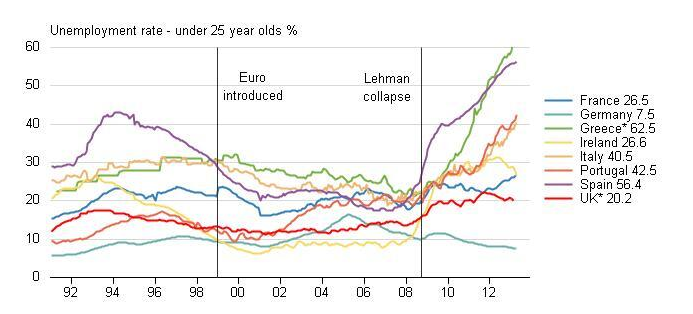
There’s a nice summary of EU plans to address the ‘slow train-wreck’ of youth unemployment here.

But as the author says, ‘where are the jobs going to come from?’

Screen Shot 2013-06-04 at 12.10.24

Amidst the litany of country-by-country disasters noted here is this:

‘The chart shows a downturn in Ireland’s youth unemployment, from over 30% in early 2012 to 26% now. This is why: “In the past four years, over 300,000 people have emigrated from Ireland; 40% were aged between 15 and 24”.- RTE News, 9 May2013′. My own recently-graduated daughter and most of her friends among them.

Post-Democracy in Italy and Europe

by Henry Farrell on April 25, 2013

I have a “gloomy article”:http://www.aeonmagazine.com/living-together/henry-farrell-post-democracy/ on the parlous state of social democracy in Italy and elsewhere in Europe up at Aeon. The draft was completed two weeks ago; if anything the events in the interim have given even more cause for depression. The Italian Democratic Party looks on the verge of entering into a coalition with Berlusconi’s people that is neither appetizing nor particularly convincing – it has also led to a very bad three way split between (1) the party’s old guard, (2) a quasi-Blairite wing lead by Matteo Renzi, the mayor of Florence and (3) the left (who would have liked to see Renzi win, if only because whoever ends up as prime minister under current circumstances is likely to be badly damaged). The Movimento 5 Stelle is still dithering, while trying to attract defectors from the Democratic Party’s left (a few weeks ago, the Democratic Party hoped that all the movement would be in the other direction). It has done poorly in a recent regional election, and is likely less enthusiastic about immediate elections than it was a few days ago. Even by the impressive standards of its international peers, the Italian left and center left have a prodigious capacity for screwing stuff up due to factionalism. It would be fair to say that it’s not withering away through disuse.

bq. Last September, Il Partito Democratico, the Italian Democratic Party, asked me to talk about politics and the internet at its summer school in Cortona. Political summer schools are usually pleasant — Cortona is a medieval Tuscan hill town with excellent restaurants — and unexciting. Academics and public intellectuals give talks organised loosely around a theme; in this case, the challenges of ‘communication and democracy’. Young party activists politely listen to our speeches while they wait to do the real business of politics, between sessions and at the evening meals.

Greece’s trap

by niamh on April 24, 2013

Greece is at the hard end of another European policy problem, related to austerity, but this time to do with immigration, and it’s turning into a serious human rights and humanitarian crisis. According to Europe’s border control agency Frontex, 93% of migrants to Europe came through eastern and central Mediterranean routes in 2011.With the tightening of the patrolling of Spanish and Italian access routes, most of these arrived first in Greece, with legal rights under the European Convention of Human Rights to seek asylum status there. Greece doesn’t have the resources to provide adequate social services, and the justice system is grossly inadequate to deal with the demands put on it. This means that large numbers of people are cast adrift in Greece in a legal limbo and with no resources. They are then at the mercy not only of highly repressive policing but of the fascist organization Golden Dawn, whose growing influence is now also starting to contaminate the political discourse of other political parties. A new internet crowd-released film, Into the Fire, documents the human face on what’s going on.

This is not just a story about Greece, but about European policy more generally. Under what is known as the Dublin regulation, people can only claim asylum in the EU country in which they first arrive. It means that if anyone manages to move on to another country, their claim to asylum need not be heard in that country, but they can be summarily deported back to the country in which they first arrived. This was supposed to be a burden-sharing measure to cut out parallel asylum claims in multiple jurisdictions. But in effect, because of the way people arrive in Europe, it corrals the EU’s asylum-seekers into the southern European countries, and increasingly concentrates it in Greece. A 2011 decision by the European Court of Human Rights found that, unlike other EU member states, Greece was not able to vindicate people’s rights under the European Convention on Human Rights, and that deportations back there are not defensible. But as shown in the documentary Dublin’s Trap: another side of the Greek crisis, these rights are hard to access and the implications extend to very few people. And securing ‘Fortress Europe’ is taking an even greater toll on human lives:

…at least 18,567 people have died since 1988 along the european borders. Among them 8,695 were reported to be missing in the sea. The majority of them, 13,733 people, lost their life trying to cross the Mediterranean sea and the Atlantic Ocean towards Europe. And 2011 was the worst year ever, considering that during the year at least 2,352 people have died at the gates of Europe.

There are lots of questions about other European countries’ ways of dealing with asylum seekers and refugees. Ireland’s citizenship laws were changed in 2004 to deter possible claimants; people are left for unconscionably long periods living in ‘direct provision’ accommodation; and the rate of successful application is very low indeed. But the scale of the humanitarian and human rights issues building up in Greece is something else again. And while many northern European policy-makers may well be silently grateful that the issue of rising refugee pressures (most recently from Syria) is kept out of their country, the fillip it gives to Golden Dawn, the third-largest political grouping in Greece in recent polls, should be a cause for deep alarm right across Europe.

Du kan gå nu.

by Ingrid Robeyns on April 15, 2013

The celebrated Swedish writer Jonas Hassen Khemiri has written a powerful open letter to the Minister of Justice Beatrice Ask (original in Swedish, English translation by Rachel Willson-Broyles). Following an interview in which Ask allegedly said that what people claimed to be racial profiling was merely a matter of “personal experience”, Hassen Khemiri gave his account of how it is to grow up in Sweden in a skin that’s darker than pale white, and with black hair. And what the new law that is leading to this racial profiling does to (some) people, including some Swedish citizens.

This is powerful stuff. Do read it.

“Du kan gÃ¥ nu.” Without apologies.

Post-Democracy in Italy and Europe

by Henry Farrell on March 1, 2013

Mark Mazower has a “good piece”:http://www.ft.com/intl/cms/s/0/04c99008-8107-11e2-9fae-00144feabdc0.html#axzz2LqsJcZby on Italy in today’s _Financial Times._

bq. The turmoil produced by the Italian elections has directed attention back to where it should have been all along – to the politics of the eurozone crisis. We have had six months of complacency, rising stock markets and wishful thinking. The conventional wisdom was that the crisis had been contained, with Ireland recovering and the risk of a Greek exit from the eurozone reduced. But this view always ignored the politics. … Technocrat prime minsters, such as Italy’s Mario Monti or Greece’s Lucas Papademos … are creatures of banking and economics. While they may understand money, that no longer recommends them to the voters who would rather have someone who understands them. The result is dangerous. It is but a short step from writing off the political class to writing off the institutions of democracy. So far most voters have not done this in either Italy or Greece. But some have and the temptation is there for more to do so [click to continue…]

Italian voters are revolting

by niamh on February 26, 2013

In yesterday’s elections in Italy, ‘voters defied a failing policy and a clapped-out political establishment‘, resulting in an indecisive outcome. Here is more evidence in the Eurozone of what the late Peter Mair called the conflict between ‘responsible’ and ‘responsive’ politics. The centre-left ‘responsible’ party of Pier Luigi Bersani won most votes, just about. But the über-‘responsible’ Mario Monti, the technocratic prime minister and Bersani’s most likely coalition partner, gained only half the support he had hoped for. Quelle surprise, one may be forgiven for thinking, since the mix of ‘austerity’-driven tax increases with no real structural reform, and with none of the stimulus that would enable reform to work, has proven highly unpopular with voters.

Once again, it seems to me, we see that it really is a mistake to leave the politics out of politics. I have some thoughts about why this is a bad idea in a recent talk (audio and slides here).

[click to continue…]

The current issue of the online journal Intereconomics features stories about the politics of adjustment in Greece, Ireland, Spain, Italy, and Portugal. Aidan Regan and I contributed the article about Ireland. Each paper outlines the measures that have been taken in recent years, and the major challenges each country now faces. All five countries share many common features of course, including the difficulty of keeping on track with deficit reduction targets in the context of no growth and truly awful unemployment figures. But the challenges discussed by authors are quite varied too: in Greece, for example, it’s governance problems that are highlighted; in Portugal and Italy, productive capacity and export performance; in Spain, problems over sustaining the revenue base of the state.

In Ireland’s case, we outline the ongoing problems involved in trying to reduce the large government deficit. We also note that the legacy of the financial crisis complicates Ireland’s recovery strategy. The government has staked a great deal on getting some relief on a portion of the deficit and debt issues that arise from recapitalizing the banks. What the government is looking for at the moment is not a debt restructuring or a default by this or any other name, but a rescheduling of a portion of the costs of unwinding the full liabilities of the now-defunct Anglo Irish Bank. From the Irish point of view, the ECB has given mixed signals on this: positive indications about the design of the ESM in June 2012, but in September, a statement that was construed by UCD Professor of Economics Karl Whelan as ‘Germany to Spain and Ireland: Drop Dead’.

Yet the backroom diplomacy continued, and the government certainly seemed to that that an agreement would be possible before the next critical deadline for Ireland of 31 March. Right now though, things are not looking so good. There are fears that, as in other areas of crisis management, there is a tendency for EU decision-makers to pull back from new commitments unless crisis is staring them straight in the face. ‘They are under-performing again’, a senior EU official said in December. Even as Germany reported a downturn in economic activity earlier this month, José Manuel Barroso said that ‘the existential threat against the euro has essentially been overcome’. Well, that’s alright then.

For all that, the game is not over yet in Ireland’s negotiations with the ECB. The Irish Congress of Trade Unions has taken up the case too. With the call to ‘Lift the Burden: Jobs not Debt‘, it’s calling for protests on 9 February. We’ll wait and see.

BReakout?

by John Q on January 25, 2013

I thought I would follow up on Chris’ post, from a position of even less expertise, but focusing more on the consequences of a referendum vote in favor of a British exit (BReakout?) from the EU. I’ll start by thinking about two polar cases.

One is the Norway/Switzerland model. Initially, the only thing that changes is that Britain gives up its political membership of the EU and institutions like the European Parliament, Council and so on. Otherwise things go on as before – Britain pays into the EU Budget, is bound by current EU regulations and subsequent changes, keeps its optouts on things like Schengen, at least initially, and maintains its current access to EU markets, free movement and so on. This seems to work well enough for Norway and Switzerland, but doesn’t seem likely to satisfy UKIP or Tory Eurosceptics. And, of course, it depends heavily on the goodwill of the EU. Britain could seek to negotiate further exemptions from EU rules, but, the EU could scale back the existing British optouts over time.

At the other extreme, Britain could unilaterally abrogate all the existing arrangements and start over from the position of, say, Russia – a major EU trading partner without any special rights or obligations other than those agreed on a case by case basis. Prima facie, that would include applicability of the standard third-country tariffs in each direction, non-tariff restrictions applicable to goods not compliant with EU (or, in the opposite direction, UK) regulations, standard visa requirements for travel, residence and work, controls on capital flows and so on. It seems clear that this would be damaging for the EU, and disastrous for the UK. Still, it also seems clear that this is what the Eurosceptics have in mind, though typically with a liberal dose of wishful thinking about how easy it will be to negotiate FTAs, visa-free travel etc.

Is there an intermediate path? I can’t immediately see one. Presumably, there is a notion that Britain would stay in while the terms of exit were negotiated. But that could last many years, and would effectively amount to the Norway/Switzerland situation in the interim.

Update Tory MEP Daniel Hannan argues that the differences between Norway and Switzerland are important, and that the UK could cut a better deal than Switzerland (again here) This seems like it would be wishful thinking, even if the exit were amicable, which seems unlikely.

Cameron’s gamble

by Chris Bertram on January 24, 2013

Most readers will know by now that the British Prime Minister, David Cameron, yesterday pledged an in-out referendum on the UK’s continued membership of the European Union, to be held in the event that the Conservatives win the next general election. Cameron says that he will try to negotiate better terms for UK membership and that he hopes that he’ll be able to recommend these to the British people in 2017 or thereabouts. I thought CT should have a post on this, but the remarks below are very much off-the-cuff and not written on the basis of any expertise re EU politics.
[click to continue…]

The ECB’s New Role

by Henry Farrell on December 6, 2012

I’ve a review in the new issue of _The Nation_ of Harold James’ history of the euro (Powells, Amazon) which does the usual annoying-reviewer-trick of taking a book and using it to talk about things that the reviewer rather than the book’s author wants to talk about. I think this works better than it sometimes does, since the book has lots of juicy (for administrative history values of ‘juicy’) details about the arguments behind the creation of Economic and Monetary Union, which have obvious implications for politics today. Anyway, “judge for yourselves”:http://www.thenation.com/article/171596/more-imperfect-union-european-central-bank if you’re interested …

bq. In September, the European Central Bank announced that it had taken decisions on a “number of technical features regarding the Eurosystem’s outright transactions in secondary sovereign bond markets.” The ECB did all it could to make these decisions sound like a nonevent. It claimed that the new policy measures—which it gave the incomprehensible-seeming label Outright Monetary Transactions—had the dull but laudable aim of safeguarding “appropriate monetary policy transmission and the singleness of the monetary policy.” As it turns out, Outright Monetary Transactions are anything but simple “technical features.” They have scant relevance to monetary transmission or to conventional monetary policy. Instead, they allow the ECB to do something that it is not supposed to do: intervene in the market for government debt.

Elections in the Netherlands

by Ingrid Robeyns on September 12, 2012

Today general elections (for parliament) are held in the Netherlands. These are politically exciting/nervous times, since the electorate has polarized quite significantly. Until a few weeks back, the polls showed two main contenders to win the elections – the SP (socialists — some believe that one could also describe them as oldfashioned social-democrats) and the VVD (nominally a liberal party, but it’s more accurate to describe it as a right-wing conservative party). Yet the SP has lost drastically in the polls in the last weeks, to the advantage of the PVDA, the social-democratic party. This is probably due to the strong performance of Diederik Samson, leader of the PVDA, and the rather weak impression made by Emile Roemer, leader of the SP. The center-liberal party D66 is doing fine, but the Christian-democrats (CDA) and the greens (Groen-Links) are expected to suffer major losses. PVV, the populist-rightwing party of Geert Wilders will keep its significant size. (For a bar chart of a recent poll, go here)

The elections are not just important for the Netherlands itself, but also for Europe and beyond — and not only because there are 12.500 people with voting rights in Bonaire, Saba, and Sint Eustatius. Until now the outgoing cabinet has been an ally of Germany in their response to the Euro-crisis; but with a changing coalition in power, this may change too. SP is strongly against Europe, as is the PVV (Wilders has shifted his focus from anti-islam to anti-Europe).

It’ll be interesting to see what will happen to Dutch political landscape once the election results are known. The local media are reporting that many voters are really at a loss in deciding for whom to vote (swing/floating voters). I know several people who have always voted either for the Greens or D66 who are now voting PVDA, since they care more about not having a coalition led by the VVD rather than the (ideological, practical and strategic) disagreements between their favorite party and the main non-conservative party (being PVDA). To be continued.