From the category archives:

European Politics

The ECB and the Davies Folk Theorem

by Henry Farrell on November 18, 2011

“Mario Draghi”:http://www.ecb.europa.eu/press/key/date/2011/html/sp111118.en.html

bq. Let me use this occasion to dwell a bit further on monetary policy in the current environment. Three principles are of the essence: continuity, consistency and credibility. Continuity first and foremost refers to our primary objective of maintaining price stability over the medium term. Consistency means to act in line with our primary objective and with our strategy both in time and over time. Credibility implies that our monetary policy is successful in anchoring inflation expectations over the medium and longer term. This is the major contribution we can make in support of sustainable growth, employment creation and financial stability. And we are making this contribution in full independence. Gaining credibility is a long and laborious process. Maintaining it is a permanent challenge. But losing credibility can happen quickly – and history shows that regaining it has huge economic and social costs.

“Daniel Davies”:https://crookedtimber.org/2006/11/29/reputations-are-made-of/ (on the Iraq War, but trust me – the logic travels).

bq. At this late stage in the occupation of Iraq, many of Henry Kissinger’s old arguments about Indo-China are being dusted down. One of the hoariest and worst is that we need to “stay the course” (or some similar euphemism) in order to maintain “credibility” – to demonstrate our resolve to our enemies, who will otherwise continue to attack us. It reminds me of my one and only contribution to the corpus of game theory.

bq. The Folk Theorem in game theory states that any outcome of a repeated game can be sustained as an equilibrium if the minimax condition for both players is satisfied. In plain language, it can be summarised as stating that “if we take strategic considerations into account, there is a game-theoretic rationale for practically anything”. This formulation leads on to my contribution, the Davies-Folk Theorem, which states that “if we take strategic considerations into account,there is a game-theoretic rationale for practically fucking anything” (it’s a fairly simple corollary; proof available from author on request).

bq. The point being that since game theory in general provides the analyst with so many opportunities to twist himself repeatedly up his own arse like a berserk Klein bottle, if a given real-world course of action appears to have nothing going for it other than a game-theoretic or strategic justification, it’s almost certainly a bad idea. Thus it is with that bastard child of deterrence, “credibility”.

bq. … The idea is that the war is costing huge amounts of money and lives with no real prospect of success and a distinct danger that it is making things much worse. However, to do the logical thing would send the signal to our enemies that we will give up if fought to a pointless bloody standstill. Therefore, for strategic reasons, we must redouble our efforts, in order to send the signal to our enemies that we will fight implacably and mindlessly in any battle we happen to get into, forever, in order to dissuade them from attacking us in the first place. It’s got the kind of combination of “counter-intuitive” thinking and political convenience that always appeals to the armchair Machiavelli, as well as to the kind of person who thinks it’s witty to describe things as “Economics 101” (Airmiles has been all over this one for ages, naturally). What’s it like as a piece of game-theoretic reasoning?

bq. Lousy. It is certainly true that one of the benefits of doing something stupid is that it saves you from having to spend money on maintaining your reputation as an idiot. However, is the reputation of an idiot really worth having?

bq. It turns out that it can be proved by theorem that the answer is no. If the game of being a belligerent idiot with no sensible regard for one’s own welfare _was_ worth the candle, in the sense of conferring benefits which outweighed the cost of gaining it, then everyone would want to get that reputation, whether they were genuinely an idiot or not. But if everyone wanted that reputation, then everyone would know that simply acting like an idiot didn’t mean that you were one, in which case it would be impossible to establish a reputation as an idiot in the first place. The point here is that it’s one of the more important things in game theory that a signal has to be a _costly_ signal to be credible; like membership of the Modern Languages Association, a reputation in deterrence theory is something that is worth having, but not worth _getting._ People who use the word “signal” in this context (usually on the basis of a poorly understood or second-hand reading of Schelling) don’t always seem to realise that they are explicitly admitting that the costs of being in Iraq are greater than the benefits.

This “story”:http://www.irishtimes.com/newspaper/frontpage/2011/1118/1224307767242.html highlights the political awkwardness of the current European political dispensation. The German Bundestag’s Finance Committee apparently knows more about the Irish government’s economic plans than the Irish public or, indeed, the Irish parliament. Nor is it very good at keeping the information to itself.

bq. THE GOVERNMENT has complained to the European Commission over the release in Germany of a document disclosing confidential details about new taxes to be introduced in Ireland over the next two years. In a deeply embarrassing development the document – identifying austerity measures of €3.8 billion in next month’s budget and €3.5 billion in budget 2013 – was made public after being shown to the finance committee of the German Bundestag yesterday. … Germany’s federal finance ministry confirmed yesterday that it had forwarded troika documents to the 41 member Bundestag budgetary committee in line with its legal obligation under European Financial Stability Facility guidelines. … Taoiseach Enda Kenny said last night he had “no idea” how details of the forthcoming budget ended up being discussed in the Bundestag in Germany. “Let me confirm something to you, the Cabinet has made no decision in regard to the budget which is on December 6th,” he said, referring to the documents [sic] specific references to the budget.

Herr Kauder’s “unfortunate turn of phrase”:http://www.ft.com/intl/cms/s/0/25ef197c-0f90-11e1-88cc-00144feabdc0.html#axzz1dqCgSwXl aside, this is not a sustainable political equilibrium, either for Germany or for the states on the receiving end of EU-crafted austerity policies. The politics of the bailout are embroiling the national politics of different European member states in ways that are likely to increase distrust and unhappiness in all of them. Nor is this going to get better without major institutional reforms at the EU level (assuming, of course, that the EU survives long enough to institute such reforms).

Skeptics of the need for ‘more Europe’ and in particular ‘more democratic Europe,’ have some excellent arguments. It’s extremely difficult to map out the political processes through which this could happen. But the ever-more-labyrinthine entwinement of different countries’ national economic politics with each other will be increasingly unbearable without some such changes. A Europe in which Germany is both the paymaster and the taskmaster is not going to be a happy Europe, either for Germany itself or for the countries entangled with it.

The Rise of the Technocrats

by Henry Farrell on November 10, 2011

I’m at a workshop, unable to blog properly, and saving my eurozone energies for revisions to a piece for _The Nation_ (the ending of which has changed dramatically twice, and which is likely to change dramatically again before its Friday deadline). But this “piece in the FT”:http://www.ft.com/intl/cms/s/2/000cb4ae-0abc-11e1-b9f6-00144feabdc0.html#axzz1dEBeOEIu is not very far from what I would be writing if I had the time.

bq. Apparently, the answer to the huge problems of the eurozone is the replacement of elected premiers with economic experts – approved officials dropped from European institutions. In Greece, Lucas Papademos, a former vice-president of the European Central Bank, has been pushed hard for the job; in Italy, Mario Monti, another economist and a former EU Commissioner, is much mentioned. They may lack a democratic mandate but they’re fantastically well regarded in Frankfurt. It remains to be seen if either will clinch the role. But what exactly is the great attraction of technocrats?

bq. If ever modern Europe needed brave, charismatic leaders to carry their nation through turbulent times, it would seem to be now. Instead, it is as if the crew of the Starship Enterprise had concluded that Captain Jean-Luc Picard is no longer the man for the job and that it is time to send for the Borg. Efficient, calculating machines driving through unpopular measures across the eurozone with the battle cry “resistance is futile” are apparently the order of the day. Faced with a deep crisis, once-proud European nations are essentially preparing to hand over power to Ernst & Young.

European democracy

by Henry Farrell on November 1, 2011

The announcement that Greece is proposing a referendum on the latest bailout deal is causing “dismay and consternation”:http://www.ft.com/intl/cms/s/0/cc377942-0472-11e1-ac2a-00144feabdc0.html#axzz1cSkouRza among the usual suspects, “reports”:http://www.ft.com/intl/cms/s/0/cc377942-0472-11e1-ac2a-00144feabdc0.html#axzz1cSkouRza that markets are troubled by the possibility of a disorderly default etc etc. But perhaps this is the best news that the European Union has seen in two years. At the very least, it’s the first time that we’ve actually seen citizens actually being asked about what they actually want (elections in which they kick the bastards out to see Tweedledum replaced by Tweedledee implementing pretty well the same austerity agenda, despite pre-election promises, don’t actually count).

To put it differently, I imagine that the strong likelihood is that the Greeks will vote ‘No’ to the proposed austerity measures. But I’m not at all convinced that this will result in disorderly default. Instead, I suspect that it will result in people running around in panic for a few weeks, grave pronouncements from senior European politicians about how horribly the Greeks are betraying their European vocation, and then efforts to stitch together a deal which might actually make sense (e.g. enough aid to prevent the economy from crashing as horribly as it is doing, as a quid-pro-quo for genuinely intrusive reformation of the Greek tax collection system). This might in turn provoke an actual real argument over what EU politics should look like post-crisis (because make no mistake – the system that is being articulated on the fly at the moment is likely to have profound long term consequences for the shape of the EU).

Or, to put it differently again, the European Union is at a point where it actually has to start taking enormous – and explicitly political – decisions about what kind of entity it wants to be. I have a long piece coming out in _The Nation_ in a couple of weeks, which talks to how traditional politics has always been a problem for the EU. European politicians have preferred to integrate by stealth rather than public debate. But they cannot do that any more. They have tried repeatedly, and failed repeatedly, to treat the rolling crisis as another, albeit much more complicated, technocratic problem, which can be solved through the usual kind of technocratic solution. As they started to do this, European Union governance shifted from the so-called “Community method” (under which decisions were taken by rough consensus among the member states, with the Commission acting as a kind of neutral buffer), to Angela Merkel’s “Union method”:http://notre-europe.eu/fileadmin/IMG/pdf/Speech.Merkel-english.pdf (PDF) in which the member states1 were supposed to take decisions on their own. This in turn hasn’t worked out very well (Germany and France disagree on quite a lot), leading to the effective governance of the European Union by the European Central Bank (what might be called, for all its “perplexities”:http://www.voxeu.org/index.php?q=node/7158, the “ECB method”). Each of these steps has led to an ever greater remove between actual decision making and democratic control. But, when you are asking people to accept a fundamentally different way of ordering politics than the one that they are used to, lack of democratic input is a problem. What is being debated at the moment is not a technocratic fix to Europe’s problems of economic stability. It is a long term set of institutional arrangements which, if they succeed, will shape Europe’s politics for generations to come, and if they fail will likely take the world economy down with them.

Momentous decisions like this should not be made on an ad-hoc basis. They need democratic legitimation. Here, the German Constitutional Court, which is typically regarded by pro-EU people as a pain in the arse, is absolutely right. Its “Lisbon decision”:http://www.feps-europe.eu/fileadmin/downloads/090701_DE_LisbonTreaty.pdf (summary PDF) reads oddly in some ways – the standard of democracy that it demands is so high that arguably Germany itself does not satisfy it. But its basic claim is undeniably correct. The European Union is not a democratic constitutional order, and no number of technical fixes to the powers of the European Parliament will make it one. Andreas Vosskuhle, the President of the GCC, “recently made a speech”:http://www.bundesverfassungsgericht.de/aktuell/rede-praesident-einheit-2011.html which again pushes the argument that the European Union needs to democratize if it is to grow in competences – but which implicitly suggests that there is a path to democratization (Vosskuhle has elsewhere suggested that Germany too should have a referendum). My rough translation of the most relevant bit:

bq. Europe’s destination cannot simply be decided within elite circles. To reach the best decisions, we must engage in more open and serious debate, in the parliaments of the member states, in the European Parliament, and in the public. Criticism and opposition are part and parcel of how democracy defines itself. And without a vibrant democracy, Europe can grow no wider.

This basic claim – even if it is usually ignored in practice by European politicians – is hard to argue with. I don’t know whether there is a European Union that could be affirmed (after long and painful debates) by both the Greek and German publics. I think that there is, but I’ll grant that these are not the most propitious times for finding out. Then, there rarely is a propitious time for finding out – when things seem stable, no-one has an interest in upsetting the balance.

Still, I am quite sure that unless there is a space for possible agreement, traditionally technocratic solutions will fail. Figuring out whether there is some such space is going to require active politics, of a kind that European politicians are innately suspicious (they systematically have tried their best to avoid consulting the public about major political changes, for fear that the public will “give the wrong answer”:https://crookedtimber.org/2008/06/16/thats-why-they-call-it-democracy/. None of this, obviously, provides a short term solution to the need to come up with some kind of fix. And perhaps, by increasing uncertainty on panicky markets, it will make things worse (equally though, markets appear not to be especially convinced by the multiple kludges we have seen to date). Even so, long term stability requires some form of explicit public buy-in – and political debates over what exactly they want to be buying into. Which is why today’s news makes me a little more optimistic – even if the politics are going to be messy we need more of them.

1 For which read: the big member states. For which read: Germany and France, with a little bit of input from Poland, the UK and Italy. Romano Prodi likes to joke that this too had its own internal dynamic – the Germany-France bilateral relationship was one in which Merkel took the decisions, and Sarkozy held the press conferences.

Scoop!

by John Q on October 6, 2011

When I read Evelyn Waugh long ago, many thoughts passed through my mind, but I can safely say that the idea of writing a blog post starting “Henry and I have a piece in the Daily Beast …” was not among them. Nevertheless:

Henry and I have a piece in the Daily Beast on the politics and economics of saving the euro, along lines that will be familiar to readers here. Some reactions from Ezra Klein and Paul Krugman.

Schauble “Going Rogue”

by Henry Farrell on October 3, 2011

I’m not going to be able to blog my opinions on the latest iteration of the eurozone crisis in any detail, thanks to an exceptionally busy week (comprehensive orals to be supervised, reports to be written, grant applications to be reformulated, papers to be presented and book workshops to be sat in upon). Semi-organized versions of my thoughts can be found here and here; John Quiggin and I have another short piece that will likely be coming out soon. But fwiw I was distinctly heartened by the news today that “Wolfgang Schäuble”:http://www.welt.de/politik/deutschland/article13638710/Schaeuble-wirbt-verstaerkt-fuer-Mehr-Europa-Plan.html and “Alain Juppé”:http://bruxelles.blogs.liberation.fr/coulisses/2011/09/alain-jupp%C3%A9-en-faveur-dune-f%C3%A9d%C3%A9ration-europ%C3%A9enne-.html are both floating the idea of real fiscal integration and accompanying democratic reforms of the EU. This has plausibly been orchestrated. If they are right to think that this could be pulled off, it would finally create an intersecting set in the “Paul Krugman Eurovenn”:http://krugman.blogs.nytimes.com/2011/09/28/the-eurovenn/. I’m still not optimistic – but I’m now prepared to up the odds to a 35% chance that Europe could actually get out of this alive. I’ve always suspected that Schäuble was “playing a complex game”:https://crookedtimber.org/2010/05/20/eurofederalism/ – he’s now putting his cards on the table. Unsurprisingly, this is giving rise to howls of indignation from conservative and euroskeptical Germans – this _Spiegel_ “piece”:http://www.spiegel.de/international/europe/0,1518,789661,00.html (in translation) gives some flavor.

bq. FDP parliamentarians have long been convinced that the finance minister is not playing with an open hand, and that he would prefer to force them out of the coalition. But there has also been an increasing amount of discontent over Schäuble among the ranks of the CDU/CSU parliamentary group. … Many conservative parliamentarians, regardless of their position on the common currency, feel as if they are being treated with contempt. … Many German politicians are also insinuating that he has a hidden agenda. They fear that one of the last fully committed supporters of the European project is taking advantage of the crisis to advance his dream of a United States of Europe … heedlessly allowed himself to be drawn into a dangerous debate over whether the EFSF could get a banking license and leverage its assets to borrow even more money from the European Central Bank (ECB). Most of his German predecessors in office would have rejected such notions with indignation and referred to Germany’s traumatic experiences during the 20th century … In addition to being imprudent, Schäuble’s comments showed bad timing. … discovered that Schäuble was using a torrent of words and statements in an attempt to conceal what he is really planning and thinking. … Schäuble’s political style is also characterized by a good deal of posturing. … Schäuble had merely demonstrated another tactic from his bag of tricks as a seasoned politician.

That he’s arousing such vehement opposition (and nasty articles in prominent German news magazines) suggests that he may have a better chance of pulling this off than I would have thought yesterday. Fingers crossed …

Contradictory beliefs

by Chris Bertram on September 22, 2011

It isn’t a good thing to have contradictory beliefs. Since I’ve notice what appear to be such beliefs in myself recently, I thought I’d share, both because I guess that there are others out there who also have them, and in the hope that Crooked Timber’s community of readers can tell either that I should discard some of them (on grounds of falsity) or that I’m wrong to think them contradictory. So here goes.

Belief 1: As a keen reader of Paul Krugman, Brad DeLong (yes, really), our own John Quiggin and other left-leaning econobloggers, I believe that most Western economies need a stimulus to growth, that austerity will be counterproductive, and that without growth the debt burden will worsen and the jobs crisis will get deeper.

Belief 2: As someone concerned about the environment, I believe that growth, as most people understand it, is unsustainable at anything like recent rates. Sure, more efficient technologies can reduce the environmental impacts of each unit of consumption, but unless we halt or limit growth severely, we’ll continue to do serious damage. There are some possibilities for switching to less damaging technologies or changing consumption patterns away from goods whose production causes serious damage, but the transition times are likely to be long and the environmental crisis is urgent.

Belief 3: Some parts of the world are just too poor to eschew growth. People in those parts of the world need more stuff just to lift them out of absolute poverty. It is morally urgent to lift everyone above the threshold where they can live decent lives. If anyone should get to grow their consumption absolutely, it needs to be those people, not us.

Belief 4: The relative (and sometimes absolute) poverty that some citizens of wealthy countries suffer from is abhorrent, and is inconsistent with the status equality that ought to hold among fellow-citizens of democratic nations. We ought to lift those people out of poverty.

If I were to attempt a reconciliation, I’d say that this suggests zero or negative growth in material consumption for the wealthier countries but a massive programme of wealth redistribution among citizens at something like the current level of national income, coupled with a commitment to channel further technological progress into (a) more free time (and some job sharing) or a shift in the mix of activity towards non-damaging services, like education (b) switching to green technologies (c) assistance to other nations below the poverty threshold. All of those things need mechanisms of course if they’re to happen — and I’m a bit light on those if I’m honest, outside of the obvious tax-and-transfer. What we don’t need is more in the way of “incentives” to already-rich supposed “wealth creators” and the like. What we certainly don’t need is a strategy that purports to assist the worst off in the wealthiest countries by boosting economic activity without regard to the type of activity it is, in the hope that this gives people jobs and, you know, rising tides, trickling down and all that rigmarole. The trouble is that Belief 1, which I instinctively get behind when listening to the austerity-mongers, is basically the same old tune that the right-wing of social democracy has been humming all these years. It is just about the only thing that will fly for the left politically in a time of fear, joblessness and falling living standards, but it seems particularly hard to hold onto if you take Belief 2 seriously.

Belgium sinking deeper and deeper…

by Ingrid Robeyns on September 14, 2011

I haven’t been reporting or commenting for a while on the ongoing political crisis in Belgium, which most recently started with the elections 15 months ago and the inability to form a government afterwards, but in fact genuinely started after the elections in June 2007 and the inability of the subsequent government to tackle some major socio-economic and political problems. In essence, the country has been politically unstable or incapable of effective governance for the last 4 years (In case you lost the story, here are my earlier posts on Belgian politics (starting with the oldest): “one”:https://crookedtimber.org/2007/09/19/the-ingredients-of-the-belgian-cocktail/ “two”:https://crookedtimber.org/2007/11/07/one-hundred-and-fifty-days-after/ “three”:https://crookedtimber.org/2007/12/02/175-days-and-still-counting/ “four”:https://crookedtimber.org/2007/12/19/belgium-time-out-of-the-political-crisis/ “five”:https://crookedtimber.org/2008/03/19/belgium-no-longer-exists/ “six”:https://crookedtimber.org/2008/09/22/15-months-of-belgian-political-mess/ “seven”:https://crookedtimber.org/2008/12/22/a-dramatic-turn-in-the-belgian-political-crisis/ “eight”:https://crookedtimber.org/2009/07/30/if-language-trumps-reasonableness-we-must-be-in-belgium/ “nine”:https://crookedtimber.org/2009/11/19/whether-or-not-it-is-good-for-europe-it-is-very-bad-for-belgium/ “ten”:https://crookedtimber.org/2010/06/13/belgian-elections-strong-victory-for-nva/ “eleven”:https://crookedtimber.org/2011/02/18/thanks-to-250-days-nogov-surrealism-flourishes-in-belgium/).

The last months were filled with one attempt after the other to find a coalition, all in a climate of the absence of trust between the two main linguistic groups, and also in what I’d call the ‘bad-divorce-atmosphere’. With that latter I mean that if one listens to the interpretation or explanation of a certain event by either the Flemish or the Francophones, it is just like listening to two spouses in the middle of a very ugly divorce: it is as if they live in two completely different realities. This, in fact, is probably the factor that makes me most pessimistic regarding the odds that the two linguistic groups will stay in the same country in the long run: just like a bad marriage, they no longer have enough valuable things in common, and their common past may no longer be enough to keep them together.

So now, in this mess, another event was just announced that may cause Belgium to sink even deeper: Yves Leterme, the Christian-Democratic former Prime-Minister, who has been been running the daily affairs for the last 15 months waiting to be succeeded by the new PM, has announced that he is moving to the office of the OECD.
[click to continue…]

Dummkoepfe

by Henry Farrell on August 15, 2011

Michael Lewis’s recent article brings up again the question of why Germans bought so much toxic financial waste in the run-up to the financial crisis. It seems clear that his ‘because they’re all obsessed with shit’ theory isn’t any better an explanation than his Provo gangsters and fairy rings take on Irish economic disaster. But that still leaves an open question.Peter Frase takes one go at it here, first using Lewis’ earlier work to ding the ‘idiots’ theory of why the meltdown happened:

bq. One popular interpretation of the crisis, and of Lewis’s book, is that the explosion of sub-prime lending and securitization was the result of mass stupidity, and that huge numbers of people simply failed to understand or account for the incredible financial risks they were taking. This is basically the approach Ezra Klein takes when he quotes Larry Summers’ famous remark that “there are idiots” and concludes that the crisis was a consequence of human weakness and error in the context of a system with few regulatory restraints. … Yet idiocy does not stand up as a the central causal factor behind the crisis. For one thing, it seems odd that there would be such a concentration of idiocy in the most lucrative field of the American economy, one which has been leeching the brightest minds out of the rest of the society for decades. Moreover, it is necessary to explain not only the preponderance of idiots, but the tendency for their idiocy to work systematically _in the same direction._ … In academic finance, the technical term for idiots is “noise traders”, and they are thought to provide erratic and irrational actions that may destabilize markets but do not systematically move them in one particular direction. …

bq. Though the financial crisis produced a great deal of institutional calamity … the individual people responsible for the worst decisions of the last decade managed to greatly enrich themselves even as they nearly annihilated the global economy. … it’s undeniable that some of them, particularly toward the end, were getting high on their own supply, taking the the bogus triple-A ratings on toxic subprime garbage at face value even though they had an inside understanding of the con game they represented. …ultimately, these people–who in a just world would be penniless and serving extended prison terms–walked away with millions of dollars. There are plenty of apt descriptions for people like that, but “idiots” isn’t the one I would choose.

and then pointing out that even if everyone wasn’t an idiot, there did appear to be a heavy concentration of them in the investment arms of German banks.

bq. German institutional investors, or as they are called at one point, simply “Dusseldorf”. Lewis never really tries to explain their outsized appetite for murky subprime instruments. … In the language of the “varieties of capitalism” school of comparative political economy, Germany is what is known as a “coordinated market economy” or CME, whereas the U.S. is a “liberal market economy” or LME. The structure of the market in a CME is fundamentally different in that it relies heavily on coordination between firms, based on tight long-term inter-linkages and above all, trust. This contrasts with the more ruthlessly competitive ethic of the LME, in which formal contracts take the place of reciprocal trust relations. So German bankers and investors were a) relative novices at modern securities wizardry; b) steeped in a capitalist culture quite different from the dog-eat-dog rapacity of the American version.

The stylized story that is doing the rounds among comparative political economy of Europe people is a little different than this. It points to how the EU forced Germany to get rid of rules that favored its regional and local banks, obliging these banks to seek new investment opportunities outside the local and _Land_ businesses that had previously provided their bread and butter. And when they went international, they found many people who were willing to sell them unimpeachable investment opportunities, and little internal or external capacity to figure out when someone was trying to sell them a pup …

Here, the suggested problem is an organizational one as much as (or more than) a cultural one – banks which are geared to a certain kind of business, and which suddenly find themselves being pushed out of that market, are likely not to have built up the expertise that will allow them to prosper in new ones. What this explains (and the cultural explanation does not) is why it is that Deutsche Bank (which was far bigger) appears to have done conspicuously well out of the crisis, while its smaller compatriots have done very badly indeed. Of course, this isn’t to say that this theory is _right_ : political scientists often have a poorish enough understanding of what is happening in markets – but if there are better ones, or contradictory evidence for this one, I’d be interested to hear it.

The Catch-22 of the ratings agencies

by niamh on July 7, 2011

Portugal’s debt has just been downgraded to junk bond status. Ireland’s efforts to boost investor confidence are under threat; Italy is starting to look wobbly.

European politicians are openly expressing their anger at the three main ratings agencies’ oligopoly, accusing them of attempting to exercise improper influence over policy-making – the timing of their downgrades is ‘not a coincidence’, and they are ‘playing politics, not economics’.

Evidence from Ireland bears this out – there seems to be no consistency in the way the ratings agencies evaluate the decisions of governments in the Eurozone periphery. Governments are put under pressure to engage in ‘orthodox’ fiscal retrenchment, in line with the EU’s excessive deficit procedures, and as required of Greece, Ireland and Portugal in line with their IMF-EU loan programmes. But as soon as they take relevant action, they find their ratings downgraded on the ‘heterodox’ grounds that taking money out of the economy will damage growth potential. Two bodies of economic theory seem to be at work here: ‘expansionary fiscal contraction’ when the aim is to enforce cuts, Keynesian counter-cyclical policy when the objective is to punish excessive contraction. Damned if you do and damned if you don’t.

Take a look at this graph, from the IMF’s May report on Ireland.

Each of the vertical red lines I’ve added represents an ‘orthodox’ fiscal adjustment on the part of the Irish government between February 2009 and December 2010. The balance was about 65% spending cuts and 35% tax increases, entirely consistent with conventional thinking. The profile looks like this:

The overall adjustment between 2008 and2014 is €29.6bn. This would be equivalent to about 19% GDP and 22% GNP in 2010. Yet Ireland’s ratings have been consistently cut.

Very odd.


Review: Gary Herrigel’s Manufacturing Possibilities

by Henry Farrell on June 23, 2011

I’m in Madrid at the moment for the annual meeting of SASE, the “Society for the Advancement of Socio-Economics ” (the main organization for economic sociologists). One of the panels tomorrow is an author-meets-critics session on Gary Herrigel’s recent book, _Manufacturing Possibilities._ While I won’t be on the panel, I have written a review of the book, which Gary has in turn responded to – both are below the fold. The review and response are also available in PDF form if you prefer to read it that way.

[click to continue…]

Fritz Scharpf on the Eurozone mess

by Henry Farrell on June 7, 2011

This “recent lecture”:http://www2.lse.ac.uk/europeanInstitute/LEQS/LEQSPaper36.pdf by Fritz Scharpf provides the most compelling analysis of the political fallout of the eurozone mess that I have yet seen. Readers who aren’t familiar with political science debates on democratic legitimacy may find the opening pages hard going. But they should persevere. The synthetic analysis of the initial politics of the euro, and of the roots of the German monetary regime are excellent (although for my money he puts too much of the blame on the ECB, and too little on the governments of countries like Ireland, which were, as “Niamh has noted”:https://crookedtimber.org/2010/11/24/dellepiane-and-hardiman-on-ireland-in-the-crisis/ less models of fiscal rectitude than temporarily lucky), and provide a lot of detail that is poorly understood among US commentators. But his conclusions are even more interesting and depressing. I quote at length, because blog readers are disinclined to read PDFs, and because this piece deserves wide circulation.

bq. The opposite is true under the “rescue-cum-retrenchment” program that is presently being enacted. Here, all cruelties must be proposed, defended, adopted and implemented over an extended period by the national government. In fact, the program amounts to a greatly radicalized version of the supply-side reforms adopted in Germany during its (much milder) recession before 2005 – which destroyed the political support of the Schröder’s Red-Green government. But whereas Schröder had the chance of developing and defending self-chosen reforms, governments in Greece, Ireland and Portugal must implement policies which are likely to be seen as dictates of Commission bureaucrats and of self-interested foreign governments trying to protect their own banks, investors and export industries.

bq. If these are extremely difficult political conditions, they will be exacerbated by the distributional implications. … As was true in Germany, the inevitable result will be a rise of social inequality and social protest. …. EMU member states cannot expect any help from the European level in managing the macroeconomic imbalances that are induced by European monetary impulses that do not fit the specific conditions of the national economy. Instead, they are expected to deal with potential imbalances through the use of their remaining policy instruments − but in doing so, they will be constrained by the rules of the Excessive Deficit Procedure and they will be controlled by the Commission’s discretionary interventions under the Excessive Imbalance Procedure.

bq. … member states in the reformed Monetary Union will indeed find themselves in the worst of three worlds. Like the provinces or cantons in a federal state, they lose control over the instruments of macroeconomic management, and they are likely to suffer from uniform national policies that do not fit their regional economy. At the same time, however, the EU budget is miniscule in comparison to the budget of federal states, there are no European taxes and there is no European social policy to alleviate interregional imbalances. Instead, member states are expected to cope with all economic problems by relying entirely on their own policy resources. In contrast to members of the earlier EMS, however, EMU member states cannot use these policies autonomously, but are subject to the intrusive supervision and potential punishment imposed by supranational authorities – which are not themselves democratically accountable and have no reason to be politically responsive to the citizens affected by their policies. In fact, no democratically accountable national government in a federal state has ever claimed such control over the fiscal, economic and social policy choices of its constituent provinces, states, Länder or cantons.

bq. From the perspective of citizens in Greece, Ireland and Portugal, the European and international agencies imposing the “rescue-cum-retrenchment” program are not, themselves, supported by democratic legitimacy. … political resignation, alienation and cynicism, combined with growing hostility against “Frankfurt” and “Brussels”, and a growing perception of zero-sum conflict between the donors and the recipients of the “rescue-cum-retrenchment” programs, may create the conditions for anti-European political mobilization from the extremes of the political spectrum. In the worst case, therefore, the attempts to save the Euro through the policies presently enacted may either fail on their own terms, or they may not only undermine democracy in EU member states but endanger European integration itself.

Will Hutton had a piece in the Observer a week ago about immigration policy in the course of which he made the following remark:

bq. the European left has to find a more certain voice. It must argue passionately for a good capitalism that will drive growth, employment and living standards by a redoubled commitment to innovation and investment.

I’m not sure who this “European left” is, but, given the piece is by Hutton, I’m thinking party apparatchiks in soi-disant social democratic and “socialist” parties, often educated at ENA or having read PPE at Oxford. I’m not sure how many battalions that “left” has, or even whether we ought to call it left at all. Anyway, what struck me on reading Hutton’s remarks was that calls for the “left” to do anything of the kind are likely to founder on the fact that the only thing that unites the various lefts is hostility to a neoliberal right, and that many of us don’t want the kind of “good capitalism” that he’s offering. Moreover in policy terms, in power, the current constituted by Hutton’s “European left” don’t act all that differently from the neoliberal right anyway. In short, calls like Hutton’s are hopeless because the differences of policy and principle at the heart of the so-called left are now so deep that an alliance is all but unsustainable. That might look like a bad thing, but I’m not so sure. Assuming that what we care about is to change the way the world is, the elite, quasi-neoliberal “left” has a spectacular record of failure since the mid 1970s. This goes for the US as well, where Democratic adminstrations (featuring people such as Larry Summers in key roles) have done little or nothing for ordinary people. Given the failures of that current, there is less reason than ever for the rest of us to line up loyally behind them for fear of getting something worse. Some speculative musings, below the fold:
[click to continue…]

Going viral

by Kieran Healy on May 15, 2011

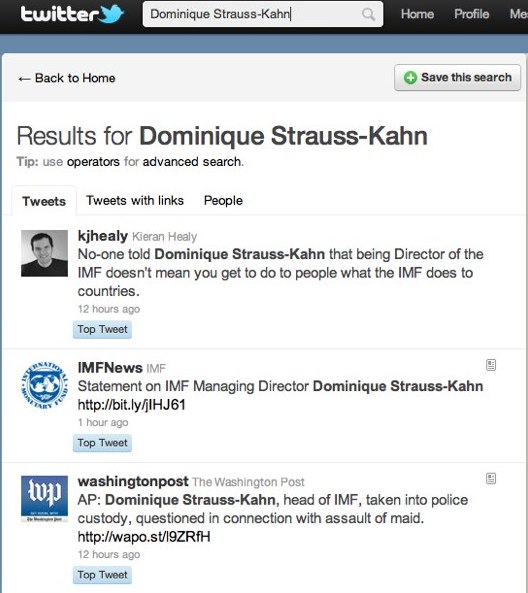
In case you were wondering who the go-to sources on l’affaire Strauss-Kahn are, at least according to Twitter:

Twitterati

The consequences of getting retweeted all over the place mostly involve being introduced to the range and sophistication of twitter spam and followbots.

The Sustainability of Europe

by Henry Farrell on May 13, 2011

“Matt Yglesias”:http://yglesias.thinkprogress.org/2011/05/the-sustainability-of-greece/

bq. I’m not intimately familiar with the details of Greek public finance, but it does occur to me that sage words I keep reading in the American press about how Europe’s leaders can’t just keep kicking the can down the road and need to deal with Greece’s basic insolvency strike me as unwarranted. In general, the capacity of large wealthy societies to allow festering problems to go un-addressed seems perennially underrated. … as I can remember people have been talking about how the United States needs to address entitlement spending and trade imbalances … Presumably at some point something will happen. But in practice we’ve managed a great deal of can-kicking, seem to have more can-kicking in us, and actually the public and the political elite alike are quite averse to the kind of steps that would address these issues. Is Greece so different?

On the economics of can-kicking, I think this is right. On the politics of can-kicking, not so much. The difference between the US and the European Union is that the US is a relatively robust political entity. Americans may vigorously dislike this or that aspect of their government, but their political arguments are mostly about what the US should do, or be, not whether the US should exist at all (even die-hard we-were-screwed-in-the-Northern-War-of-Aggression-ers mostly seem to think of themselves as patriots; Alaska and the commonwealth of Puerto Rico are the only parts of the US I can think of with significant secessionist movements). Europe is quite different. The EU’s legitimacy is relatively fragile. Very few people indeed think of themselves as more European than French or German. Even fewer feel that they have any strong allegiance e.g. to the European Council or the European Commission.

So my worry is straightforward. Greece is not so big a problem that it cannot be kicked down the road by the Europeans indefinitely. So too, Ireland and Portugal, and perhaps even (with more straining) Spain. But the specific _manner_ in which the can is being kicked down the road has consequences for European legitimacy. Greeks, Portuguese and Irish people don’t like being at the sharp end of imposed austerity. They have obvious villains to blame for it – the EU (in particular the ECB and the Commission) and the ‘Germans.’ But Germans, Dutch people etc don’t have much reason to like the EU these days either. For them, it is associated with a giant sucking noise pulling frugal German taxpayers’ savings into the gaping maw of Greek pensioners. Neither those on the receiving or those on the giving end of current policies is very happy. And both have good reason to associate their unhappiness with the EU. And the EU does not have much legitimacy to spare in any event.

I don’t think that this will lead to the collapse of the European Union. I do think that it is likely to result in very long-lasting institutional stagnation, if it continues. Ad hoc decisions, none of which seem unjustifiable at the time, may have long term fallout for European integration (for one: can we see Irish people voting through any new Treaty changes any time soon?). And kicking the can down the road at best does nothing to solve these problems (which I do not think are likely to go away of their own accord), while doing a lot to exacerbate them. NB though that this is my personal view – I suspect that at least one CTer disagrees, and is more optimistic.