From the category archives:

Feminism

What do you mean your wife won’t take care of them?

by Kieran Healy on April 10, 2010

Feminist Philosophers reports on some egregious behavior under the auspices of the National Endowment for the Humanities:

a good friend of mine (a tenured philosophy professor in the states) was just accepted to an NEH summer seminar in [European city]. She’s a single mom and, obviously, wants to bring her son along. But, she says, she “has just been given 12 hours to “demonstrate” that she has full-time childcare arrangements for her son for the month of July that “are to the [completely unspecified] satisfaction” of the Institute directors; if she fails to meet this requirement, she has been told her accceptance in the program will be withdrawn. She was notified of said acceptance on Monday.”

The mind boggles. Then again, I’ve always thought it a very fortunate accident of nature that men are never in a position where they are responsible for offspring genetically related to themselves. (Is there even a word for that?). If they were, it would really be impossible to have a proper career.

Update: Edited to clarify the role of the NEH (as funder, not organizer). And just to be clear, I don’t have any inside knowledge on this incident beyond the post quoted above. As I say in comments below, perhaps some further details will emerge that make the whole thing an unfortunate misunderstanding or otherwise resolve things. We’ll see, I guess.

“Contrary to the values of the republic”

by Chris Bertram on January 27, 2010

Sometimes a thought occurs about something that might make for an interesting blog post, but I realise that whilst I know enough to have the thought, I’d have to do a great deal of research to write something that would survive the scrutiny of people who know their stuff. Still, it may be that commenters who know more than me can say something of value, and that I could at least serve as a prompt. So here goes. An article on the BBC website discusses the recommendations of a French parliamentary committee which described the veil as :

bq. “contrary to the values of the republic” and called on parliament to adopt a formal resolution proclaiming “all of France is saying ‘no’ to the full veil”.

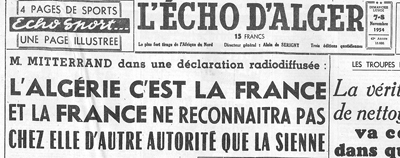
Hmm, I thought. It wasn’t so long ago that “all of France”, at least for some values of “all of France” had a more divided view about the veil. Roughly at this time, in fact:

(Picture nicked from the very excellent Images of France and Algeria blog, which has, incidentally, lots of interesting stuff on the 1961 Paris massacres of Algerians.)

But then I also remembered that official France had not, in fact, been very tolerant of the veiling of Algerian women. The photographer Marc Garanger is famous for his many pictures, taken during the war, of Muslim women forcibly unveiled so that they could be photographed for compulsory ID cards. There are some “here”:http://www.noorderlicht.com/eng/fest04/princessehof/garanger/index.html . So how did that all work out then? A little googling reveals that this very month, historian Neil MacMaster has a new book entitled _Burning the Veil: The Algerian war and the ’emancipation’ of Muslim women, 1954-62_ (Manchester University Press). I couldn’t find any reviews, as yet. The blurb writes about a campaign of forced modernisation followed by a post-revolutionary backlash involving a worsening of the position of women in Algeria.

So two thoughts then: (1) far from being an aberration in France, there was a very recent period when very many French women (or perhaps “French” women) were veiled; (2) attempts by the state to change that didn’t lead to female emancipation and the triumph of Enlightenment values.

Gender Equality

by Harry on December 15, 2009

During Ingrid’s visit to Madison she was surprised to find that Gender Equality: Transforming Family Divisions of Labor (UK) has already been published, mainly because she expected me to organise a book event on it in a timely fashion, or at least announce it on CT. Mea Culpa. The book came out of the conference I wrote about here. Gornick and Meyers previously published Families That Work, a comprehensive discussion of family policy in various European countries with a view to recommending a mix of subsidies, leaves, and regulations for the United States; after a visit to present the work in Madison, Erik Wright pressed them to develop a more general set of recommendations for moving toward a dual carer-dual breadwinner system, which is the lead essay in the current book. The commentaries all take off from the lead essay, with varying degrees of criticism: commentators include Nancy Folbre, Johanna Brenner, Heidi Hartmann, Rosemary Crompton, Ann Orloff, Erik Wright and me, and not one, but two, former CT-guest bloggers, Kimberly Morgan and Lane Kenworthy. Oddly, given that her essay is more critical of the kinds of policies that I’d like to see (some variant of what Gornick and Meyers recommend) than any of the others, my own favorite commentary is Barbara Bergmann’s. As will be no surprise to anyone who knows her work, Bergmann argues against a system of leaves, especially paid leaves, on the grounds that, since men will not take the leaves, increasing the opportunities and incentives for women to take the leaves will, in fact, entrench rather than overturn the gendered division of labor. I’m not persuaded, and it’s not because I am more optimistic about men taking on more child-caring (though I am, but that’s because Bergmann is pessimistic in the extreme) but more because I don’t see childcare becoming a well-paid career, or a significantly male one, in the foreseeable future. But what I liked about her commentary was the sensitiveness to context — the way that she makes clear that any commentary on proposals like this cannot be “for” or “against” but must take into account the likely effects which will vary depending on the historical circumstances of the society being considered.

Anyway, this post is the announcement Ingrid had been expecting, and I’ll tardily try to put together an event about the book before too long.

Minarets in Switzerland

by Kieran Healy on November 30, 2009

I hadn’t been following the story of Switzerland’s efforts to ban the construction of minarets. Switzerland has about 400,000 muslims and — though there are many mosques — precisely four minarets. The referendum succeeded by a comfortable majority. As you can see from the poster, the rights of women under Islam were pointed to as a reason to support the ban. The Guardian reports that the pro-ban SPP

said that going to the European court would breach the popular sovereignty that underpins the Swiss democratic model and tradition … It dismissed the arguments about freedom or religion, asserting that minarets were not a religious but a political symbol, and the thin end of a wedge that would bring sharia law to the country, with forced marriages, “honour” killings, female genital mutilation and oppression of women … The prohibition also found substantial support on the left and among secularists worried about the status of women in Islamic cultures. Prominent feminists attacked minarets as male power symbols, deplored the oppression of Muslim women, and urged a vote for the ban.

The Times reports that there’s some evidence that more women were in favor of the ban than men, too. One can only suppose that, having waited until 1971 to give women the vote in Federal elections, and in some parts of the country until 1990 in Cantonal elections, the Swiss are now making up for lost time making good on their commitment to feminism.

Perspective

by Belle Waring on September 28, 2009

I decided just to boost this comment I made in the thread below about Dr. Kealey’s failed attempt at humor. (My sexism. Let me show you it.) I considered removing the bad words, but then decided, fuck it. If Panera bread is banning CT from its wireless for you right now, sorry hypothetical Panera-eating CT readers. Who can’t read this apology.

I’d like to share a little anecdote from my college years. I had a Roman History prof who would frequently make comments on my appearance, in front of the gathering class, as I made my way to my seat in the front row (because I was a very diligent student!). And at a gathering of students and faculty I decided to leave and put on my coat, but then got sidetracked into a discussion with him and said I needed to take my coat off. And he said, you can do that but if you do I’m going to stare at your breasts—but you knew that when you got that tattoo there. (The tattoo is like 3 inches below my clavicle anyway, thank you.) He actually said that to me! And then, when I was applying to graduate school, I had to approach my advisor with a problem, because normally I would ask this prominent scholar who gave me an A+ (which, I may say, I thoroughly deserved) in Roman History to write a recommendation, but I knew from previous experience that I didn’t actually want to be alone with him in his office. And so my advisor had to convince another professor, of equal status, to write me a recommendation that was somewhat fictional, on the assurance that when I did have a class with him that term he would find me everything promised, etc. He kindly did so and didn’t regret his decision. So where I’m going with this is, that fucking sucked and was a terrible experience for me, and Dr. Kealy is a fucking asshat who is even now making the lives of his attractive female students needlessly miserable. And just FYI, dsquared’s reliable, not-making-a-big-deal-out-of-it, stand up feminism makes him infinitely more sexually appealing to the leftist ladies of the world. That shit is like catnip. It is only the strict, sex-hating conventions of Crooked Timber, under which fraternization between co-bloggers is totes banned, which keeps us apart right now. And the happily married thing.

Just adding, it was particularly irritating about the grade, because I really did deserve an A+ in that class, but it was impossible to know whether my grade was influenced by my breasts. My boyfriend at the time, for example, questioned it on this basis. I doggedly went on earning the same grade in other classes until at one point my GPA was above 4.0. But the tarnish never really went away. And all of this fell under the look but don’t touch rubric, while still being humiliating and awful.

Particularly humiliating and awful in light of the fact that a teacher at my middle/high school “fell in love with me” on the first day of 7th grade (when I had just turned 13) , and proceeded to have a protracted–I don’t know what you would call it, affair, maybe–which he carefully avoided consummating until four weeks after I reached the age of consent in Washington D.C. The schmuck wrote a book about me, in addition to taking approximately one billion pictures of me (he was the photography teacher, natch.) I mean really, a whole novel. What a pitiful, yet shitty thing to do. And then I finally told my mom about it, and he got fired from the school in my senior year, and then almost all the girls at my (all-girls) school turned uniformly against me and treated me awfully for “ruining his life.” So think how happy I was to get to college, where there would be real scholarship and adults who behave with minimal decency! Hollow laughs ensue. Now I’m not writing this so you can all say, poor Belle, that’s really awful. I’m fine now and that’s not the point. But there’s a reason all those annoying strident feminists go on about how the personal is the political. Kealy doesn’t know the personal histories of the female students he’s ogling. And they deserve to be treated like human beings, not fresh-faced dollies to use as mental props during masturbation.

Utterly Gratuitous Sexism, Anyone?

by Belle Waring on June 24, 2009

Much digital ink has been spilled on Ross “I Would Do Anything For Love, But I Won’t” Douthat’s review of Helprin’s “Digital Barbarism”, but no one–except sage Unfogged commenter Witt–has noted what may be the very most annoying part: the insertion of pointless sexism into a fine xkcd cartoon. A cartoon, I might add, that Douthat does not even bother to actually cite by name. Read the comic here. Now feast your eyes:

One of the more trenchant cartoons of the Internet era features a stick-figure man typing furiously at his keyboard. From somewhere beyond the panel floats the irritated voice of his wife.“Are you coming to bed?”
“I can’t,” he replies. “This is important.”
“What?”
“Someone is wrong on the Internet.”

How, might I ask did Douthat know that the voice in question is that of an irritated wife? And what marks the stick figure as that of a man? Oh, right, the unmarked is always male, right? It’s true that xkcd often depicts female stick figures as having longer hair, but this is not invariably so. Verdict: douchebag.

UPDATE: my husband informs me that brilliant unsung CT commenters have been all over this is comments to his post. But the point stands.

Toward a Humanist Justice

by Harry on June 22, 2009

Toward a Humanist Justice, a collection of critical essays on the work of Susan Moller Okin edited by my friends Debra Satz and Rob Reich, has just been published. The essays were first presented at a conference in honour of Okin organized at Stanford shortly after her death (which we reported here), and the book includes essays by Alison Jaggar, Joshua Cohen, Cass Sunstein, Mary Lyndon Shanley, the late Iris Young, David Miller, and others. One of the big problems with collections like this, focused on a single person’s work and deriving from a conference, is that they can be very disparate. Unlike a volume conceived around a single theme or problem, it is very hard to discipline contributors, and the contributors themselves are invited to the conference for a variety of reasons which include deep personal connections to the subject of the conference, a consideration which is sometimes, and not wrongly, given more weight than consistent engagement with the themes of that person’s work. The difficulty arises when it comes to the volume, and the editors don’t dare to dis-include those papers which don’t really belong in a unitary collection (I hereby request any editors who ever feel awkwardness about dis-inviting me in such a situation – which I can envisage arising – to be frank with me without any fear of me being even mildly irritated). So it really is a delight to find no such problem with the volume – not only are the essays all on central themes in Okin’s work, but they are well written (or well edited, you can never be sure) and all that I have read are very good indeed.

[click to continue…]

TMI… seriously!

by Maria on May 18, 2009

In other cool things about L.A., I have to admit the non-mortal earthquakes are pretty great. I’ve sat through two of the 5+ richter ones and was about 4 miles from last night’s epicenter. The most striking thing is that in the first few seconds of an earthquake, a completely random explanation for it pops into my mind. The first time around I got quite irate that our upstairs office neighbours were thumping around making such racket that the building swayed. Last night, although I live 2 miles from the freeway, I instantly thought ‘wow, that’s one big truck passing by. Or maybe it’s a tank?’.

It turns out that’s not an unusual reaction. Human brains are very good at rationalising the immediate aftermath of a disaster into business as usual. But, contrary to popular belief, not panicking isn’t all that successful a survival strategy. A book I read last year ‘The Unthinkable; Who Survives When Disaster Strikes’, says much of the planning around plane crashes, fires, etc. assumes that the first thing people will do is panic and run around doing stupid things that impede their escape. In fact, the most common and dangerous reaction is to just go limp, stay passive and assume that the nightclub fire is really not all that bad or that you should sit in your crashed plane seat until help arrives. Or that the hostage situation is all a terrible misunderstanding. That’s a very good way to die.
[click to continue…]

The Girls From Planet 5

by John Holbo on April 20, 2009

Sigh.

You know what that means. I’ve been reading Jonah Goldberg again. Here we go, pondering the notion that a few of these teabag types might be right-wing extremists of a certain sort.

I wrote a book on fascism which tried to show that what everybody knows isn’t necessarily true. The idea that soldiers will return from war and become right-wing militants? Well, that has its roots in Fascist Italy, where veterans returned as black-shirted shock troops of “Il Duce,” Benito Mussolini. The only problem with this theory is that what they clamored for was socialism — the socialism of the trenches! — and their leader had earned the title “Il Duce” as the leader of the Socialist Party.

Now obviously ‘socialism of the trenches’ means something like: recover that feeling of unity and common cause we had, in the immediate aftermath of that initial irruption of chaos and disaster, when everyone set aside petty class differences and stood, shoulder to shoulder, against a perceived external enemy.

And it’s obvious that nothing like that could be spiritually akin to – oh, say, Glenn Beck’s 9/12 project. Because Glenn Beck isn’t in favor of socialism.

Sigh.

Let’s talk Texas secession. Like I said, Belle bought me this stack of old paperbacks – because she loves me – and the whole mouldering lot are turning out to be weirdly prescient. First the beaver management, now this. [click to continue…]

How much better is breastfeeding?

by Harry on March 12, 2009

Hanna Rosin in the Atlantic.

One day, while nursing my baby in my pediatrician’s office, I noticed a 2001 issue of the Journal of the American Medical Association open to an article about breast-feeding: “Conclusions: There are inconsistent associations among breastfeeding, its duration, and the risk of being overweight in young children.” Inconsistent? There I was, sitting half-naked in public for the tenth time that day, the hundredth time that month, the millionth time in my life—and the associations were inconsistent? The seed was planted. That night, I did what any sleep-deprived, slightly paranoid mother of a newborn would do. I called my doctor friend for her password to an online medical library, and then sat up and read dozens of studies examining breast-feeding’s association with allergies, obesity, leukemia, mother-infant bonding, intelligence, and all the Dr. Sears highlights.

After a couple of hours, the basic pattern became obvious: the medical literature looks nothing like the popular literature. It shows that breast-feeding is probably, maybe, a little better; but it is far from the stampede of evidence that Sears describes. More like tiny, unsure baby steps: two forward, two back, with much meandering and bumping into walls. A couple of studies will show fewer allergies, and then the next one will turn up no difference. Same with mother-infant bonding, IQ, leukemia, cholesterol, diabetes. Even where consensus is mounting, the meta studies—reviews of existing studies—consistently complain about biases, missing evidence, and other major flaws in study design. “The studies do not demonstrate a universal phenomenon, in which one method is superior to another in all instances,” concluded one of the first, and still one of the broadest, meta studies, in a 1984 issue of Pediatrics, “and they do not support making a mother feel that she is doing psychological harm to her child if she is unable or unwilling to breastfeed.” Twenty-five years later, the picture hasn’t changed all that much. So how is it that every mother I know has become a breast-feeding fascist?

At some point, when I was a little bit obsessed with this topic myself, I looked a handful of studies and my experience was like Roisin’s; they all showed very small benefits, but I noticed that none of them tried to control for the socio-economic status of the mothers. Ever since I have been rather skeptical about the benefits, but have dutifully supported the breastfeeding of my kids, despite the difficulties that both they and their mother endured. Breastfeeding meant that for the first several months of each of their lives their primary relationship was with their mother, and everything I did with them had to be scheduled around the need for them to feed. With the first two, both of whom screamed pretty much constantly while awake for 4 months, I — and my wife — frequently went against our instinct that they were hungry, and refrained from giving them any formula (as the books tell you to), causing, I suspect, far more misery for all of us than was necessary.

My favourite La Leche League story (frequently referenced in Rosin’s article) is a from a friend who teaches high school. She asked a La Leche League counsellor how she could pump, given the brief breaks between classes, and the time it takes to let down. “well”, said the counsellor, “that’s easy, you just massage your breasts for 10 minutes before you pump”. “But I’m teaching in front of 30 teenagers in that 10 minutes before I pump, I can’t massage my breasts in front of them”. “Oh yes you can, they’ll soon get used to it”.

Siobahn, to whom I owe the link, says that her favourite line of the article is this:
“This is why, when people say that breast-feeding is “free,” I want to hit them with a two-by-four. It’s only free if a woman’s time is worth nothing.”

Update: see Laura’s excellent follow-up/summary, and ensuing discussion.
Belated Happy Birthday, International Women’s Day!

by Ingrid Robeyns on March 9, 2009

8march

According to “Wikipedia”:http://en.wikipedia.org/wiki/International_Women’s_Day, yesterday was the 100th International Women’s Day (I started writing this post yesterday, but spent most of that day at a feminist meeting and having a women’s night out. Sorry. But here it is – better late than never). “Last year, here at CT”:https://crookedtimber.org/2008/03/08/international-womens-day/, we discovered that in some countries this is not celebrated as a social or political event (as it is in Europe) but rather as a day to give your wife or girlfriend chocolates or flowers. So I felt it’d be good to post an old-fashioned political poster, stolen from the very same wikipedia site. Isn’t it awesome? [click to continue…]

Update: please feel free to use the exercise below, or any adaptation thereof, with or without attribution, if you find it useful. (Prompted to post this by a conversation at Laura’s).

One of the first times I taught about the gendered division of labour in my Contemporary Moral Issues course, a student articulately challenged the relevance of the issue to her. I had assigned the key chapter of Susan Okin’s classic Justice, Gender, And The Family, which argues that the gender system is in violation of fair equality of opportunity, because girls are socialized to be carers (and boys aren’t), therefore end up disproportionately in caring (and therefore lower paid) labour, and, because they take the lion’s share of the burden of caring labour in the home, end up lower paid than their spouses; and yet face a high probability of a divorce after which they will not be able to share in their spouse’s greater earning power (I disagree with Okin about Rawls, but agree with her that if the mechanisms she identifies are at work there is a social injustice — more on that another time). For her empirical case, she relies heavily on Lenore Weitzman’s study of divorce. My student said this research was not relevant to her generation. Putting aside the methodological worries about Weitzman’s study, I was rather unnerved to figure out on the spot that the women she studied were in the generation of my students’ grandparents. I wouldn’t want to draw conclusions about my own life course from studies of my grandparent’s generation either, especially if I had had it drummed into me both by parents and teachers that my own circumstances were entirely different from those of my grandparents, and even more if I were aware (as some of the girls are) that so soon after admitting girls as equal participants universities now have to practice affirmative action for boys in admissions to get close to equal sex-ratios. I pointed this out, and then, again on the spot, tried to figure out a way of showing that the issues, if not the figures, probably are relevant to my students nevertheless. I was pretty happy that in 5 minutes I had them convinced that at least it might be relevant. Here is a slightly refined version of the exercise.

[click to continue…]

Feminism and Basic Income Revisited

by Ingrid Robeyns on February 2, 2009

We’ve had some discussions on the desirability of a basic income from a feminist perspective here before (“here”:https://crookedtimber.org/2007/02/28/redesigning-distribution/ and “here”:https://crookedtimber.org/2007/07/10/should-feminists-support-basic-income/). So I thought I would mention that about a month ago a special issue of “Basic Income Studies“:http://www.bepress.com/bis/ was published which addresses precisely the question “whether, all things considered, feminists should endorse a basic income.”:http://www.bepress.com/bis/vol3/iss3/ All authors answered this question with (relatively) affluent societies in mind; so the question still need to be answered for developing countries.

I guest-edited this issue and, as I wrote in “the introduction”:http://www.bepress.com/bis/vol3/iss3/art3/ (which also summarises the papers), apart from Barbara Bergmann’s contribution, I genuinely did not know what the other contributors (John Baker, Anca Gheaus, Jacqueline O’Reilly, Almaz Zelleke, and Julieta Elgarte) would argue. So although these authors are all either feminists or generally supportive of feminist views, I was truly surprised to find out that they strongly disagreed on the desirability of a basic income for feminists. On the one hand this is due to the different kinds of feminism which they endorse. Bergmann is a ‘Total Androgyny, Male Style’- type of feminist, whereas Baker and Zelleke, for example, are much more concerned about the short-term interests of carers and those who do not want to or cannot take on large paid jobs, which are often mothers and female carers. Yet the other source of disagreement is the predicted effects of a basic income on the gendered division of labour. Gheaus thinks it will become more unequal (a view I share based on an empirical literature survey of similar policy instruments or financial changes, which I did as a graduate student). Elgarte thinks we need to make policy space for an ‘avantgarde’ who is practicing a more egalitarian gender division of labour while at the same time protecting those who are living in more gendertraditional households, whereas Zelleke doesn’t think the gender division of labour will worsen if a basic income would be implemented.

How is all this possible? The answer, I think, lies in the fact that these papers argue at a high level of generality and without specifying what the level of the basic income will be and what other elements of the welfare state (public goods, merit goods, etc.) will be kept and/or implemented. Of course, this critique is not true for Bergmann, who has done some interesting calculations and argues that if we have a Swedish-style welfare state with targeted transfers and subsidized public and merit goods, there is no fiscal room left to increase taxation rates for a basic income; and it is also not entirely true for O’Reilly, who compares existing social policies aiming at gender equality, and concludes that she is sceptical about what a basic income can do better.

So my conclusion? “…the main merit of this debate in Basic Income Studies is that it provides evidence of the consolidation of the conflicting feminist views about basic income proposals when analysed at a general level. Therefore, I believe that it is time to move to a second stage of feminist analyses that needs to focus more on the details of the entire package deal of a basic income society, in an empirically grounded fashion.” (introduction, p. 5)

“Basic Income Studies”:http://www.bepress.com/bis/ is one of those wonderful Open Access Journals, so anybody interested can read it all “here”:http://www.bepress.com/bis/vol3/iss3/.

Talking Heads

by Scott McLemee on January 8, 2009

I was in touch with Astra Taylor about her documentary Žižek! quite a long time ago, or so it seems. She has a new film called Examined Life consisting of what might be called philosopher-in-the-street interviews. The talking heads include (to reshuffle the list alphabetically) Kwarne Anthony Appiah, Judith Butler, Michael Hardt, Martha Nussbaum, Avital Ronell, Peter Singer, Sunaura Taylor, Cornel West, and Slavoj Žižek.

Here’s the trailer:

I haven’t seen the film yet — it’s only showing in NYC now, it seems — but would welcome a screener DVD. It’s not like I’m going to bootleg it out of the trunk of my car or anything. I don’t even have a car, if that makes the folks at Zeitgeist Films feel any better.

(crossposted)

Hormones for toy choice

by Chris Bertram on December 10, 2008

From “an otherwise serious article”:http://www.independent.co.uk/news/science/its-official-men-really-are-the-weaker-sex-1055688.html about the effects of pollution on males of all species:

bq. … a study at Rotterdam’s Erasmus University showed that boys whose mothers had been exposed to PCBs grew up wanting to play with dolls and tea sets rather than with traditionally male toys.