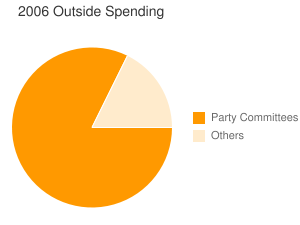
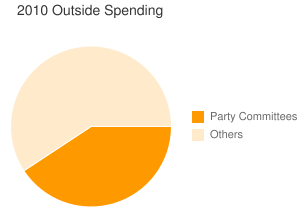
A lot of US-based bloggers are speculating about who is going to win or lose in the Congressional mid-terms. Myself, I’ve nothing much to add to that discussion. What’s more interesting to me is the potential transformation happening within the Republican Party. Parties – like most other organizations in advanced industrial democracies – depend on money. And it’s pretty clear that the sources of fundraising are changing. Take a look at this “Sunlight Foundation”:http://blog.sunlightfoundation.com/2010/10/15/court-rulings-change-elections-independent-spending-dwarfs-party-spending-in-midterm/ post on the balance between spending by traditional party committees and by outside groups. Or just look at the key graphs.
Charles Ferguson has “a nice piece”:http://chronicle.com/article/Larry-Summersthe/124790/ in the _Chronicle of Higher Education_ about Larry Summers, the economics profession and their position in American public life. Definitely worth a read.
Utter genius. But watch it now – I suspect that when “This constitutes a fair use of Disney’s Donald Duck” meets a takedown notice from the Mickey copyright mafia, the takedown notice is going to win.
I don’t know whether Clive Crook is _deliberately_ trying to show us how thin the partitions are between supposedly sensible centrism and “grand guignol style theater”:http://www.ft.com/cms/s/0/bef99b4c-c9af-11df-b3d6-00144feab49a.html, but he’s certainly doing a damn fine job of it.
bq. These and other compromises disappointed the left. But the message to the electoral centre was consistent: Mr Obama would have let the left have its way if he could. What he should have done – and what he ought to do from now on – is simple. Instead of blessing leftist solutions, then retreating feebly to more centrist positions under pressure, he should have identified the centrist policies the country could accept and advocated those policies. … The left will tear its hair over another surrender and the centre will note where the president’s sympathies actually lay. … Substantively, whether taxes on high-income households rise now or two years from now does not matter very much. … Symbolically, though, Mr Obama’s position speaks volumes. … Nothing short of the Scandinavian model (plus stronger unions, minus the commitment to liberal trade) will ever satisfy the Democratic left. Its role, its whole purpose, is to be betrayed. So betray it, Mr President, and start leading from the centre.
This really is a rather wonderful piece of writing in its own, quite particular way. Mr. Crook “doesn’t have a theory of politics”:https://crookedtimber.org/2010/07/19/mr-crookletides-tiger/ (he never bothers to provide any evidence for all those confident assertions about how centrists are vigilantly monitoring the Obama administration for the slightest hint of hippy-hugging), so much as a kind of torrid internal psychodrama that (for reasons best known to him) he has chosen to inflict upon us repeatedly in printed form and that (for reasons best known to them) the editorial team of the _Financial Times_ has decided to pay him for. And that psychodrama is on full display here. The dithering Obama, trying to resist the siren-calls of the left and only half-succeeding. The ever-disappointed centrist voter, sadly shaking its collective head yet again as the president hesitates over whether to embrace his true love or to succumb to the allures of forbidden passion. And that frenzied maenad, the left, fated always to be betrayed, because it is only in being betrayed that she can achieve her true destiny. It’s like an opera. A _very bad_ opera. Or perhaps one of those Greek plays in which everyone ends up killing each other after having had sex with their parents and siblings. What it doesn’t resemble – at all – is a piece of serious political thinking and writing. I’d have thought that this would be a significant problem for a political column myself – but then I’m not an editor for the _Financial Times._
I’ve been mulling over Jonathan Rauch’s “essay on the Tea Party movement”:http://www.nationaljournal.com/njmagazine/cs_20100911_8855.php for the last few days. It is a really fascinating piece of sociological journalism. And this “post by Brad Plumer”:http://www.tnr.com/blog/jonathan-cohn/77840/can-the-tea-party-be-controlled brought some of the inchoate thoughts swirling around my head into focus.
bq. Jonathan Bernstein touches on an interesting question below: Who, exactly, speaks for the Tea Party movement? Many Tea Partiers would say that no one does. It’s a grassroots movement, decentralized, self-organizing, bottom-up—all that jazz. Apart from Sarah Palin and Glenn Beck, it doesn’t really have any leaders. And yet, there are plenty of groups that would love to channel the Tea Parties’ energy (and rage, let’s not forget rage) for their own purposes. On top of that, the Tea Party movement may need a bit of centralization and coordination to survive and prosper in the future. But all those competing priorities can create an awful lot of tension. [click to continue…]
Another episode in “What David Moles said”:http://chrononaut.org/2010/09/16/many-writers-have-all-the-virtues-of-civilized-persons/
Art Goldhammer on “the Sarkozy meltdown”:http://artgoldhammer.blogspot.com/2010/09/astonishing-rebuke.html
bq. The problem is that this statement was a lie, according to Merkel. … astonishing public rebuke, Merkel’s spokesperson …The idea that Sarkozy would simply have invented an exchange with Merkel and that he would have invoked her “total and entire” support without having cleared it with her beggars belief. A president who behaves in this way permanently discredits himself. Plummeting in polls, attacked for human rights violations, chastised by the Pope, sued by Le Monde, and now slapped in the face by Merkel, Sarkozy seems to be coming unhinged, prepared to say anything and do anything to retain his increasingly tenuous hold on power. How long before an open revolt breaks out in his own party?
“Matthew Yglesias”:http://yglesias.thinkprogress.org/2010/09/harvardperetz-controversy-illustrates-folly-of-charitable-donations-to-wealthy-u-s-universities/ on Martin Peretz and the university donation business.
bq. It’s really too bad that Harvard has chosen to take this tack. Obviously the only person in this conversation who’s questioned anybody’s right to “free speech” or exhibited a weak “commitment to the most basic freedoms” is Peretz himself. Equally obviously, Peretz’s right to be a bigot does not create a right to be honored by prestigious universities. My alma mater is doing a disservice to their brand and to public understanding of the issues by deliberately obscuring things in this manner. It would be more honest to say that Harvard is a business run for the benefit of its faculty and administrators. The business model of this business is the exchange of prestige in exchange for money. Peretz has friends who have money that they are willing to exchange for some prestige, and Harvard intends to take the money.
Of course we should fight for social justice. Justice is good. And it’s social. Broadly speaking. So I’m asking about the term, not the thing. I ask because I see that Senator Gregg has come out against justice. Near as I can figure.
Normally I would say it is a bad idea to drop a term just because someone like Glenn Beck gets everyone wound up about it. But I tend to think ‘social justice’ just means justice. Of course people have different ideas about what justice is, but ‘social justice’ doesn’t really express those differences. It’s vaguely associated with 1960’s-style stuff and socialism, but not in a way that sheds any light. Not in a way that really says anything.
Example. I’ve finally gotten around to reading Erik Olin Wright, Envisioning Real Utopias, on Harry’s recommendation. I’m not that far yet, but near the start there’s a section on ‘social justice’ then a section on ‘political justice’. Honestly, I can’t tell the difference. [click to continue…]
I’ve an “article”:http://democracyjournal.org/article.php?ID=6773 on the horrible mess that is EU economic politics in the new _Democracy._ The bit I’d most like people to take away:
bq. austerity measures will not lead to economic stability. They will never be applied to strong member states, and will fail to address the problems of weaker ones, which are more likely to face problems of overheating in the private sector than over-reliance on public borrowing. They are also extremely crude, and would provide little flexibility for states faced with asymmetric shocks. Most importantly, the emphasis of austerity hawks on fiscal rectitude and nothing but is not politically sustainable. They would reproduce the problems of the early twentieth-century “gold standard” system, in which economies responded to crises with chopped wages and swingeing increases in unemployment. As Barry Eichengreen has emphasized, democracies cannot credibly maintain such a system over the long run. European citizens are suspicious of the EU because they do not understand it. If they come to see it as a set of shackles chaining them in economic squalor and misery, their suspicion will be transformed into positive detestation. EMU cannot survive widespread public loathing. Yet such loathing would be the ineluctable result of enforced austerity programs.
But also (following on from yesterday’s review), you should really read “Jacob Hacker’s piece”:http://democracyjournal.org/article.php?ID=6772 in the same issue on the politics of healthcare reform going forward.
bq. Reformers may have won the war in 2010, but they lost the battle for public opinion: Americans were convinced reform was needed, but not that the federal government should have the authority to make sure it was done right. Reformers cannot afford to lose the second battle for public opinion. Winning it will require organization and narrative. It will also require that progressives coalesce around a broad vision, as they did in the years after the passage of the Social Security Act. That vision should have two sides: the case against insurers and the case for government. … They can begin by resisting insurers’ self-serving entreaties to be freed from the requirement that they spend at least 80 percent of their bloated premiums on the actual delivery of care. … But making a case against insurers is not enough to justify the stronger federal role that is essential. Reformers … should not be afraid … to point out where the law needs to be strengthened, especially when that also means pointing out where private insurers continue to fall short. And nowhere is this more true than when it comes to the public option.
Available from “Amazon”:http://www.amazon.com/gp/product/1416588698?ie=UTF8&tag=henryfarrell-20&linkCode=as2&camp=1789&creative=390957&creativeASIN=1416588698 “Powells”:http://www.powells.com/partner/29956/biblio/9781416588696 .
This is a transformative book. It’s the best book on American politics that I’ve read since _Before the Storm._ Not all of it is original (the authors seek to synthesize others’ work as well as present their own, but provide due credit where credit is due). Not all of its arguments are fully supported (the authors provide a strong circumstantial case to support their argument, but don’t have smoking gun evidence on many of the relevant causal relations). But it should transform the ways in which we think about and debate the political economy of the US.
It’s always somewhat embarrassing to agree with Thomas Friedman. So when he switches from trumpeting the US as the new hyperpower to the end of hyperpower argument I was making all along,, it struck me that it might be time to reconsider whether I need to change my own views. But, that would be excessively contrarian.
A central lesson of this experience (of course, not one that Friedman or Joffe is ever likely to learn) is that the whole idea of a military hyperpower is a nonsense. The idea that military force can be used for any positive purpose (that is, other than as a defensive response to the use of military force by others) persists despite a lack of any significant supporting evidence. The US crusade in Iraq has cost, or will cost $3 trillion (not to mention the lives of thousands of American, and hundreds of thousands of Iraqis). That’s more than the US would spend on official development assistance for the whole world in 100 years at current rates (and the lion’s share of ODA goes to supporting military/geopolitical goals – the poorest countries get less than $10 billion a year between them). Things have gone pretty badly in Iraq, but even supposing that the ultimate outcome had been a stable and prosperous democracy, it’s clear that the benefit-cost ratio would be very low. You get a similar answer if you look at the whole period since Macarthur pushed on to the Yalu river back in 1950. And by comparison with other countries that have tried to use military power to pursue foreign policy goals, the US has done much better (or rather, much less badly) than anyone else .
More striking was the simultaneous departure of Brink Lindsey and Will Wilkinson. Lindsey has been the leading proponent of a rapprochement between libertarians and (US-style) liberals, under the unfortunate portmanteau of “liberaltarianism”, and Wilkinson was similarly seen as being on the left of Cato.
These departures presumably spell the end of any possibility that Cato will leave the Republican tent (or even maintain its tenuous claims to being non-partisan). And Cato was by far the best of the self-described libertarian organizations – the others range from shmibertarian fronts for big business to neo-Confederate loonies.
On the other hand, breaks of this kind often lead to interesting intellectual evolution. There is, I think, room for a version of liberalism/social democracy that is appreciative of the virtues of markets (and market-based policy instruments like emissions trading schemes) as social contrivances, and sceptical of top-down planning and regulation, without accepting normative claims about the income distribution generated by markets. Former libertarians like Jim Henley have had some interesting things to say along these lines, and it would be good to have some similar perspectives
Conservative leaders issued a series of statements today to try to resolve the growing tensions over the so-called “Ground Zero Mosque” planned for lower Manhattan.
“We’re being cast as opponents of religious freedom,” said blogger <a href=”http://www.salon.com/news/politics/war_room/2010/08/16/ground_zero_mosque_origins”>Pamela Geller</a>, “and that’s not fair. We’re just saying that this is a highly sensitive matter and a very important place for us. We’re all about freedom. And to prove it, we propose that the location of the Ground Zero mosque should be dedicated, instead, to a Museum of Danish Mohammed Cartoons. We were very pro-freedom when those cartoons were published, and we think it would be appropriate if the site were to serve as a memorial to that watershed moment in the history of freedom.”
What a world. You go and write a too-long post in which you raise the obviously impossible possibility that someone might argue that gay marriage is like cigarettes – i.e. you can get cancer second-hand – while apologizing for the sheer, silly disanalogousness of the analogy. And then Jonah Goldberg comes up with the brilliant idea that if you support gay marriage on libertarian grounds [as Glenn Greenwald does] … why then how can you support anti-smoking legislation? Riddle me that! [click to continue…]
Newt Gingrich, distinguished professor of history and reigning intellectual heavyweight of the Republican Party, explains how <a href=http://gotmedieval.blogspot.com/2010/08/professor-newts-distorted-history.html>crafty Muslims are trying to exploit the ignorance of liberal American elites</a>:
<blockquote>The proposed “Cordoba House” overlooking the World Trade Center site — where a group of jihadists killed over 3000 Americans and destroyed one of our most famous landmarks — is a test of the timidity, passivity and historic ignorance of American elites. For example, most of them don’t understand that “Cordoba House” is a deliberately insulting term. It refers to the <a href=http://www.tocmp.com/pix/images/1976ChryslerCordobaSportCoupe.jpg>Chrysler Cordoba</a>, a car made famous by a foreign kind of Mexican man who touted its un-American “soft Corinthian leather.” […I]n fact, every Islamist in the world recognizes Cordoba as a symbol of soft Corinthian leather. It is a sign of their contempt for Americans and their confidence in our historic ignorance that they would deliberately insult us this way.</blockquote>
Well, at first I thought Newt had to be kidding, but then I did some historical research, and guess what? He’s completely right! Check out the Islamomexicanian accent and music that was used to sell “this small Chrysler” to an unsuspecting American market:
I just read the Walker decision. Let me pick on something Orin Kerr has written which seems to me confused, or at least problematic. I’m going to get all philosophy about ‘rational basis’, and Kerr will really just be an occasion for discussion … but first the law background. [click to continue…]