by Henry Farrell on April 10, 2007
Via Ezra Klein, I see that Jonah Goldberg has lapsed into what Ezra describes as a “weird revery over how the rugged individualism of Americans makes them totally unsuitable for social welfare programs.” In Goldberg’s own words:
I find interesting about the liberal defense of European welfare states (They really work! No Really!) is how they leave culture out of the equation almost entirely. … liberals are uncomfortable discussing the reality and constraints of culture for a host of reasons, from multiculturalism to vestigial hangups about seeing the world through prisms of class. … Maybe, just maybe, France and Denmark can handle the systems they have because they have long traditions of sucking-up to the state and throne? Marty Lipset wrote stacks of books on how Canadians and Americans have different forms of government because the Royalist, throne-kissing, swine left America for Canada during the Revolutionary War and that’s why they don’t mind big government, switched to the metric system when ordered and will wait on line like good little subjects…. If government systems are the only variable, or even the most important and decisive one, then how come it’s so damn hard bringing third world countries into the first world?
Now it’s a bit rich for a _National Review_ hack to be talking smack about “long traditions of sucking-up to to the state and throne.” But even if we were to pretend for a moment that Goldberg’s argument is serious, it’s terrible. First of all, it gets Lipset’s thesis badly wrong. While Lipset was keen on enduring American values, he didn’t pretend for a moment that they were the only force shaping US politics. Indeed, he explicitly documented how American values became more ‘European’ as a result of the institutional innovations of the New Deal (funnily enough, Goldberg seems to have missed that bit in his doubtless extensive reading on the topic). But more generally, sweeping claims about the all-determining-power of fixed national cultures have a godawful reputation in the social sciences these days. Values change, and sometimes change dramatically. Individuals are more than the passive bearers of cultural traits; they, like, make choices, and sometimes change their minds about things. The institutions that surround them change, and when these institutions change, so too, very often, do political beliefs, values etc.
There are respectable and serious scholars out there, who make more limited and specific contentions about how culture matters to politics (I tend not to agree with many of their arguments, but I obviously don’t have a monopoly on the truth). However, sweeping, half-assed claims that Culture is Destiny simply don’t feature in serious argument any more. Instead, they enjoy a sort of zombie-like half-life in some corners of the rightwing punditocracy, where their explanatory deficiencies are outweighed by their political usefulness in providing a higher justification for selfishness. Which is what seems to me to be happening here.
by Henry Farrell on March 28, 2007
A new bloggingheads between Dan Drezner and meself is up, in which, as the blurb puts it, “Dan and Henry analyze Bh.tv’s new business model and then defy it by failing to yell at each other.” One of the topics we discuss is the economic future of the EU, and Andy Moravcsik’s recent article on it. As a slightly belated EU 50th birthday post, and an addendum to my previous disagreement with Andy, I’d like to point to this brand new paper (pdf) by Martin Höpner and Armin Schäfer at the Max-Planck Institut in Cologne. The take home point is that the EU’s market integration processes aren’t neutral and technical, as they are often described as being, but are instead highly political, and have adverse consequences for coordinated market economies. This feeds into the EU’s legitimation problems.
Deregulating the economy is a genuinely political decision that cannot be left to independent agents. … Whether the member states need a ‘neo-liberal’ corrective is not for the observer to choose but must be the result of public deliberation and parliamentary decisions – otherwise, the price to pay is a serious democratic deficit. However, instead of a strengthening of input-oriented legitimacy, we witness ongoing – yet increasingly unsuccessful – attempts to de-politicize EU politics. European-level actors transform essentially political matters into apparently technical ones. An extensive interpretation of the ‘four freedoms’ of the European Treaty allows Commission and Court to enforce
liberalization measures juridically. The law shields these attempts from political resistance especially in organized economies.
Which leads me to wonder, after having read Dani Rodrik’s critique of the cheerleaders of globalization in the _FT_ yesterday whether the EU isn’t being badly misinterpreted by outside observers, especially in the US. The usual claim that one reads is that the EU’s problems are the problems of creaking economies refusing to modernize, rejecting sensible proposals such as the original, tougher form of the Services Directive etc. But can’t this be interpreted from the other direction? Couldn’t one reasonably argue that the near-stalling of the EU’s market integration process demonstrates how over-strident efforts to deregulate are liable to result in political stalemate and backlash from an increasingly truculent public? In short, can’t the EU’s political problems be interpreted not as a failure of the European social state, but as a demonstration of the political limits of attempts to introduce global deregulation, free trade in services _und so weiter_ without real public discussion?
by Henry Farrell on March 15, 2007
I came across James Fallows’ 1991 piece on _The Economist_ (to which my subscription has just lapsed), The Economics of the Colonial Cringe, and thought it pretty interesting. On the one hand, this seems a little dated:
In functional terms, The Economist is more like the Wall Street Journal than like any other American publication. In each there’s a kind of war going on between the news articles and the editorial pages. The news articles are not overly biased and try to convey the complex reality of, well, the news. Meanwhile, the editorials and “leaders” push a consistent line, often at odds with the facts reported on the news pages of the same issue.
If there’s any marked difference these days between the line touted in the editorial pages line and the perspective of the news articles, I can’t detect it. The _WSJ_ seems to still have a firewall between the two (although in fairness its editorial pages are also far loopier than those of the _Economist_).
On the other, this still seems bang on the mark.
The other ugly English trait promoting The Economist’s success in America is the Oxford Union argumentative style. At its epitome, it involves a stance so cocksure of its rightness and superiority that it would be a shame to freight it with mere fact. American debate contests involve grinding, yearlong concentration on one doughy issue, like arms control. The forte of Oxford-style debate is to be able to sound certain and convincing about a topic pulled out of the air a few minutes before, such as “Resolved: That women are not the fairer sex.” (The BBC radio shows “My Word” and “My Music,” carried on National Public Radio, give a sample of the desired impromptu glibness.) Economist leaders and the covers that trumpet their message offer Americans a blast of this style. Michael Kinsley, who once worked at The Economist, wrote that the standard Economist leader gives you the feeling that the writer started out knowing that three steps must be taken immediately — and then tried to think what the steps should be.
by Henry Farrell on March 2, 2007
Brad DeLong on China and Jeff Faux:
In general, we have a choice between policies. We can eliminate or sharply restrict trade with an odious regime–as we do with Cuba–in the hope that it will put pressure on it for reform. We can encourage the maximum possible trade with an odious regime–as we do with China–in the hope that the more economic, cultural, and political contact there is the more we strengthen the forces over there that we like. Which of these policies we follow will have impacts on domestic income distribution–but much smaller impacts than do our educational, social insurance, and tax policies which do much, much more to move wealth and opportunity down or up the American income distribution. I tend to be on the side of free trade abroad and social democracy at home. But I am not sure that I am right. I am sure, however, that painting the issues as Davos plutocrats (and their water carriers) and commissars-turned-capitalists on one side and America’s working people on the other doesn’t move us forward at all.
I don’t agree with Brad that ‘painting the issues as Davos plutocrats … doesn’t move us forward at all.’ The consonance between mainstream political opinion on China and the interests of American businesses hungry for access to the Chinese market surely reflects in part the efforts of think tanks and politicians who depend on aforementioned businesses for funding and donations. But I do agree that there’s more to the story. The most interesting piece I’ve read on this recently is James Mann’s long article (behind paywall) in the current issue of _The American Prospect_. [click to continue…]
by Henry Farrell on February 23, 2007
This story from the _Irish Times_ ought to be of interest to US readers.
A Californian technology firm with only a handful of workers in Dublin funnelled revenues of almost $1 billion (€762 million) into an Irish holding company which made more than a quarter of its profits. SanDisk Manufacturing made a net profit of $105.96 million on revenues of $955 million in the eight months after its Irish unit started business in April 2005 …By accounting for such revenues in Ireland, they take advantage of the 12.5 per cent rate of corporate taxation on their profits, a rate that compares favourably with other EU states and the US. … SanDisk indicated last year that the total cost of setting up its Irish operation was less than $500,000. It said then that tax “certainly was part of the consideration” when moving here but that tax “certainly was not the determining factor,”
Sandisk isn’t the only company doing this, of course, but its (to employ the common euphemism) ‘tax-avoidance strategy’ is more blatant than most. The US is pretty vigorous about reclaiming taxes from citizens living abroad, but has been curiously supine in its attitude to the various schemes that US companies have come up withto relocate revenues outside the taxman’s grasp. Some of this is probably unavoidable – large multinational corporations have complicated internal flows of revenue which they can manipulate to make tax-dodges look legitimate – but the failure of companies like Sandisk even to try to hide what they’re up to suggests that they don’t expect much in the way of enforcement action.
by Chris Bertram on November 13, 2006
In the past few weeks John and Henry have engaged in arguments with Tyler Cowen and Will Wilkinson on the subject of whether relative wealth matters. To be sure, that isn’t the ostensible focus of the dispute with Tyler, which is about demographics. But digging deeper, the crux of Tyler’s argument has been that Europe’s ageing population matters because it will lead to lower growth rates and that the compounding effect of these will be that Europe’s position relative to the US (and China, and India) will decline, and that that’s a bad thing for Europeans. Whilst Tyler insists that these global relativities matter enormously, Will suggests that domestic relativities between individuals matter hardly at all. Since I think of Will and Tyler as occupying similar ideological space to one another, I find the contrast to be a striking one, and all the more so because I think that something like the exact opposite is true. That is to say, I think that domestic relativities matter quite a lot, and that global ones ought to matter a good deal less (if at all) just so long as the states concerned can ensure for all their citizens a certain threshold level of the key capabilities.
[click to continue…]
by Henry Farrell on November 3, 2006
I’ve received an email chivvying me into linking to the new Economist blog with the irresistible hook that now I “can attack [them] directly.” The new blog would appear to be at least in part a subdivision of Megan McArdle industries. Consider it linked.
by Henry Farrell on October 23, 2006
Back to Jacob Hacker’s book, this review by Roger Lowenstein in the NYT this weekend is really pretty awful. It’s one of those reviews which prompt you to wonder whether the reviewer has read the same book as you have. The very faintest of praise,”as predictable and, at times, whiny as his examples seem, Mr. Hacker does make a contribution to our understanding,” together with some unpleasant insinuations, “[s]ounding at times like a liberal Pat Buchanan.” But what really gets me is that Lowenstein baldly mis-states Hacker’s argument. [click to continue…]
by Chris Bertram on August 23, 2006
Jeffrey Sachs, William Easterly (and Bono for that matter) can stop their bitching, Christopher Hitchens has an explanation for a good deal of global destitution:
bq. … the mass murder of people on aeroplanes is a leading cause of poverty.
If only Larry Summers were still in post, he could have offered Hitch a job. (shamelessly stolen from Marc Mulholland ).
by Henry Farrell on July 28, 2006
Via Dan Drezner, this fun little article by James Surowiecki in the _New Yorker_.
bq. Airbus’s woes are being held up as proof that it is, in the words of one columnist, “a textbook example of how not to run a commercial enterprise.” The Wall Street Journal explained that Airbus was failing because of its “politicized management,” while the Times suggested that Airbus had to decide whether it was a company or a European “employment project.” … What much of the talk about the inherent weakness of Airbus ignores is that, just a few years ago, it was Boeing that looked fundamentally flawed, while Airbus was seen as the future of the industry. … The problem with such prognostications is that they infer basic truths about a company’s prospects from its short-term performance. … People are generally bad at accepting the importance of context and chance. We fall prey to what the social psychologist Lee Ross called “the fundamental attribution error”—the tendency to ascribe success or failure to innate characteristics, even when context is overwhelmingly important. … Because we underestimate how much variation can be caused simply by luck, we see patterns where none exist. It’s no wonder that management theory is dominated by fads: every few years, new companies succeed, and they are scrutinized for the underlying truths that they might reveal. But often there is no underlying truth; the companies just happened to be in the right place at the right time.
This applies not only to judgements about the success of companies, but to judgements about the success of countries. A few years ago, the political scientist Peter Katzenstein went through a couple of decades worth of those special issues that the _Economist_ runs on particular countries for his own amusement. He found that there wasn’t any long term consistency in judgement – a country cited as a model of how to create a thriving economy in one special issue might be cited as a prime example of political dysfunction the next time round, and back in the good books a few years later. This isn’t a problem that’s specific to the _Economist_; it’s a more general one of how the political wisdom on the sources of economic success is incredibly unstable. A couple of decades ago, the shelves were filled with books on Japan Inc., and nasty xenophobic bestsellers like Michael Crichton’s _Rising Sun_ claiming that Japan was going to gobble up America unless it fought back. Before that, there was a lot of talk about _Modell Deutschland_ as the way forward. _Und so weiter_. We don’t know very much at all about the root reasons why economies succeed or fail, for some of the reasons that Surowiecki cites. Countries too can happen to be in the right place at the right time, and may find their luck running out unexpectedly when conditions change.
by Chris Bertram on July 26, 2006
I wish Daniel would post more on CT and less on the Guardian’s Comment is Free site, partly because I worry that regular CT readers may sometimes miss his pieces. Today he has a really interesting article arguing that agricultural subsidies aren’t always bad for the global poor and, indeed, by lowering prices for Africa’s consumers, may often be good for them. That definitely goes against the conventional wisdom (both left and right) in blogdom. Definitely worth a read.
by Eszter Hargittai on June 28, 2006
Via Jim Gibbon I’ve discovered Gapminder. Wow! It’s a wonderful visualization tool for data. The focus is on world development statistics from the UN. The tool is incredibly user-friendly and let’s you play around with what variables you want to see, what you want highlighted in color, whether you want to log the data, what year you want to display, and whether you want to animate the time progression (oh, and how quickly).
I’ve made an example available on YouTube. (I used Gapminder to create the visualization and Hypercam to capture it.)
Here is some context for that particular graph. My first interests in research on Internet and social inequality concerned the unequal global diffusion of the medium. I wrote my senior thesis in college on this topic and then pursued it further – and thankfully in a more sophisticated manner – in graduate school. So this is a topic that has been of interest to me for a while and it’s great to be able to play with some visual representations of the data.
So what you have on the video graph is a look at Internet diffusion by income (logged) from 1990-2004. I picked color coding by income category, which is somewhat superfluous given that the horizontal access already has that information, but I thought it added a little something. (For example, to summarize the puzzle of my 1999 paper – the first to run more than bivariate analyses on these data -, it focused on explaining why all the red dots are so widely dispersed on the graph despite all representing rich long-term democratic countries.)
Thanks to the tool’s flexibility, you can change it so that the color coding signifies geographical region and could then tell immediately that what continent you are on – an argument some people in the literature tried to make – has little to do with the level of Internet diffusion.
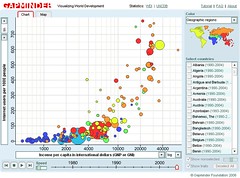
Imagine the possibilities of all this in, say, classroom presentations. Jim links to a great presentation using this tool. (Although I disagree with the presenter’s conclusion at the end about the leveling of differences regarding Internet diffusion.)
I recommend checking out the tool on your own for maximum appreciation of its capabilities.
UPDATE: There is more! Conrad – Jim’s source on this – tells me that the tool on the Trendalyzer site has even more option. Moreover, you can download a beta version of the software that even lets you import your own data.
by Chris Bertram on June 19, 2006
I want to flag an issue which I seem to have noticed in a variety of liberal egalitarian writings on global justice, namely the cut that philosophers and theorists often make between entitlement to land and natural resources on the one hand, and entitlement to socially created stuff on the other.[1] Liberal egalitarians usually reject any kind of libertarian finders-keepers principle with respect to the first category of goods. But in relation to the second, they often argue for the right of insiders to exclude outsiders from access to those goods that are the collective historical creation of the insiders’ political entity.[2] What follows is just a bit of thinking aloud: there are a lot of uncrossed ts and undotted is. I’d welcome both constructive comments and pointers to relevant papers.
This natural/social cut looks wrong and insufficiently motivated to me. With respect to natural resources and land, I guess the background thought might be that these resources come as manna from heaven, as it were, so that all of the worlds people and peoples have an original equal claim to them. We can then argue about the right way of progressing from that claim to operational property rights, but it is easy to see how arguments for (e.g.) something like a global resources dividend can go: those who actually use the resources need to compensate the others who share their original equal entitlement for that use.[3] The difficulty I see is this: that social resources also come as unequally distributed manna from heaven to each new generation. Those who inherit stable institutions, a culture conducive to economic growth etc., look to be just as arbitrarily lucky with respect to those resources as those (Norwegians for example) who are lucky with respect to the discovery of natural resources on their territory. So why not deal with the two kinds of resources in the same way: that is, initially posit an equal original right of all to ownership, and sanction transfers to those who have been comparatively unlucky in the initial distribution?
[click to continue…]
by Jon Mandle on May 17, 2006
At the end of last week, I attended the conference on “Equality and the New Global Order” at the Kennedy School of Government that I had mentioned here. The extremely impressive list of speakers lived up to the high expectations. I have written up some fairly extensive notes below. However, they are based on my recollections and notes, not any recordings or transcripts, so please don’t quote from these or rely on their accuracy – if you’re interested in pursuing these issues, many of the papers are available here.
[click to continue…]
by Jon Mandle on April 26, 2006
On May 11-13, the Kennedy School at Harvard will be hosting a conference on “Equality and the New Global Order.” The three days are organized around “Foundational Questions,” “Institutions,” and “Global Public Health.” The tentative schedule is very impressive. Versions of several of the papers are now available – I’m guessing more will be put up over the next two weeks. The talks are free and open to the public. I’m going to try to make some of the sessions, so please say hello.