by John Q on November 24, 2006
Australia now has its own version of the Downing Street memos, dating back to 28 February 2002. That’s when Trevor Flugge, Chairman of our (massively corrupt) grain trading monopoly AWB was told of the invasion of Iraq, and of Australia’s planned participation by our Ambassador to the UN*, John Dauth who even predicted that readmitting weapons inspectors would only produce a short delay.
This adds yet another layer of deception to what was already an amazing story of duplicity.
* The official line from our Department of Foreign Affairs and Trade is that Dauth was just making a lucky guess.
[click to continue…]
by Henry Farrell on November 20, 2006
There’s lots that I don’t agree with in Anatol Lieven’s reformulation of realism, but this quote from his LRB “review”:http://www.lrb.co.uk/v28/n22/liev01_.html of books on the Cold War (behind the subscriber wall) really has the number of the “more rubble less trouble mob”:https://crookedtimber.org/2006/11/06/compare-and-contrast-2/.
One important aspect of Westad’s book is the complex connection he makes between the US and Soviet modernising projects and racism. While both regimes insisted on their right to dictate values and solutions to the benighted peoples of the Third World, both also claimed that those peoples were capable of adopting them, doing so rapidly, and thereby joining the ‘socialist community’ or the ‘free world’. But because, in classic missionary style, both sides saw their truths as self-evident, their programmes as beneficial, and their own benevolence as beyond question, they often had no rational explanation to offer when their projects failed and their clients turned against them. In these cases, there was often an astonishingly rapid swing towards racist explanations. Currently, the neo-cons in America alternate between arguing that all Arab societies are capable of making rapid progress towards democracy (and that anyone who denies this is racist) and asserting that ‘Arabs understand only force.’
by John Q on November 3, 2006
The catastrophe in Iraq has passed the point where there’s much useful to be said about military options, such as immediate withdrawal, phased withdrawal, stickign with the current failed policies or introducing a draft and ramping up the numbers. They’re all bad, and no one can say for sure which will be worse (for the record, I think withdrawal is inevitable and better sooner than later). But having launched this disastrous war on the basis of false premises the US and its allies are morally obliged to make reparations. It’s even possible that paid on an appropriate scale, reparations might do something to improve the situation.
Over the fold is a piece I wrote for the Australian Financial Review.
[click to continue…]
by Henry Farrell on November 2, 2006
Just in case they were wondering. The riots in France weren’t “Muslim riots”:http://www.tnr.com/blog/spine?pid=53207 that are only likely to end “when the muezzin summons the faithful to prayer from Notre Dame.” Nor does anyone except Stanley Kurtz and the more or less deranged (but I repeat myself) believe that France is descending into a ‘civil war’ where ‘Islamic militias [will] tear [the] capital apart.’ To quote two sources that, like, actually know what they’re talking about.
“Mitchell Cohen”:http://www.dissentmagazine.org/article/?article=659 in _Dissent_.
Media often made it appear that everyone detained in last fall’s violence was North African, but recent studies complicate the picture. A study of the Yvelines suburb near Paris showed that 33 percent of those questioned by authorities were “European” in origin, 35.5 percent were North African, and 28.9 percent African.
Last week’s “Economist”:http://www.economist.com/surveys/displaystory.cfm?story_id=E1_RDQRPVN
When the riots started, they were treated in some quarters as a “suburban intifada”. “Jihad comes home”, ran one newspaper headline. Some American observers regarded the uprising as further proof of Europe’s inability to control the spread of radical Islam. … A report into the riots by the French Renseignements Généraux, the domestic intelligence-gathering service, however, found the opposite. Islamists had “no role in setting off the violence or in fanning it,” it concluded. Clichy’s mayor agrees. “I completely reject the idea that the riots were an Islamist plot,” he says. “During the rioting I never heard of a young man burning a car in the name of Allah; but I heard of plenty of Muslims saying, ‘go home in the name of Allah’.” Instead, the intelligence officers reckoned, the rioting was a “popular revolt” provoked by a toxic concentration of social problems: joblessness, poverty, illegal immigration, organised crime, family breakdown and a lack of parental authority. France had been so preoccupied with watching Islamic radicals, said the report, that it had neglected the wider problems in its banlieues.
by John Q on October 31, 2006
I’ll leave it to others more expert on the history of European Marxism to discuss the main arguments in Sheri Berman’s book. I’ll focus on a couple of peripheral points. [click to continue…]
by Eszter Hargittai on October 23, 2006
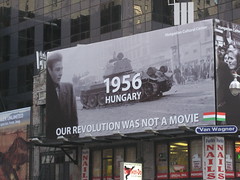 Fifty years ago today events occured in Budapest that quickly led to the death of many and the emigration of about 200,000 Hungarians to various corners of the world. (Considering a country of 10 million, that’s a significant number.)
Having grown up in a system that didn’t recognize this day as worthy of mention (given that its whole point was to topple the Soviet-influenced regime) I have never had much of a connection to it. And having left Hungary soon after the political changes of the early 90s after which the date became officially important and a holiday, I have never developed much of a bond with it. In fact, I’m more likely to recognize November 7th as a special date (the one Hungarians and others in the region used to celebrate) than October 23rd. All that is a testament to how strongly social context can influence one’s perception of important historical events and dates.
The image above is from the Times Square area in New York City. I was walking down Broadway on Saturday and noticed the red-white-and-green lines. I figured it was a mistaken use of the Italian flag. When portrayed horizontally, the Italian flag has to be green-white-and-red in order not to be confused with the Hungarian flag. But people unfamiliar with the Hungarian flag (which would be most of the world) don’t know this and so I sometimes see the Italian flag portrayed that way. However, as I neared 50th St. I realized that this was meant to be a Hungarian flag. The Hungarian Cultural Center put up two huge billboards on the corner of Broadway and 50th to commemorate the occasion and to invite folks to “REimagine freedom“.
And yes, there has been unrest in Budapest during the past few weeks including some events today. Some people are trying to draw parallels to the events of 1956, but that seems ludicrous. Just because some people – mostly on the far right so you are not going to see sympathies from me – who are especially good at inciting a few hundred folks do not like the current regime doesn’t mean the president prime minister [d’oh, of course] needs to be ousted. (I commented on all this a few weeks ago.)
by John Q on October 15, 2006
Not surprisingly, the publication by the Lancet of new estimates suggesting that over 600 000 people have died (mostly violently) in Iraq, relative to what would have been expected based on death rates in the year before the war, has provoked violent controversy. A lot of the questions raised about the earlier survey, estimating 100 000 excess deaths in the first year or so appear to have been resolved. In particular, the lower bound estimate is now around 400 000, so that unless the survey is rejected completely, there can be no doubt about catastrophic casualties.
One number that is striking, but hasn’t attracted a lot of attention is the estimated death rate from air strikes, 13 per cent of the total or between 50 000 and 100 000 people. Around half the estimated deaths in the last year of the survey, from June 2005 to June 2006. That’s at least 25 000 deaths, or more than 70 per day.
Yet reports of such deaths are very rare. If you relied on media reports you could easily conclude that total deaths from air strikes would only be a few thousand for the entire war. The difference between the numbers of deaths implied by the Lancet study and the reports that shape the “gut perceptions” that the Lancet must have got it wrong are nowhere greater than here. So are the numbers plausible?
[click to continue…]
by John Q on September 23, 2006
French newspaper L’Est Republicain has published a report, citing sources in the French security services who claim that Osama bin Laden is dead of typhoid, having been unable to obtain treatment by virtue of his isolation.
« Selon une source habituellement fiable, les services saoudiens auraient désormais acquis la conviction qu’Oussama Ben Laden est mort. Les éléments recueillis par les saoudiens indiquent que le chef d’Al-Qaïda aurait été victime, alors qu’il se trouvait au Pakistan le 23 août 2006, d’une très forte crise de typhoïde ayant entraîné une paralysie partielle de ses membres inférieurs. Son isolement géographique, provoqué par une fuite permanente, aurait rendu impossible toute assistance médicale. Le 4 septembre 2006, les services saoudiens de sécurité ont recueilli les premiers renseignements faisant état de son décès. Ils attendraient, d’obtenir davantage de détails, et notamment le lieu exact de son inhumation, pour annoncer officiellement la nouvelle ».
Via ABC News (Australia)
by John Q on September 22, 2006
This Nature editorial reports the alarming news that six international health workers face execution in Libya on bogus charges of spreading HIV. As the editorial points out, despite the absence of any real improvement in its human rights record, Libya is being treated as a Beacon of Light by both the US and EU because it has backed off its previous support for terrorism and WMDs. It should be made clear to the Gaddafi regime that murdering health workers is on a par with terrorism as a crime against the international community.
More from ScienceBlogs
by Eszter Hargittai on September 20, 2006
People have been asking me to comment on the recent riots in Budapest so I thought I would say a few words. First, a necessary caveat. I don’t follow Hungarian politics closely.* In fact, I don’t follow Hungarian politics much at all. I could probably write a whole separate post as to why not, suffice it to say that I don’t live in that country for a reason (or two or three) and years ago I decided that it was simply not good for my blood pressure to keep track of events. So I don’t. That said, when something especially noteworthy happens, I am curious to know what it is and will go to Hungarian sources instead of relying on various international reports. I’ve read up on recent events a little bit so here is a quick summary.
Politicians lie. Yawn. The twist here is that apparently many Hungarians naively assumed that they don’t. Worse yet, Prime Minister Ferenc Gyurcsány was caught on tape saying that his party lied a lot before the elections last Spring. To clarify, the instigator of the riots was not some public speech the Prime Minister made in the last few days. Rather, someone taped and recently leaked a discussion [link to Hungarian text] he had with a a few top people about 180 of his party representatives back in the Spring.
The level of honesty in his comments is naive, refreshing and scary all at the same time. Imagine if you could give some magic potion to a president or prime minister of your choice that would lead the person to talk about his/her actions and policies from the last few years completely openly and eagerly. It could result in some frightening and fascinating speeches. And who knows where that would lead.
Hungary’s got a lot of problems. The main point of Gyurcsány’s speech was that it was time to fix at least some of them. Yes, the irony is that the point of the speech was to say that it was time to stop the lies and make some difficult, but important changes.
[click to continue…]
by Chris Bertram on September 15, 2006
Over at Comment is Free, our very own Daniel “has joined”:http://commentisfree.guardian.co.uk/group_post/2006/09/post_389.html with other writers on that site to urge support for the Global Day for Darfur.
by Chris Bertram on September 14, 2006
Regular readers will know of the Euston Manifesto, a British-based initiative by various self-described leftists some of whom were big supporters of the Iraq war and all of whom share an obsession with the idea that “Enlightenment values” are under threat from a nefarious coalition of Islamists, postmodernists and Chomskyites. Now they have “a US chapter”:http://www.telospress.com/main/index.php?main_page=page&id=44&chapter=0 , launched by people around the journal Telos. The list of initial signatories and supporters is interesting, but contains figures not usually thought of as having much to do with the left as traditionally construed. They include Daniel Jonah Goldhagen, Walter Laqueur, Martin Peretz and Ronald Radosh. Laqueur has become the victim of a Mark Steyn-like obsession with demography and recently gave a positive review of Michael Gove’s execrable Celsius 7/7 in the the TLS, Peretz – a member of the pro-war “Democratic Leadership Council” – has just joined the advisory board of Lewis Libby’s defense fund, and Radosh is a regular writer for David Horowitz’s FrontPageMag.
update: a link to Tony Judt’s essay “The Strange Death of Liberal America”:http://www.lrb.co.uk/v28/n18/judt01_.html from the latest LRB seems right (via “Marc Mulholland”:http://moiders.blogspot.com/ ).
by John Q on August 21, 2006
Daniel Byman and Kenneth Pollack start a lengthy Washington Post piece by observing
The debate is over: By any definition, Iraq is in a state of civil war.
and their assessment only gets gloomier from there on in, pointing to the disaster as a source of further regional conflict, a recruiting poster and training ground for terrorists, massive flows of refugees and so on. They have essentially nothing positive to suggest except for the observation (for which General Shinseki got fired before the war) that
Considering Iraq’s … population, it probably would require 450,000 troops to quash an all-out civil war there. Such an effort would require a commitment of enormous military and economic resources, far in excess of what the United States has already put forth.
Since the commitment of 450 000 troops is even less likely now than it was in 2003, the conclusion is, in effect, that the situation is hopeless.
We’re well past the point where admissions of error will do any good. Still, I’m stunned that Pollack could write
How Iraq got to this point is now an issue for historians (and perhaps for voters in 2008); what matters today is how to move forward
This was so brazen that I thought I must have got him confused with someone else. But no, it’s the same Kenneth Pollack who wrote The Threatening Storm: The Case for Invading Iraq.
by Henry Farrell on August 19, 2006
Flynt Leverett has an “article”:http://www.prospect.org/web/page.ww?section=root&name=ViewPrint&articleId=11859 in _The American Prospect_ this month arguing that Democrats should embrace Kissinger-style realism if they want to redirect US foreign policy.
bq. Henry Kissinger established a paradigm for U.S. grand strategy in the Middle East. In this paradigm, American policy should seek always to empower moderates and marginalize radicals. The best way to do this was through careful management of the region’s balance of power, primarily through diplomatic means. The essence of such diplomacy is “carrots-and-sticks” engagement — credibly threatening negative consequences for regional actors who work against U.S. goals, but also promising strategically significant benefits in exchange for cooperation. … Regarding democratization, the administration’s three examples of U.S.-engineered democratic empowerment in the region — Afghanistan, Iraq, and Lebanon — are all basket cases. …There is no evidence that democracy reduces the incidence of terrorism, and ample evidence from places like Egypt and Saudi Arabia that holding more open elections in most Arab societies would produce governments that are more anti-American and less reformist than incumbent “authoritarians.” … Democrats have fallen into a “soft neconservatism” that has dulled the party’s voice on foreign policy. Henry Kissinger once observed that the United States is the only country in which the term “realist” is used as a pejorative. The more progressive elements of the Democratic coalition have been especially strident in voicing their antipathy to Kissingerian realism. … It is time for Democrats to understand that, when it comes to curbing the threats posed by problematic states like Iran, encouraging reform in strategically important states like Egypt and Saudi Arabia, or ensuring Israel’s long-term future, realism has become the truly progressive position on foreign policy.
While I agree with some of Leverett’s specific recommendations about engagement with Iran etc, his underlying argument is profoundly misguided. Kissinger-style realism was and is a long term disaster – a willingness (sometimes, as with Kissinger himself, a quite grotesque eagerness), to kow-tow to brutal dictatorships when it was perceived as being in America’s short term interests. Leverett claims that realism “ laid the foundations for eventual peaceful victory in the Cold War.” This is a highly dubious claim – if, for example, Kissinger had gotten his way in sidelining the human rights part of the Helsinki process (see further John Maresca’s _To Helsinki_ on this), things would have gone very differently (and in all probability, much worse) in Central and Eastern Europe when Soviet hegemony began to crumble.
The one thing that the neo-cons were right about was that America’s foreign policy in the Middle East (seeking to shore up crumbling and corrupt autocracies) was unsustainable in the long term. Their proposed solution to this problem – the imposition of democracy through force – has turned out, predictably, to be a complete disaster. But Leverett’s preferred alternative of maintaining the status quo would have only been very slightly better; a slow motion train wreck rather than a quick one.
by John Q on August 18, 2006
The discussion of this post brought up a question I’ve been worrying about for quite a while. Given the catastrophe in Iraq (and the deteriorating situation in Afghanistan) should those of us who supported intervention in Kosovo revise our position?
While I still think the likelihood of another round of genocidal ethnic cleansing justified action in Kosovo (and makes a bigger effort in Darfur morally obligatory at present), I think some aspects of the Kosovo action were mistakes that sowed the seeds of future disaster.
My view at the time was that the failure to get UNSC approval wasn’t that important, since there was a clear consensus in favour of intervention and the only problem was that the Russians didn’t want to be forced to state a public position.
Now I think that was wrong and the effort should have been made to secure a UNSC resolution, making whatever concessions were needed to get Russia not to veto it. The problem wasn’t so much the breach of legality in this case, as the precedent it set, which was expanded beyond all recognition by Bush and Blair in Iraq.
I also think (and thought at the time) that the bombing of Belgrade crossed the line from striking military targets to terrorisation, most obviously with the bombing of the TV station. This precedent was used recently in Lebanon. I plan more on this general issue soon.