When I was 13 a new boy called Matthew Arnold arrived at my secondary school. It wasn’t the beginning of the year, just some random autumn day — not even a Monday. 15 minutes before the bell went for school Ms. Bolton brought him to me through the drizzle, told me his name, and told me to look after him and introduce him to people. He wasn’t in my class, and Ms. Bolton had never taught me, so God knows why she asked me to do it — I was not the friendliest, or the most socially adept, kid, by a long shot. He was taller than me, gangly, with big NHS specs, and more socially awkward. Being the new kid could be a cruel experience, as I later discovered myself.
A colleague recently sent me a paper on the economics of open borders, by John Kennan, which I hadn’t known of before, though it came out in 2013.
Kennan’s conclusion is striking
Liberal immigration policies are politically unpopular. To a large extent, this is because the beneficiaries of these policies are not allowed to vote. It is also true, however, that the enormous benefits associated with open borders have not received much attention in the economics literature.20 Economists are generally enthusiastic about free trade. But if free movement of goods is important, then surely free movement of people is even more important.
One conclusion of this paper is that open borders could yield huge welfare gains: more than $10,000 a year for a randomly selected worker from a less-developed country (including non-migrants). Another is that these gains are associated with a relatively small reduction in the real wage in developed countries, and even this effect disappears as the capital–labor ratio adjusts over time; indeed if immigration restrictions are relaxed gradually, allowing time for investment in physical capital to keep pace, there is no implied reduction in real wages.
So, is Kennan right about the benefits of open borders? And if so, is there a way of transferring some of those benefits to already-resident wage earners who would otherwise lose, or at least not gain, from expanded migration?
[click to continue…]
{ 56 comments }
My campus — like, no doubt, a good number of others — has been afflicted over the past 18 months or so by what seems like a rise in the number of racist incidents. We made the headlines recently, when someone attended a football game with an Obama mask on and a noose around his neck. (Oddly enough, the football stadium did not have a standing rule against people attending with nooses round their necks – and I am not sure how you can reasonably introduce such a rule frankly when you are about to introduce a rule that people can attend carrying guns). But there have been other, to my mind nastier (because anonymous) incidents. Nazi and other white-supremacist symbols scrawled here and there; “Heil Hitler” salutes in the face of two girls leaving sorority known (by those in the know which, bizarrely, includes me) to have a preponderance of Jewish members; racist graffiti in the bathrooms, etc. I say it ‘seems’ like a rise, because we don’t know how well reported incidents were before we introduced a specific mechanism for distinguishing racist and other ‘hate and bias’ incidents from general bad behaviour a couple of years ago. If there has really been a growth in incidents, that would be easy to explain. But one point of the post is to ask what the evidence suggests about whether there actually has been an increase on other campuses.
The other is to tell a little story about one of the lesser-known incidents. I tell the story because it is mildly amusing, but also because it hints at a different response to such incidents than that which has been publicized so much by the anti-coddling brigades. (I should say that students on my campus do not seem to demand coddling, though you might think that my response in the vignette below was a coddling response).
{ 52 comments }
An open thread for commenters to recommend their favourite books of 2016.
I’ll start with Lynsey Hanley’s *Respectable* (Allen Lane).
Trying to understand my country in the light of the EU referendum vote, I picked up a copy of Lynsey Hanley’s *Respectable: The Experience of Class*. I’m glad I did. Hanley is now an academic at Liverpool John Moores and lives a life shaped by the culture and expectations of Britain’s middle class, nourished, as she explains, by a diet based on mackerel and pulses. But this isn’t where she started. Life began on a vast working-class estate on the edge of Birmingham, Chelmsley Wood, a place to where many families had been decanted as part of the post-war social democratic experiment, and where they’d stayed. The book is about social class and social mobility, about getting from there to here, and about the “walls in the head” that make the transition a matter of profound anxiety and which stop many people from leaving at all. It is also about divisions within the working class, between those who cope with their subordinate status by keeping up appearances, and those who don’t, between those who read the Mirror and those who read the Sun. As Hanley puts it in the introduction: “Changing class is like emigrating from one side of the world to the other, where you have to rescind your old passport, learn a new language and make gargantuan efforts if your are not to lose touch completely with the people and habits of your old life.”
{ 55 comments }
Here’s another excerpt from my book-in-progress, Economics in Two Lessons. Rather than work sequentially, I’m jumping between:
Lesson 1: Market prices reflect and determine opportunity costs faced by consumers and producers.
and
Lesson 2: Market prices don’t reflect all the opportunity costs we face as a society.
In the section over the fold, I’m looking at monopoly and regulation. Next up, public ownership.
As usual, praise is welcome, useful criticism even more so. You can find a draft of the opening sections here.
{ 32 comments }
Well, the big news is that the new Tana French (The Trespasser

Now to the East Coast; a study in contrasts. First we have Elly Griffiths’ Ruth Galloway novels. The heroine is an archeologist at what seems like a rather shambolic new University on the Norfolk coast; her cases all involve old bones of some sort, but the murders are, mostly, reasonably recent. The world is about as cozy as you’ll find in new crime fiction; people basically like each other though you may not like the central cop, a self-absorbed Lancastrian who is partly redeemed for the reader by the mysterious liking that an oddly named Druid who works in a technical capacity at the University (yep) has for him. The plots are satisfying, the writing fluent, the characters predictable but (with the exception of the cop) broadly likeable. They’ll each take you a few hours to read — frivolous fun, like a Cosmo. Warning (which MIGHT be a minor spoiler): as with Sophie Hannah, but more so, the first book will make you anxious that the supernatural is going to play some sort of explanatory role — its ok, it doesn’t. Start with The Crossing Places 
David Mark’s Detective Sergeant Aector McAvoy books do not resemble a cosmo at all. Set in Hull, they are as dark as you imagine the worst winter day being there — in fact, I only know Hull through these novels, and I don’t think that I have once imagined sunshine there. It’s noir, without relief. The villains are evil and ruthless and some of the cops no better. McAvoy starts the series as an officer suffering the consequences of whistle-blowing on some sort of corruption in the force. He’s lucky to be under the protection of a capable senior officer, Trish Pharaoh, and also to have a spouse who is (I think implausibly) adoring and understanding. But the plots are satisfying, and after the first novel, The Dark Winter
IS there a series set in Lowestoft? Or Southwold?
{ 9 comments }
“Holding with Haeckel that all life is a chemical and physical process, and that the so-called “soul” is a myth …”
– H.P. Lovecraft, “Herbert West – Reanimator”
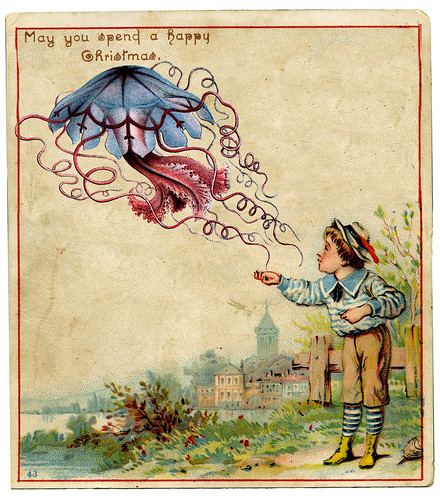
Years ago I made a parody Christmas book mash-up of Lovecraft/Haeckel/Clement Clark Moore. I called it Mama In Her Kerchief and I In My Madness: A Visitation of Sog-Nug-Hotep. I made print versions but then took them down (they weren’t quite it.) Yet it lived, lurking beneath the surface, in the form of a perennially popular pair of Flickr albums and this old Hilo post. Hidden, winter sun-dappled tide pools of hideous, unfathomable, happy depths for kiddies to dip their toes in! But 2016 is the year of fake news. You can’t spell ‘fake’ without the ‘Haeckel’. So my fraudulent yet innocent concoctions have wandered and, eventually, been mistook for genuine Victoriana. Oh, well. I can’t completely blame them. Real Victorian X-Mas cards are often dark and weird. Hence the joke.
Caliginous gloom is the best disinfectant. If, as some whisper, ‘even death may die’, then perhaps it is possible to quash a rumor that Haeckel actually designed X-Mas cards. Accordingly, I have seized the seasonal opportunity to republish and set the record straight. A new, improved version of the print edition is now on Amazon! It is also available on Kindle. Somehow Amazon not seen the connection yet, but I imagine that will resolve itself. (Also, I made slightly different covers for the two editions. Which do you prefer?)
For impoverished urchins, with nary a penny to spare, yet high-speed internet access, I have updated the Flickr galleries with some higher quality images. The old ones were skimpy. My most popular images, Blue Boy and Feeding Birdies, are available in larger sizes. Some others, including several of my favorites. (Maybe I’ll get around to doing all of them. But not today.)
{ 5 comments }
The world is watching the denouement in Aleppo, with stories emerging of massacres, particularly of young men (and probably by young men). A [story I read from Patrick Cockburn in the Independent](http://www.independent.co.uk/voices/aleppo-fall-latest-syria-civil-war-bombardment-bashar-al-assad-rebels-advance-a7470716.html) reported that such is the shortage of manpower for the Syrian army that other young men, emerging from eastern Aleppo, are being immediately conscripted into the Syrian army. A Syrian refugee I heard speaking the other day said there was no choice but to leave because you would either be killed, or you would be forcibly enlisted and forced to kill others. And many of the young Eritreans who find their way to Europe are also fleeing conscription (they face indefinite military service). This is hardly a new thing. The last major exodus of Americans fleeing the jurisdiction of their state was of young men who were evading the Vietnam draft.
James C. Scott, in his wonderful [*The Art of Not Being Governed*](http://yalebooks.com/book/9780300169171/art-not-being-governed) writes of state conscription as one of the main reasons why the subjects of states flee to the hills, to a zone outside of state control. There are few such zones today, and those that there are may be governed by forces even less appealing that the states that conscripts are fleeing from.
This all got me thinking about some of the media narrative on refugees over the past few years. The preponderance of young men has been treated by those who want to keep refugees out as a reason for suspicion. The “genuine” refugees for the newspaper columnists are mothers and children. It is the toddler drowned on the beach, like Aylan Kurdi, who elicits public sympathy. But young men are often the ones with most reason to flee. It is they who face the starkest choice between killing and being killed. No wonder they predominate.
{ 43 comments }
I’m a pretty enthusiastic fan of Simon Brett’s Charles Paris mysteries — they are light, charming, and funny, rather like Simon Brett, if a little bloody and boozy (which, for all I know, Simon Brett is too) Decent Interval
The Charles Paris Mysteries on the radio, however, are simply exquisite. Bill Nighy is, as you’d expect, brilliant as the down-at-heel irresponsible, formerly philandering, lush. Jon Glover is hilarious as his neglectful agent, and Suzanne Burden makes his long-suffering estranged wife with whom he often lives as believable as anyone could. The scripts are terse, witty, and filled with in-jokes (I love his ring tones for his wife and Maurice, his agent). And, as in the books, nobody seems to have noticed the a very large fraction of all the murders in the UK seem to have happened with Paris in the next room. Radio 4’s Christmas present to us all is The Cinderella Killer. I haven’t listened to it yet, because they only just broadcast episode 2, and my preference is to wait for them all, and then binge (its only two hours — I’ll listen while shoveling snow some day). But I guarantee it will be perfect.
Oh, and incidentally, what is going on with Brian Protheroe? He seems to be in everything on the radio these days. When’s the next album coming out? Has anyone other than me heard of him?
{ 3 comments }
The first time I was arrested, I had to cancel a meeting with one of my professors The police officers who arrested me had given me a beating between the arrest and the processing (in the van — this was 1985 during the Miner’s Strike, and police officers felt a fairly general permission to be fairly randomly violent to arrestees; they put the boot in while openly concocting the false stories they were going to tell about us). I was let out of Bow Street Station at 3 am, so that I could not get back to Herne Hill. In the morning I walked from the house of the friend I had woken at 4 to give me somewhere to sleep to campus, and informed my professor that I wasn’t going to be in a great condition to meet, and asked if we could postpone. He immediately asked what he could do to help, and asked whether he could testify at my trial (which he duly did, story here; great hilarity ensued). Some might call that coddling I guess, but it meant and still does mean a huge amount to me, and I always do the same (even if the charge is not related to politics and, to be clear, although I probably have some limit, I would support students who were arrested in causes I disagree with; something not at all unlikely to come up because by and large students don’t know my politics).
Knowing about this, a colleague (different college, different state) called yesterday to ask my advice. One of her students, an 18 year old African American woman, was arrested at an anti-Trump demonstration. This is in LA (I’ve also been beaten up by cops and arrested there! Thrill a minute, my life. Story here). Much of the charge sheet is illegible but it is a misdemeanor, and what I can make out is “Willfully and maliciously obstructing free movement or [illegible] for others public [illegible]’. The hearing is next week, and apparently neither the protest organizers nor the college have provided legal support. I’m trying to find my one lawyer acquaintance in LA with relevant experience (of the two lawyers who have worked for me, one is a judge, and the other is a labor lawyer and too fancy and famous for me to feel comfortable approaching him). In the meantime though — my colleague plans to attend the hearing with the student, and to record it and take notes. My advice is to ensure that 2 or 3 other students come along for support (it is enormously more tolerable to go through these experiences with support from friends than alone). But — should the student have a lawyer present? And if so, any suggestions of where to find one? (Again, its LA).
{ 44 comments }

{ 17 comments }
Dear unhappy voters of 2016:
We keep hearing you called populists and, to put it in your vernacular, you had one job and you’re doing it wrong.
{ 23 comments }