Breaking news: world leaders gathering in Baga, Nigeria

by Ingrid Robeyns on January 13, 2015

In Paris, France, about 20 people were killed in hyper-violent attacks, by gunmen claiming to fight for what they see as the values embedded in Islam.

In Baga, Nigeria, about 2.000 people were killed in hyper-violent attacks, by gunmen claiming to fight for what they see as the values embedded in Islam.

In Paris, world political leaders gathered to demonstrate in defense of freedom and against terrorism. They mourned the loss of 20 white Europeans. The events led to intense media exposure and public debates worldwide.

In Baga, world political leaders will soon gather to demonstrate in defense of freedom and against terrorism. They will mourn the loss of 20,000 Black Africans. It is expected that these events will lead to intense media exposure and public debates worldwide.

{ 99 comments }

Happy new year, all. This episode of my ongoing travelogue finds me and the family slowing the pace down significantly and spending six weeks in Bali. Due to an excess of comfort and indulgence, it’s being posted roughly a month late – I am now in New Zealand. Thanks as always for everyone’s kind comments on this series.

[click to continue…]

{ 40 comments }

The Internationalism of the American Civil War

by Corey Robin on January 11, 2015

One of the topics I’ve long been interested in is the traffic between the European right and the slaveholding South in the US. We know a fair amount, now, about the relationship between the abolitionist movement in the US and the European left, including Marx, but less about the impact that slavery and its defense had on the European right.

What first piqued my interest in this issue was reading Nietzsche. Nietzsche talks a lot about slavery in his work, and it’s long been the conventional wisdom that his references here are metaphorical and philosophical rather than contemporary and literal. I’ve had my doubts about that, as I’ve written.

One can hear in the opening passages of “The Greek State” the pounding march not only of European workers on the move but also of black slaves in revolt. Hegel was brooding on Haiti while he worked out the master-slave dialectic in The Phenomenology of Spirit. Though generations of scholars have told us otherwise, perhaps Nietzsche had a similar engagement in mind when he wrote, “Even if it were true that the Greeks were ruined because they kept slaves, the opposite is even more certain, that we will be destroyed because we fail to keep slaves.” What theorist, after all, has ever pressed so urgently—not just in this essay but in later works as well—the claim that “slavery belongs to the essence of a culture”? What theorist ever had to? Before the eighteenth century, bonded labor was an accepted fact. Now it was the subject of a roiling debate, provoking revolutions and emancipations throughout the world. Serfdom had been eliminated in Russia only a decade before—and in some German states, only a generation before Nietzsche’s birth in 1844—while Brazil would soon become the last state in the Americas to abolish slavery. An edifice of the ages had been brought down by a mere century’s vibrations; is it so implausible that Nietzsche, attuned to the vectors and velocity of decay as he was, would pause to record the earthquake and insist on taking the full measure of its effects?

There’s also Nietzsche’s tantalizing reference in his notebooks to Harriet Beecher Stowe as the inheritor, along with Rousseau and the French Revolution, of Christianity:

The French Revolution as the continuation of Christianity. Rousseau is the seducer: he again unfetters woman who is henceforth represented in an even more interesting manner—as suffering. Then the slaves and Mrs. Beecher-Stowe. Then the poor and the workers.

According to my friend Harrison Fluss, Domenico Losurdo’s long anticipated biography of Nietzsche, which came out in Italian years ago and is about to appear, finally, in English, discusses this and related passages (which don’t get much treatment in the literature), suggesting that Nietzsche may have been more aware of the question of slavery on this side of the Atlantic than we think.

In any event, I got a book in the mail a few weeks ago that begins to deal with the larger issue of the slaveholding South and the European right: Don Doyle’s The Cause of All Nations: An International History of the American Civil War. It’s about a much larger topic, as the title suggests, and I haven’t really dived into it yet, but I’ve read one chapter and the intro and have already learned some fascinating things. [click to continue…]

{ 139 comments }

Sunday photoblogging: Birdcage Walk

by Chris Bertram on January 11, 2015

{ 8 comments }

Some social science links of interest

by Eszter Hargittai on January 10, 2015

  • Nature has an editorial about why investment in the social sciences must accompany investments in the sciences.

    If you want science to deliver for society, through commerce, government or philanthropy, you need to support a capacity to understand that society that is as deep as your capacity to understand the science. And your policy statements need to show that you believe in that necessity.

    To many readers of CT, this is unlikely to be a particularly surprising statement, but one need only glimpse at the comments that follow to appreciate how controversial the idea seems to some.

  • The New Yorker has a long piece about the sociologist Howard Becker and his work about what it means to be a “deviant.” Certainly if you’re a sociologist, it is unlikely that you would not have encountered his work at one time or another during your training at minimum thanks to his helpful tips on how to write as a social scientist.
  • The Pew Research Center has an interesting new position of “Director to lead the creation of the Pew Research Center Labs.”
  • The new open-access journal Social Media + Society is now ready for submissions (submission fees waved for now).

{ 21 comments }

Happy New Year, Crooked Timber!

by John Holbo on January 9, 2015

Oh, and Merry Christmas! (Been a hectic holiday season for the Holbo/Waring clan. Good and bad. Leave it at that. So I went off the grid.)

Here’s a bit of Crooked Timber, captured in Takoma Park, MD.

crookedtimber [click to continue…]

{ 30 comments }

Charlie Hebdo

by Chris Bertram on January 7, 2015

We don’t have all the facts about the attack on Charlie Hebdo, but it seems very likely that it was carried out by extreme Islamists as revenge for the magazine’s satirizing of Islam. I’m sure there will be a lot of comment over the next few days about the symbolic and principled aspects, the need to stand up for freedom of speech, and so on. I don’t dissent from that, but I’m finding it hard to see past the immediate horror of ten, eleven or more human beings, journalists, gunned down like that in a West European capital city. Awful.

The attack comes just after the Islamophobic marches in Germany by Pegida and the many reports of desperate refugees fleeing Syria in unseaworthy hulks. No doubt the Islamophobic parties, the Front National, UKIP and the rest will try to take advantage and ordinary Muslims will feel more isolated and threatened. We need to remember that most of the victims of extremists of this type have been everyday people who happen to be Muslims, we owe those victims our solidarity and to resist the voices who will try to shut them out. We can do that by affirming that citizenship and inclusion are for everyone, regardless of religion, and that we will help those fleeing from persecution by IS and the like.

{ 873 comments }

Social democrats in the twin-peaked world

by Henry Farrell on January 6, 2015

Paul Krugman wrote last week about the rise of a ‘twin peaked’ world in which the global poor are doing much better, as are the extremely rich, while the working class are doing badly in comparative terms. He asks:

Who who speaks for those left behind in this twin-peaked world? You might have expected conventional parties of the left to take a populist stance on behalf of their domestic working classes. But mostly what you get instead — from leaders ranging from François Hollande of France to Ed Milliband of Britain to, yes, President Obama — is awkward mumbling. (Mr. Obama has, in fact, done a lot to help working Americans, but he’s remarkably bad at making his own case.)

The problem with these conventional leaders, I’d argue, is that they’re afraid to challenge elite priorities, in particular the obsession with budget deficits, for fear of being considered irresponsible. And that leaves the field open for unconventional leaders — some of them seriously scary — who are willing to address the anger and despair of ordinary citizens.

There’s plausibly a structural story behind the inability of conventional leftwing parties to challenge conventional orthodoxies and respond to the needs of their traditional constituency. They haven’t really relied on this constituency for a long time. Peter Mair’s Ruling the Void hasn’t gotten nearly the attention that it deserves, perhaps because it came out after its author’s death. But Mair – an expert on the evolution of political parties and party systems – makes a strong case that leftwing parties in Europe today have become profoundly disassociated from their voters. This is in part because of ordinary people withdrawing from political parties – the membership of mass parties has collapsed over the last few decades. However, it is also because the elites of parties don’t rely on mass membership to provide resources – instead they rely on resources from the state and networks where they are firmly embedded with other elites. The result is that European political parties rather than representing their constituents to the state, tend to represent the state and its imperatives to their constituents.

This helps explain the extraordinary haplessness of mainstream leftwing parties faced with the politics of austerity. It’s reinforced by the politics of the European Union, which was purpose designed as a non-democratic space (into which, however, bits of democracy have crept over time).

bq. Despite the seeming availability of channels of access, the scope for meaningful input and hence for effective electoral accountability is exceptionally limited. It is in this sense that Europe appears to have been constructed as a protected sphere, safe from the demands of voters and their representatives.

National policies are constrained by EU institutions such as the European Central Bank and other institutions, which are designed to be non-majoritarian ones “from which parties and politics are deliberately excluded.” The result is that:

bq. insofar as competing policies or programmes are concerned, the value of elections is steadily diminishing. Thanks to the European Union, although crucially not only for that reason, political competition has become increasingly depoliticized.

European voters, mainstream European parties and European leaders have increasingly learned how to live without effective participatory democracy. And now it’s biting the social democratic left. The withering of links between leftwing parties and their electoral base, combined with the movement of real decision making to the European level, leaves these parties in the cold. They neither know how to connect to voters any more, nor have any real program for change on those occasions (thanks to exhaustion with their opponents) they actually win office. It’s little wonder that so many of their voters are defecting.


{ 256 comments }

31 days of garlic

by Eszter Hargittai on January 4, 2015

Garlic cloves cut up ready to be pressed

I like garlic and I’m also convinced that it has health benefits. I’d like to make fresh garlic a regular part of my diet. I realized that I’m not traveling at all in January so I will have more say in what I eat than is often the case when I travel. Thus my 31 Days of Garlic challenge was born. I’m fine with repeating approaches, but I’d also like to spice things up a bit (sorry). Will you help me? Do you have some favorite dishes that include fresh garlic or that could include fresh garlic? I’m especially interested in relatively quick and easy recipes (lots of work things coming up in the next few weeks) and ones that don’t involve an oven (as mine needs repair). But I’ll have some downtime as well so don’t hesitate to share trickier ideas.

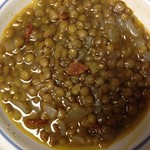
Lentil soup with garlic On the 1st of the year, as is the Hungarian tradition (shared by other cultures), I made lentil soup for good luck. I don’t usually include garlic, but I did press a clove into it and it worked well. The pictured soup is missing a usual ingredient, carrots. I didn’t have any at home, but sauteing some onions, adding various spices, adding the clove of garlic and some sausage resulted in a very yummy dish.

Tea ingredients with garlic On the 2nd, I added a pressed garlic clove to my tea. It’s a palatable way to have it, certainly the quickest way I know to include it in my diet. A teaspoon of honey is also an important component of that mixture. The particular tea I have on the image is especially good for soothing the throat (or so I was told by someone who works in theater and I’ve found the recommendation helpful).

Omelette with garlic On the 3rd, I added it to scrambled eggs. The eggs also included onions, fresh mushrooms, rosemary ham and shredded Parmesan. I had it with grape tomatoes, farmer’s cheese and this delicious cornbread. (I highly recommend that cornbread recipe, but I do suggest cutting all ingredients in half as it results in more cornbread than you’ll know what to do with unless you’re serving at least a dozen people.)

What should be next for my 31 Days of Garlic challenge?

I’ll be posting pictures of the dishes/drinks on my Instagram.

{ 112 comments }

Sunday photoblogging: 19th arrondissement

by Chris Bertram on January 4, 2015

{ 20 comments }

Best political philosophy/theory papers, a decade later

by Chris Bertram on January 3, 2015

Back in 2004 I wrote [a piece here](https://crookedtimber.org/2004/05/17/best-political-philosophytheory-papers/ ) asking for people to nominate the most significant political philosophy/theory papers of the previous ten years. On twitter, @sreddi_515 asks me whether there was ever a second round. Well no, but why not?

Last time I nominated five suggestions to kick us off, so why not again? Some of these papers I profoundly disagree with, but I think they are all worth the effort.

* Charles Mills (2005). “‘Ideal Theory’ as Ideology”. *Hypatia*, 20(3).
* Andrea Sangiovanni (2007). “Global Justice, Reciprocity, and the State. *Philosophy and Public Affairs*, 35(1).
* Arash Abizadeh (2008). “Democratic Theory and Border Coercion”. *Political Theory*, 36(1),
* Zofia Stemplowska, (2008). “What’s ideal about ideal theory?” *Social Theory and Practice*, 34(3).
* David Estlund, (2011). “Human nature and the limits (If any) of political philosophy”. *Philosophy and Public Affairs*, 39(3).

Over to you….

{ 41 comments }

Untimorous Beastie

by Maria on January 3, 2015

People are always asking me where my hugely fluffy and dolphin-smiling Samoyed dog, Milo, is from. ‘Northamptonshire’ always gets a laugh. He’s been a great little traveler from the first, which is probably pure luck, but I put it partly down to his general ebullience. Last April, Ed and I drove a few hours north of London to get the little beastie. We stopped off first at Ed’s old prep school, where he’d been sent from Ireland at the age of eight. It was a Sunday and they now just do weekly boarding, so we walked around the school’s silent rose garden, playing field and pond. I can’t say seeing the place helped me understand its place in his psyche any better, but he was surprised and moved to remember places and things he’d forgotten, and find the new-old memories were happier than he’d thought. Then we went and plucked our white little furball from his own litter and drove three hours home with him on my lap. He didn’t wee or howl or soil himself, or even try to escape, poor little thing. Having no obvious traumas on that journey seemed to set him up to be a good car dog; well, so far so good, anyway.

Milo’s habits are simple and revolting. He is a proper South London dog. For the first couple of months there was nothing on the street he wouldn’t eat; spilt curry, vomited curry, styrofoam, plastic bags, used condoms and cigarette butts. He has absolutely no concept of gastrointestinal cause and effect. The first time he stayed overnight with Henry and his family in Ireland this summer, Milo crept out and gobbled half a gallon of gone-off shellfish that had been thrown away into a ditch down the road. When Ed is old and takes – finally – to warming up old stories for me, he’ll probably not count as a high point in our marriage the three a.m. pool of crustacean-laced dog-sick at the bottom of the bed and me under a pillow saying; ‘It’s too disgusting; you deal with it’.
[click to continue…]

{ 37 comments }

Happy New Year!

by Eszter Hargittai on January 2, 2015

No CT posts in 2015 yet? No wishing our readers a Happy New Year? Let’s fix that. With this video, wishing all our readers and commenters (hopefully the latter a subset of the former ;-) much health and happiness in 2015!

{ 38 comments }

Thinking about various interchanges on the Internetz, a great many have the frustrating property that, while they appear to be couched in consequentialist terms, some or all of the participants are defending claims that they actually hold for deontological reasons[^1]. For example, a follower of Pythagoras (who, apocryphally, forbade the eating of beans) might appear in a discussion about beans and claim that we shouldn’t eat beans because
* they cause flatulence
* bean production is environmentally destructive
* the bean industry is dominated by exploitative multinationals
The problem for someone seeking to counter these arguments is that, even if they are all refuted, the Pythagorean will not agree that it is OK to eat beans.
[click to continue…]

{ 451 comments }

Even the liberal New Republic…

by Corey Robin on December 29, 2014

supports third party challenges that would forcing the Democrats to lose a presidential election in order to produce a change in the party’s ideological direction:

In the spring of 1983, the magazine ran a cover story…declaring that the Democratic Party needed to lose the 1984 election. Longtime liberal subscribers recoiled with horror. But Fairlie wanted a defeat that would shock a sclerotic party into reform and recovery, not a Republican triumph. In fact, the essay did a good job laying out the path that Bill Clinton and the Democratic Leadership Council would follow on the way to the election of 1992.

When The New Republic makes this argument from the right, TNR-style liberals like David Bell, writing in the LA Review of Books above, welcome it as a healthy dose of clear-eyed realism.

When leftists make this sort of argument from the left, TNR-style liberals like Sean Wilentz, murmuring darkly of “left-wing utopianism,” invoke Dostoevsky. Seriously.


{ 118 comments }