Comments policy

by John Q on December 12, 2011

Following some discussions among the CT crew:

1. We are amending our comments policy to state (addition in bold) “We respect the preference of many genuine commenters for pseudonymity and will protect their privacy. However, this respect entails an obligation to abide by the rules set out above. In cases of serious abuse, including those of racist and sexist abuse, serious defamation and disruptive sockpuppeteering, we will, if appropriate, publish the identity of such abusers and share their identifying information with other sites.”

2. In the past, we have applied this policy in the most lenient way possible. Commenters who have used sock puppets to make abusive comments, frequently directed at CT members, have been warned off, rather than being publicly exposed. In the future, no warnings will be given. Where sock puppeteers or abusers of pseudonymity are identified, they will be publicly exposed. As a guide to commenters, if you wish to comment on matters involving race or gender, or that might be considered personally defamatory, do not write anything you would not wish to see published prominently under your own name.

{ 103 comments }

Fun with Statistics

by Tedra Osell on December 11, 2011

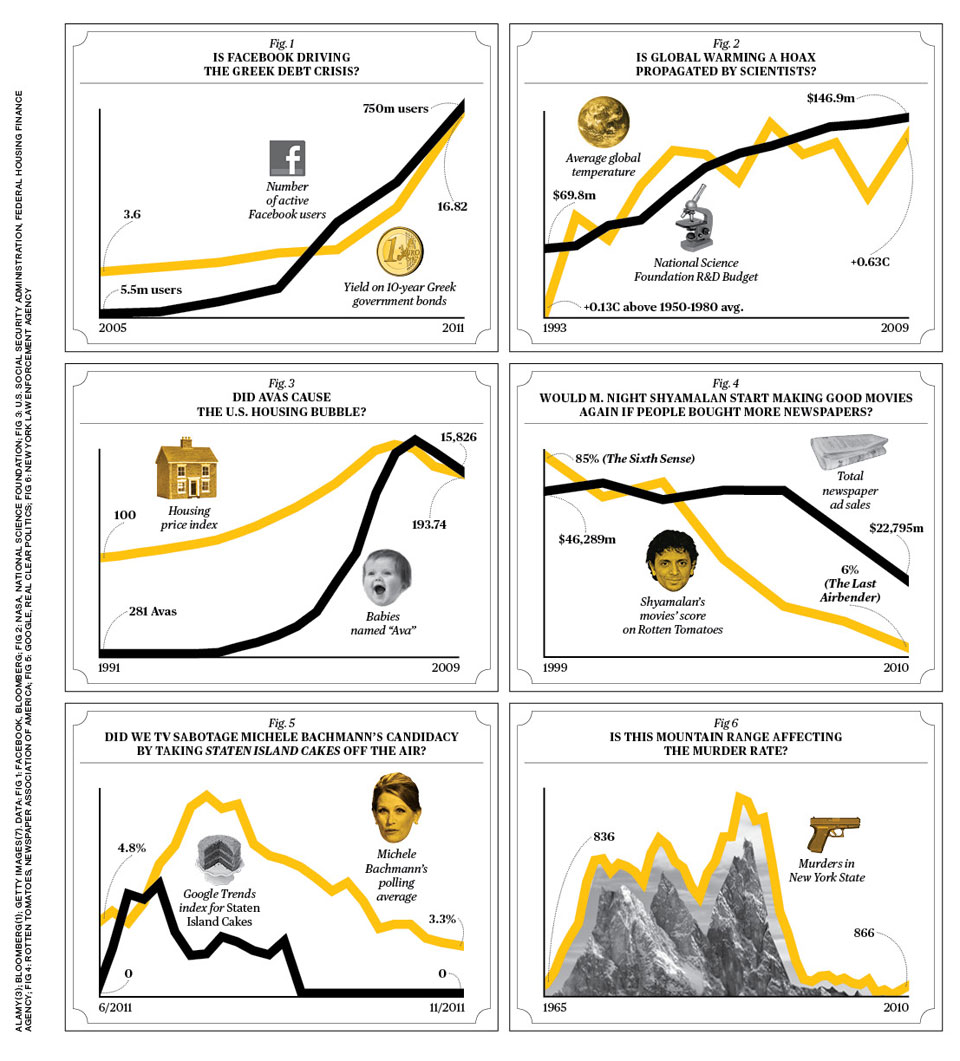
Old friend and former grad student buddy Lawrence White (not sure where he’s teaching these days–Lawrence, are you out reading? –pointed out that <a href=”http://www.businessweek.com/magazine/correlation-or-causation-12012011-gfx.html”>this</a> might be a useful teaching tool. Plus it’s just kinda fun.

Suddenly it all makes sense

Speaking of teaching, this is one of two seasons of the year in which I feel quite gleeful that I no longer have that responsibility. You people really shouldn’t be surfing the web unless your grading is done, you know.

{ 20 comments }

Euro-Kremlinology

by John Q on December 9, 2011

Understanding developments in the European crisis has become rather like Kremlinology, trying to figure out the meaning of subtle changes in wording, and rearrangements of the Politburo on the podium for May Day parades. In particular, Mario Draghi of the ECB goes back and forth, sometimes suggesting that the ECB will do what nearly everyone else can see is minimally necessary to the survival of the euro (namely, print lots of them, and use some to buy EU government debt, as was done by the Fed and the Bank of England). At other times, though, it’s as if Jean-Claude Trichet is doing a ventriloquist act.

In one respect, todays EU agreement was anything but subtle. The fact that the Eurozone countries and those aspiring to join them were prepared to go ahead without the UK (and a few others) suggests that they have something serious in mind. But what – the announcement is pretty much a restatement of the Growth and Stability pact, and under present circumstances, the deficit targets can only be seen as aspirational.

Applying one of the approaches that used to be standard in Kremlinology (not necessarily a reliable one, then or now) I’m going to assume that the EU leaders are acting with some sort of coherent goal in mind and work from there. In particular, I’m going to assume that everyone who matters now recognizes the need for a big monetary expansion and the use of newly created money to resolve, or at least stabilize, the debt crisis. [click to continue…]

{ 126 comments }

Books I Did Not Read This Year: an Ebook

by Kieran Healy on December 9, 2011

"Books I Did Not Read This Year."

I’ve been using the Readmill ebook reader on-and-off. I like it quite a bit. Using it prompted me to make an ebook of my own. Because I moved my own website over to Octopress a little while ago, everything I’ve ever written on it going back to 2002 is now in Markdown format. So over lunch yesterday I took advantage of John MacFarlane’s amazingly useful Pandoc, which can make EUPB format ebooks out of markdown files, selected thirteen posts from the Archives and made a little anthology called Books I Did Not Read This Year (epub). It’s free to download, because I’m such a generous person. Enjoy it on Readmill, iBooks, your or any other EPUB-compatible reader. Daniel kindly made a Mobi version for Kindle owners. I plan on making a few more of these, forming a Press (e.g. “Harbard University Press” or “Pengiun”), and then adding them to my Vita.

{ 11 comments }

Where are the baby boomer philosophers?

by Brian on December 8, 2011

Eric Schwitzgebel has “a fascinating post”:http://schwitzsplinters.blogspot.com/2011/12/baby-boom-philosophy-bust.html about how little influence baby boomers have had in philosophy. He uses a nice objective measure; looking at which philosophers are most cited in the “Stanford Encyclopaedia of Philosophy”:http://plato.stanford.edu. He finds that of the 25 most cited philosophers, 15 were born between 1931 and 1945, and just 2 were born between 1946 and 1960.
[click to continue…]

{ 71 comments }

Too Depressing

by Belle Waring on December 8, 2011

I can’t believe the Obama administration caved on this.

For the first time ever, the Health and Human Services secretary publicly overruled the Food and Drug Administration, refusing Wednesday to allow emergency contraceptives to be sold over the counter, including to young teenagers. The decision avoided what could have been a bruising political battle over parental control and contraception during a presidential election season.

Thanks a lot, Kathleen Sebelius. God knows we wouldn’t want one of the groups least likely to use contraceptives properly to be able to easily get their hands on some Plan B. Up next: banning over-the-counter sales of paracetemol. Ha.

Belated Update: Reading below I do see that excerpt is misleading if you haven’t read the whole article; they didn’t take Plan B away from existing over-the-counter-sales, they just refused to extend it to full OTC status which would extend to those 17 and younger.

{ 181 comments }

Hey Girl

by Belle Waring on December 8, 2011

You’ve probably all already seen this Ryan Gosling Biostatistics tumblr, but just in case…I’m here for you. Totally not suggested by Cosma, at all. He didn’t even ever hear about it till now, because he is a serious researcher, and busy reading, and stuff.

My desire to see a Classics-themed Zachary Quinto tumblr is insufficient to overcome the inertia that would be needed to carry it out. So just go to google image search and then imagine a lot of excessively precise directions for wagon-building, a la Hesiod, interspersed with Pindar-like confusion as to whether gold, fire, fame, or perhaps even something else, is the best.

{ 27 comments }

Coalition Di Rupo I

by Ingrid Robeyns on December 7, 2011

That’s the name of the new government of Belgium, inaugurated yesterday, which got off the ground after fivehundredfourthyone (that is: 541) days of negotiations (mind you: that number is written in Globish, not Oxford English). Elio di Rupo, leader of the Francophone social-democrats, had been trying to form a coalition for quite some time, but whether by coincidence or not, soon after Belgium’s credit rating worsened about 10 days ago, the agreement between the 6 negotiating parties quickly emerged. For those of you thinking that 6 parties make a government unworkable: a 6-party coalition is not unusual for Belgium. In fact, until quite recently this would be better formulated as 3 ‘party-families’, since it was assumed that the ideological line (being green, liberal, Christian-democrat or social-democrat, for example), was overwhelmingly more important than the linguistic identity of a party. But those days are gone, which means that we now do have 6 parties, rather than 3 party-twins.

I haven’t been following the coalition negotiations in detail, so mainly want to open up space for those of you who want to discuss whatever you want to discuss regarding the new coalition. Just three brief observations below the fold.
[click to continue…]

{ 22 comments }

Annals of Interesting Peer Review Decisions

by Henry Farrell on December 7, 2011

Tom Bartlett describes the efforts of two psychologists to publish replication results for an article, which had purported to show that people could use ESP to predict whether they would be shown erotic pictures in the future. The replication found no observable effect, but (according to the authors’ account of it)had a difficult time finding a publisher.

bq. Here’s the story: we sent the paper to the journal that Bem published his paper in, and they said ‘no, we don’t ever accept straight replication attempts’. We then tried another couple of journals, who said the same thing. We then sent it to the _British Journal of Psychology,_ who sent it out for review. For whatever reason (and they have apologised, to their credit), it was quite badly delayed in their review process, and they took many months to get back to us.

bq. When they did get back to us, there were two reviews, one very positive, urging publication, and one quite negative. This latter review didn’t find any problems in our methodology or writeup itself, but suggested that, since the three of us (Richard Wiseman, Chris French and I) are all skeptical of ESP, we might have unconsciously influenced the results using our own psychic powers. … Anyway, the BJP editor agreed with the second reviewer, and said that he’d only accept our paper if we ran a fourth experiment where we got a believer to run all the participants, to control for these experimenter effects. We thought that was a bit silly, and said that to the editor, but he didn’t change his mind. We don’t think doing another replication with a believer at the helm is the right thing to do … [the] experimental paradigms were designed so that most of the work is done by a computer and the experimenter has very little to do (this was explicitly because of his concerns about possible experimenter effects).

Although the Bartlett piece doesn’t make this suggestion, I can’t help wondering whether the reviewer was one of the authors of the original piece. Myself, I’ve had a couple of interesting interactions with editors over the years, but nothing that even comes close to matching this. I suppose you could make an argument that if you think that psychic powers are plausible subjects of investigation, you have to account for the possibility of compromising psychic effects, but the potential for abuse (e.g through claims about ever-more speculative ways in which the experiment could be compromised) is obvious.

{ 45 comments }

1. Female Genital Mutilation, Everywhere, Ever.
2. Women Getting Raped in Far-Away Lands, like Afghanistan. AND YOU DON’T EVEN CARE!
3. Growing Gender Imbalances in China and India (Also known as “Where’s Your Precious Right to an Abortion Now, Missy?”)
4. Sexist Islamic Law Codes (“Wait, why just–” “Shut up.”)
5. World Hunger (But not through those programs where they only give micro-payments/loans to women on the basis of research that it is more effective.)
6. Lack of Access to Clean Drinking Water For The World’s Poorest Citizens, Because, Hey, While You’re There.
7. Africa. Is Some Shit Just Fucked up There, or What? Get On That.
8. Access to The Most Basic Knowledge About Human Reproduction and Assistance of Midwives Can Lower Peri-Natal Deaths Tremendously, But Please Don’t Tell Anyone About Contraception or Abortions.
9. Forced Prostitution, Sex Slavery, Human Trafficking.
10. Are We Seriously Just Not Even Trying to Go to Mars Anymore? Really, Though? We Made it to The Moon in Like 5 Years With Some Slide Rules and Horn-rimmed Glasses and Shit, and Now All We’ve Got is These Weaksauce Telescopes Peering Back in Time. What the Fuck? Mars, Bitches!

Now you know, ladies. Sorry any sexism in developed nations up to and including your own personal experiences of sexual assault didn’t even make it on the list, but better luck next time!

For the record, I’m just going to go out there and say the Siri thing was a conspiracy–of one. One pro-life programmer who cared about it a LOT, and 8,000 other programmers who let the error stay in through multiple testing of multiple versions due to (in this case) malign neglect; they just never looked. The claims that Siri is worse than Google only when and where it relies on Yelp seem to have been falsified; the program really looks to have something of a significant blind spot, too significant to be chalked up to error. I’m willing to give the Apple programmers the benefit of the doubt and say they are not juvenile frat-boy assholes. There’s just this one asshole, and then a large number of men and some women (some of both of whom are no doubt, living in this fallen world as we do, also assholes), who never tested the program along this particular axis. People have bitched about it; Apple will fix it; the next time someone will check first. This is often how you fight sexism in ordinary life. You don’t dive in front of that Afghani girl about to take a bottle of acid to the face and shoot the guy attacking her. You just influence the people around you by expression your opinions forcefully. Should we all donate money to the many thousands of feminist organizations working overseas to combat the life-threatening situations many of the world’s women face? Yes. Really. And you should take that fucking sandwich out of your mouth and give the money to OxFam. Pro Tip: “Afghanistan, infinite no backsies!” is not a valid argument to the effect that a given woman should shut up about some given topic.

{ 190 comments }

Fun with Anti-Science

by Tedra Osell on December 6, 2011

Okay, this is too easy to pass up.

The WaPo reports that Teva Pharmaceuticals has applied to the FDA to sell Plan B over the counter. W00t! No more worrying about when the pharmacy closed or whether or not the pharmacist is gonna pull some conscience-clause bullshit on you, shy teenagers with broken condoms or forgotten birth control pills can sneak it into a shopping basket disguised with a magazine just like they do their tampons, things will be just a little easier from here on out.

BUT NO NOT SO FAST, MISSY.

<blockquote>“When anybody can buy an emergency contraceptive like this over the counter, you open the door for all sorts of abuse, and especially so when it comes to child abuse and child exploitation,” said Janice Crouse of Concerned Women of America.</blockquote>

Yes! If children who are being raped  or forced into prostitution prevent themselves from getting pregnant, then they are destroying valuable evidence, and that would be wrong. Or at least I assume that’s the reasoning here; surely Ms. Crouse doesn’t think that potential child rapists hold themselves back only for fear of not being able to force-feed their victims Plan B after raping them. Does she?

She’s also concerned that over-the-counter Plan B will make it harder for parents to be, um, “involved” with their children. Poor choice of words there, but let’s ignore it.

<blockquote>”When you are talking about selling something like this over the counter, you are opening up a can of worms when it comes to parental involvement in their children’s lives.”</blockquote>

Again, this is a TOTALLY VALID objection. It’s vitally important that parents have the power to force their underage children to bear them grandchildren, or at least to make them have to get an abortion rather than preventing the pregnancy in the first place.

Ah, but wait.

<blockquote>“It’s not a drug that prevents life — it’s a drug that destroys life,” said Jeanne Monahan of the Family Research Council, a conservative advocacy group. “If we define life as beginning at fertilization or conception, then this drug can be an abortifacient.”</blockquote>

This is my favorite part of the whole article. Let’s redefine “life” so that we can classify things as abortifacients! I’ll start:

If we define life as beginning at the moment a man first sets eyes on a woman, then not putting out for every dude on the street is an abortifacient.

If we define it as beginning the moment the ring is on her finger, then every business trip is an abortifacient.

If we define it as beginning with ovulation, then menstruation is an abortifacient! MENSTRUAL PADS MUST BE PRESCRIPTION ONLY.

Your turn!

{ 87 comments }

Howdy

by Tedra Osell on December 6, 2011

Those of you who don’t already “know” me might well be wondering “who the hell is this bitch?” Or actually probably not: CT readers aren’t known for being vulgarians, I don’t think, unlike many of the commenters at the Chronicle (dear god, poor Clare). Thank god I haven’t read the Chronicle in years.

If you had been thinking that, though, it would be a reasonable question, inasmuch as I am, in the world of academe, absolutely no one. (Which frees me from having to read the Chronicle, among other perks.) I left the ivory tower something like five years ago–I no longer remember, exactly–for the exalted position of housewife and PTO mom (did you know that the PTA is a national organization that collects dues, which means that a lot of school parent-teacher orgs now call themselves PTOs? I didn’t). That was fun, and I got to do a lot of teaching because my kid’s public school was kinda run like a co-op and required ridiculous amounts of parental involement, so I developed lesson plans for reading and writing and chemistry and put together a PTO library of sorts and did all sorts of other things, as PTO moms do.

Now, though, said kid, who unlike me shall remain pseudonymous, is in a “regular” middle school, meaning that I’m not actually allowed on campus during the day at all (!). So mama needs to get a job. Adjuncting is Right Out, as is getting a credential and teaching K-12 in California; I’m bored, but not insane. So my shiny new 2012 iteration is gonna be freelancing: I’m thinking academicish editing and hopefully the odd opinion piece somewhere.

Which means I’d been mulling over this whole “writing and being public again” thing lately, when lo, John Q. asked me “hey, would you be interested in writing at CT ever?” And I said, “you know what? Yes, that might be kind of fun.”

So here I am.

There is a certain irony in appearing on an academic(ish) blog as myself only now that I’m no longer an academic. Talk about imposter syndrome. Which maybe I will at some point, who knows.

Until then, though, you can expect me to talk about education, definitely: both higher and k-12. Academic and general writing on- and offline, probably. Popular feminism, most definitely. Politics and culture, inevitably. The weirdness of transitioning from “academic” to “entrepeneur,” as my business workshop kept calling us, no doubt (has anyone besides me ever noticed how insufferably pretentious both those titles are, especially when self-administered?). And if you’re really really lucky, cat videos.

Feel free to toss me links, topics, or photos of your kittens.
{ 40 comments }

Welcome to Tedra Osell

by John Q on December 5, 2011

We at Crooked Timber are very happy to welcome the latest addition to our crew, Tedra Osell. Tedra was one of the pioneers of academic blogging when she founded the much-missed BitchPhD blog back in (I think 2004), and now writes for Inside Higher Education at Mama PhD. Her joining us is the result of a happy coincidence of wants – we were talking about how much the site could benefit from someone like Tedra (in fact, specifically from Tedra herself), just as she was posting about a return to blogging. I won’t try to describe Tedra’s previous work, let alone predict her contributions here, but I’m confident they will be well worth reading.

{ 50 comments }

Adorno?

by John Holbo on December 5, 2011

Somehow I got on the AEI mailing list, so I get email. In this case, an announcement of an upcoming (Dec. 12) event. “Liberalism and Mass Culture: Fear and Loathing of the Middle Class,” a Bradley Lecture by Fred Siegel. (This Fred Siegel. He’s apparently working on a book about “The Inner Life of American Liberalism”. But the AEI site seems to be down at the moment, so you’ll have to check back later for event details.) I’ve got a good feeling about this one:

There are (at least) three foundational myths of contemporary liberalism. One is that John Kennedy’s assassination was instigated by the rank intolerance and hatred of the American people. A second is that of “upsouth”: the assertion that Northern racism was and is every bit as pervasive, if more subtle, than that of the Old South. The third is that the American popular culture of the 1950s was stifling not only in its “Donald Duck” banality but also in a subtle form of fascism that constituted a danger to the Republic. In this view, the excesses of the 1960s were a struggle to free America’s brain-damaged automatons from their captivity at the hands of the lords of mass culture.

At this AEI event, Fred Siegel will address this third myth. For all the bile directed at the 1950s, it was the high point of American popular culture, a period when many in the vast middle class hoped to elevate their tastes. The attack on mass culture, a mix of Marxant theorizing and aristocratic instincts, paved the way for a new form of status competition based on supposedly elevated consumer and cultural preferences.

Part of me likes best the faux-scrupulosity of the parenthetical “at least”, utterly undone by the second paragraph revelation that the first paragraph was two-thirds grumping around and he’s not even going to talk about the Kennedy assassination. (I have written abstracts in my time, but it has never occurred to me to start one, in effect: ‘Damn kids, get off my lawn!’ But, now that I think about it, there’s really no reason why an abstract should not be angrily digressive. Why not?) Part of me loves the idea that somewhere, someone is writing a book about how the inner life of American liberalism is, I guess, Theodor Adorno. That’s thinking outside the box, innerly-speaking. Part of me loves the image of all these liberals whispering ‘upsouth’ to each other constantly, in that knowing way.

OK, I guess he could be winding up to take a swing at Dwight Macdonald. But does Dwight Macdonald talk about Donald Duck, in particular?

{ 181 comments }

The 46 races

by Chris Bertram on December 5, 2011

I’m re-reading Samuel Scheffler’s paper “Immigration and the Significance of Culture”, _Philosophy and Public Affairs_ 2007. From the footnotes, the list of “races” into which the US immigration authorities divided humanity in 1914:

bq. African (black), Armenian, Bohemian, Bosnian, Bulgarian, Chinese, Croatian, Cuban, Dalmatian, Dutch, East Indian, English, Finnish, Flemish, French, German, Greek, Hebrew, Herzogovinian, Irish, Italian (North), Italian (South), Japanese, Korean, Lithuanian, Magyar, Mexican, Montenegrin, Moravian, Pacific Islander, Polish, Portuguese, Roumanian, Russian, Ruthenian (Russniak), Scandinavian (Norwegians, Danes, and Swedes), Scotch, Servian, Slovak, Slovenian, Spanish, Spanish-American, Syrian, Turkish, Welsh, West Indian.

{ 86 comments }