Again, today’s rallies at noon and at 4 have been large, though not massive. The Assembly is debating the bill, and the Dems are doing everything they can to delay it: when I was there an hour ago they were debating a motion to refer it to another committee — whereas they can only speak a few minutes each on a motion to table, they can speak forever (and it certainly seemed that was what they were doing) on a motion to refer. The senators are still outside the state (and donations are pouring into their coffers, I gather — the Reps are going to face a lot of money at the next election). Walker has delayed the budget speech for a week. There must come a point at which the observation that he is, in fact, incapable of governing will affect people’s view of him. Here’s a video by one of our graduate students:
{ 48 comments }
Via Shehzad Nadeem at OrgTheory comes this report on Muammar el-Gaddafi’s son and the Ph.D in Political Theory he wrote at the LSE in 2008, who as it happens also accepted a pledge of £1.5m from the Gaddafi International Charity and Development Foundation, which Saif ran. Gaddafi the Younger’s thesis, which you can read in its entirety if you like is titled “The Role of Civil Society in the Democratisation of Global Governance Institutions: From ‘Soft Power’ to Collective Decision-making?” In it, he argues that,
inclusion of elected representatives of non- governmental organisations (NGOs) in tripartite decision-making structures could potentially create a more democratic global governing system. … the thesis argues that there are strong motivations for free individuals to seek fair terms of cooperation within the necessary constraints of being members of a global society. Drawing on the works of David Hume, John Rawls and Ned McClennen, it elaborates significant self-interested and moral motives that prompt individuals to seek cooperation on fair terms if they expect others to do so. Secondly, it supports a theory of global justice, rejecting the limits of Rawls’s view of international justice based on what he calls ‘peoples’ rather than persons. Thirdly, the thesis adopts and applies David Held’s eight cosmopolitan principles to support the concept and specific structures of ‘Collective Management’.
He goes on to say that,
The core aim of the thesis, then, is to explore the potential for the concept of Collective Management to develop a more democratic, morally justified system of global governance that recognises the rights of individuals … and is particularly focused on empowering civil society organizations (CSOs) to give a stronger voice to those currently under-represented in the existing system
From here it is only a short few steps to the view that when push comes to shove, blood will run in the streets and you and your family will fight to the last bullet. I think there’s a passage in A Theory of Justice that can be read as endorsing this claim.
{ 75 comments }
Much as I’ve been loving Harry’s posts on Wisconsin, it seems odd that we haven’t said more here on CT about the more important struggle going on in Libya and about the Arab world more generally. It is difficult to get a sense of what is going on from the sporadic reports, but it looks very much as if Libya’s transition will be to the Arab awakening what Romania’s was to the end of Stalinism in eastern Europe. Gaddafi seems now to have lost his grip on reality if not yet completely on power. Let us hope that he suffers a similar fate to Ceacescu.
Anyone who does want to follow developments in the Arab world has one best option to do so: Al Jazeera . Vilified by the US under Bush (and its reporters almost certainly murdered by the US military on several occasions), Al Jazeera has been both the conduit of information and the catalyst for change and democratization.
The Emir of Qatar may be a despot, but for Al Jazeera alone he could be winning a Frederick the Great prize as the most enlightened one of recent decades. The democracies of the West, by contrast, have contributed nothing. If the Arab peoples do succeed in freeing themselves, they will have done so themselves and despite the actions and attitudes of the West and the United States with its policies of Israel-first and make-deals-for-oil. For that reason, and so unlike Eastern Europe, such influence the US has in the future will be a function of its power alone and not its moral authority, which is now non-existent. Anyone can back a democratic revolution when it is half won, or cavil at the most disgusting atrocities, but no-one is going to forget that the West backed many of the Arab dictators (especially Mubarak) until nearly the end and still supports some of the worst of them (such as the Saudis). Some might cite Iraq as the exception here but it isn’t really: Rumsfeld embraced Saddam until he went off-message just as Blair welcomed Gaddafi back into the fold when it seemed opportune to do so. Let us hope the Arab 1848 continues to more successful conclusions.
{ 122 comments }
The update is that yesterday the rallies at lunchtime and 5pm were, according to the Sentinel, “massive” — and, according to participants “much bigger than we expected”. The Journal-Sentinel has been documenting this with great photo albums — here’s yesterday’s. The teachers go back to work today, and many schools I’ve heard of are holding demonstrations of teachers and students before school opens. The Senate goes back to work, and the Reps are trying to tempt the Senate Dems back by proposing a bill requiring that voters show ID at the polls. The momentum has held up remarkably well on these colder days of Sunday and Monday, the question is whether things will hold up today. There is some talk of a high school student walk-out during the day, but I don’t have confirmation of that (I’ll get it when the 14 year old crawls out of bed). Frustratingly I can’t find a definitive time for the afternoon rally yet, but my bet is 5pm. Anyone who wants to donate Pizza, here is the Ian’s webpage — best pizza in Madison, being delivered from 2 blocks away, but ordered from 47 states and 14 countries (someone from Turkey ordered pizza for the protesters?). Worth reading the story on the front page, and worth bearing in mind that there are a few protesters who are not enamored with mac and cheese pizza, believe it or not. I was out of town yesterday (in my Dem senators’ adopted state) but am looking forward to returning today.
Apparently this was made by a 13 year old kid, but I haven’t found out the name. I like the sped-up bit, and the choice of Green Day.
Comment away.
{ 12 comments }
Via Kris Olds again: Dave being common. Not sure which I prefer, the banana or the beer. (I confess that I find this sort of acting obnoxious whether the politician is a toff or not. Imagine Eric Heffer pretending to be something he wasn’t).
{ 8 comments }
Back in July last year, I was puzzled that no one seemed to be worried about the shutdown of US government that would inevitably follow a Republican victory in the House. Now with the shutdown due on March 4, I’m even more puzzled. It seems virtually certain that the shutdown will take place, and even more likely than before that it will be protracted. It’s true that there is a lot happening in the US, and the world, to distract our attention. But precisely for that reason, a shutdown of the government in Washington will be a much bigger deal than it was in 1995. Yet no one seems particularly worried, or even interested.
{ 60 comments }
The Madison teachers just voted to stay out at least one more day, so more fun at the Capitol tomorrow. My kids are ecstatic. If you can be there, you’re more than welcome.
{ 24 comments }
This EPI report was released February 10th (hence the slightly out-of-date language), and the answer, apparently, is no:
Walker is promoting public employee pay cuts, changes in collective bargaining laws, major benefits reductions, and a possible decertification of public employee unions as the antidote to the alleged overpayment of public employees in Wisconsin and the key to reducing the state’s budget deficit.
{ 31 comments }
Gail Collins (via Bill Gardner):
In Wisconsin, the new Republican governor, Scott Walker, wants to strip state employees of their collective-bargaining rights because: “We’re broke. We’ve been broke in this state for years.” Wisconsin’s Democratic state senators went into hiding to deprive the Republican majority of the quorum they need to pass Walker’s agenda. The Senate majority leader, Scott Fitzgerald — who happens to be the brother of the Assembly speaker, Jeff Fitzgerald — believes the governor is absolutely right about the need for draconian measures to cut spending in this crisis. So he’s been sending state troopers out to look for the missing Democrats. The troopers are under the direction of the new chief of the state patrol, Stephen Fitzgerald. He is the 68-year-old father of Jeff and Scott and was appointed to the $105,678 post this month by Governor Walker. Perhaps the speaker’s/majority leader’s father was a super choice, and the fact that he was suddenly at liberty after having recently lost an election for county sheriff was simply a coincidence that allowed the governor to recruit the best possible person for the job. You’d still think that if things are so dire in Wisconsin, the Fitzgerald clan would want to set a better austerity example.
I think Collins is barking up the wrong tree here. Fitzgerald is a common name in Wisconsin, and I’m sure it never occurred to Walker that he was related to his sons. Accusing Walker of this sort of corrupt practice just seems ad hominem.
{ 20 comments }
Today’s protests were the largest yet — the police estimate was 70,000. Not a single arrest. Tea Party people turned up in… well, force would be too strong a word — 500 maybe — and looked, to be honest, a bit bewildered. I did wonder for a moment whether WEAC had paid a bunch of out-of-work actors to make the tea party look stupid and lift our spirits, but, no, I think they were genuine and doing it themselves. Only 2 doors of the Capitol were open (the others were clear for emergency vehicles, which I was a bit alarmed hadn’t already been done yesterday). I’ve no sense of the numbers, but there are 5000 in the Capitol at any given time, and a march of protesters about 15-20 people wide and pretty densely packed is surrounding the building walking round the square.
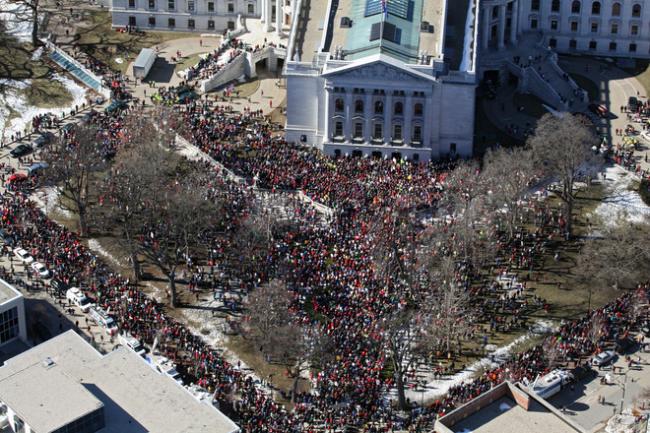
State Street was completely packed for several blocks too. The mood was pretty jovial and optimistic (but it is not clear what that optimism is grounded in). There’s no new news today, but yesterday AFSCME and WEAC offered to accept the benefit cuts in return for the removal of the union busting provisions and Walker dismissed it out of hand, making vivid what this is all about. The Senators are still in Illinois (but some seem to have migrated somewhere more palatable than Rockford and who can blame them. My guess is that the winter storm coming tomorrow will make for a quiet day. Insofar as I can judge the mood, my sense is that teachers in Madison want to return to work Monday (there’s a mass union meeting at 2 on Sunday to decide this) and to get the Assembly Democrats to ensure that no real legislative action happens before 4.30 when large scale action can begin. Fuller coverage in the Journal Sentinel.

For those who have asked: at present not a single Democrat is wavering, and it looks unlikely that any will. There were initial worries in the Assembly, but the causus solidified pretty fast, and will almost certainly hold. People have, rightly, given them a lot of credit.
A word about the police. I’ve been brutally beaten and arrested by cops on two continents during activities in support of strikes, and have been at many, many more demonstrations and protests of this scale or larger, though not for a long time (if you watch the video, I was much fatter then, and have no memory at all of the red baseball cap I seem to have had on prior to the arrest). Bad things are always possible. But in my experience usually (as in both my cases) violence depends on incompetent or ill-willed policing (or, more rarely, the determination of agent-provocateurs or irresponsible buggers to provoke it). Often, there is considerable tension between the police and demonstrators especially when (as this week) neither side was really ready for what was going to happen. These protests have been good-natured and fun, but still it is striking how good the policing has been — a lot of cops visibly present, but low key and friendly, determined not to play any role in raising the temperature. All the more remarkable for the fact that neither the protesters (with a few exceptions) nor the cops (with even fewer) have experienced things like this before, and still weren’t anticipating anything like it 4 days ago. Several lefties of my acquaintance (including myself) have made a point of friendly contact with cops, and simply telling them how impressive it has been.
Rallies are scheduled tomorrow, but a major winter storm may make them less impressive than they’ve been. The Assembly reconvenes on Tuesday and my guess is that 5 pm first on Monday, then on Tuesday. will be the gathering times for major action. Unfortunately I’ll be out of town on Monday, but will get my family to fill me in if you want further reports.
{ 30 comments }
The protests today were much bigger, again, than the day before. Rumours are swirling that maybe Sarah Palin will turn up tomorrow (not that her support is likely to do us much good, but that’s life) and even Obama (in which case he’d better be a little more energetic in our support than he has been). My guess is that Palin is the more likely of the two. The news today is that the Assembly vote has been delayed till Tuesday (this morning’s meeting was such fun that the Reps shut it down). If you are within traveling distance, and have the time, the Capitol in Madison is the place to go. Be there by 11.
(My 14 year old stayed up all night, and testified before the Assembly at 5.20 am, pointing out that whereas most of the testimony of schoolkids had been about teachers, janitors and clerical staff were in an even worse situation because in theis economy it will be even more difficult for them to get other jobs and they are less likely to be married to other people with well paying secure jobs. At least, that’s what she told us. With not an iota of pride. Unlike her father.)
{ 82 comments }
I posted recently on The paradoxical politics of credible commitment, noting the excellent analysis of Gordon Brown’s politics by Sebastian Dellepiane.  He argues that the Labour government did not make the Bank of England independent simply in order to defuse City suspicions of them. This self-binding policy was also in fact enabling, because it made it possible for Brown to adopt a classic Keynesian economic strategy by about 2000.
The Euro started out as a self-binding credibility-gaining mechanism for Eurozone member states. But the Euro also turned to have an ‘enabling’ side to it. It contributed to new kinds of instability by facilitating the extension of cheap credit and by permitting increasingly risky lending practices to spread throughout the European financial system, in Germany and France as well as in the weaker peripheral economies.
This has led me to think some more about the relevance of the logic of credibility gains in the current European crisis.
The self-binding austerity politics now under way in the Eurozone also has some paradoxical features. The crisis has produced an explosion of fiscal deficits and an accumulation of sovereign debt. The ECB favours fiscal austerity to restore stability, and so does German public opinion. This means that every other member state must adjust to low demand conditions and domestic deflation. But while Gordon Brown’s self-binding monetary policy proved to be enabling, Eurozone governments’ self-binding fiscal policy might be seen as self-disabling, because it involves commitment to a strategy that may prove self-defeating. There are two reasons for this.
{ 20 comments }
I chatted last night with a friend who is a Dem Representative (so not a Senator holed up wherever they are now), and my wife saw him an hour or so later, and said he looked as exhausted as he sounded. The Dem Reps are in the building round the clock basically, and excited but also tired. My friend says it really gives them energy to get messages of support, from old friends and new friends. Honestly, pretty much wherever you are, a short encouraging email will help keep their spirits up, and obviously if you’re in Wisconsin a nice note to your own (Dem) Rep is appropriate (Phelps – send a nice note to a bunch of them, ok, you’re almost uniquely capable of writing a letter that will encourage in this situation). An extremely polite note to your (Rep) Rep explaining why he or she should be opposing the bill, and making whatever pledge of support you can bring yourself to make, conditional on him/her contributing to the bill’s defeat, is also in order. Here’s the list of home pages, addresses, etc. I’m off now to see my mate and find my daughter.
Oh, by the way, its looking as if Tuesday’s budget speech will announce the de facto privatization UW Madison, so that’ll be fun too.
{ 27 comments }
A little while ago, my son pointed me to a news item in a periodical called The Onion, reporting Republican opposition to an Obama proposal to protect the earth against destruction by asteroid impact. The usual libertarian arguments were advanced, pointing out that everyone would be forced to pay for this protection, thereby undermining the incentive to act for themselves.
At the time, I was suspicious that this might be some sort of satirical gag[1]. But now I see the proposal being discussed, and rejected, at the very serious Volokh blog (H/T Paul Krugman and Matt Yglesias).
So, based on my extensive agnotological studies, let me make some predictions about some of the scientific claims we are likely to see advanced (by the same people, but at different times), once the debate over Obama’s socialist plan hots up.
[click to continue…]
{ 39 comments }

Congratulations to Belgium, which holds since midnight the world record cabinet formation after the elections now exactly 250 days ago. Being the founders of surrealism, the Belgian people decided to celebrate this with people’s parties in open air, especially a big one Gent. The poster says ‘steun onze helden’, that is, ‘support our hero’s’, but this should be interpreted as ironically as possible. The people organising and attending these parties are fed up with the Belgian politicians who are unable (or unwilling?) to form a coalition and govern the country. If you want to see another piece of Belgian surrealism, watch the Flemish comedian Geert Hoste giving an interview to CNN in which he comments on the situation and the festivities.
[click to continue…]
{ 39 comments }