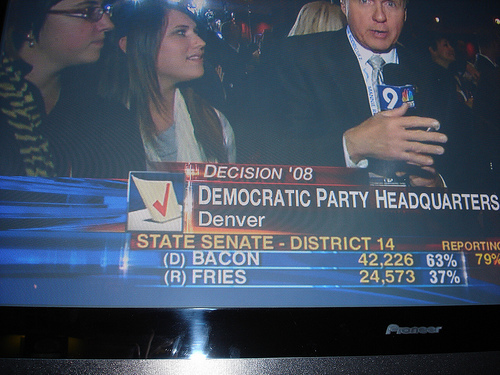
Via John Gruber.
I’ve not been able to access my work voicemail for the past month. I moved offices, but took my number with me. When I tried to access my voicemail, I kept getting a “number not recognized” message. Today, they finally told me that I had to dial a new and different number for voicemail access, different, that is, from the standard variation on the number people call to speak to me (or to _leave_ the voicemail). So I dial the new code. There’s a a month-old message from the voicemail people: “thanks for your inquiry about not being able to access your voicemail. You can’t access it on the old number, you’ll need to dial XXXX instead.”
{ 39 comments }
Over the fold is my piece from today’s Australian Financial Review on the task facing Obama. The original version started “Following his convincing election victory, Barack Obama can look forward to taking office under the most challenging conditions facing any incoming president since Franklin Roosevelt’s inauguration in 1933,”, but another columnist came in with an almost identical lead, so I changed mine. But the great thing about a blog is that you can choose which version you like best (or dislike least). The original opening paras are at the end of the post.
{ 37 comments }
Andrew Gelman with a first pass at analyzing the election data.

This figure illustrates point 5 below — the election was more of a partisan swing than a redrawing of the electoral map. Andrew’s impressions:
1. The election was pretty close. Obama won by about 5% of the vote, consistent with the latest polls and consistent with his forecast vote based on forecasts based on the economy. … 3. The gap between young and old has increased–a lot: But there was no massive turnout among young voters. According to the exit polls, 18% of the voters this time were under 30, as compared to 17% of voters in 2004. (By comparison, 22% of voting-age Americans are under 30.)
4. By ethnicity: Barack Obama won 96% of African Americans, 68% of Latinos, 64% of Asians, and 44% of whites. In 2004, Kerry won 89% of African Americans, 55% of Latinos, 56% of Asians, and 41% of whites. So Obama gained the most among ethnic minorities.
5. The red/blue map was not redrawn; it was more of a national partisan swing.
{ 81 comments }
Whatever disappointments and unhappiness lie in the future, my two sons are going to grow up in an America where it is a _done deal_ that an African-American with a foreign-sounding name can run for President and win. That’s pretty nice to wake up to.
{ 27 comments }
With the networks calling Ohio for Obama, the only question remaining for today is the size of the win. I’m rushing to write a column (for the Australian Financial Review) but I thought I’d open up a post for anyone who wanted to comment.
{ 35 comments }
According to Arnie, McCain has 100% of the vote. Well, it made me laugh.
Shortly after the Republican convention, I received the following complaint about CT:
How is it possible that the Housemartins have NEVER been mentioned on Crooked Timber?
A mystery indeed. My correspondent was reminded of the Housemartins by the people who were grinning themselves to death. in St Paul. But why complain to me?:
I know, I know, Holbo is random pop culture guy, but you seem to be the best candidate for CTer with (at least prior) affection for “Take Marx… Take Jesus… Take Hope.”
That’s probably right (and I like the gentle suggestion that I am the not-popular culture guy, or, as one of our readers said to me, the “archaic lower-middle-brow British culture” guy). I even saw the Housemartins once, which given my record of attending live popular music events demonstrates remarkable affection (none for 15 years, and only about 10 which didn’t involve Loudon Wainwright III or Richard Thompson before that). I’ve even got all their albums (well, both of them).
But, I thought, is there a song for today? Sitting on a Fence?; Get up off our knees?; Heaven Help Us All (introduced by Peely)?; We’re Not Going Back? (The Christians among you are bound to recognise the sentiments in Sunday isn’t Sunday — I have a “Antidisestablishmentarians for Obama” button, which I got because I figured it announced my membership of a vanishingly small minority group.. My friend told me I was being elitist. “Why, antidisestablishmentarianism is a non-elite view, here”; “Yes, but only elitists know what it means”. What can you do?)
Take your pick. And, sure, the world will be a little bit better tomorrow, but not enough better that you can’t make it better still.
Update: Doug K nominates Caravan of Love. I could go with that.
{ 16 comments }
Recently Aaron S. Edlin, Andrew Gelman and Noah Kaplan wrote “an article in The Economists’ Voice”:http://www.bepress.com/ev/vol5/iss6/art6/?sending=10393 setting out their argument that rational altruists should vote. A more careful version of the argument is “here”:http://www.stat.columbia.edu/~gelman/research/published/rational_final6.pdf, and if you like there is also a “mocking response by Andrew Leonard in Salon”:http://www.salon.com/tech/htww/2008/10/31/voting_for_charity/index.html, and a more sensible “counter-mock by Gelman on his blog”:http://www.stat.columbia.edu/~cook/movabletype/archives/2008/11/rationality_of.html.
There’s something right about the argument Edlin et al are making; it being rational for you to vote does require a degree of altruism. But I think their model (a) makes some fairly heroic assumptions, and more importantly (b) doesn’t explain why so many people in America should go vote today. Below the fold I give a slightly different reason for voting, one that applies in all 50 American states. The short version is that you should vote today because it increases your chances of getting a good outcome next time.
[click to continue…]
{ 38 comments }
Pejman Yousefzadeh: “Vote to remind a certain Presidential candidate that he and his surrogates can’t get away with the claim that they only intend to raise taxes on the rich.”
I guess Pejman Yousefzadeh endorses Barack Obama for President. Because, after all, the only way to hold Obama accountable for claiming that he only intends to raise taxes on the rich is, presumably, to gather evidence that this was not his true intention. I fail to see how it will be possible to gather more evidence about his true intentions than we’ve got already if he loses.
But seriously: I think it’s significant that the complaint against Obama is not that his tax plan is bad (who would say that, if they wanted to win over voters?) No, the complaint has to be that Obama’s tax plan isn’t Obama’s. Republicans have had such a rhetorical advantage on the tax question for decades that it’s remarkable to see them so hobbled this time out. That’s change I can believe in!
{ 12 comments }
Jerome Weeks points out a trend-in-formation: literal video, which is something like Situationism minus Marx plus YouTube:
It’s a form of satire that seems to work best with the more inflated, ’80s or ’90s pop-rock videos, the ones that were developed as little storytelling movies, even though the “movies” had little to do with the song itself or seemed patently pretentious, with or without the song. In short, there’s a profound disjuncture among the posturing twit-lead singer, what he’s supposedly singing about and what’s going on all around him. As they used to say about political photo-ops: It doesn’t matter what the candidate is saying, it’s the background he’s in front of and how he looks….
In a literal video, the lyrics provide a running description of what is happening onscreen — commentary that, as Jerome says, “repeatedly calls attention to (and calls into question) the video’s image choices, making them appear laughably random. Or it subverts any greater, intended import they might have by flatly describing the images and thus “grounding” or re-contextualizing them in a more self-consciously ‘down-to-earth’ matter, while actually presenting a wise-ass commentary on them.” [click to continue…]
{ 42 comments }
No doubt if I had more time I’d find the right answer to this question, but I’m lazy and/or pressed for time, so here goes. For quite a while now the polls which include Nader and Barr show a significantly bigger distance between Obama and McCain than those which exclude Nader and Barr. I thought I understood why, but when my 12 year old asked me to explain my explanation was so bad that not only did it collapse as I tried to articulate it, but it also disappeared (I no longer remember what my supposed understanding was). Why is it? Barr seems to get about 1%, and Nader 2-3% when they are included (both numbers seem remarkably high to me, but what do I know?). Could it be that Nader, as well as Barr, is drawing mainly from McCain (protectionist Republicans who are either too racist to vote for Obama or too sophisticated to believe he’ll be a protectionist?). Or is there some technical explanation that I don’t understand?
{ 45 comments }
Amazon is giving away a a free ‘sampler’ album from Light In the Attic records
I see that the Black Angels just played a Halloween gig with Roky Erikson. That reminds me of another free mp3 to pass along. A great cover of Erikson’s “You Don’t Love Me Yet”. I know about that one because I really enjoyed Jonathan Lethem’s novel – same title
– which didn’t get much attention. It’s kinda like Philip K. Dick wrote an episode of “Friends”. But in a good way. No, that’s not what it’s like, except for the names. What can I say? It’s a slight work, evoking aimlessly attractive youth. There are comic couplings and decouplings, and very nicely written it is.
I know what day it is. But every post can’t be about the election.
{ 11 comments }
The Times “has a story”:http://www.timesonline.co.uk/tol/news/world/us_and_americas/us_elections/article5063279.ece that “Peter Millican”:http://philosophy.hertford.ox.ac.uk/peter.htm , an Oxford philosopher, was offered $10,000 to help some Republicans “prove” that Obama’s memoirs were ghost-written by Bill Ayers. On a bizarreness scale of 1 to 10, that gets close to the Obama-was-Malcolm-X’s-lovechild story.
{ 39 comments }
While the global financial crisis and the US election have monopolised attention for the last couple of months, the climate change crisis hasn’t got away, and most of the news has been bad. It’s now pretty widely agreed that any global policy that doesn’t stabilise atmospheric greenhouse gas concentrations around 450 parts per million (CO2 equivalent) runs a real risk of environmental disaster. The only plausible policy of that kind This is a contract and converge scenario where all countries accept a common emissions entitlement per person, to be reached over coming decades. That in turn means big reductions in emissions entitlements for people in developed countries.
The Australian Treasury has just released estimates of the cost of an measures to reduce greenhouse gas emissions, most importantly an emissions trading scheme. Of course, there have been quite a few exercises of this kind, but what’s striking about this one is that it looks at a much wider (and more realistic, if we want to save the planet) range of options, going all the way to a 90 per cent reduction in emissions relative to 2000 levels, achieved by 2050.
Treasury estimates that, under this scenario, GNP per person in Australia will average $78 000 in 2050 compared to $50 000 at present. By contrast in the reference scenario which has an 88 per cent increase in emissions, 2050 GNP is estimated at $83 000, or about 6 per cent higher (I don’t think this takes account of environmental and other damage costs avoided through climate mitigation, which will much more than offset the cost of mitigation in the long run).
When I get a bit of time, I’ll report more on the details and assumptions. But the quibbles coming from predictable rentseekers, and their tame consultants, look like just that, quibbles. It’s striking how many supposed advocates of the free market think we’ll all be rooned unless we continue to subsidise industry (and households) by allowing them to dump their garbage into the atmosphere free of charge.
Treasury’s estimates are, not surprisingly, quite consistent with the arguments I’ve made for a long time. That’s because any competent economist doing the analysis must come up with estimates of a comparable order of magnitude. If you want to make the case that saving the planet requires reducing living standards, or even a big reduction in the rate of growth of living standards, you need either to invent a whole new economics or wave your hands vigorously enough to conceal the fact that you don’t have any economic analysis to support you.
{ 92 comments }
