There’s a short profile of me up at the National Journal’s “Blogometer”:http://blogometer.nationaljournal.com/archives/2006/01/119_the_kitchen.html today. Feel at liberty to slag me off in comments.
Christopher Hitchens has been noteworthy for his strong support of the Iraq war and the Bush Administration’s vision of the war on terror. Many were surprised when he recently joined an ACLU lawsuit challenging the NSA program of warrantless wiretaps. Could you direct me to any insightful citizen journalism that could help me understand this story?
A: Sure. It’s because he’s an anti-semite.
Pajamas Media is not an embarassing money pit bringing shame to political bloggers everywhere.
{ 67 comments }
Inspired by this post, I read The Army and Vietnam
I especially appreciated the introduction and its lucid introduction to the strategy of a successful insurgency/counterinsurgency. I liked that part so much that I’ve transcribed about four pages, in the interest of posting it in small blog-sized chunks for discussion. The book was published in 1986. It’s fascinating to see how much of it applies to the situation in Iraq, and how much is less relevant.
I hope that this inspires a few readers to buy the book
Here goes.
{ 23 comments }
 Eugene Volokh “is already on this”:http://volokh.com/archives/archive_2006_01_15-2006_01_21.shtml#1137628916, but I caught a segment “on the radio”:http://www.npr.org/templates/story/story.php?storyId=5162955 about the “UCLAProfs.com”:http://www.uclaprofs.com, the site founded by some recent political science grad “dedicated to exposing UCLA’s most radical professors,” people who are engaged in “brainwashing” their students, an activity “described”:http://www.uclaprofs.com/profs/piterberg.html as “about as hard as shooting fish in a barrel.” The idea that professors exert a vise-like grip on the pliable minds of their students is a dubious one at best. But frankly, the notion that cardigan-wearing lefties can out-compete the cornucopia of brain-cleansing goods and services on offer in the city of Los Angeles strikes me as wholly implausible.
What most irritates me about the site is that it will probably play to the persecution complexes of some of the people on the list, which will lead them to make comments about Joe McCarthy and Fascism, which is exactly the kind of reaction UCLAprofs.com wants. The best thing about this otherwise lame project is its black-fist rating system for the radicalism of professors (three fists out of five shown here). Political Science prof Mark Sawyer had the right idea with “his profile”:http://www.uclaprofs.com/profs/sawyer.html — he wrote in to complain, saying “I now have tenure … I have been away from UCLA for 2 1/2 years at Berkeley and Harvard. I have been active though in the anti-war movement etc. So I feel I deserve 5 fists.”

But apart from the fist innovation, UCLAprofs.com is pretty badly written, poorly designed and completely fails to hit its target, as most of the “radical causes” it cites (disapproval with President Bush, opposition to the war in Iraq) are in fact at present majority positions in the United States. It doesn’t come close to the delicious heights of “Discover the Network”:http://discoverthenetwork.org/default.asp, let alone “Discover the Nutwork”:http://homepage.mac.com/jholbo/nutwork/. So I’m afraid that on my personal scale of 1 to 5 McCarthys (also shown here), UCLAprofs.com receives a derisive half a McCarthy, a new record low. It would have gotten a zero except for the superb self-parodic line in the article “There’s Something About Petitions”:http://www.uclaprofs.com/articles/petitions.html where the author says “The list also demonstrates that a large number of UCLA professors are ardently in favor of affirmative action, and just as ardently opposed to conservative legal nominees, even opposing fellow alumni like Justice Janice Rogers Brown.” That’d be _Judge_ Brown, incidentally, not Justice, whom we all know and love for her “excellent speeches”:https://crookedtimber.org/2005/05/05/janice-rogers-brown-revisited/. Now if you’ll excuse me I have to supervise the students who are presently washing my collection of Che Guevara t-shirts as part of an in-class research exercise.
{ 52 comments }
Chris Brooke really is excelling himself these days. First, a relentless (and funny, and good) take down of Anthony Browne’s pamphlet The Retreat of Reason. Then a slightly obsessive-seeming savaging of everyone’s favourite right-wing left-winger, Stephen Pollard. And cat pictures too. Enjoy him while he’s in such a good mood.
{ 5 comments }
The “Boston Review”:http://bostonreview.net/ has just put “the results”:http://bostonreview.net/BR31.1/stateofthenation.pdf of a very interesting opinion survey online. They’ve asked respondents whether they would approve of military intervention to support a number of goals, and provided a breakdown of how party ID correlates with the answers. Republicans are far more likely than Democrats to approve of military intervention to ensure the supply of oil, to destroy terrorist camps, and to assist in the spread of democracy. The differences are much less marked when military intervention is intended to prevent genocide or to assist an ally under attack. When military intervention is intended to help the UN support international law, Democrats are far more likely than Republicans to be in favour. This provides a valuable corrective to the widely discussed Transatlantic Trends “survey”:http://www.transatlantictrends.org/index.cfm?id=2 of a few months ago, which reported that Democrats were far less likely than Republicans to support interventions aimed at helping the international spread of democracy. As I interpret these results (and I acknowledge that they could be interpreted in various ways), Democrats are more likely than the earlier numbers suggest to favour such interventions – but only if they’re in accordance with international law. The interesting question – which we’ll never know the answer to – is how Republicans and Democrats would have responded to these questions in 2000 or even in late 2001. I suspect that Democrats would have been more likely than today to favour intervention to spread democracy, but that very few Republicans indeed would have been favorably disposed to actions of this sort.
The Boston Review suggests that this is the first in a series of ‘State of the Nation’ surveys that they’ll be running and reporting – this looks set to be a very valuable resource indeed.
{ 30 comments }
As a follow-up to Ted’s post, Chris Bray, a historian on duty as a sergeant in Kuwait has some interesting “reflections”:http://hnn.us/blogs/entries/20531.html.
[click to continue…]
{ 29 comments }
JoAnne at Cosmic Variance discusses graduate student culinary experiences inspired by this article in Symmetry Magazine.*
Jonathan Bagger, a Physicist at Johns Hopkins reminisces about his grad student days: “I lived with four housemates in Princeton. We had an ongoing competition to see who could make the cheapest meal. The winner, at 17 cents a serving, was pigs’ feet. Not cooked the way pigs’ feet normally are, but simply broiled.”
At least some people can recall their grad student eating experiences (then again, are these experiences you necessarily want to recall?). For me, several years are a complete blank although Kieran may want to remind me – having shared offices for a couple of years – that junk food does not equal blank. What saved me was a fellowship in my fourth and fifth years that came with money to be spent at the student center cafeteria. It was more money than you could possibly want to spend in the dining hall so you ended up inviting friends. That was a nice perk. Unfortunately, it was only after my fellowship with that program had run out that we realized you could spend those points in the faculty dining room eating good meals. Not that I’m complaining. At least I had some regularity in my eating habits for those two years.
[*] If I didn’t happen to own symmetry.org they could have a much cooler URL.
{ 20 comments }
A few days back Dsquared and I were involved in “a comment thread over at Stumbling and Mumbling”:http://stumblingandmumbling.typepad.com/stumbling_and_mumbling/2006/01/merle_haggard_a.html about Merle Haggard’s politics. That post had been prompted by Chris Willman’s “Rednecks and Bluenecks”:http://www.amazon.com/exec/obidos/ASIN/1595580174/junius-20 , and that’s also the subject of a “Jesse Walker review in Reason Online”:http://www.reason.com/links/links011606.shtml which is worth a read. I’ve been meaning to get hold of Willman’s book and this is a further spur to me doing so.
{ 25 comments }
I started reading The Sling and the Stone: On War in the 21st Century
[click to continue…]
{ 41 comments }
A few days ago Matthew Yglesias linked despairingly to a Caitlin Flanagan Atlantic book review/long article on ‘blowjob nation’ (and he wasn’t despairing because it was paywalled). Now I see (via Maud) it is available free online at Powell’s books. It seems to need a comment box; now it has one.
I myself will not comment, except to note that – in a sign of the times – TLS the Times just started a bunch of blogs. Just bought itself a typepad account, apparently. And – another sign of the times, perhaps – this venerable literary organ has allowed one of its tv critics (assigned to the Big Brother beat) to employ this image of herself (semi-worksafe). Like Flanagan, she appears to be named Caitlin. And that’s all I have to say.

{ 11 comments }
I’ve always thought that the Oil-For-Food scandal and the parallel scandal (promoted mainly on the left of the blogosphere) about corruption in Iraq’s postwar reconstruction were overblown. Under the circumstances, corruption was inevitable in both cases. If you supported feeding Iraqi children or attempting to repair the damage caused by the war, you had to expect, as part of the overhead, that those with power in Iraq would seek to skim money off the top, and that they would find willing accomplices in this task. Having said all that, corruption shouldn’t be passively accepted. It’s a crime and, wherever they can be caught, those guilty of it should be punished.
By far the biggest fish to be caught in the net so far is Australia’s monopoly wheat exporter, AWB, which was, until 1999, the government-owned Australian Wheat Board. It has become evident that AWB paid hundreds of millions of dollars to Saddam’s regime, and it has now been stated in evidence that the deals in question were discussed with Australia’s foreign minister, Alexander Downer., who has played a leading role in defending Australia’s participation in the Iraq war.
[click to continue…]
{ 10 comments }
Gone are the days when you had to clip letters from different newspapers and magazines to get a mix of fonts. This nifty tool lets you write out words with letter images from Flickr. (I assume the images have to be tagged with a letter to be part of the pool from which the program draws photos.) If you don’t like a particular letter design, you can click on just that one to get a different image.

For more Flickr goodness, you can keep track of the time using Clockr.
{ 6 comments }
The journal First Monday started publishing IT-related articles on the Web in May, 1996. The entire archives of the journal have remained freely accessible to the public over the years. First Monday will be celebrating its 10th anniversary this coming May in Chicago with a conference appropriately focusing on issues concering open collaboration on the Internet. In line with the journal’s history and the meeting’s topic, the program and related materials will be available online for all to see. Submissions are due February 6, 2006.
I’ve been looking again at data from the “Philosophical Gourmet Report”:http://www.philosophicalgourmet.com/, “Brian Leiter’s”:http://leiterreports.typepad.com/ reputational survey of philosophers. Here are a couple of scatterplots showing the relationship between the size of a University’s endowment and the reputation of its philosophy department, as measured by the PGR, broken out by Private and Public universities. The red regression line in each panel shows the general association between the two variables. Only data for the U.S. are shown, and not all departments in the PGR are included. (Also available as a PDF file.)
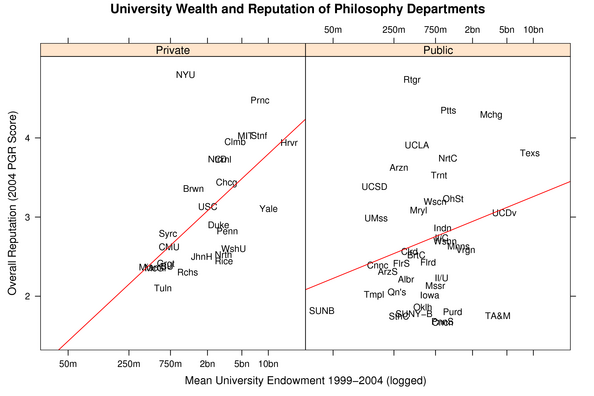
The relationship is pretty strong for Private schools, and weaker for public ones. I believe this is because endowments better index the overall wealth of private than public schools, given that the latter get more money from the state. Of course, much as they would like to, philosophy departments don’t get to spend the whole endowment. But in a way this makes the strong tie between the two more interesting, both when it does obtain and when it doesn’t. NYU stands out. It’s a pretty rich university, but not spectacularly so. Yet it has the top-ranked philosophy department , which we would not expect at all based simply on its endowment. (Rutgers, the top-ranked public school and #2 overall, is also a very interesting case.) When it comes to investing in prestige, philosophers may be a good bet for an urban university. Occasional foodies notwithstanding, they do not take up much space compared to, say, particle accelerators or engineering labs. Also unlike particle accelerators, philosophers are fueled mainly by coffee, beer and small pastries. Rather than reflecting some conscious strategy at the university level, the strong performers might represent the existence either of substantial department-level resources accumulated over time, or the presence of entrepreneurial chairs or administrators who have managed to get their hands on extra money. Conversely, schools like Texas A&M and Yale do not do as well as we would expect on the basis of the overall wealth of the university.
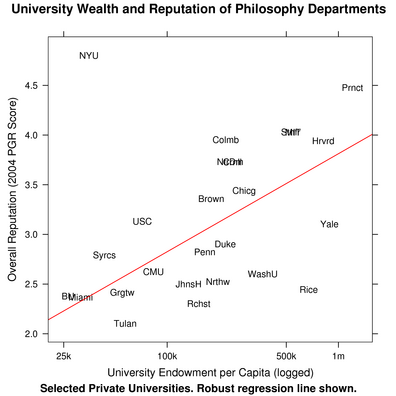
*Update*: Here’s a plot of reputation against per capita endowment (per FTE student). I’ve only shown the private universities because I don’t think the endowment numbers for public schools are that informative. Once again, you can see NYU is a big outlier. Rice also appears as a distinctive observation with this measure. (A “PDF version”:http://www.kieranhealy.org/files/misc/endow-percap-priv-pgr.pdf is available as before.)
{ 51 comments }