Rebalancing rights

by John Q on April 2, 2019

That’s the title of a collection of papers published by the Green Institute, including one I posted here a little while ago. Lots of people were involved but Tim Hollo was the prime mover on this one.

Over the fold, a statement of my view that property rights, notably the rights of corporationsl are socially constructed. That view isn’t universally shared, to put it mildly, so feel free to respond.

[click to continue…]

{ 41 comments }

Sunday photoblogging: Strasbourg Cathedral

by Chris Bertram on March 31, 2019

One from back in 2013

Strasbourg Cathedral-3

{ 4 comments }

Three things have made me think about why the way we do policy is wrong; the European Parliament passed the Copyright Directive, privileging IP over everyone else and locking in the current Big Tech players it affected to despise; climate breakdown rumbled on through a wave of public protests with no meaningful way to connect public concern to parliamentary processes and build in future harms to present decisions; and it emerged that more than one new housing development around where I live have ‘playground apartheid’, where kids living in the less expensive apartments aren’t allowed to play in the parks being created.

I was really, really, really not going to write about this as I finally have some energy and emotional wherewithal to crack into a shedload of deadlines, but then Chris Marsden – who you should follow if you’re interested in tech – tweeted this:

“Because @Europarl_EN is abolishing the future, I thought I’d time travel back to when we thought evidence based policy was worth a try”

And of course Chris is right. We are abolishing the future. Our policy processes are broken not just horizontally – they privilege lobbyists over citizens for reasons anyone who’s ever heard of a collective action problem will understand – but temporally. [click to continue…]

{ 47 comments }

Rights of Nature, but not natural rights ?

by John Q on March 24, 2019

There’s an interesting article by Anna Grear in Aeon, criticising the idea that Nature should have human-style rights, and linking to the website of the Centre for Humans and Nature, which has lots more interesting discussion.

I’ve recently written a contribution to a forthcoming book by Tim Hollo, in which I take the opposite view. My central point is that corporations are routinely treated as persons for legal purposes, and that the effect is frequently harmful to Nature. There is in my view, no reason in principle, not to give legal standing to representatives of Nature, similar to that given to the representatives of social constructions like corporations. A lengthy extract over the fold.

[click to continue…]

{ 73 comments }

Sunday photoblogging: People’s Vote march

by Chris Bertram on March 24, 2019

People's Vote March 23 March 2019-10

A shot from yesterday’s People’s Vote march to stop Brexit. (There are some other pictures on my Flickrstream of the same event.) We’ve reached a crunch moment when those of us who want the UK to remain in the European Union could win or where we end up with a disorderly exit (followed by a humiliating agreement from a position of weakness).

{ 72 comments }

Sunday photoblogging: Hebron Road

by Chris Bertram on March 17, 2019

Hebron Road, BS3

{ 5 comments }

Next week: the EthicsLab launch in Yaoundé

by Ingrid Robeyns on March 16, 2019

Next week, the EthicsLab is launched in Yaoundé, the capital of Cameroon. This is a new research center on ethics and public policy at the Université Catholique d’Afrique Centrale, which aims to foster research on these issues in Central Africa. The launching is a big event, with one week of workshops as well as a conference where ethicists and political philosophers from around the world come together to help the EthicsLab build its research agenda.

The driving force behind the EthicsLab is Dr. Thierry Ngosso, currently a Berggruen Fellow at the J. Safra Center for Ethics at Harvard University, who has been working towards this launch for many years. I am in absolute admiration of how he has managed to get this together – given that he did this as a PhD-student and subsequently during a series of temporary postdocs positions. But Thierry has been very smart and very patient, building this step by step, first organising a series of Summerschools with help of his (local and international) friends, and then taking the next step to launch the EthicsLab.

For me, as a European participant to this event, I also feel very excited about getting to know so many political philosophers and ethicists who are based in Africa. The list of participants consists of a mixture of philosophers from different African countries, or African philosophers working outside Africa, as well as international (mainly American and European) colleagues. It’s not surprising that we know colleagues from nearby places better than from further away places. But still, I know more international colleagues from the US, Canada and Australia than from Africa or Latin-America: resources, and possibly also language, matter too.

So, three cheers for the EthicsLab, and wishing them lots of success in strengthening ethics and political philosophy in Central Africa!

{ 6 comments }

Lessons from Dutch academic activism (part 1)

by Ingrid Robeyns on March 15, 2019

I have been a very poor blogger here at CT recently. That’s because I took up a second job – namely becoming an activist for the reform of the funding of Dutch academia. I have been wanting to try to write on this here repeatedly, but one thing that stopped me was that I didn’t know where to start. So rather than overstreching myself (what I have already been doing in real life…), I thought I can write a series of posts (irregularly, and I may not write more than two or three) on what general lessons one can learn from being an academic who engages in activism to reform academia.

So off we go, with lesson 1.
[click to continue…]

{ 24 comments }

Whipping

by Harry on March 13, 2019

If you were an MP, and your party was in government, and it proposed a motion, but promised that you could have a free vote on that motion, but then at the last minute whipped you to vote against a slightly modified version of that same motion (the motion it, itself, had proposed, minus one statement of fact which, though removed, everyone knows still to be a fact), how long would it take you to get back to your constituency and prepare for a general election? And, more generally, what would you be thinking?

And, does this count as a victory for May? The motion she proposed passed, after all, despite her orders for her party to vote against it.

{ 83 comments }

Why is carbon pricing so hard?

by John Q on March 13, 2019

I’ve just published a piece in Aeon (an excellent and free online magazine) drawing on the analysis in my (about to be published) book Economics in Two Lessons. I make the case that carbon pricing, whether through a tax of an emissions trading scheme, is the most cost-effective way to stabilize the global climate. Moreover, it’s straightforward to offset any adverse effects on low-income earners, displaced workers and others.

That raises the obvious question: if carbon pricing is so good, why is it so hard to implement, compared to less efficient alternatives like mandatory renewable targets. One factor, which I discuss, is that the creation of property rights over previously open-access resources creates obvious, and often powerful losers.

I was limited by space, so I couldn’t discuss the more puzzling problem of why regulations are more politically salable than prices even in the absence of income effects.

{ 33 comments }

Notes on Peterson, Shapiro, Facts, Feelings

by John Holbo on March 10, 2019

I teach Plato’s Meno. I emphasize that, despite it being a hard dialogue, Meno, the guy, isn’t hard to size up. ‘Virtue’ is success. Meno is a get-ahead guy. Are some guys born with it, do you get it by practice, is there intellectual secret sauce? I talk to my students about self-help books. What good, do you think, can a book like How To Win Friends and Influence People do you?

You can read my commentary chapter on Meno here. There’s quite a bit of self-help stuff in it. (You can always buy my book on Amazon! [Associates link.])

Since this is my angle, I should keep up with the self-help scene, shouldn’t I? But, I confess, I didn’t keep tabs on the meteoric rise of Jordan Peterson. At first, when I heard folks complaining, I thought: stern Canadian Jungian? Sweet Tiamat in Toronto, sounds Abzulutely fabulous! Like the premise for a Guy Madden film.

Recently I tried to find time to familiarize myself better. Let me share with you a bit from one exchange that struck me as especially … well, yes, funny. It’s from a 2-hour episode of the Rubin Report, from November 30, 2018. It’s Jordan Peterson, Ben Shapiro and Dave Rubin talking “religion, trans activism, censorship, the IDW and more.” (Hey. I study the metaphysics of self-help literature. I gotta dance with the one what brung me.)

Round about minute 52 it runs sort of like this. (Very rough transcript, not word-for-word. but I’ve tried to be fair, not omitting anything that changes the sense. You can check it against audio. If I have made transcription errors or left out any detail that changes the sense, I will correct.) [click to continue…]

{ 82 comments }

Monopoly: too big to ignore

by John Q on March 9, 2019

That’s the headline given to my latest piece in Inside Story

Here’s the opening para

Two hundred years after the birth of Karl Marx and fifty years after the last Western upsurge of revolutionary ferment in 1968, the term “monopoly capitalism” might seem like a relic of outmoded enthusiasms. But economists are increasingly coming to the view that monopolies, and associated market failures, have never been a bigger problem.

and the conclusion

The problems of monopoly and inequality may seem so large as to defy any response. But we faced similar problems when capitalism first emerged, and Western countries came up with the responses that created the broad-based prosperity of the mid twentieth century. The internet, in particular, has the potential to enhance freedom and equality rather than facilitate corporate exploitation. The missing ingredient, so far, has been the political will.

{ 10 comments }

Locke and slavery, again

by John Q on March 9, 2019

A few years ago, I wrote a series of articles in Jacobin showing how Locke’s theory of property, on which most modern propertarianism is based, was entirely consistent with his personal involvement in American slavery and the expropriation of indigenous Americans. Historian Holly Brewer has come to Locke’s defence, pointing to more evidence about Locke’s involvement in American affairs, of which I was previously unaware. I’ve responded[1], arguing that, far from exonerating Locke, the new evidence shows that Locke was deeply enmeshed in American slavery throughout his life, yet never took a stand against it.

Brewer’s broader concern is to defend liberalism against critics who argue, pointing to Locke and the US Founding Fathers, that the whole ideology was conceived in the context of slavery. Here, I think she is making a mistake in accepting the idea of Locke, rather than the much more defensible Adam Smith as the founding theorist of liberalism.

[click to continue…]

{ 8 comments }

MMT and the scope for seigniorage

by John Q on March 6, 2019

The central idea of Modern Monetary Theory (MMT), as I understand it, is that, rather than worrying about budget balances, governments and monetary authority should set taxation levels, for a given level of public expenditure, so that the amount of money issued is consistent with low and stable inflation. In this context, the value of the net increase in money issue is referred to as seigniorage. To the extent that seigniorage is consistent with stable inflation, it is achieved by mobilising previously unemployed resources.

A crucial question is: what is the scope for seigniorage? In particular (expressing things in MMT terms), is the scope for seigniorage sufficient to permit the introduction of ambitious programs like a Green New Deal without the need for higher taxes to prevent inflation.

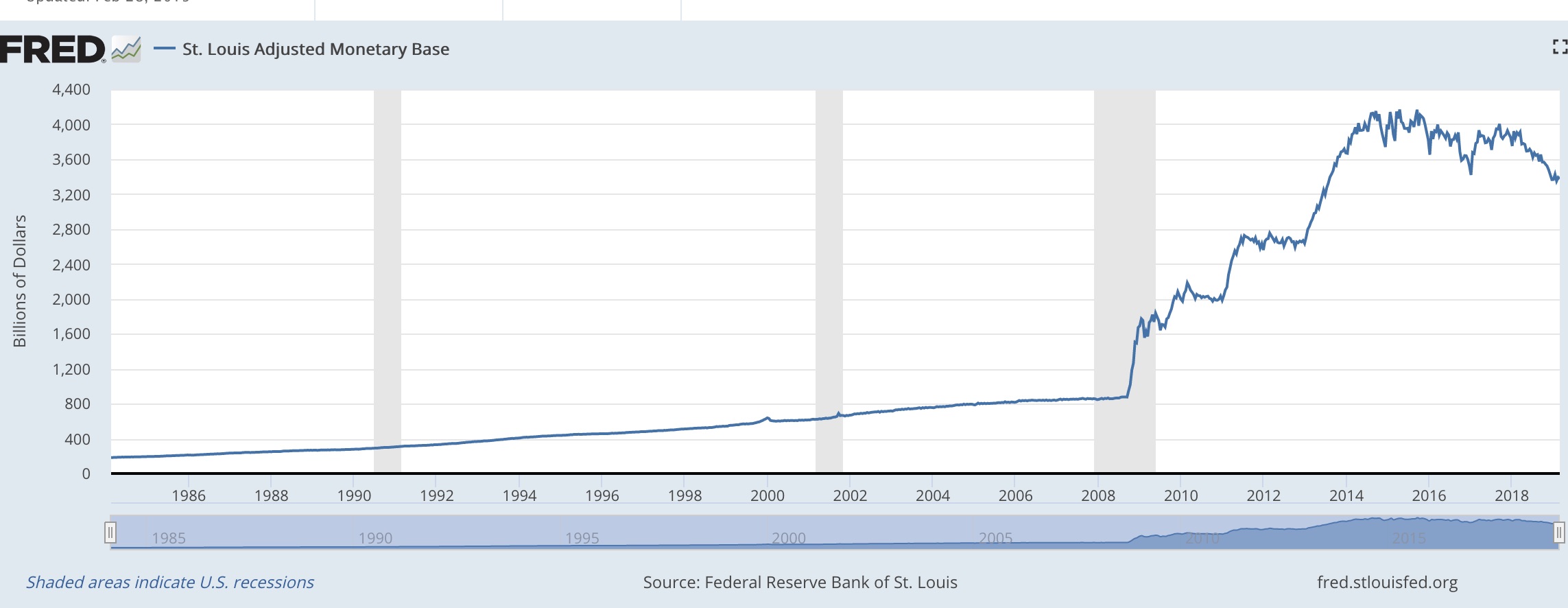
The recent episode of Quantitative Expansion in the US provides some evidence here. Contrary to the dire predictions of some critics, QE did not lead to runaway inflation. This is consistent with the view, shared by MMT advocates and mainstream Keynesians, that, in the context of a liquidity trap and zero interest rates, there is substantial scope for monetary expansion.

How much is “substantial”?

According to the St Louis Fed, the monetary base grew from around $800 billion to just over $4 trillion between 2008 and 2016. That’s an increase of $3.2 trillion, which is a lot of money. Expressed in terms of GDP, though, it doesn’t seem quite as large. Over eight years, $3.2 trillion is $400 billion a year or around 2 per cent of US GDP ($20 trillion).

[click to continue…]

{ 39 comments }

The transformation of left neoliberalism

by Henry Farrell on March 5, 2019

I haven’t been blogging at Crooked Timber as much as I used to. That doesn’t mean I haven’t been active – the last two years have probably been the most productive two years of my life (it turns out that my way of dealing with political stress is to write. and write. and write – more on that as the stuff I have been up to comes out). But it’s hard to resist noting Brad DeLong’s <a href=”https://www.vox.com/policy-and-politics/2019/3/4/18246381/democrats-clinton-sanders-left-brad-delong”>very good interview</a>, and Mike Konczal’s response to it. Brad:

<blockquote>Until something non-rubble-ish is built in the Republican center, what might be good incremental policies just cannot be successfully implemented in an America as we know it today. We need Medicare-for-all, funded by a carbon tax, with a whole bunch of UBI rebates for the poor and public investment in green technologies. That’s the best policy given the political-economic context. If the political-economic context were different — well, I’m fundamentally a neoliberal shill. It is very nice to use market means to social democratic ends when they are more effective, and they often are. If you can properly tweak market prices, you then don’t just have one smart guy trying to design a policy that advances an objective — you have 30 million people all over the country, all incentivized to design a policy. That’s a wonderful thing to have.</blockquote>

Mike:

<blockquote>Delong focuses on the political aspect of this shift, noting that there is nothing on the conservative Right that meets left-leaning neoliberals halfway to try and negotiate market-based policies. “Barack Obama rolls into office with Mitt Romney’s health care policy, with John McCain’s climate policy, with Bill Clinton’s tax policy, and George H.W. Bush’s foreign policy,” and yet conservatives give him zero credit, call him a socialist, and actually attack each of these ideas just as much as they would more ultra-left policies. … I’ve also carried a rifle in this battle, trying to move the party Left—and it is happening. But this movement is happening largely because the story that left neoliberals tell us all about the economy itself, not just the politics of it, has fallen apart. … This is a matter of ideas: ideas having failed, and us needing new ones. … The positive effects of more inequality never happened. … we are seeing a revival of structural arguments that wages are increasingly determined by institutional structures rather than individual measures. … Relaxation of antitrust enforcement would lead to more competition and innovation, as was told. Unions would no longer get in the way of businesses. [but] …  firm dynamism has fallen dramatically. The rate of business startups has fallen. … high markups and profits, low interest rates, weak investment—point to a significant market power problem that impacts the macroeconomy.</blockquote>

Mike is building on the old Internet argument about ‘left neoliberalism’ (a term that I semi-accidentally popularized; but the best and most succinct <a href=”http://bactra.org/weblog/778.html”>account was Cosma’s</a>). It’s notable that the people like Brad, Matt Yglesias and Ezra Klein who got grief in that debate have moved significantly to the left in the interim: Brad’s interview is a formal acknowledgment of a shift that has been taking place for a long time. Which is not to say that they are going to join the DSA, but that just as there’s a significant distinction between social democrats and democratic socialists, they have plausibly changed from being left neoliberals to neoliberal leftists. It isn’t just that they want neoliberal tools to deliver left-leaning results; they have always wanted that. It is that they tacitly or explicitly realize that preferred neoliberal means of policy delivery need to be embedded in a framework that is being built up by a broader social movement.

Two questions follow (for me, anyway). One is for the neoliberal leftists, as a part of a broader left coalition. When and to what extent will their preferred approach to delivering policy clash with, or undermine, the necessary conditions for achieving collective action and making the policy sustainable? If they are pushing for market means towards social democratic ends, that is fine and good – markets can indeed sometimes be the best way to deliver those ends, and few of us would want to be completely without them (including Marxists like <a href=”https://catalyst-journal.com/vol2/no3/socialism-for-realists”>Sam Gindin</a>. But one key lesson of the last couple of decades is that market provision of benefits makes it harder to build and sustain coalitions – private gain and public solidarity are at best uncomfortable bedfellows. Figuring out the political tradeoffs – when market means are worthwhile even when they make collective action tougher, or where non-market means might be better for sustainability reasons, even when markets are more efficient – is going to be hard, and we need to start building shared language and concepts to make it easier to resolve the inevitable disputes.

The other is for the left including both its neoliberal and non-neoliberal variants. It is clear why Brad and others are jumping ship – apart from the intellectual problems that Mike describes, there isn’t a politically viable there there to their right. But  I am not as sure as I would like to be about the there there to their left either. The left is enjoying a resurgence in the US (not so much elsewhere). There are coalitions being formed, plans being conceived. But there are enormous obstacles to be overcome. First in the US (where the system seems almost deliberately designed to prevent the radical action required e.g. to tackle global warming, and where billionaires can credibly threaten to pull down the election if the Democratic candidate is not to their liking). Second, at the global level, where the soi-disant liberal order is in decay, and it is not clear that there is very much that is going to replace it. There may be no plausible choice in American politics other than the left right now. That doesn’t mean that the left has a very good chance of doing the things that it needs to do.


{ 64 comments }