I used to blog about opera a fair bit here at CT, but I’ve tended to let that go over recent years, after all, I lack the competence of a proper music critic. Still, I would like to report that Saturday’s premiere of WNO’s production of Die Meistersinger, with Bryn Terfel as Hans Sachs, was the most stunning and energizing operatic performance I’ve ever attended. Started and 4, finished at 10, but those hours went awfully quickly. The music was wonderful, Terfel is an awesome presence on the stage, and the chorus – especially in the final act – was simply amazing. The staging, especially in Act 3, was also breathtaking. When you add in that the venue is probably the best one in the UK for opera, it all came together for a terrific evening capped by an energetic standing ovation from the audience. The production will be broadcast (a concert performance) as part of this year’s Proms (Radio 3 and BBC4) so if you are somewhere you can catch it, do so. If you can get hold of any tickets for the remaining performances in Cardiff or Birmingham, do so (and sell your most prized possessions to acquire them). Today’s papers have a couple of reviews: Andrew Clark in the FT and Andrew Clements in the Guardian . What would you have to do to get unqualified enthusiasm from those guys? (UPDATE: Rupert Christiansen in the Telegraph, a much better judged review.)
From the category archives:
Culture
This should really be a comment to Henry’s post, but I have the keys to this car, so I’m going to drive it, too. We have Zuckerberg’s remark:
I first heard about David Lipsky’s Although Of Course You End Up Becoming Yourself: A Road Trip With David Foster Wallace from Mark Athitakis when we were on a panel in New York a few weeks ago. The book consists of transcripts from a prolonged interview with Wallace conducted just after Infinite Jest appeared. I’ve published some comments on the book elsewhere, but wanted to pluck out and pass along a long passage — one that Mark read during the panel discussion.
It spins out from a reference to the Interlace system in IJ, but you can skip the background without losing the point. (Ellipses in brackets are mine; otherwise they are sic from the text, as with much else.)
[click to continue…]
This is pretty good, though it tails off towards the end. The material about breaking the “colour bar” on the Bristol buses, the St Paul’s riot of 1980 and the growth of drugs in the 1990s is all very well done. (Best seen by going to Playlist )
Influential upon myself, I mean. Everyone else is doing it, at least for “American/white/politics/economics/mostly libertarian type guys” values of “everyone”. I suck at lists like this. It’s hard to give an honest answer, in part because I’m not prone to conscious conversion experiences, but mostly because I’m good at repressing things and so really find it hard to remember things I read that really hooked me at the time.
In any event, and in roughly chronological order:
If you are one of the few remaining people not to have tried it out, watch this movie or this Daily Show clip and then come back here. The rest of you know that Chatroulette is a human slot machine where pretty much every other round comes up with some guy abusing himself or demanding that any ladies within range expose themselves. As a trained observer of human behavior I was professionally obliged to investigate. Bearing in mind the second sort of modal user, I used the following image:

Selected perfectly SFW results follow.
Sometimes a thought occurs about something that might make for an interesting blog post, but I realise that whilst I know enough to have the thought, I’d have to do a great deal of research to write something that would survive the scrutiny of people who know their stuff. Still, it may be that commenters who know more than me can say something of value, and that I could at least serve as a prompt. So here goes. An article on the BBC website discusses the recommendations of a French parliamentary committee which described the veil as :
bq. “contrary to the values of the republic” and called on parliament to adopt a formal resolution proclaiming “all of France is saying ‘no’ to the full veil”.
Hmm, I thought. It wasn’t so long ago that “all of France”, at least for some values of “all of France” had a more divided view about the veil. Roughly at this time, in fact:
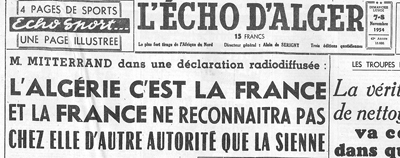
(Picture nicked from the very excellent Images of France and Algeria blog, which has, incidentally, lots of interesting stuff on the 1961 Paris massacres of Algerians.)
But then I also remembered that official France had not, in fact, been very tolerant of the veiling of Algerian women. The photographer Marc Garanger is famous for his many pictures, taken during the war, of Muslim women forcibly unveiled so that they could be photographed for compulsory ID cards. There are some here . So how did that all work out then? A little googling reveals that this very month, historian Neil MacMaster has a new book entitled _Burning the Veil: The Algerian war and the ’emancipation’ of Muslim women, 1954-62_ (Manchester University Press). I couldn’t find any reviews, as yet. The blurb writes about a campaign of forced modernisation followed by a post-revolutionary backlash involving a worsening of the position of women in Algeria.
So two thoughts then: (1) far from being an aberration in France, there was a very recent period when very many French women (or perhaps “French” women) were veiled; (2) attempts by the state to change that didn’t lead to female emancipation and the triumph of Enlightenment values.
Winter has been brutal in more than the obvious ways. I just heard via a friend’s Facebook update that Vic Chestnutt gave up the ghost on Christmas Day. Justin Keating, a lion of the Irish left has also died (Garrett Fitzgerald remembers their work together in cabinet here) Cardinal Cathal Daly has gone to God, just as the Catholic hierarchy finally, mulishly owns up to its failure to protect children from sexual abuse. By Irish standards, his funeral seemed small and subdued, testament to the painful truth that however much we get right in this life, getting one awful thing very, very wrong is hard for others to forgive.
A funeral full of colourful characters, sadness and celebration was that of Michael Dwyer, Ireland’s best film critic. He was described by Daniel Day Lewis as “gentle, modest and kind”, a critic who “was never cruel, ever, nor was he self-serving.” That is high praise from an actor. (More here) Dwyer wasn’t afraid to tell you when a film was rubbish. He just had no need for spite or ego in how he did it.
Hugh Linehan relates many of Michael Dwyer’s achievements, and reminds me of lots I hadn’t known of or had forgotten: Dwyer was a Kerryman, and gave the Tralee Film Society and later the Federation of Irish Film Societies a kick in the arse at a time when there was so little choice in Ireland for films, books and music. He founded and later saved the Dublin Film Festival. Dwyer had friends throughout the world of cinema; the French government recognized him and declared him a Chevalier des Arts et des Lettres.
I grew up in a little town in 1980s Ireland. I wouldn’t wish to have lived anywhere else, but even to a rather prim teenager it felt limited. Most of the notoriously banned books like Ulysses or Lady Chatterley’s Lover were freely available by then, but our cultural window was still narrow. Books were Mills and Boone in the supermarket or something you went to Dublin for. Films were whatever was showing at the local flea-pit, assuming it was open and not, at that moment, turned into a restaurant or just left to rot. Television had two channels and video, when Xtravision came to our town, was mostly Rocky’s and Jean Claude van Damme flicks.
[click to continue…]
bq. If sketchy in other regards, _Brother West_ is never anything but expansive on how Cornel West feels about Cornel West. He is deeply committed to his committed-ness, and passionately passionate about being full of passion. Various works of art, literature, music, and philosophy remind West of himself. He finds Augustinian humility to be deeply meaningful. This is mentioned in one sentence. His taste for three-piece suits is full of subtle implications that require a couple of substantial paragraphs to elucidate.
From Scott's _IHE_ evisceration of Cornel West’s latest effusion. Recommended.
Update: I want to be finished with this, but probably should respond to Edward Champion's pissy little attack on Scott, since I helped launch this snowball down the hill in the first place. The bit about Scott not having published a book is fair enough, as far as it goes (which isn’t very far). But the bit about how Scott is “a man who doesn’t even possess a bachelor’s degree” is not. Academic credentialism is a pretty shitty substitute for argument – and if Champion disagrees and really wants to play that game, he should perhaps cough up a bit more about his own academic accolades and accomplishments for those (like himself) who care about these things. The crack about how:
his crude and lifeless essays have proven so soporific that, in 2004, the National Book Critics Circle awarded him the dubious Nona Balakian Citation for Excellence in Reviewing for his unadventurous pursuits. It was a questionable distinction, enervated by the fact that only a handful of out-of-touch elitists actually care about this dubious accolade
acquires a somewhat different resonance if one knows that Champion ran against Scott to be elected to the board of aforesaid organization – and lost. One can only presume that their failure to elect him by acclaim is Complete and Sufficient Evidence of their out-of-touch-eliteyness.
Champion is a bit of a sad sack – a gnawer-over of scraps of literary carrion disdained by larger predators and snarler at those whom he fears might take them away from him. And furthermore a writer possessed of a wavering and uncertain grasp of the English language (viz. the rummy use of ‘enervated’ in the passage above) and perpetrator of such metaphors as “a superficial conclusion distressingly reminiscent of a teabagger’s uninformed protest.”
Update 2: Scott responds to the fried chicken nonsense in his new _IHE_ column.
This post is going to have it all: comics, fonts, broadbrush high-lowbrow cultural opinionation, curiously reasonably priced British TV.
We’ll start with fonts. Why did the modernists go ga-ga for sans serif? Take Tschichold, my recent subject of study. Early in his career, he dogmatizes that there is something technically obligatory, inherently suited to the Engineering Age, about sanserif type. What induced him to make such an implausibly strong claim, and induced others to buy it, was somehow a tremendous aesthetic impulse in this direction. This felt so necessary. Human beings aren’t skeptical of arguments that give them exactly what they want, so bad arguments are often most interesting as indices of desire. But what was the Big Deal with filing down all the little pointy bits, all of a sudden? [click to continue…]
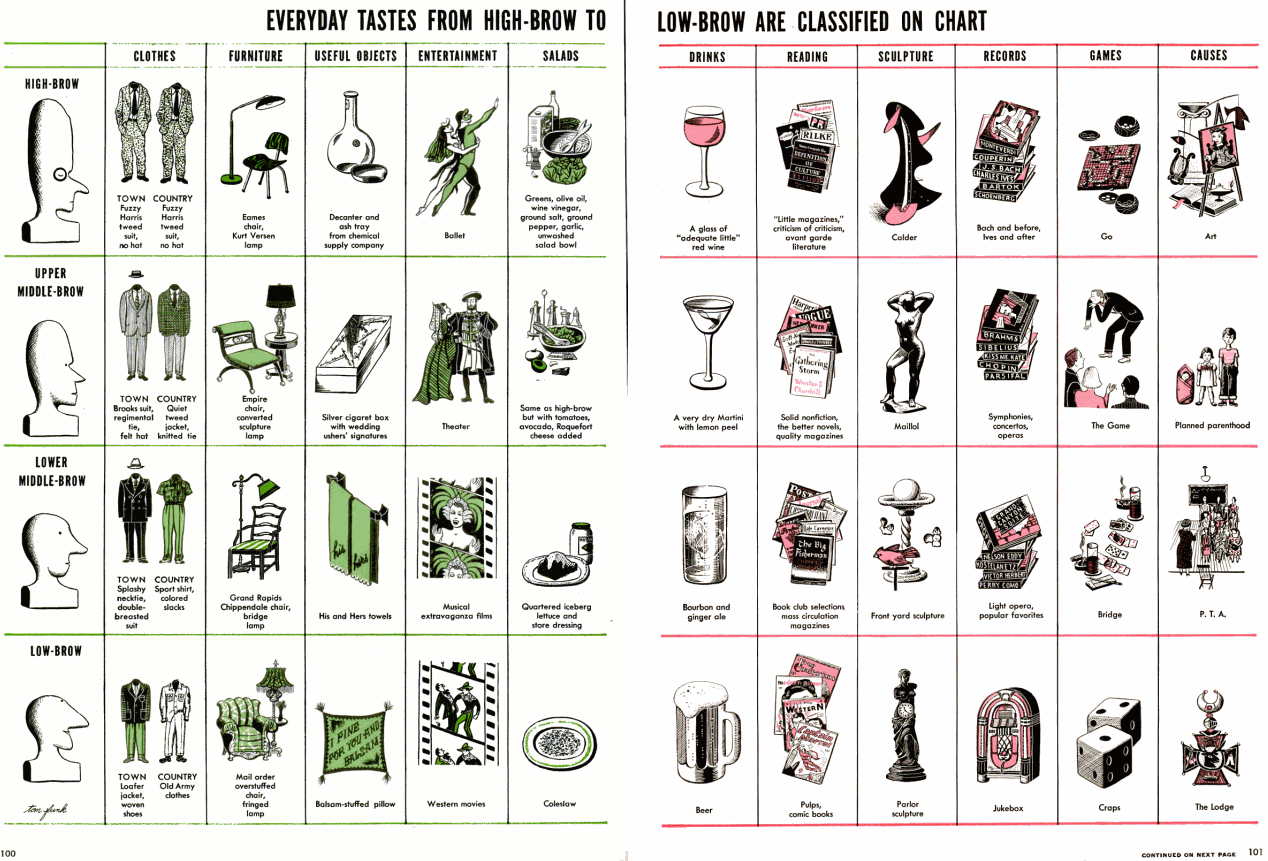
From a 1949 issue of Life Magazine, your guide to the “three basic categories of a new U.S. social structure — and the high brows have the whip hand”. With the rise of the cultural omnivore still well off in the distance, this is your must-have guide for the vagaries of mainstream culture in postwar America. Click for a larger version.
Those of you working in higher education in the UK already know about the barbarous proposal to make future support for research depend on a government assessment of its “impact” – in other worlds whether there’s a tangible payoff in terms of economic growth or social policy. Whilst some people — “Wordsworth Country!” — will no doubt be able to spin the positive effects of their works for tourism, and those designing surface-to-air missiles systems will be about to cite the probable benefits to UK exports, others are not so lucky. Medieval French poetry, the metaphysics of holes, set theory … forget it, basically. The comedian David Mitchell had a pretty good column recently on the whole miserable business.
My colleague James Ladyman has launched a petition on the No.10 website to tell Gordon Brown what we think of the idea. If you’re British, even if you don’t live in the UK any more, pop over and sign it .
I was kind of surprised to see that the wonderful Tom Russell has a long essay on some new blog called The Rumpus, all about Juarez, El Paso, drug wars, borderlands, corruption, et cetera. I love his music, and I like his writing too, so I’m always pleased to see some more of it. The content, though, the content is shocking.
bq. I turned that page in section B where there was a short item about two El Pasoans slain yesterday in a Juarez bar shooting. Back page stuff. Hidden near the end of the story was the astounding body count: _nearly 2900 people, including more than 160 this month alone, have been killed in Juarez since a war between drug traffickers erupted January 2008_ . John Wesley Hardin wouldn’t stand a chance.
Jesus. You’re probably safer in Kandahar.
… as, for example, when the conversation is <a href=”http://theconversation.blogs.nytimes.com/2009/06/03/guns-gays-and-abortion/”>an exchange between Gail Collins and David Brooks</a> on “Guns, Gays and Abortion” that begins,
<blockquote><b>Gail Collins:</b>Â David, can we talk hot-button social issues for a second? I know this is not really an area where you fly the conservative colors, but <i>you’re the go-to guy on how America lives</i>, and I’d like to hear your thoughts even if we can’t work up a fight.</blockquote>
This just makes me want to lie down on top of the <a href=”http://www.hoffmania.com/blog/2008/06/brooks-obama-do.html”>Applebee’s salad bar</a> and never get up again.
This essay on _The New Criterion_ by George Scialabba (not our own Scott McLemee, thank you very muchmisattribution now corrected) has been getting some recent attention because it says harsh things along the way about cultural diversity. Although Scialabba certainly doesn’t like the culturalist left very much, his discussion of its problems are a class of a diversion on the way to the main argument of the piece, which concerns the problems of the cultural conservatives who criticize them.
the New Criterionists sometimes boast that they and not the multiculturalists are the true democrats, applying to themselves Arnold’s words in Culture and Anarchy “The men of culture are the true apostles of equality. [They] are those who have had a passion for diffusing, for making prevail, for carrying from one end of the society to the other, the best ideas of their time.” But it is a hollow boast. Arnold freely acknowledged, as Kramer and Kimball do not, the dependence of spiritual equality on at least a rough, approximate material equality.
in these and other passages Arnold demonstrated his humane moral imagination and democratic good faith. Kramer and Kimball have yet to demonstrate theirs. Finally, there is the complicated matter of disinterestedness, or intellectual conscience. That both Kramer and Kimball would sooner die than fake a fact or twist a quote, I do not doubt. But disinterestedness is something larger, finer, rarer than that. To perceive as readily and pursue as energetically the difficulties of one’s own position as those of one’s opponent’s; to take pains to discover, and present fully, the genuine problem that one’s opponent is, however futilely, addressing — this is disinterestedness as Arnold understood it.
Arnold thought he had found a splendid example of it in Burke who, at the close of his last attack on the French Revolution, nevertheless conceded some doubts about the wisdom of opposing to the bitter end the new spirit of the age. …I wish I could imagine someday praising Kramer and Kimball in such terms. But alas, I know nothing more un-New-Criterion-ish.
This, and other essays, are collected in Scialabba’s new book, which is just out (I got my copy yesterday), and which I can’t recommend highly enough. This bit, on Robert Conquest, has the quality of the best aphorisms:
It may be a delusion, as Conquest repeats endlessly, to imagine that state power can ever create a just society. But one reason some people are perennially tempted to try is that private power is generally so comfortable with unjust ones.
I’d enjoyed Scialabba’s essays very much when I read them individually, but to be properly appreciated, they should be read together. NB also that Scott, while entirely innocent of the essay quoted above, did write the introduction to the new volume.