by Ingrid Robeyns on November 10, 2025
With another COP starting today, and the question of climate change having played no role at all in the Dutch elections recently, and, well, for a zillion different reasons – it seems like a good time to ask the question: what books can help to make people move on this topic? (or if you think books are the wrong medium, and we should only look at TikToks or cinema movies or Netflix series, I’d love to hear arguments for that view too).
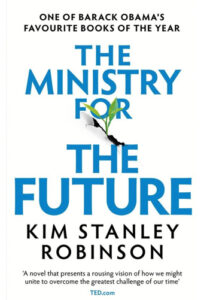 To me, the most magnificent fiction book on climate change is Kim Stanley Robinson’s The Ministry for the Future. It is phenomenal. I hadn’t read it yet when Henry organised a seminar on the book here at Crooked Timber, but I can only say: do read it. Admittedly, the book is very long – and this might be asking too much of many people, given the very many other demands on our lives. But there’s an easy solution: listen to it. This book is perfect as an audiobook. You listen while walking, and you’ll gradually get through the entire book while enjoying your daily walk. Given the many different voices in the book, it might even be better as an audio-book than to read it from paper/screen.
But since The Ministry for the Future already was discussed at length here, let me focus on two other books that might help to centre our awareness and political debates on climate change: Eleanor Catton’s Birnam Wood and Kimberly Nicholas’s Under the Sky We Make. The first is fiction, the second is non-fiction for citizens. Attention: one spoiler about Birnam Wood under the fold. [click to continue…]
by Ingrid Robeyns on December 9, 2024
A few weeks ago, seven political philosophers at my department, who regularly meet to discuss issues related to sustainable futures, met to discuss Hannah Ritchie’s book Not the End of the World. That book quickly appeared on the bestseller’s lists. For everyone who read her book, or is perhaps thinking about reading her book, here’s what we thought about it (which, regular readers of this blog will notice, is an example of Team Philosophy which we discussed here a while ago.)
Our review can be found below the fold.
[click to continue…]
by Doug Muir on September 20, 2024
Every few years the UN publishes one of these big papers on “world population prospects”, which are… exactly what they sound like: a best guess at what’s going to happen with the world’s population over the next few decades.
Nut graph after the jump:
[click to continue…]
by John Q on September 19, 2023
That was my suggested headline for my latest opinion piece, which ran in Australian online magazine Crikey under the sub-editors (blander IMO) choice of “We don’t need a nuclear renaissance. We need a solid plan on renewables”
The idea of the piece was to respond to Exhibit A in the case for nuclear power, the successful French construction program of the 1970s and 1980s, under the Messmer Plan. I’ve previously written about the way this program depended on the power of the French state at the time, which can’t easily be replicated today. A little while ago, I was suddenly struck by the thought that the Messmer Plan would have been much more effective if it were applied to solar and wind energy rather than nuclear. It’s over the fold (I’ve removed the lead, linking to current Australian politics)
[click to continue…]
by John Q on March 1, 2023
I’ve enjoyed Miriam’s posts on things, little and big, that restore our faith in humanity, so I thought I would share a little hope of my own.
I spend a lot of my time thinking about global heating, where it’s often hard to be optimistic about the future. But there are some bright spots. In particular, there’s a good chance that 2023 will be the year that coal use finally begins a sustained decline, and relatedly the year the carbon dioxide emissions from electricity generation start to fall.
[click to continue…]
by Eric Schliesser on November 24, 2022
The effect of such extreme climate change is difficult to predict. We just do not know what the world would be like if it were more than seven degrees warmer; most research has focused on the impact of less than five degrees. Warming of seven to ten degrees would do enormous harm to countries in the tropics, with many poor agrarian countries being hit by severe heat stress and drought. Since these countries have contributed the least to climate change, this would be a colossal injustice.
But it’s hard to see how even this could lead directly to civilisational collapse. For example, one pressing concern about climate change is the effect it might have on agriculture. Although climate change would be bad for agriculture in the tropics, there is scope for adaptation, temperate regions would not be as badly damaged, and frozen land would be freed up at higher latitudes. There is a similar picture for heat stress. Outdoor labour would become increasingly difficult in the tropics because of heat stress, which would be disastrous for hotter and poorer countries with limited adaptive capacity. But richer countries would be able to adapt, and temperate regions would emerge relatively unscathed.–William MacAskill (2022) What We Owe The Future, “chapter 6: collapse” p 136.
Two ground-rules about what follows:
- I ignore all the good non-longtermist, effective altruism (EA) has done. It’s mostly wonderful stuff, and no cynicism about it is warranted.
- I ignore MacAskill’s association with SBF/FTX. I have said what I want to say about it (here), although if any longtermists associated with the EA movement come to comment here, I hope they remember that the EA community directly benefitted from fraud (and that there is an interesting question to what degree it was facilitated by the relentless mutual backscratching of the intellectual side of the EA community and SBF); and perhaps focus on helping the victims of SBF.
- Perhaps, for some consequentialists (1) and (2) cancel each other out?
Anyway, after my post on MacAskill’s twitter thread (here) and my post on the concluding pages of Parfit’s Reasons and Persons (here), I was told by numerous people that I ought to read MacAskill’s What We Owe the Future. And while I am going to be rather critical in what follows (and subsequent posts), I want to note a few important caveats: first, MacAskill is asking very interesting social questions, and draws on a wide range of examples (also historically far apart). I am happy this is a possible future for philosophy today. Second, he is an engaging writer. Third, What We Owe the Future is — as the first and last chapter make clear — quite explicitly intended as a contribution to movement building, and that means that the standards of evaluation cannot be (say) identical to what one might expect in a journal article. In a future post, I’ll have something to say about the relationship between public philosophy and movement building, but in this post I will be silent on it. Fourth, if you are looking for a philosophically stimulating review of What We Owe the Future, I warmly recommend Peter Wolfendale’s essay here for a general overview (here). If you are especially interested in objections to the axiology, I warmly recommend Kierin Setiya’s piece in Boston Review (here). It’s also worth re-reading Amia Srinivasan’s high profile, prescient critique of MacAskill’s earlier work (here).*
[click to continue…]
by Ingrid Robeyns on October 31, 2022
Yesterday I attended/watched four talks on climate action. The first three were at a festival in Amsterdam where Chris Armstrong, a new branch on our crooked tree, was also speaking, on his book on oceans politics. First I attended two talks by some Dutch-speaking people (including David Van Reybrouck, famous author of the colonial histories Congo and Revolusi, who is now fully dedicated to working on ecological causes). Then I attended Andreas Malm’s talk on how to fight in a world on fire. Nothing special to report for those who have read the book – but given the pretty critical discussion of my bookreview of his work here recently I’d thought I should mention that he came across as more nuanced than [how I read] his book. For example, he stressed that the vast majority of the climate movement will remain peaceful, and that those who want to move to sabotage must carefully choose their targets – focussing on targets that are part of the problem, and as part of an action that doesn’t alienate people but instead lets the climate movement grow.
But the most interesting talk of the day was by Greta Thunberg, who launched The Climate Book at the London Literature Festival. Thunberg has put together a one-stop-volume on climate change and climate action. You can watch her speech and subsequent interview here (it effectively starts at 14’35”). In essence, Thunberg believes that governments are not going to do what is needed without millions more climate activists putting pressure on those governments, so that they speed up action and put the interests of ordinary people central. At some point, she mentions that so many individuals have the opportunity to be an activist, but don’t. She clearly sees this as a [moral, political] duty (she also uses the word “burden” at some point), and calls upon everyone to join a local activist group. [click to continue…]
by Ingrid Robeyns on April 30, 2022
About a year ago, the old second-hand car that my husband and I bought in 2007 was nearing its end. It had served us very well, but our car mechanic had been warning us for some years that it wouldn’t last for much longer. So we were contemplating what to do; we thought seriously about car-sharing combined with public transport, but for various reasons (the pandemic being one, having a child with special needs another), we decided to buy another car. We gathered information and decided to buy an electric car. The new car has been wonderful – I’ve never really liked driving a car but driving an EV is much more pleasant. And in Utrecht, the city where we live, the local authorities put new electric chargers in the streets at the same pace that new EVs are registered. So, at home we’ve never encountered any noteworthy difficulties with charging.
Until last week, I think we only had positive things to say about our experiences with driving an EV. But then we decided to go to France for a week. [click to continue…]
by John Q on January 12, 2022
Most discussion of energy storage that I’ve seen has focused on batteries, with occasional mentions of pumped hydro. But in the last week, I’ve seen announcements of big investments in quite different technologies. Goldman Sachs just put $250 million ($US, I think) into a firm that claims to worked out the bugs that have prevented the use of compressed air storage until now
And several companies are working on gravity storage (raising and lowering massive blocks) to store and release energy
Underlying these points is a crucial fact in physics/engineering: Any reversible physical process is an energy storage technology.
That’s why concerns about the variability of wind and solar power will come to nothing in the end
[click to continue…]
by Ingrid Robeyns on December 14, 2021
In the Board of the Human Development and Capability Association (HDCA), where I’m currently serving as past-president, there has been an intensifying of the debate on the climate consequences of the annual conference. The HDCA is an international association of mainly academics, though it also attracts policy makers, activists, and others, who are interested in the human development approach (best-known from the UNDP’s Human Development Reports) and one of the main theoretical frameworks underpinning it, the capability approach.
The essence of the tension is clear: there is a significant cost in terms of greenhousegas-emissions of flying to another corner of the world to attend a three-day conference; greenhousegas-emissions need to be reduced as drastically and fast as possible in order to protect the climate, and a stable climate is an important precondition for human flourishing/human development. So what should an organisation such as the HDCA, or its individual members, do with this tension? Clearly, all academics still flying to conferences should ask themselves this question. Hence, let’s open up the discussion here, and see what insights (or good ideas) you might have. [click to continue…]
by Chris Bertram on May 26, 2021
One of the lessons of Branko Milanovic’s work on global inequality has been the realization that location, and perhaps more pertinently, nationality, is a more important explanation of how well and badly off people are than class is. Citizens of wealthy countries enjoy a “citizenship premium” over the inhabitants of poor ones that exists because they have access to labour markets and welfare systems that their fellow humans largely do not. Of course, there’s a sense in which this global difference also represents a class difference, with many of the workers simply located elsewhere while the residual “proletarians” of the wealthy world enjoy a contradictory class location (to repurpose a term from Erik Olin Wright). While it might be that world GDP would increase dramatically if barriers to movement were removed, as some economists have claimed, the relative position of the rich world poor depends upon those barriers being in place. Or to put it another way, free movement could make many poor people much better off and might not make the rich world poor any worse off in absolute terms, but it would erode their relative advantage. And people, however misguidedly care about their relative advantage.
What kind of politics would we expect to have in rich countries in a world like ours, if people were fully cognizant of this citizenship premium? I suspect the answer is that we would expect to see stronger nationalist movements seeking to preserve the advantage of members of the national collective over outsiders and correspondingly weaker parties based on class disadvantage within those countries. Which is, in fact, the tendency we do see in many European countries where traditional social democracy is struggling badly at the moment. In those same countries we might also expect to see some voters who are unthreatened by freer movement, or by the rise of new powers in the world, being more open to a more cosmopolitan politics and more preoccupied by other issues such as climate change and the environment. And this is, in fact, what we do see.
[click to continue…]
by Ingrid Robeyns on November 16, 2020
The United Nations Development Program’s flagship index of wellbeing and social progress, the Human Development Index, no longer captures what humans need, and needs to be replaced by a Green Human Development Index. That’s what I’ll argue in this post.
First, some context for those who do not know the Human Development Index (HDI). The HDI is the main index of the annual Human Development Reports, which, since 1990, have been published by the United Nations Development Program (UNDP). The reports analyse how countries are doing in terms of the wellbeing of their citizens, rather than the size of the economy. In 1990, the Pakistani economist Mahbub ul Haq had the visionary idea that in order to dethrone GDP per capita and economic growth as the yardstick for governmental policies, an alternative index was needed. He asked Amartya Sen to help him construct such an index. The rest is history. The HDI became a powerful alternative to GDP per capita. It consists of three dimensions and several indicators. The first dimension is human life itself, for which the indicators are child mortality and life expectancy. The second dimension is knowledge, captured by school enrollment rates and adult literacy rates. And the last dimension is the standard of living, for which the logarithmic function of GDP per capita is used.
It is easy to criticize the HDI for not capturing all dimensions of wellbeing, or for other shortcomings. For whatever those academic arguments are worth, there is no denying at how successful the HDI has been at accomplishing its two primary purposes: to dethrone GDP per capita and economic growth as the sole yardsticks for societal progress, and to stimulate policy makers to put human beings central in their institutional design and policy making. And by that yardstick, the HDI has been a great success. Each year, the release of the Human Development Reports captures the attention of media and policy makers worldwide. Many politicians and governments care about their ranking in comparison with other countries. And, most importantly, the political power of the HDI provides an incentive for countries to try to invest more in education and health, combatting child mortality and increasing life expectancy.
Yet, it is now time to abandon the HDI. Paradoxically, this is not despite, but because of its political success. The reason is that we have entered the Anthropocene – the geological epoch in which the human species is changing ecosystems and the geology of the Earth. The most well-known of those changes that humans have caused is climate change. And since these ecosystems and planetary boundaries in turn affect human flourishing, they must be central in any analyses of that human flourishing. [click to continue…]
by John Q on November 8, 2020
Joe Biden’s win in the US Presidential election is part of a run of good news for the Global Climate. Biden has promised to rejoin the Paris Agreement on his first day in office.
The US is then required to commit a Nationally Determined Contributions (NDCs) to reductions in carbon emissions. Biden has already announced that he is committed to achieving zero net emissions by 2050, and this, along with an interim 2030 target will presumably be the basis of the US NDC.
Net zero by 2050 is now the international norm.
[click to continue…]
by John Q on October 19, 2020
That’s the headline for my latest piece in Inside Story, looking at the implications of zero interest rates for renewable energy sources like solar and wind. Key para
Once a solar module has been installed, a zero rate of interest means that the electricity it generates is virtually free. Spread over the lifetime of the module, the cost is around 2c/kWh (assuming $1/watt cost, 2000 operating hours per year and a twenty-five-year lifetime). That cost would be indexed to the rate of inflation, but would probably never exceed 3c/kWh.
The prospect of electricity this cheap might seem counterintuitive to anyone whose model of investment analysis is based on concepts like “present value” and payback periods. But in the world of zero real interest rates that now appears to be upon us, such concepts are no longer relevant. Governments can, and should, invest in projects whenever the total benefits exceed the costs, regardless of how those benefits are spread over time.
by John Q on August 25, 2020
That’s the headline for a piece I just wrote for Independent Australia, looking at a new report from Greenpeace about the harm done by air pollution from coal-fired power, in addition to the climate-destroying effects of CO2 emissions. The report estimates 800 deaths per year, and is, from what I can see, consistent with other studies.
Final para
As a possible recovery from the COVID-19 pandemic comes into sight, it’s time to place human health above the desire to maintain the economic status quo. Australia can and should get off coal by 2030, without harming workers employed in the industry. In doing so, we will be saving both lives and money.
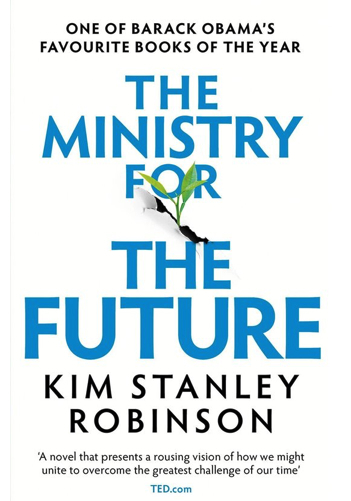 To me, the most magnificent fiction book on climate change is Kim Stanley Robinson’s The Ministry for the Future. It is phenomenal. I hadn’t read it yet when Henry organised a seminar on the book here at Crooked Timber, but I can only say: do read it. Admittedly, the book is very long – and this might be asking too much of many people, given the very many other demands on our lives. But there’s an easy solution: listen to it. This book is perfect as an audiobook. You listen while walking, and you’ll gradually get through the entire book while enjoying your daily walk. Given the many different voices in the book, it might even be better as an audio-book than to read it from paper/screen.