No, I’m not kidding. The US football season is wrapping up with its usual bang: two playoff games this weekend, then the Super Bowl two weeks later. So if you’ve never checked it out, this might be a time.
So, in the spirit of philosophical discussion, let’s start with some reasons you might not want to watch American football.
— “I don’t consume media about team sports. The exploitation and commodification of the players, the hysteria of the fans, the endless advertisements, the disgusting late-capitalist excess generally, all appall me.”
Okay so 1) this is a perfectly defensible and legitimate philosophical position, and 2) you can stop reading now. I’m trying to explain to a bunch of white meat fans why beef is actually pretty great, and you’re a vegetarian. Nothing wrong with being a vegetarian, it’s great, but this post isn’t for you. [click to continue…]
If you follow college football, you probably heard that Glenn “Shemy” Schembechler was recently forced to resign from his post as assistant director of football recruiting at University of Michigan shortly after he was hired. This occurred after news emerged that he had liked numerous racist tweets. Glenn is the son of “legendary” Bo Schembechler, who won 13 Big Ten championships as coach of UM football from 1969–1989. Apparently it wasn’t enough to prevent Glenn’s hiring that he denied that his brother Matt had told their father that UM team doctor Robert Anderson had sexually assaulted him during a physical exam. Glenn insisted that “Bo would have done something. … Bo would have fired him.” Yet law firm WilmerHale had already issued a report confirming that Bo had failed to take action against Anderson after receiving multiple complaints from victims about Anderson’s abuse. Matt has testified that his father even protected Anderson’s job after Athletic Director Don Canham was ready to fire him.
Women are often asked why they didn’t scream when they were being raped, or why they didn’t immediately report the rape to the police, as if these inactions are evidence that the rape never happened. This post is about why Bo didn’t scream after his own son complained of sexual victimization by his team’s doctor. The answer offers insight into the political psychology of patriarchy, which is deeply wrapped up in the kind of denial of reality that Glenn expressed, and that Bo enforced. It also illuminates why women don’t scream when they are assaulted.
The Africa Cup of Nations 2021 (postponed) is about to start, with Cameroon v Burkina Faso on Sunday. As a Liverpool fan, I’m torn between Egypt and Senegal, although since I’m an admirer of the Chelsea goalkeeper Edouard Mendy who went from a year on the dole in France to the very top levels of football, and displaced the incredibly expensive Kepa). So, on balance it is Mane-Mendy Senegal for me. Tips? Opinions?
I’m rather unlikely to post about sports, but you have to watch this. I’m not even a baseball fan, which I feel a bit sacrilegious saying as I sit just a few miles from Wrigley Field, but unless you know absolutely nothing about baseball, you should watch this.
Like most recreational tri-athletes, I don’t pay much attention to what’s happening in the top levels of the sport, let alone in the separate worlds of swimming, cycling and running[1]. But I took notice last year when Eliud Kipchoge ran a marathon distance in under two hours, a barrier long thought to be unbreakable, and one that reminded my of my failed attempts to break four hours over the same distance.
Kipchoge had plenty of help in his effort, including pace runners (providing an added drafting benefit) and a guide car projecting laser light on to the track to ensure exact pacing. These non-standard features mean that the time doesn’t count as a record for the marathon event.
Apparently, the biggest boost, however, came from his shoes, Nike’s recently released Vaporfly’s which incorporate a special carbon plate and a foam designed to return as much as possible of the energy expended from the impact of each pace. In subsequent events, runners with Vaporflys have produced winning times as much as 4 per cent faster than would be expected. And, it seems, the benefit is just as great, or even greater, for middle-aged slowpokes.
As with similar innovations in swimming and cycling, there was a lot of pressure to ban these technological marvels. But the International Olympic Committee, unwilling to take on the might of Nike, decided to allow the shoes, while trying to limit further innovations.
So, should I lay out $A300 or so for a pair of these marvels, which apparently may last for only a couple of hundred km (YMMV)? For the moment, I’m not going to. I’m going to have one more try to break four hours, and for this purpose I’m racing against my (not quite as old) self, not other competitors or even the clock. Once the technology becomes general, I’ll no doubt adopt it like everyone else.
In the meantime, what really appeals to me is the claimed capacity of cooling wristbands to lower body temperature. Even in moderate temperatures, I end events drenched in sweat and temperatures in Queensland aren’t always moderate. Does anyone have any experience/thoughts on this?
Tailenders is the best of the BBC’s proliferating podcasts about cricket. The star is a regular guest, Machin, who is in some obscure way related to Sachin Tendulkar (maybe) and professes (completely plausibly) to have no interest in cricket at all (you can listen to the best of Machin here). Among Machin’s roles is to invent features. These are usually games and quizzes, but the current, ongoing, feature is ‘tales of cricketing sadness’ in which listeners send in tales of their own failures, to amuse and to get catharsis. I don’t have any interesting tales of cricketing failure [1] and anyway I thought that for our audience cricket might be too restrictive. So, instead, it being silly season, can we have tales of oddness — incongruity — well, anything that might entertain us here at CT? Here’s mine, to set the tone.
The knock-out phase is upon us, and this World Cup seems more open then any I can remember. Of the remaining teams only Denmark, Sweden, Switzerland and Japan seem utterly hopeless, which leaves us with 12 contenders, of whom Belgium, Brazil, France and Spain look the most likely. If James is fit, then maybe Colombia has a chance, and who would write off Uruguay? The [FT has some useful stats](https://www.ft.com/content/e0883dfa-7abd-11e8-8e67-1e1a0846c475) ….
With Euro 2016 about to start, thoughts naturally turn to Euro 96, when England hosted the tournament. 1996 was a great year for me, I awoke from what may, in retrospect, have been a period of undiagnosed depression (certainly hypochondria), and it felt like coming out into the sunlight. My two boys were 8 and 11 respectively, it was the year of Britpop, the phoney battle between Oasis and Blur and the wonder that was Pulp’s Different Class. It was also the the year of Liverpool 4, Newcastle 3 (the greatest game in the history of the Premier League), and the year when I started a journal, *Imprints*, with a conference at Senate House in London which commenced with a debate between Jerry Cohen and Tony Skillen. As the conference finished, we all crowded around a radio to hear the England-Spain penalty shoot-out (the last time England prevailed in one). Though England didn’t win the tournament, losing to Germany — who else? — in the semis, we got to see the thrashing of the Scots with McAllister’s miss and Gazza’s genius and then then destruction of the Dutch, all to the soundtrack of Baddiel, Skinner and the Lightning Seeds. We were on the verge of the first Labour government since 1979, and with the Tories looking tired and split the country felt together and optimistic. The St George’s flag, which fluttered everywhere that summer, seemed to stand for this mood, somehow magically recovered from a narrow and exclusive nationalism.
(Much of this was undoubtedly fluff and illusion, and probably massively irritating to the other local nationalities. Still, the optimism was real, the sense that a better future was coming after the night of Thatcherism.)
“Today, alas, that happy crowded floor looks very different.” Thirty year of hurt have turned into fifty, and nobody has any expectations of this England team. But more pertinently, we live in a deeply divided country, squeezed by austerity and xenophobia, where each camp in the Brexit referendum views the other with loathing and contempt (I’m no exception). The Labour government that came to power in ’97 squandered its chances in the sand of Iraq. England is now a dark fractured place: nasty, British and short-tempered, beset by cuts, food banks, benefit sanctions and performance targets. The St George’s flag has become the property of racists, Islamophobes and “white-van man”, a symbol to be deployed against unpatriotic middle-class lefties. I hope we get through this, and stay in Europe, but the wounds will be deep and the resentments strong either way. What a difference twenty years makes.
Spurs threw it away, totally lost their heads tonight, so Leicester win the Premier League with two games to spare. It is hard to think of a sporting achievement that compares to Leicester City’s. 5000/1 at the start of the season, widely tipped for relegation, and now [this](http://www.bbc.co.uk/sport/football/35988673).
Yesterday’s verdicts that the 96 Liverpool fans who died at the 1989 FA Cup semi-final at Hillsborough were unlawfully killed is a complete vindication for their families who have campaigned for justice for 27 years. It is also a total condemnation both of South Yorkshire Police and of their friends among the tabloid press, the pundits and the politicians who first blamed the victims and then spent years treating the bereaved with contempt. I’ll not say more about the facts and the history here, since [there](http://www.theguardian.com/football/2016/apr/26/hillsborough-families-27-year-struggle-for-truth-vindicated) [are](http://www.liverpoolecho.co.uk/news/liverpool-news/hillsborough-myths-exposed-inquests-tissue-11247115) [plenty](http://www.liverpoolecho.co.uk/news/liverpool-news/hillsborough-disaster-inquests-verdicts-delivered-11240268) [of links](http://www.bbc.co.uk/news/uk-20782891) that people can follow. I just want to say a few general things. First, there is the lesson that sometimes people who campaign against injustice, who stubbornly stick to their task over the decades can win, even against the state and its supporters. Second, we need to notice, again, how injustice comes about and persists where the victims are people who don’t matter in the eyes of the powerful. In 1989, Scousers in general and football fans in particular were people who didn’t count, who didn’t matter, who could be stigmatized and stereotyped as feckless, violent, drunken, workshy and blamed for their own misfortune. Later they were whingers with a “victim mentality”. Third, for all that pundits ridicule “conspiracy theories”, there are sometimes conspiracies by the state and its agents, perpetrated against “people who don’t matter”, and aided by those same journalists and commentators with their contempt for the victims, their lack of interest in the facts, and their deference to the official version. Everywhere, “people who don’t matter”, whose interests are ignored and whose pain is ridiculed, can take heart from what the Hillsborough families have achieved. The next step for justice should be the prosecution of those responsible.
Another year, and the [Six Nations has rolled around again](http://www.bbc.co.uk/sport/rugby-union/35471997), a competition between the also-rans and second-bests in world rugby. Thoughts? Predictions? For me, being an England supporter will be harder than ever. England have decided that the solution to their endemic problems is to appoint Eddie Jones. Well, I suppose he did somehow get Japan to beat South Africa. Jones promptly picked the odious eye-gouger and biter Dylan Hartley as captain. Though I’m tempted to insist on the Scottish and Irish bits of my family tree at this point, I fear it is too late and I will simply have to live with the shame.
A friend asked me last week how I watch cricket. Do I sit for 8 hours at a time, or watch highlight reels, or what? So I explained that when possible I watch live during breakfast when the kids have left the house, and actually take a short lunch break if there is live cricket to watch. If I am cooking, or cleaning the house, I have it on, turned up loud, in case anything unmissable happens (only if my cooking is uncomplicated enough to . But, if I know a game is likely to get tense and exciting, and will not be able to see it at all — teaching, days of meetings, etc — then I try to avoid learning what happened, and watch either highlights or, sometimes, long parts of innings, later (sometimes much later). He scoffed. How hard can it be to avoid learning what happened in a Test match when you’re in Wisconsin? [1] He, much more impressively, has to avoid learning the scores in a Packers game (I didn’t say that, in fact, this is something I manage to do all season every season, with no effort at all). Anyway, he told me that when he was a kid, on days that his dad couldn’t see a game, he (the dad) would come home and say “We’re in the cone of silence. Nobody say anything” and expect complete cooperation from everyone in his herculean effort to avoid learning the score.
Well, every Briton over the age of 40 knows what comes next. But surely there must be an episode from an American sitcom with exactly the same plot, no?
[1] During the World Cup I had the misfortune of teaching a class with a smart and lovely Indian lad, who did his absolute best to keep results to himself, but…well, his best often wasn’t good enough.
Woop, I turn around for one second, completely ignoring my past self who was all, “Belle, just put some words or music or something on your blog! It’s not brain surgery, and Ben Carson is a brain surgeon, so….” and the result is that our blog stagnates! Well, no more of that. I’m saying stuff. Stuff like, you should listen to this insanely good Breakwater song, “We’re Going to Work it Out”!
So mellow, with a Latin swing thing happening. Also, this rubby-dubby sound like someone was rubbing on a balloon; what is that even, well-informed commentariat?
In not-mellow-at-all-bummer news we have this article on Deadspin documenting a case in which NFL player Greg Hardy assaulted his girlfriend. It’s an excellent piece that pulls together evidence that seems to have been publicly available for some time. Hardy was both charged and convicted (unusual for DV cases, especially with a powerful man involved), but the case was overturned on appeal and then expunged. I wasn’t aware this could even happen except when the Innocence Project proves that a person was unjustly put on death row, but in principle it’s an intuitive mechanism. The criminal justice system needs to be able to say, not merely “not guilty” but affirmatively “innocent.” This could be useful–in other cases.
There are photos of the woman’s injuries, and it may be that, as in the Ray Rice situation, the visual imagery will make an impact where the conviction (howsoever temporary) did not. Wait, except Ray Rice got the charges against him exchanged for some anger management or something? Well, we can say his career was permanently injured.
Greg Hardy is a better player than Rice and more valuable to his team, so they are probably backing him up all the way (even when he gets in a fight with coaching staff! Special Teams, tho, the B-list coaches.) Part of Hardy’s defense involved the ludicrous claim that, given how much stronger and bigger he was than the victim, the woman should have been much injured more seriously. Like, if he had assaulted her, her mere beatdown couldn’t have happened. This makes less than zero sense (people can’t hold back?) and I believe it has the dubious distinction of being shared with Mike Tyson’s DV defense back in the 90s. From the Deadspin post.
When asked to explain Holder’s injuries during his bench trial, he and Curtis would testify that Holder had jumped into the bathtub, then thrown herself on the couch, and then went crazy trying to attack Hardy. Hardy’s lawyer, Chris Fialko, would assert that Holder must have caused the injuries to herself. If the 290-lb. pass rusher had really wanted to hurt a woman who weighed well less than half what he did, his argument went, the damage would have been a lot worse.
Riiiiiight. My eyes are oscillating like unhinged gyroscopes, back, back, ever back. I can only see darkness and brain now.
The following statement came after the fight with the special teams coach, but listen to the leadershippy leadership of the owner of the world’s most hated football franchise: “[Greg Hardy’s], of course, one of the real leaders on this team and he earns it and he earns it with respect from all of his teammates and that’s the kind of thing that inspires a football team,” [Cowboys owner Jerry] Jones said. Mmm, taste the respect of a dude who flips the coaches clipboard up in his face on the field.
Although Deadspin is mostly a snarky sports blog that tells you why your NFL team sucks, it is also at times serious investigative journalism. They broke the Te’o Manti catfishing thing too. (I can’t summarize it, really.) In cases like these the established sports media seem disinclined to look too carefully into anything.
The competition just kicked off with England v Fiji. (Come on you Pacific Islanders.) I don’t have strong views on who’s likely to win, just the usual quiet self-confidence in the robust predictive value of national stereotypes. More informed commentators than I can weigh in below about the likely outcomes. As always, though, the one constant truth of all sporting competition remains clear and strong: Anyone but England.
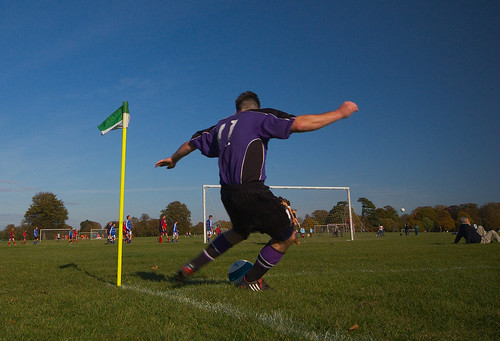
Apologies for the hiatus in Sunday photoblogging. It turned out that getting the embedding code from Flickr whilst travelling with an iPad was more challenging than I imagined it would be. Here’s a picture from a few years ago. Most sports photography is with long-lenses (300mm or so), this was an attempt to capture the action by getting up really close with a wide-angle lense. It succeeded enough for a student newspaper to steal the image, anyway.