That’s Some High-Quality Wank There

by Henry Farrell on May 25, 2009

Clive Crook “positions himself as a reasonable moderate”:http://www.ft.com/cms/s/0/55522abc-4894-11de-8870-00144feabdc0.html between the extremes of Republican torture-and-detention-porn crazies, and people who, you know, who take civil rights seriously.

The left’s complaints make far more sense than Mr Cheney’s. Mr Obama is adjusting the Bush administration’s policies here and there and seeks to put them on a sounder legal footing. This recalibration is significant and wise, but it is by no means the entirely new approach that he led everybody to expect.

Mr Obama is in the right, in my view, but he owes his supporters an apology for misleading them. He also owes George W. Bush an apology for saying that the last administration’s thinking was an affront to US values, whereas his own policies would be entirely consonant with them. In office he has found that the issue is more complicated. If he was surprised, he should not have been.

The signature intellectual defect of the non-compromisers on each side of this debate is an inability to recognise conflicting ends. The Democratic party’s civil libertarians seem to believe that several medium-sized US cities would be a reasonable price to pay for insisting on ordinary criminal trials for terrorist suspects. There can be no trade-off between freedom and security, because the freedoms they prioritise trump everything. To many on the other side, no trampling on the liberty of ordinary citizens, no degree of cruelty to detainees, no outright illegality is too much to contemplate in the effort to stop terrorists. On this view, security trumps everything.

The “seem to believe” is a weasel-phrase, which would (to use his own dubious phrasing) “seem” to be nicely calculated so as to allow him to make very nasty insinuations and accusations without having to prove them, and the “several medium-sized US cities would be a reasonable price to pay for insisting on ordinary criminal trials for terrorist suspects” bit is a common-or-garden shameful and disgusting slur. If Crook has _any_ substantial evidence that ‘several medium sized cities’ have been put at risk, or are likely to be put at risk, because of civil libertarians’ tiresome insistence on trials and such, I invite him to produce it. And no, “hypothetical ticking bomb scenarios”:https://crookedtimber.org/2004/06/18/by-the-power-of-stipulation-i-have-the-power/ don’t do it, thank you very much.

The underlying claim of this shoddy exercise, such as it is, has three parts. First, that the people who are insisting on civil liberties in the GWOT are wild-eyed and extremist zealots, fundamentally similar in kind to the members of the lock-em-up-and-torture-em-to-death crowd on the other side. Second, that a difficult balance has to be struck between civil liberties for terrorists on the one hand and the need to avoid the destruction of medium-sized American cities on the other. Third, that the only people capable of making the necessary complex choices are sceptical moderates like Clive Crook who realise, as others don’t, that differing ends are incompatible, there are unavoidable trade-offs in life &c&c. In its fully fledged form, this might be described, after the example of Isaiah Berlin, as High Table Liberalism – that anguished and serious engagement with the difficulties of political choice in a world of irreconcilable and competing values which occurs somewhere between the end of the main course and the serving of the port and Stilton. But it reminds me even more of a radio comedy sketch I remember from my youth in Ireland, where a punter representing the Plain People of Ireland and a nun are discussing how best to deal with football hooligans. The punter says that they’re a pack of bastards, and the only solution is to chop off their goolies. The nun says no, we need to think too of the principles of charity and forgiveness, of Christian love etc – and the only solution is to chop off their goolies. Clive Crook is taking the part of the nun here.

Betting with Bryan Caplan

by John Q on May 25, 2009

Bryan Caplan responds to the data on US and EU-15 unemployment by offering a bet.

The average European unemployment rate for 2009-2018 (i.e., the next decade) will be at least 1 percentage point higher than U.S. unemployment rate. The bet will be resolved when Eurostat releases its final numbers for 2018.

Betting is usually unwise, but nonetheless I’m willing to take Bryan on, with one amendment. I will take the bet provided that people in prison are counted as unemployed. By my estimate, that raises the US rate by about 1.5 percentage points and the the EU-15 rate by about 0.2 percentage points. That is, assuming current imprisonment rates remain unchanged, the bet is that the Eurostat measure of unemployment (which excludes prisoners) should be no more than 2.3 percentage points higher in the EU-15 than in the US.
[click to continue…]

According to the latest Eurostat data*, the unemployment rate in the US was equal to that in the EU-15 in March, and is now likely to be higher. Writing in the NY Times, Floyd Norris refers to the conventional wisdom that flexibility inherent in the American system — it is easier to both hire and fire workers than in many European countries implies that unemployment should be lower (at any given point in the business cycle) in the US than in Europe.

[click to continue…]

Standard & Poors have issued a Very Serious Warning to the UK, with regard to its AAA credit rating. I reach into the archives and pull out John’s excellent article on the general subject.

Periplum Plug-in for Google Earth

by John Holbo on May 22, 2009

Here’s the link. (This is, obviously, a follow-up to this post.)

Redefining Plagiarism

by Henry Farrell on May 21, 2009

“Groklaw”:http://www.groklaw.net/article.php?story=20090518204959409 points out some interesting characteristics of the Terms of Service for Wolfram Alpha:

As Wolfram|Alpha is an authoritative source of information, maintaining the integrity of its data and the computations we do with that data is vital to the success of our project. … f you make results from Wolfram|Alpha available to anyone else, or incorporate those results into your own documents or presentations, you must include attribution indicating that the results and/or the presentation of the results came from Wolfram|Alpha. Some Wolfram|Alpha results include copyright statements or attributions linking the results to us or to third-party data providers, and you may not remove or obscure those attributions or copyright statements. Whenever possible, such attribution should take the form of a link to Wolfram|Alpha, either to the front page of the website or, better yet, to the specific query that generated the results you used. … Failure to properly attribute results from Wolfram|Alpha is not only a violation of these terms, but may also constitute academic plagiarism or a violation of copyright law. Attribution is something we expect you to give us in exchange for us having provided you with a high-quality free service. The specific images, such as plots, typeset formulas, and tables, as well as the general page layouts, are all copyrighted by Wolfram|Alpha at the time Wolfram|Alpha generates them.

[click to continue…]

Michèle Lamont on Philosophers

by Harry on May 20, 2009

A colleague (in Philosophy) just sent me this interview with Michele Lamont about How Professors Think (which just arrived in my mailbox but I still haven’t read). The book is based on interviews of academics who serve on funding panels, and teases out the differences between several disciplines in how they think of their standards and apply them, among other things.
It’s all worth reading. I was particularly struck by this:

Philosophy is a problem discipline, and it’s defined as such by program officers. Philosophers do not believe that nonphilosophers are qualified to evaluate their work. Perhaps that comes out of the dominance of analytic philosophy, with its stress on logic and rigor. Philosophers think their discipline is more demanding than other fields. Even its practitioners define the discipline as contentious. They don’t see that as a problem; argument and dispute are the discipline’s defining characteristics.

All that conflict makes it difficult to get consensus on the value of a philosophy proposal — or to convince people from other disciplines of its merits. The panels I studied are multidisciplinary. Nonphilosophers are often frustrated with the philosophers. They often discounted what philosophers had to say as misplaced intellectual superiority.

[click to continue…]

Diamond’s Vengeance

by Jon Mandle on May 19, 2009

Around four years ago, there was some controversy about Jared Diamond’s Guns, Germs, and Steel (and, I gather, a PBS documentary based on the book). Various bloggers at savageminds.org – a group anthropology blog – for example, here and here and elsewhere – attacked Diamond for various reasons, up to and including calling him racist. Brad DeLong replied by accusing the critics of being “positively green with envy at Jared Diamond’s ability to make interesting arguments in a striking and comprehensible way, and also remarkably incompetent at critique.” Henry discussed the flap here, here, and here, writing: “I strongly suspect that the ‘Diamond=racist’ claim is a more-or-less pure exercise in boundary maintenance – I certainly haven’t seen any substantial counter-evidence to date. Which isn’t to say that there isn’t a real, substantive argument to be had between different ways of knowing, or that there aren’t advantages to anthropological approaches which can’t be captured in a big, sweeping structuralist account like Diamond’s.” And he linked to Tim Burke, who here and here offered a critique of Diamond that was more – shall we say – nuanced (and interesting!) than the one at savageminds.org.

Now there’s a new controversy. About a year ago, Diamond published an article in the New Yorker called “Vengeance Is Ours.” Abstract is here – full text available to subscribers only (I think) from that link.
[click to continue…]

Planning for Pandemics (repost and update)

by John Q on May 19, 2009

As governments and the WHO wrestle with the decision on whether to divert resources from the production of seasonal flu vaccines to develop a vaccine against H1NI (swine) flu, I thought I’d repost this piece from 2005, suggesting an expansion of vaccination against seasonal flu, in part to expand production capacity to prepare for problems like this.

Thinking a little more, and with the idea of global public goods in mind, it seems obviously in the enlightened self-interest of developed countries to go beyond domestic vaccination programs and contribute both vaccine supplies and organisational resources to encourage routine vaccination in poor countries, as well as ensuring a further expansion of production capacity.

The same goes, I think, for more extensive use of antivirals like Tamiflu, which apparently have the nice property that the flu virus does not develop resistance to them.

[click to continue…]

Nicholas Winton is 100

by Harry on May 19, 2009

I prevaricated. [Update 1] Do you congratulate someone who has avoided the limelight? Or do you risk providing it? In the end, if he didn’t want it, he should have avoided it more successfully. Anyway, many happy returns to him.

[Update 1] JQ says I vacillated. He’s right.

Yuck!

by Henry Farrell on May 19, 2009

Via “P.Z.”:http://scienceblogs.com/pharyngula/2009/05/chest_bursters.php (but put under the fold so as to protect the delicate sensibilities of CT’s readership).
[click to continue…]

TMI… seriously!

by Maria on May 18, 2009

In other cool things about L.A., I have to admit the non-mortal earthquakes are pretty great. I’ve sat through two of the 5+ richter ones and was about 4 miles from last night’s epicenter. The most striking thing is that in the first few seconds of an earthquake, a completely random explanation for it pops into my mind. The first time around I got quite irate that our upstairs office neighbours were thumping around making such racket that the building swayed. Last night, although I live 2 miles from the freeway, I instantly thought ‘wow, that’s one big truck passing by. Or maybe it’s a tank?’.

It turns out that’s not an unusual reaction. Human brains are very good at rationalising the immediate aftermath of a disaster into business as usual. But, contrary to popular belief, not panicking isn’t all that successful a survival strategy. A book I read last year ‘The Unthinkable; Who Survives When Disaster Strikes’, says much of the planning around plane crashes, fires, etc. assumes that the first thing people will do is panic and run around doing stupid things that impede their escape. In fact, the most common and dangerous reaction is to just go limp, stay passive and assume that the nightclub fire is really not all that bad or that you should sit in your crashed plane seat until help arrives. Or that the hostage situation is all a terrible misunderstanding. That’s a very good way to die.
[click to continue…]

Rise of the Romulans

by Henry Farrell on May 17, 2009

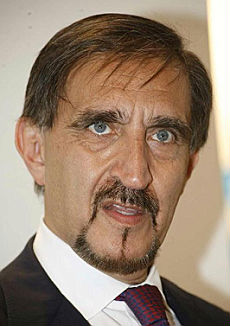
So I’ve been thinking that I ought to do more posts on stuff that is happening in Italy, Germany and France but that isn’t being covered well in the English language newspapers. Such as, for example, “this story”:http://www.repubblica.it/2009/05/sezioni/cronaca/immigrati-7/la-russa-boldrini/la-russa-boldrini.html about how Italy’s minister of defence, Ignazio La Russa, has gotten into trouble for saying some offensive things about the United Nations, and the UNHCR representative in Italy (who has been critical of the Berlusconi government’s nastiness to aliens). But I’m being distracted from this high minded mission by La Russa’s quite extraordinary resemblance to a left-over special effect from classic Rodenberry-era Star Trek. It’s juvenile of me, but there you go. I’m figuring him for a Romulan-Klingon hybrid, but I’m not really a Star Trek buff (haven’t seen the show in two decades or so), so am prepared to bow to superior wisdom should such exist out there on the Interwebs …

larussa

Going Dutch

by Henry Farrell on May 16, 2009

So, because I was in Europe last week, I didn’t post to my bloggingheads with Dan Drezner, talking about the joys (and limitations) of the European (for which read Dutch – EU member states differ dramatically in their provision of social services) welfare state. This was all riffing on a “piece in the NYT”:http://www.nytimes.com/2009/05/03/magazine/03european-t.html?pagewanted=1&em which talks about the kinds of stuff that insurance covers in the Netherlands.

insurance covered prenatal care, the birth of their children and after-care, which began with seven days of five-hours-per-day home assistance. “That means someone comes and does your laundry, vacuums and teaches you how to care for a newborn,” Julie said.

I thought that this sounded _great_ myself, having gone through the ‘oh my god, they’ve sent us home with a baby and what the hell are we supposed to do now’ panic with our firstborn. Dan, not so much. Matt Yglesias and Matthew Continetti discussed the same article a few days later. Diavlogs below …

Maddow interviews Duelfer and Windrem

by Jon Mandle on May 15, 2009

On her show last night, Rachel Maddow provided a genuine service. [tip: TPM] She reviewed Bush Administration claims about the link between al-Qaeda and Iraq (with clips) and ran that alongside a time line concerning the use of torture. This took about six minutes. Then she interviewed Charles Duelfer, former head of the Iraq Survey Group, who says that “Washington” suggested using stronger interrogation techniques against an already cooperative Iraqi official, and Robert Windrem, who reports that two sources confirmed to him: 1. the suggestion was to use waterboarding; 2. it came from the Vice President’s office; 3. the purpose was to find a link between al-Qaeda and Iraq.

Duelfer doesn’t exactly say that he was told to find a link between al-Qaeda and Iraq. But that’s the strong suggestion of his comments, and he doesn’t object when Maddow draws that inference. (He does object to the characterization of his being ordered to use more aggressive techniques. It was more of a suggestion – one which was not acted on.)

Visit msnbc.com for Breaking News, World News, and News about the Economy