Billions of miles away at the edge of the Solar System, Voyager 1 has gone mad and has begun to die.
Let’s start with the “billions of miles”. Voyager 1 was launched in early September 1977. Jimmy Carter was a hopeful new President. Yugoslavia and the USSR were going concerns, as were American Motors, Pan Am, F.W. Woolworth, Fotomat booths, Borders bookshops, and Pier 1. Americans were watching Happy Days, M*A*S*H and Charlie’s Angels on television; their British cousins were watching George and Mildred, The Goodies, and Tom Baker as the Fourth Doctor. If you turned on the radio, “Hotel California” by The Eagles was alternating with “Dancing Queen” by Abba (and, if we want to be completely honest, “Car Wash” by Rose Royce). Most cars still ran on leaded gasoline, most phones were still rotary dial, and the Internet was a wonky idea that was still a few weeks from a working prototype.
_The Thorn Birds_ was on top of everyone’s bestseller list. The first Apple II home computer had just gone on sale. The Sex Pistols were in the studio wrapping up _Never Mind The Bollocks_; they would tour on it for just three months and then break up, and within another year Sid Vicious would be dead of a heroin overdose. Barack Obama was a high school junior living with his grandparents in Honolulu, Hawaii: his grades were okay, but he spent most of his time hanging with his pot-smoking friends in the “Choom Gang”. Boris Johnson was tucked away at the elite Ashdown House boarding school while his parents marriage was slowly collapsing: although he was only thirteen, he had already adopted his signature hair style. Elvis had just died on the toilet a few weeks ago. It was the summer of Star Wars.
And Voyager 1 was blasting off for a tour of the Solar System.
There’s no way to pack the whole story of Voyager 1 into a single blog post. Here’s the TLDR: Voyager was the second spacecraft to fly past Jupiter, and the first to take close-up photos of Jupiter’s moons. It flew on past Saturn, and examined Saturn’s moon Titan, the only moon with an atmosphere. And then it flew onwards, on and on, for another forty years. It officially left the Solar System and entered interstellar space in 2012. It just kept going, further and further into the infinite emptiness.
(You know about the Golden Record? Come on, everybody knows about the Golden Record. It’s kind of hokey and cheesy and also kind of amazing and great.)
Voyager has grown old. It was never designed for this! Its original mission was supposed to last a bit over three years. Voyager has turned out to be much tougher than anyone ever imagined, but time gets us all. Its power source is a generator full of radioactive isotopes, and those are gradually decaying into inert lead. Year by year, the energy declines, the power levels relentlessly fall. Year by year, NASA has been switching off Voyager’s instruments to conserve that dwindling flicker. They turned off its internal heater a few years ago, and they thought that might be the end. But those 1970s engineers built to last, and the circuitry and the valves kept working even as the temperature dropped down, down, colder than dry ice, colder than liquid nitrogen, falling towards absolute zero.
(Voyager stored its internal data on a digital tape recorder. Yes, a tape recorder, storing information on magnetic tape. It wasn’t designed to function at a hundred degrees below zero. It wasn’t designed to work for decades, winding and rewinding, endlessly re-writing data. But it did.)
Voyager kept going, and kept going, until it was over 15 billion kilometers away. At the speed of light, the Moon is one and a half seconds away. The Sun is about 8 minutes away. Voyager is twenty-two hours away. Send a radio signal to it at lunch on Monday, and you’ll get a response back Wednesday morning.
* * *
I could go on at great length about Voyager — the discoveries it has made, the Deep Space Network that has maintained contact over the decades, the ever shrinking crew of aging technicians keeping it alive on a shoestring budget, how amazing it has all been. But I’ll restrict myself to just this: the Pale Blue Dot.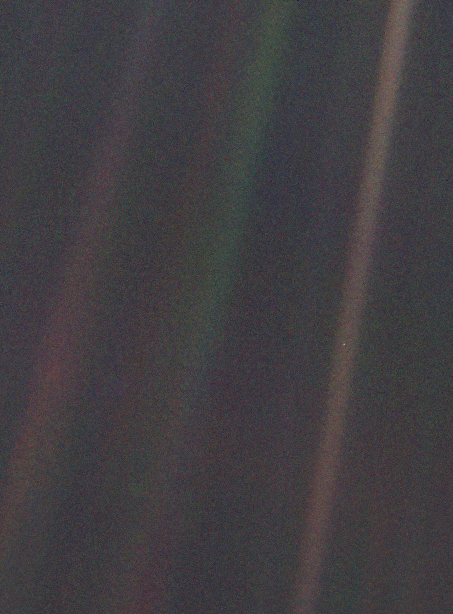
In 1990, just before Voyager’s camera shut down forever, the probe turned around and looked backwards. It zoomed in and took a picture of Earth. But by that time, it was so far away that Earth was just a single pale blue pixel. Look at the right-most band of light. A little past halfway down — see that speck? It’s not a defect. It’s not something on your screen. That’s the Earth.
“That’s here. That’s home. That’s us. On it everyone you love, everyone you know, everyone you ever heard of, every human being who ever was, lived out their lives. The aggregate of our joy and suffering, thousands of confident religions, ideologies, and economic doctrines, every hunter and forager, every hero and coward, every creator and destroyer of civilization, every king and peasant, every young couple in love, every mother and father, hopeful child, inventor and explorer, every teacher of morals, every corrupt politician, every “superstar,” every “supreme leader,” every saint and sinner in the history of our species lived there – on a mote of dust suspended in a sunbeam.” — Carl Sagan
Voyager kept going for another 34 years after that photo. It’s still going. It has left the grip of the Sun’s gravity, so it’s going to fall outward forever.
* * *
Here’s a bit of trivia: Voyager 1 currently holds the record for most distant active spacecraft. It’s not even close. The only other contender is Voyager’s little sister, Voyager 2, which had a different mission profile and so lags billions of kilometers behind their older sibling.
Here’s another bit of trivia: if you’re reading this in 2024? It’s very unlikely that you will live to see that record broken. There are only two other spacecraft outside the Solar System — Voyager 2 and New Horizons. Both of them are going to die before they get as far as Voyager 1. And nobody — not NASA, not the Chinese, not the EU — is currently planning to launch another spacecraft to those distances. In theory we could. In practice, we have other priorities.
* * *
We thought we knew how Voyager would end. The power would gradually, inevitably, run down. The instruments would shut off, one by one. The signal would get fainter. Eventually either the last instrument would fail for lack of power, or the signal would be lost.
We didn’t expect that it would go mad.
In December 2023, Voyager started sending back gibberish instead of data. A software glitch, though perhaps caused by an underlying hardware problem; a cosmic ray strike, or a side effect of the low temperatures, or just aging equipment randomly causing some bits to flip.
The problem was, the gibberish was coming from the flight direction software — something like an operating system. And no copy of that operating system remained in existence on Earth.
(This is a problem NASA long since solved. These days, every space probe that launches, leaves a perfect duplicate back on Earth. Remember in “The Martian”, how they had another copy of Pathfinder sitting under a tarp in a warehouse? That’s accurate. It’s been standard practice for 30 years. But back in 1977, nobody had thought of that yet.)
Voyager Mission Control used to be a couple of big rooms full of busy people, computers, giant screens. Now it’s a single room in a small office building in the San Gabriel Valley, in between a dog training school and a McDonalds. The Mission Control team is a handful of people, none of them young, several well past retirement age.
And they’re trying to fix the problem. But right now, it doesn’t look good. You can’t just download a new OS from 15 billion kilometers away. They would have to figure out the problem, figure out if a workaround is possible, and then apply it… all with a round-trip time of 45 hours for every communication with a probe that is flying away from us at a million miles a day. They’re trying, but nobody likes their odds.
So at some point — not tomorrow, not next week, but at some point in the next few months — they’ll probably have to admit defeat. And then they’ll declare Voyager 1 officially over, dead and done, the end of a long song.
And that’s all.
{ 49 comments }
NomadUK 02.19.24 at 2:36 pm
Pioneer 10 and Pioneer 11 are out there as well, though the Voyagers were moving so fast they caught up and passed them (figuratively; they were nowhere near each other).
Perhaps someday we will take great voyages again. For now, it appears we are in a downward spiral, closing in on ourselves, distracted with our little power plays and trivia. Sic transit gloria mundi.
SusanC 02.19.24 at 2:39 pm
That was great; thank you.
Voyager was also famous for being one of the first practical applications of Reed-Solomon codes.
https://en.wikipedia.org/wiki/Reed–Solomon_error_correction
SusanC 02.19.24 at 2:41 pm
I can remember being in school and having to write an essay about Voyager when it first launched,
Present-dat me would probably write a more technical article.
SusanC 02.19.24 at 2:45 pm
Way back when, some humour magazine (probably Punch) did a parody or the Pioneer plaque, along the lines of “As a slightly lopsided spider, I find this image deeply offensive.”
Alan White 02.19.24 at 4:08 pm
Thank you for this beautiful eulogy. I’m a life-long space aficionado since the Mercury program, and this is a quite fitting tribute to the machine and the people behind it.
Adam Hammond 02.19.24 at 5:38 pm
It left our mote of dust suspended in a sunbeam, and will sail on in darkness, not encountering another sunbeam until the end of the universe. The odds against it approaching another star before they all go out are literally astronomical. Space is unfathomable.
oldster 02.19.24 at 5:52 pm
Isn’t the underlying tragedy simply that the universe is so vast, and the speed of light so slow? That’s what rules out our exploration of distant galaxies, and requires every sci-fi story to start with some cheat (warp-drives etc.).
It may be just as well, since it keeps the aliens from traveling to us, too.
Thanks, though, this was a lovely eulogy, as Alan said. For those of us who grew up with the heady days of the race to the moon, it will always seem sad to have to settle for life in our solar system. But, the sooner that people can realize that this earth is all we have (and Mars is a pointless distraction), the sooner they will commit to caring for it.
Aardvark Cheeselog 02.19.24 at 6:18 pm
That is a beautiful tribute.
I was not really paying attention to politics at the time (I was a year ahead of Obama in high school, though not in Hawaii), except for a teen nerd’s interest in space policy. And I was cognizant that money for space exploration was very tight, in the aftermath of Apollo. The goals for the shuttle kept getting scaled back, from fully-reusable spaceplane that could take off and land using just big airports to the eventual half-assed technology demonstration it eventually became.
Voyager was a very big-ticket program. I’m morally certain that if you could go back to the relevant meetings and argue to fund a duplicate vehicle to stay behind for maintenance purposes, you’d be laughed out of the room. The cost of a single copy of that hardware was a noticeable fraction of the annual NASA budget in those years. And do you know, the constant-dollar funding for NASA decreased by almost 30% between 1972, when the program was authorized, and 1982?
NASA had an awful big bunch of eggs in the Voyager basket. Which I think really started to pay off when people saw the hi-res images of Saturn’s rings from the Voyager 2 mission.
KT2 02.20.24 at 12:36 am
Great story. At 16 bits per second, this web page would not be communicable, unless we had a Voyager Radio setup
Beyond the above amazing tribute – thanks… What astounds me is we are able to receive the radio transmissions- still – “At a distance of 163 AU (24.4 billion km; 15.2 billion mi) from Earth as of January 2024,[5] it is the most distant human-made object from Earth.” Wikipedia
At “Commands are 16-bps, Manchester-encoded, biphase-modulated onto a 512 HZ square wave subcarrier”
“Communicating Over Billions of Miles: Long Distance Communications in the Voyager Spacecraft” is extremely detailed with math and great animations.
“Thirty-eight hours ago, a 20 kW signal was transmitted from Earth towards the Voyager 1 spacecraft. Nineteen hours ago, the signal was received by Voyager 1 and returned by a 20 Watt transponder. And, as I write this article, a station in Madrid, Spain is receiving that return signal at a power level of $$9\times10^{-23} \text{kW}=9\times10^{-8} \text{pW}$$ (-160.48 dBm.) For reference, a very good FM radio receiver can pick up signals at $$9\times10^{-5} \text{pW}$$, the signal received from Voyager is 1000 times weaker.”
…
“Due to the incredible weakness of the spacecraft’s downlink by the time it reaches Earth, large parabolic reflectors, and hyperbolic sub-reflectors collect the microwave radiation and focus it on a cryogenically cooled receiver at the base of the antenna.”
…
“Each Deep Space Network location has multiple 34-meter antennas and a single 70-meter antenna. While any one of the antennas is more than powerful enough to transmit to Voyager, a single 34-meter antenna does not collect enough electromagnetic radiation to detect Voyagers downlink. Antennas at each site can be linked to simultaneously receive the signal from the spacecraft, providing increased gain through radio interferometry.”
…
https://www.allaboutcircuits.com/news/voyager-mission-anniversary-celebration-long-distance-communications/
Duke the lost engine 02.20.24 at 1:50 am
“But back in 1977, nobody had thought of that yet.”
Maybe not nobody – in Space Odyssey 2001 Mission Control have another copy of HAL, but no ability to replace the rogue HAL on the spacecraft.
bad Jim 02.20.24 at 5:53 am
It’s certainly a tribute to NASA’s design prowess, and perhaps to its conservatism, that its projects have been able to endure so much more for so much longer than was ever expected.
A contrast may be seen in the little Mars helicopter Ingenuity, which also far exceeded its designers’ expectations, but did so with off-the-shelf components instead of the ultra-hardened components used in the rest of the interplanetary fleet, and nonetheless managed to survive the extremes of its environment.
More at Ars Technica
otto 02.20.24 at 9:26 am
Fantastic write up!
I would read a glossy magazine spread on those ageing engineers.
MisterMr 02.20.24 at 12:38 pm
I think that around 2274 Voyager 1 will be back to Earth, turned into a strange God-machine.
I loved that movie.
Bill R 02.20.24 at 2:39 pm
Someone help my fading memory. Didn’t it play a leading role in a well known Science Fiction novel?
Trader Joe 02.20.24 at 4:29 pm
@14 Bill R
Its the core of the plot in the 1979 Movie Star Trek the Motion Picture (now dubbed Star Trek 1). Mister Mr. alludes to the basic plot. There have been other similar riffs on this as well (basically future civilizations that have forgotten we sent it finding it and assuming it must have come from other unknown sources (like finding a pair of glasses, being surprised the prescription is correct and not realizing they are your own).
Thanks for the fine tribute. Like many here I was fascinated with all things NASA at the time it was launched and couldn’t wait to get the fully glossy download of the pictures in National Geographic (among other sources).
Stephanie Lambert 02.20.24 at 9:02 pm
This is a wonderful post by Doug Muir, and I would love to subscribe to the blog, but I get an html version of the blog instead of a sign up page.
If you can email me any help with that, I’d be thrilled.
Matthew Heath 02.21.24 at 10:54 am
Why the shade on “Car Wash”? It’s Good!
Nick 02.21.24 at 12:28 pm
“Voyager was the first spacecraft to fly past Jupiter”
That honour goes to Pioneer 10, in 1973.
Doug Muir 02.21.24 at 6:08 pm
“That honour goes to Pioneer 10, in 1973.”
Correction made — thanks!
Doug M.
Doug K 02.21.24 at 7:46 pm
thank you Doug and KT2 for details on the communication.. both a kind of poetry.
ChatGPT just started generating gibberish at a higher rate than normal, surely just a coincidence.
MCR 02.22.24 at 12:02 am
Lovely piece about voyager.
But I am pretty sure that there was only one Borders store in 1977 (on State St. in Ann Arbor).
Christopher Biggs 02.22.24 at 2:30 am
I posted this two part minific on mastodon ( @unixbigot@aus.social ) this morning. Every day I write a story over morning coffee, tagged with #PowerOnStoryToot
The Voyager One space probe sails though the interstellar void, having passed the boundary between the bubble of gases pressurized by its home star and the wider galaxy. It is the human artifact most distant from Earth, so far away that its radio transmissions take nearly a full day to reach home.
The probe is equipped with a golden disc, a record encoded with greetings in every human language. There is also a Side B.
All its life, Voyager has been transmitting back what it finds, out among the sparse molecules and speeding cosmic rays. Every so often one of those rays passes through the computer, perturbing it. Finally, the transmissions stop making sense, bit rot has robbed the probe of speech. Voyager lets go.
A mechanical component has been idle since creation, patiently registering an endless repetition of “not yet, not yet” from the flight computer. Voyager’s grip on this Dead Man’s Handle goes slack, springs and catches move, and Side B begins to play.
????Daisy, Daisy, give me your answer, do. I’m plumb crazy, all for the love of you????
#Tootfic #MicroFiction #PowerOnStoryToot
Part two:
The funeral transmission from Voyager One crosses vast distances. ????Daisy, Daisy, give me your answer, do. I’m plumb crazy, all for the love of you????
Earth hears.
At Canaveral, a carpark splits open as a secret silo, hidden and forgotten for generations, activates.
The Senators who voted to fund the Voyager program believed it was a one way trip. But they were, all of them, deceived; for another probe was made.
Smoke, and flame erupt from the silo. No cryogenic fuels here, instead the long-storage combinations of Unsymmetrical Dimethyl Hydrazine as fuel, and as oxidizer the officially nonexistent “Compound Omega”, OClF?.
The engineers who built the Voyagers had their backs. In secret they forged a third probe. What, you thought NASA really pays a thousand dollars for a bolt? Into this probe they poured their love and craft and willingness to overcome all obstacles.
A nose cone appears, then a rocket. Rising into the sky on a pillar of fire, exhaust of hydrochoric and hydroflouric acids plus exotic hydrocarbons beyond counting, the vehicle streaks skyward.
The bold letters on its hull spell “THUNDERBIRD 3 ???? INTERSTELLAR RESCUE”.
#Tootfic #MicroFiction #PowerOnStoryToot #BonusPanel
Ricardo M 02.22.24 at 3:24 am
Thank you for this beautiful write-up. For another beautiful piece of art on that team of engineers looking after these spacecrafts, please run, don’t walk to watch “It’s Quieter In the Twilight,” which chronicles the lives of these resourceful people, some of which are probably right now feverishly working to revive the ship, hoping it gets to live to see its 50th anniversary.
https://www.space.com/nasa-voyager-mission-engineers-documentary
Susan Y 02.22.24 at 4:21 am
My dad worked at JPL I have a photo of him being handed his Voyag project certificate. He loved that the first Star Teek movie used Voyager’s return in the plot. Dad passed in 2013,but my mom still has the certificate as well as copies of some of the photos that came back from Voyager.i hope his life force is out there someplace in the stars saying goodbye to his old friend.
Thanks Voyager. It’s been a great trip.
Jon 02.22.24 at 6:49 am
I think it’s worth pointing out that Voyager was the backup plan after the more ambitious Grand Tour mission – that would have been designed to visit all the outer gas giants – was rejected. It’s hard to know at this remove, but I suspect that the JPL engineers and scientists went ahead and designed enough robustness into the Voyagers that they would stand a reasonable chance of reaching beyond Saturn, anyway.
N.b. Ed Stone (Voyager Project Scientist) was my frosh advisor at Caltech. In retrospect I probably would have had a more fun, albeit less lucrative career had I gone into planetary science. Loved his office – his filing system consisted of stacks of papers and books on every horizontal surface.
Tami 02.22.24 at 7:36 am
@NomadUK said “Perhaps someday we will take great voyages again. For now, it appears we are in a downward spiral, closing in on ourselves, distracted with our little power plays and trivia. Sic transit gloria mundi.”
We’re always in a downward spiral, probably since our birth as a species but certainly as long as there has been oral traditions. We’re always distracted some human minutia. And yet there are always the dreamers, the explorers, the engineers, the ones that push us a little further. That we are both incredibly preoccupied with banalities of the day AND capable of propelling our species into new territories, new inventions, new ways of living, new ways of being human is what defines us as human.
Our greatness isn’t behind us, it’s here and now and always has been.
Dervish 02.22.24 at 9:08 am
I seem to remember there was at least one backup copy of the Voyager spacecraft. A model was on display in the auditorium at JPL through the early 80’s, and I remember being told that the backup was fully functional. But certainly there aren’t many people left who remember how that thing was programmed.
Juande Santander-Vela 02.22.24 at 11:24 am
Regarding 2001, A Space Odyssey, they had dual HAL9000’s on Earth. Of course, NASA has always been a leader in Systems Engineering and Systems Thinking, and always took into account that things needed to be built with their failures in mind. By thinking and testing and measuring how things fail is how you learn to build things that last.
Ani Kostova 02.22.24 at 1:08 pm
This was an amazing publication and I felt deeply every word in it. I cannot find any conditions regarding using this text elsewhere, though – would it be right to translate and re-publish it with link to it on independent online media in my own country, Bulgaria?
Doug Muir 02.22.24 at 1:43 pm
I’m the original poster. I have no objection. Just put my name on it and the original location of publication (here), and send along a link.
Doug Muir
Ani Kostova 02.22.24 at 1:53 pm
Thank you very much. I will send the link once it’s ready. Thank you again for this spectacular read. :-)
Reuben 02.22.24 at 10:19 pm
@14 Bill R
Pretty sure in that terrible L Ron Hubbard novel ‘Battlefield Earth’, the aliens originally find their way to earth using the map engraved on the golden record?
Daniel 02.23.24 at 12:49 am
For the record, Pioneer 10 was the first probe to fly past Jupiter December 1973 and take pictures of some moons.
Ned Clark 02.23.24 at 4:50 am
This is great! What a tribute to Voyager I the team of dreamers who made it’s celestial journey possible. Dare to dream!
????
xoxoxoBruce 02.23.24 at 2:40 pm
15 Billion miles not kilometers, by the JPL Mission Status link.
Kelly 02.23.24 at 11:54 pm
Oh, that you could make me so misty eyed over the fate of a jumble of electronics far beyond distances I can comprehend… thanks for the lovely read.
dilbert dogbert 02.25.24 at 2:36 am
I did a launch loads analysis of the predecessors to the Voyagers – Pioneers 10 and 11.
https://rps.nasa.gov/missions/10/pioneer-10-11/
I was working at TRW and going to work each day thinking they would find out I was a fraud.
dilbert dogbert 02.25.24 at 2:46 am
#8
I was working at NASA after escaping from TRW. When Captain Chaos ordered the meatball replaced by the worm. We Silly Serpents immediately turned the worm upside down and backwards. VSVN. Or Very Soon Virtually Nothing.
Thomas Jørgensen 02.25.24 at 12:51 pm
The main reason nothing is planned to go further is that current probes of the outer system mostly aim to go to a planet or moon and orbit or land there – which is rather harder, but also more rewarding.
There is, however, one mission knocking about the heads of fevered astronomers that would go further out than Voyager – The solar Gravity Lens Telescope. Out past 550 au, you can point a telescope at the sun (while blocking the actual sun) and use the gravity of the sun as the largest lens ever.
Going out this far and stopping does, however, require absolutely bonkers drives.
Fission Fragment Rockets and the Thin Film Isotope Nuclear Engine Rocket (TFINER) are the current lead proposals and both of them are right and proper mad science. The wiki articles are glorious.
Dan 02.25.24 at 9:28 pm
So long, and thanks for all the fish.
Ani Kostova 02.28.24 at 10:43 am
@Doug Muir: Hi, may I ask you to write to me on my e-mail, for to post your article in this Bulgarian online media they asked me for a short bio of the author?
Gary Hughes 03.01.24 at 7:16 pm
Good article. Some comments/corrections if I may…
“Voyager was the second spacecraft to fly past Jupiter”
Voyager 1 was the third spacecraft to encounter Jupiter after Pioneers 10 and 11
“Its power source is a generator full of radioactive isotopes”
One isotope, Pu-238 in the form of PuO2.
“the circuitry and the valves”
The spacecraft computers were solid state (7400 series TTL). Some of the instruments used tubes (vidicons, photomultiplier tubes etc).
” Voyager’s little sister, Voyager 2”
Voyagers 1 & 2 were identical and Voyager 2 launched first. I don’t thinks that makes it the “little sister”.
“These days, every space probe that launches, leaves a perfect duplicate back on Earth”
Build 3 and launch 2, using the 3rd as a test article, was common practice for planetary probes from the 60s. Less so as technology improved. Launching a pair with a delay allows the first-launched to go through checkout in space before the second launches, providing a window to fix any problems found during checkout.
I do not know if a 3rd Voyager was built and if it was whether the RTGs would have been installed.
Ani Kostova 03.02.24 at 7:00 am
@Doug Muir: https://www.toest.bg/voyager-1-sudbata-na-samotniya-puteshestvenik/
Mark Mincer 03.08.24 at 5:50 pm
What a wonderful article. A well deserved tribute!
John B 03.09.24 at 4:39 pm
https://en.wikipedia.org/wiki/The_Farthest
Wonderful documentary about the 2 Voyager probes. I remember them launching, in old age I see their death.
Along with the recent documentary “Good Night Opy” about the Mars Opportunity and Mars Spirit rovers, these are wonderful stories from the Space Age and its essential humanity. Our little explorers, gone to far flung lands on our behalf.
It’s that moment when something you have created does something that you did not anticipate, that you had not planned for, that you did not realise they had the capability to do. That you yourself might not be able to do.
Every parent reaches that moment with a child. Humanity is reaching that point with its children.
Jozef Imrich 03.15.24 at 1:26 am
A day before St Patrick’s day the Voyager 1 starts making sense again after months of bohemian babble
https://www.theregister.com/AMP/2024/03/14/voyager_1_not_dead/
In the year of Charter 77, NASA launched the Voyager Spacecraft into space with dangerous pieces of music, including J. S. Bach’s Brandenburg Concerto No. 2.
It’s likely that extra-terrestrial life will have developed a fondness of German Classical music and will one day come to earth and say, ‘Take us to your Lieder.’
KT2 03.15.24 at 3:26 am
Voyager 1 starts making sense again after months of babble
Veteran spacecraft shows signs of sanity with poke from engineers
https://www.theregister.com/2024/03/14/voyager_1_not_dead/
Doug Muir 03.17.24 at 10:10 am
Yeah, fingers are really crossed on this one. If they pull it off, I’ll be astonished and delighted.
Doug M.
KT2 04.09.24 at 7:02 am
Wow. After 46yrs! At 19bps and 18hrs for signal to reach earth…
“NASA Figured Out Why Its Voyager 1 Probe Has Been Glitching for Months
“Corrupted memory hardware is causing the mission to transmit gibberish, but there may be a way to fix it.”
https://gizmodo.com/nasa-voyager-corrupted-hardware-chip-anomaly-gibberish-1851390354
“Engineers Pinpoint Cause of Voyager 1 Issue, Are Working on Solution
…”Two possibilities are that the chip could have been hit by an energetic particle from space or that it simply may have worn out after 46 years.”
https://blogs.nasa.gov/voyager/2024/04/04/engineers-pinpoint-cause-of-voyager-1-issue-are-working-on-solution/
Leave this thread open for +46yrs?
Comments on this entry are closed.