Some Americans have been talking about our shared European culture lately! As CT’s resident American-in-Europe, I feel I must respond. So, here’s a European culture story. (This is Part 2, You can find Part 1 here.)
Okay, so Imperia! Big concrete statue on the shore of Lake Constance. Medieval sex worker. 9 meters tall, weighs 18 tons, rotates once every four minutes. Here she is again:
Let’s look at some details.
Imperia is Ready for her Closeup
In her right hand, Imperia holds this sad chump:
He’s a medieval Emperor. In his own hand he holds an orb, representing universal secular power. He wears Roman-style sandals. He’s naked, and his genitals dangle limply. His expression is glum, dejected, resigned.
In her left hand, this guy:
He’s a Pope. While the Emperor has the physique of an aging athlete, the Pope is a flabby nerd. He’s naked too, but his legs are crossed. He wears delicate little socks with pointy toes. His plump face is pulled into a moue of annoyance. While the Emperor’s body language is limp and drooping, the Pope is tense with irritation. The Emperor is impotent; the Pope is frustrated.
And then there’s Imperia herself: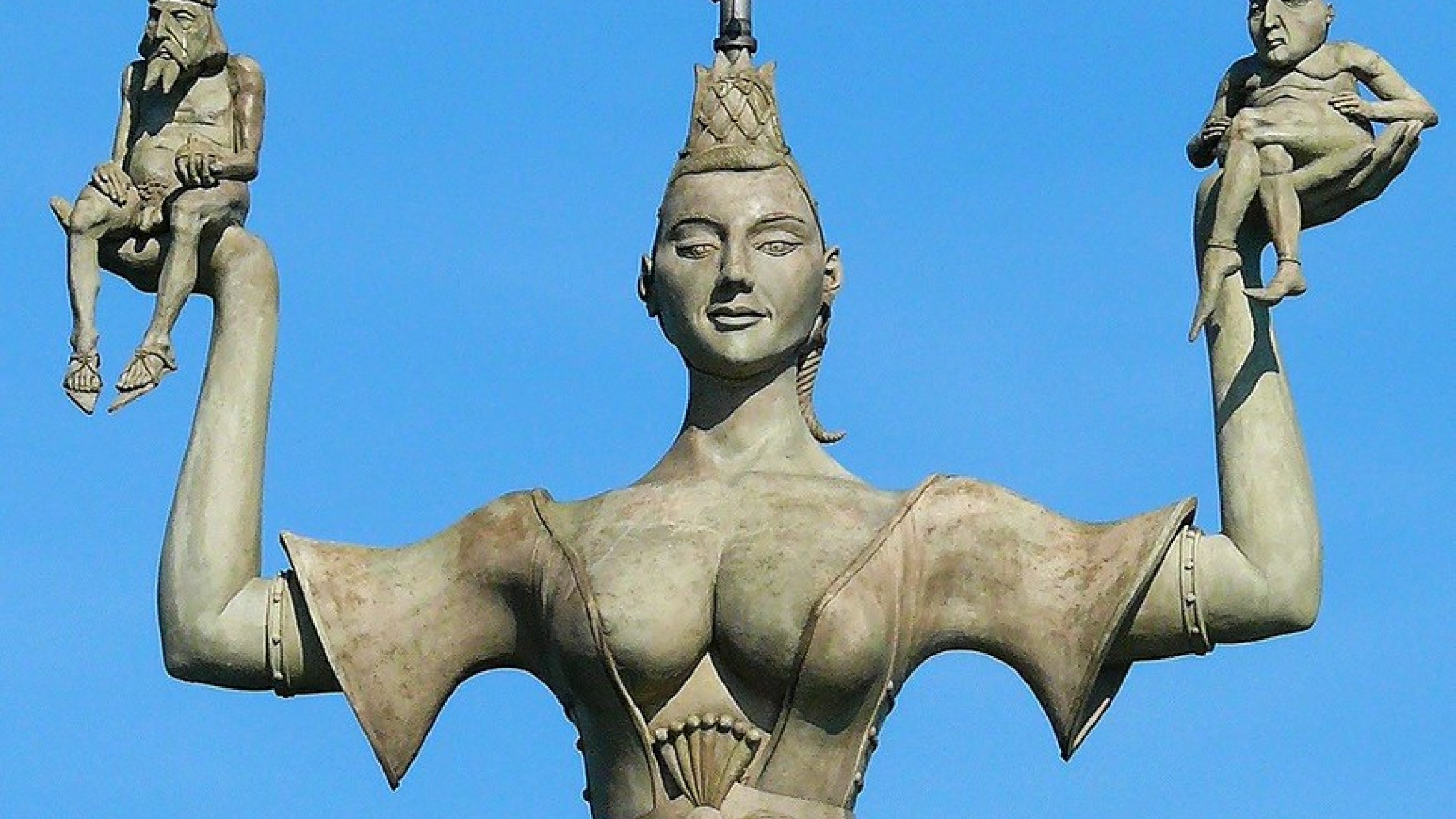
There’s a lot going on with Imperia, but the detail that catches the eye? Her small, cruel smile.
More generally, everything about her radiates strength, confidence, command. Her head is upright — the flowery ornament emphasizes this — but her eyes are directed very slightly downward, de haut en bas, as if contemplating something beneath her. She’s literally looking down her nose at you.
Her posture is erect, shoulders broad. She’s holding up the two shrunken men without the slightest sign of effort. She’s strong: you can see muscle under her sleeves, and more muscle along her extended thigh.
One foot is off the ground, but this doesn’t suggest imbalance. She’s obviously stepping forward, advancing.
(I found one critic who thought she was inspired by the Minoan Snake Goddess. That’s a pretty deep cut, but… maybe?)
So Imperia went up in 1993. The sculptor was a guy named Peter Lenk, who is still around. I’m not a fan. Most of Lenk’s sculptures are 3-D political cartoons, and they’re usually some combination of ugly and vulgar. He’s got a following, but most of his stuff leaves me flat.
Imperia, though… Imperia, in my opinion, goes pretty hard. I view Lenk as a one-hit wonder, and Imperia is his Macarena.
Scandal at the Council
In the previous post, I went on at some length about the Council of Constance. One detail I omitted: during the years of the Council, 1415-18, Constance was famously full of sex workers.
Makes sense, right? The Council was all men — priests, bishops, noblemen, professors, lawyers. Plus their servants, plus all the workers who came into town to support them. Thousands of men, away from home for years at a time. Obviously there were going to be sex workers. And because Constance was a small city that was drastically overcrowded, the sex workers were really obvious. They couldn’t be herded into a red light district, because there literally wasn’t room.
And this was very much commented on at the time. You had the densest concentration of religious and political elites that Europe had seen in generations. They were here to reform the Church, so that it could provide spiritual and moral guidance to the world. But the moment you set foot in Constance…
The optics were not great. Before long, Europe was abuzz. It was an age of cheap woodcuts, and these told the story better than any thousand words:
[included: hot bath, dinner, musical accompaniment]
And then of course the Council was mostly a failure. Yes, they fixed the problem of the three Popes. But they didn’t solve the Hussite heresy. (In fact, by the brutal judicial murder of Jan Hus, they created a martyr and made it worse.) They didn’t repair the broken system that kept producing bad Popes. And they barely gestured half-heartedly in the direction of reforming the Church.
So Imperia is a sarcastic commentary on the hypocrisy of the Council members, 600 years after the fact? Sure, that works. But I think there’s a lot more going on here. Good art has layers, and while I wouldn’t call Imperia great art, I think she’s a serious work.
Here’s one layer: Sculptor Lenk has acknowledged an inspiration. It’s the short story “La Belle Imperia”, written in 1831 by French author Guy de Balzac.
The Veterinary of Incurable Diseases
I have learned more from Balzac than from all the professional historians, economists, and statisticians of the period altogether — Friedrich Engels
I’m not going to go down a rabbit hole about Balzac, but he was a damn interesting dude. He’s one of those characters who combined a love of life — eating, drinking, chasing women, parties and arguments — with rigorous and terrifying work habits: he wrote over 90 novels plus millions of words of essays and short stories.
Lots of writers have drunk themselves to death. Balzac may be the only one who did it with coffee. He drank forty to fifty tall, strong cups per day, every day, for thirty years. Unsurprisingly he developed heart problems, which claimed his life at the age of 51. (To be fair, the three or four bottles of wine and several cigars per day probably didn’t help.)
Balzac got the odd nickname “vétérinaire des maladies incurables,” possibly because a lot of his stories involved situations that were simply screwed beyond hope of redemption. His short story “La Belle Imperia” fits this pattern. In the story, Imperia is a high-status courtesan at the Council of Constance. A naive young priest falls in love with her, and wackiness ensues.
I don’t think it’s a fantastic story — I’m not a huge Balzac fan to begin with, and I don’t think this is his best — but if you like, you can read it for yourself. And I do think Balzac’s introduction of Imperia is worth noting:
Imperia was the most precious, the most fantastic girl in the world, although she passed for the most dazzling and the beautiful, and the one who best understood the art of bamboozling cardinals and softening the hardiest soldiers and oppressors of the people. She had brave captains, archers, and nobles, ready to serve her at every turn. She had only to breathe a word, and the business of anyone who had offended her was settled. A free fight only brought a smile to her lips, and often the Sire de Baudricourt — one of the King’s Captains — would ask her if there were any one he could kill for her that day… Thus she lived beloved and respected, quite as much as the real ladies and princesses, and was called Madame.
In 1855, Gustave Dore did an illustration of Imperia:
It’s early Dore — he was just getting started — and not that great. Still, we’ll come back to it.
So Imperia is just a story about a very charismatic sex worker who rules men with her wiles? Well… there’s more. Because Balzac got the idea for a courtesan named Imperia from actual history.
Scarlet Woman
There was a real Imperia. Her name was Imperia Cognati, and she lived in Rome around the turn of the 16th century — a contemporary of Machiavelli and Leonardo da Vinci. For about a decade right after 1500, she utterly dominated the Roman social scene. Her lovers included Agostino Chigi. Chigi is now forgotten, but he was the richest man in Italy for decades, and a major patron of the Renaissance.
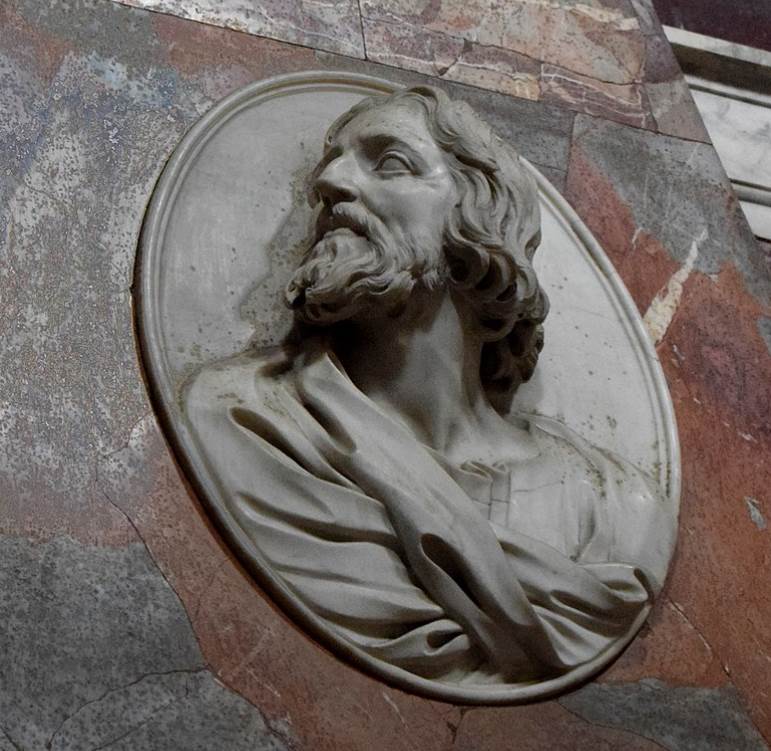
[as he got richer, his images looked ever more like Jesus]
Rabbit hole avoided: I was going to write a couple of thousand words about Chigi, his monopoly on the alum trade, and how that brought him into head-on conflict with King Henry VII of England, whose grandfather Owen Tudor we glimpsed as a handsome young courtier in the last post. But no. I will note that Chigi was the banker to three Popes in a row. Pope Alexander VI was a murderous gangster, Pope Julius II was harsh and brutal, and Pope Leo X was a cheerful hedonist who drove the Church into bankruptcy. Together, they helped set off the Protestant Reformation!
[that’s Alexander VI. he was pretty evil. good choice for this cover, though.]
Meanwhile: remember in the previous post, where I talked about how the Medici became the Papal bankers by providing money to bribe the College of Cardinals? Well, Chigi filled that position after the Medici left it. And what became of the Medici, you ask? Well, that’s complicated, but part of the answer is that they graduated from helping others become Pope to becoming Pope themselves. Leo X, that fun-loving patron of art and music, was a Medici Pope, and he wouldn’t be the last.
Another of Imperia’s lovers was the painter Raphael. 
[“Self-Image Of A University Economics Department“, fresco by Raphael, c. 1510)
There’s a woman who pops up in several of Raphael’s paintings: young, blonde, with high cheekbones and a long nose. We’ll never be completely sure, but it’s widely suspected that she’s Imperia. Here’s an example:
I am not an art guy, but I did take a couple of courses back when. And I remember the professor mentioning that Renaissance Italian artists Had A Thing for blonde models. Olive-skinned beauties do occasionally pop up, but the default female phenotype isn’t very Mediterranean. More like Scandinavia. Or the upper Midwest: give her a parka and a toque and hey it’s Janet Luedtke, sophomore at the University of Wisconsin – Eau Claire.
Anyway! You’ll notice that Raphael gave her a baby unicorn, symbol of innocence and purity. Raphael did like his little jokes.
The descent of Imperia
So now we have a genealogy of sorts.
(1) In 1415 you have the Council of Constance, full of prostitution and hypocrisy.
(2) About 100 years later, you have a real-life courtesan named Imperia. She’s in Rome, not Constance, but she has powerful men as her lovers, is herself a high-status celebrity, and moves in the social circles of the hedonistic Medici Pope.
(3) Around 1830 Balzac writes a short story in which he puts the 16th century Imperia back into the 15th century Council of Constance, because why not.
(4) In 1993, inspired by the Balzac story, Peter Lenk erects Imperia.
That’s good as far as it goes, but now we’re going to complicate it a bit. Because Peter Lenk wasn’t the only creative to be inspired by the Balzac story.
A Little Flesh, A Little History
Back in the early 20th century there was a German painter named Lovis Corinth. Corinth started as a realist, but became much more of an Expressionist after he had a stroke in 1911. Here’s one of his earlier pieces: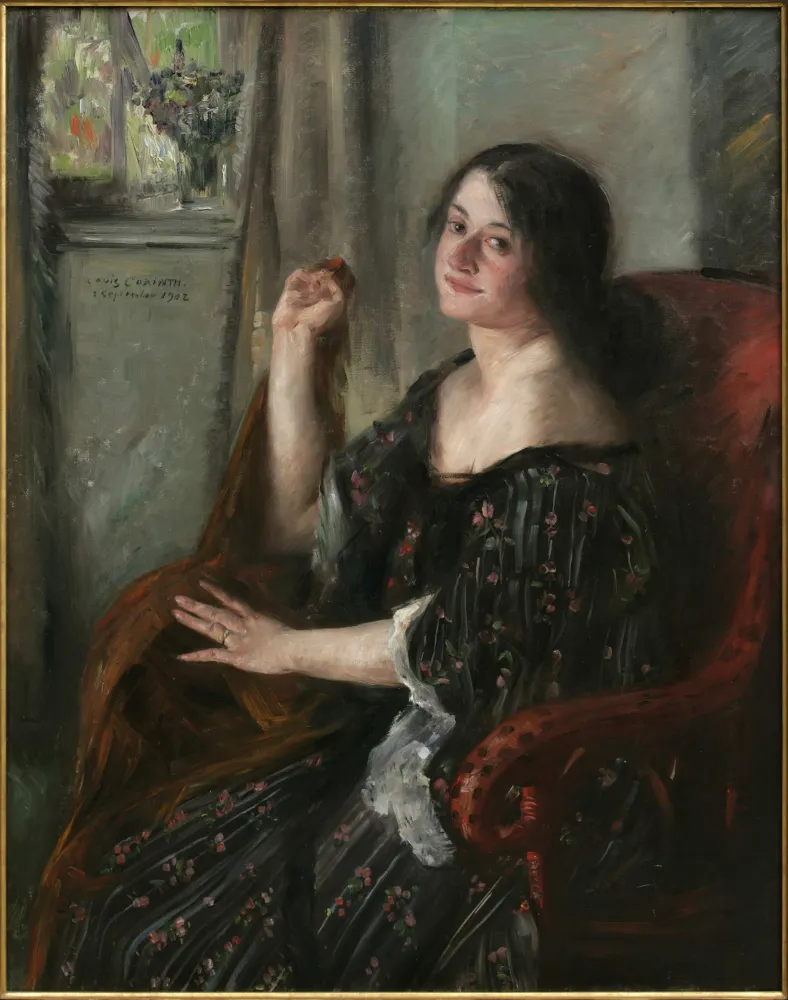
[portrait of a woman who’s going to have an interesting life]
That’s Corinth’s student Charlotte Berend, who became a respectable painter in her own right. At the time of the painting, they were lovers. Later they married.
Corinth liked painting women, and he liked painting nudes, and he liked painting nude women. So it’s maybe not surprising that he took inspiration from the Balzac story. He did his own painting of Imperia, in his late Expressionist style:
[Janet Luedtke Gets Drunk And Wins A Bet]
Done in the spring of 1925, it was one of Corinth’s last paintings. A few months later he would die of pneumonia.
Okay, now scroll up to the Gustav Dore engraving about a thousand words back. See the resemblance? Corinth (1925) was obviously riffing on the illustration that Dore (1855) had done 70 years earlier — utterly different style, but same layout.
Now scroll up again and look at the Raphael. Both women are round-faced, pale-skinned blondes with high cheekbones. It’s much less certain, but… maybe Corinth was drawing from Raphael as well as from Dore?
And in the other direction, we know that sculptor Lenk (1993) draw inspiration from the Balzac story (1831). Was he aware of the Corinth painting as well?
Well: on one hand, googling shows no connection. And it doesn’t appear that Lenk ever mentioned the painting.
On the other hand, Lovis Corinth is pretty famous in Germany. And there are some similarities — the upraised arm, the bracelets, the fact that they’re both stepping forward with one (right) foot. And while the painted Imperia isn’t holding up any dwarves, she is utterly dominant over the little dark priest to the right.
Other-other hand, could be coincidence. Or one of those things where an artist just picks up on details from another artist’s work entirely unconsciously. We’ll probably never know.
Also Nazis because really, why not
Corinth’s wife — the former student Charlotte — seems to have been pretty level-headed. Left a widow with two children, she took charge of her husband’s collection and managed it pretty successfully for the next few years, 1925-33. And then the Nazis came to power in Germany.
Did I mention that Charlotte was Jewish? Well, she was. And she seems to have instantly realized what a deadly threat the Nazis were. She left Germany in 1933 with her children, taking some of Corinth’s paintings — she couldn’t get them all out. The family settled in New York City. Charlotte eventually died there, an old lady, in the 1960s.
Meanwhile, back in Germany, Corinth’s remaining paintings were judged by the Nazis and found wanting. A number of them were hung in Goebbel’s “Degenerate Art” exhibition —
[Nazis: fuck those guys.]
— and then several were publicly burned, along with other “degenerate” works of art. So there are various Corinth paintings that we only know from photographs or descriptions.
(But of course, Nazis being Nazis, some of the more interesting paintings quietly slipped into the hands of senior Party members and their particular friends. Every few years another one surfaces somewhere. Yes, eighty years after the end of the Second World War, we’re still recovering paintings that the Nazis looted. Dotted across Europe there are schlosses and chateaus where someone — usually, a very wealthy someone — can appreciate great art in comfort and privacy. Why should they suffer, just because Grandfather had some questionable friends?)
“Imperia” made it to New York, though. She’s in a private collection, but occasionally appears in public for Corinth retrospectives.
I Can Do This, I Swear
All right: this article may have gotten just a tiny bit out of control.
But just one more post, honest. Come back in a day or two and we’ll talk about candy everybody wants, belated respectability, what we see when all that is solid melts into air, and — finally — why I think Imperia is important, serious art, and well worth a look.
Thanks for reading!
[Update: Part 3 and last can be found here.]
{ 11 comments… read them below or add one }
oldster 02.25.26 at 1:30 am
Great fun as always, Doug.
Austin Loomis 02.25.26 at 2:39 am
Wikipedia “tells us that he was “born Roderic Llançol i de Borja” and “is commonly referred to by the Italianized form as Rodrigo Borgia.” Yeah, those Borgias. He wasn’t even the first Borgia pope.
D. S. Battistoli 02.25.26 at 7:35 am
I think I’m starting to get a hang of your style; its amazing accessibility has so much going for it. For those readers who might have heard of such topics as the Council of Constance and Martin V, it would be cool if every once in a while you linked to something from the literature about these topics. In some cases, you’re offering really hot takes, or going rather out on a limb—like not including the end of the Western Schism in the balance of whether the Council was a success or failure. I think readers could appreciate your uniqueness more if a few of the cool things you point to along the way were pieces of academic research.
Take “I found one critic who thought[. . .].” Back in the day at CT, you would have lots of readers interested in who that critic was, and potentially willing to click through to their writing. I’ve been out of town for a while, but such may still be the case.
Keep up the long-view thinking; it is wonderful.
Adam Roberts 02.25.26 at 8:01 am
“Guy de Balzac” >> Honoré de Balzac
D. S. Battistoli 02.25.26 at 12:45 pm
By hazard, I am reading chapter 48 of Book 4 of Gargantua er Pantagruel today. Here, Rabelais describes Pantagruel’s welcome among the Papemanes, implicitly after the Council of Constance:
[—]Nous parlons de Dieu en terre. L’avez-vous oncques veu ?
—Ilz entendent (dist Carpalim) du Pape, sus mon honneur !
—Ouy, ouy (respondit Panurge), ouy dea, messieurs, j’en ai veu troys, à la veue desquelz je n’ay guères profité. […]
«Si ferions, si ! (respondirent-ilz) cela est entre nous jà résolu. Nous luy baiserons le cul sans feuille, et les couilles pareillement. Car il a couilles, le Père Sainct, nous le trouvons par nos belles Décrétales : autrement ne seroit-il Pape.
Sex-centered mocking art about 15th century popes and schismatism are as old as the 15th century itself.
Tm 02.25.26 at 2:48 pm
Regarding sex workers, if you haven’t visited the abbey museum in Stein am Rhein, you definitely should. It has well preserved renaissance frescoes (c 1515) in the banquet hall depicting (among others) profane market scenes which also feature sex workers (but they are not naked). This hall was meant for representation by the abbot so it might tell us something about the elite mores of the time.
ja sto 02.25.26 at 2:56 pm
Fascinating detective work, forensic art historian that you have now become. Excellent. Let me recommend Robertson Davies, Cornish Trilogy to you! It possibly predates your family tree here, or it could be a parallel history, written with a bit more novelistic flair. In any case, you will surely appreciate it after your amazing search for Imperia. Robertson Davies, those Canadians always seem to win in the end and good for them!
Tm 02.25.26 at 3:18 pm
You don’t mention the strange headdress which seems to imply a fool’s cap. But why would strong clever Imperialismus wear one? (Constance has a carnival tradition but of the Alemanic style which isn’t commonly associated with the fool’s cap).
Alan White 02.25.26 at 11:20 pm
Another wonderfully sinuous trek through history! Thank you Doug (if I may).
Ken_L 02.26.26 at 4:52 am
Thank you Jesus for President Trump, saviour of the Western civilisation described so compellingly in the post.
MisterMr 02.26.26 at 7:02 am
Not knowing where this story is going in part 3, I’m reminded of this statuette. Searching on Google I find the Phyllis and Aristotle trope that was popular at the time.
I follow the link to the more general Power of women trope, that includes the “battle for the trousers” idea.
I discover Christine de Pizan, a protofeminist born in 1364 who tought that these stories were misoginistic.
Is Imperia a cool feminist figure or a disguised misoginistic one? Hmmm?