Last week Australia’s central bank (Reserve Bank of Australia, RBA) raised interest rates. Again.
Political economists have been talking for decades about the RBA’s tendency to redistribute wealth from the bottom upwards. But now it seems most people understand that the latest interest rate rises requires ordinary people to hand over more of their cash to their bank, to get it out of circulation and bring down inflation.
Asking whether superannuation or taxes could also be used for the purpose of reducing interest rates, the ABC pointed out that interest rates were not always the way inflation was managed. They published an article asking ‘Would you rather hand over an extra $300 a month to your bank or the federal government?’ – suggesting that this might even be an option.
Rightly, the ABC points to the place of government in setting up this structure. But history shows that for all that government is nominally in charge. Well. You might have noticed that banks are fairly powerful. Government v bank doesn’t always mean the government wins…as we will see.
Battle of the Banks
I recently published a review of Bob Crawshaw’s Battle of the Banks, which is about the role of the media in what nearly every historian agrees was a controversial (sometimes seen as just plain mad) decision on the part of 1940s Labor Prime Minister Ben Chifley to try to nationalise Australia’s banking sector.
We have a number of accounts of this fairly notorious episode in Australian history. This one might be the most rollicking. Here is my review, though you probably need institutional access to the Journal of Australian Studies to read it. Yell out if you can’t and I can send you a pre-published version.
The basic story of the battle of the banks is this:
- The Curtin/Chifley governments had been able to use the banking system( especially the ‘People’s Bank’, the Commonwealth Bank of Australia, which was owned and operated by the government as a central, merchant and trading bank) to help finance Australia’s participation in the Second World War.
- They now sought to use similar measures to enable them to finance Post-War Reconstruction, which among other things included a very substantial housing program, which they said would fulfil all the dreams of ‘Mrs Australia’.
- To do this, there was a new banking Act. Led by what is now NAB, the commercial banks challenged the Act in the High Court. Based on a bit of the constitution about money moving across state borders as a foundational goal of federation, one of the provisions of the Act (requiring local government to bank with the Commonwealth Bank so that the flow of cash would help finance housing) was deemed unconstitutional.
- Evidently pissed off, Chifley called a Cabinet meeting where it was agreed that since this Act was bust, they would nationalise the banks.
At this point nearly every historian (including Crawshaw) declares this to be ‘rash’, as if Chifley just thought it up out of pique and somehow bulldozed cabinet into this crazy plan.
But in fact bank nationalisation has been Labor policy for several decades.
Populist Money Movements
Historian Peter Love wrote an excellent book a while back now about populist opposition to ‘the ‘money power’, which grew as banking became more influential in the development of Australian capitalism.
Peter Love shows they way this movement helped cohere working class activism in the face of multiple crises, especially the bank crashes of the 1890s and the 1930s Great Depression.
In the 1920s, opposition to the ‘money power’ also coalesced into a politics attached to Douglas Credit. This was a (kinda wacky, in retrospect) idea that a new kind of money could be distributed as as a kind of ticketing system. This would guarantee consumer demand on one hand, and redistribute national wealth on the other, rather than allowing historical power blocs to accumulate more, while others have insufficient money to purchase what they need. It is a precursor, in some ways, to both MMT and a universal basic income.
In the 1920s when ideas and practices of banking, money, economics and politics were still a little more up for grabs than they now seem, the labour movement’s anxiety about the money power helped give Douglas credit political potency. The political party linked to the idea made some progress in the 1930s.
During and after the Great Depression, the idea that we could fix things by issuing currency differently took such hold that it grew into a key reason (on the surface at least) for a Royal Commission into the Monetary and Banking Systems in Australia, commencing in 1935 and reporting in 1937. Reading the report and the submissions from banks, one gets the impression that Social Credit was the public reason for the Royal Commission. Underneath it – at least to my (fairly cursory…SO FAR) reading – was a desire to consolidate data about banking to see what sort of regulation and coordination the sector needed in the wake of the Great Depression.
I wrote about this recently for Griffith Review.
Banks are a utility
The final report of the Commission (1937) includes a dissenting report by Chifley. In it, he describes the way that banking has become more important in the past half-century or so.
Emerging in modern form as a partner of the state, helping facilitate fiscal policy, in other respects banking was a marginal industry on the edge of international shipping. It was crucial to that, though, providing the money needed to ship (say) you wool clip to England to meet a contract. In return for this service, banks took a cut, known as the ‘discount rate’. This was core business to such a degree that some 19th century banks didn’t even accept deposits. That wasn’t what they were there for.
Beginning with the 1851 gold rush (I think), this began to change in Australia. Becoming buyers and sellers of gold set them up as deposit-holders because a deposit was the better way to pay for gold.
And slowly, slowly – too slowly for some farmers and small business owners – they also became providers of business credit.
So in 1937, Ben Chifley looked at this system and saw that nothing could happen in the economy without the banks. It was a utility. In my Griffith Review piece I likened banking-as-utility to sewage. It is essential, but also full of shit.
That time Australia nearly nationalised all the banks
As a utility, Chifley thought that (a) nationalisation was best, but in the absence of that, what with how all the other commissioners were more conservative and were never going to back nationalisation, (b) banking profit rates should be seriously limited. Chifley had some specific suggestions, but the commissioners did in fact agree that the government could consider limiting bank profits.
For Chifley limiting profits would ensure government had the cash it needed to do stuff and/or money was circulating in the economy where it belonged (a key factor during the Great Depression to be sure), rather than flowing relentlessly into the coffers of the banks’ rich shareholders, redistributing national incomes straight into the pockets of the ‘money power’.
We should briefly note that the situation Chifley saw has only intensified. Since bank deregulation, home loans are the big asset on banks’ balance sheets. These are created from nothing (kind of), secured against the ever-rising value of real estate. They are like a vacuum, created to hoover up wages.
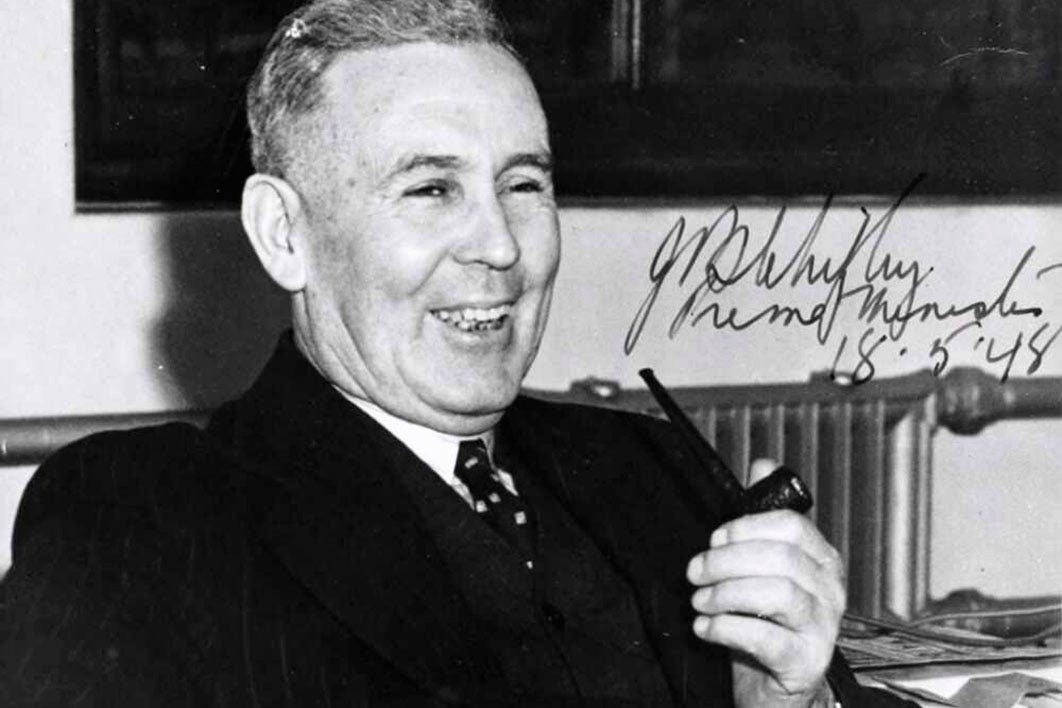
So Chifley’s attempt to nationalise the banks in the 1940s was not such a mad plan as it seems in retrospect. It not only reflected longstanding Labor policy, but it also embodied Chifley’s 1937 observation that banking was the sewage system of the economy: public (economic) health depends on its effectiveness, and a focus on very high profits was likely to fuck up its very purpose.
From the people’s bank to the bankers’ bank
Spoiler alert: Chifley failed. The proposal was that banks would be compulsorily acquired at the commercial rate independently assessed and where every bank worker would keep their job at the current pay rate or better. But in the anti-communist moment, the banks were able to leverage wider dissatisfaction with Chifley to ensure he would not be elected and that their fella, conservative visionary Robert Menzies, would be.
Chifley’s opportunity was gone. And the banks now felt themselves to be unstoppable.
While they were on a roll they decided to go after the Commonwealth Bank, known then as ‘the people’s bank’.
The commercial banks really, really didn’t like that this central bank also competed with them as a trading bank. Just like Rupert Murdoch doesn’t like the existence of the government-funded national broadcaster, the ABC, they felt that the Commonwealth Bank had an unfair commercial advantage.
So, the pressure mounted until the central bank and the trading bank roles were separated. The Reserve Bank of Australia was established as the central bank in 19t60, separating out this goal from the Commonwealth Bank.
Whatever else they may be, we would hardly describe either the Commonwealth Bank or RBA as a ‘people’s bank’ any more. And the power of the banks, not to mention their incredible annual profits, has certainly not lessened – even after another, much more scathing, Royal Commission in 2017-18.
{ 8 comments }
Martin Holterman 05.11.26 at 8:41 am
For the record, taxes can also be used to combat inflation, but only to the extent that they reduce consumption or investment. Taxing the rich is most likely to affect these individuals’ savings, and would therefore not be an effective tool. One way or another reducing the purchasing power of lower and middle-income citizens is the only plausible way to do the job.
MisterMr 05.11.26 at 11:55 am
@Martin Holterman 1
If taxes manage to reduce rich individual consumption, they do reduce inflation (and arguably create unemployment).
I don’t think that long term taxes (as opposed to one-off stuff) would be only be absorbed by savings, otherwise in time savings would become negative.
Wealth taxes might be different, but I’m not that sure of it.
marcel proust 05.11.26 at 12:26 pm
RE: Martin Holterman@1
Conventional economic theory asserts an equality between savings (appropriately defined) and investment (appropriately defined). If taxes are successful in reducing the savings of the rich, and this bleeds through into total savings, presumably it would reduce investment and therefore inflation.
Perhaps, however, as Keynes said with respect to stimulative monetary policy during a depression, “There’s many a slip between the cup and the lip.” It would certainly be an aesthetically pleasing symmetry (for some definitions of aesthetically pleasing) if fiscal policy meant to restrain inflation were as weak as monetary policy intended to turn around a depression. That, however, would not be evidence in support of it.
D. S. Battistoli 05.12.26 at 10:51 am
Hannah, if you think it is worth the candle for you to respond, can you help me (as a non-Australian reader) understand how Ben Chifley and Labor’s economic policies map onto the country’s accession to the Bretton Woods I framework? The 1937 Royal Commission would have related to a pre-Bretton Woods monetary world.
Bretton Woods I seems to have been for the most part a Keynesian-friendly framework, if one that entailed a decrease of monetary-policy sovereignty for participating countries. And of course we now live in a post-1971 Bretton Woods II world. But I don’t know how these shifting global monetary- and economic-policy winds affected Australia in the period you discuss. I feel like, in looking back, I might be gazing across a filter zone that I’m having a hard time identifying.
(Now, please do accept my apologies if this should be plain-as-day, or if is something you address in one of your paywalled articles—I’d be glad to just read a copy of one of those if the answer is there).
Bob 05.13.26 at 5:55 pm
This comment in the original post got my attention: “But now it seems most people understand that the latest interest rate rises requires ordinary people to hand over more of their cash to their bank, to get it out of circulation and bring down inflation.”
If this is what “most people understand” then most people are wrong. If your mortgage payments go up due to higher interest rates, that does not take money “out of circulation.” It just puts more money in the hands of the banks and their shareholders–money that remains available to be spent, albeit by different people.
The real mechanism whereby higher interest rates affect money in circulation is through their effect in raising the price of what banks sell– loans. The result of higher rates is that fewer new loans are made, and some existing loans are repaid. Money is created when bank loans are made, and destroyed when loans are repaid.
Tm 05.18.26 at 7:38 am
Isn’t this a bit more complicated? If I remember correctly, low interest rates close to zero have been criticized by the left for creating financial bubbles and thereby again enriching the rich, while middle class savers are losing money. Am I getting this wrong?
Hannah Forsyth 05.18.26 at 10:58 pm
Thanks for all the comments, my ability to keep track is closely connected to the velocity of other deadlines, which are currently exceeding the speed limit.
I’ll start from the bottom and see how I go. Tm: yes, the dice are indeed loaded. Extraordinary feature about the flexibility built into capitalist systems is the same winners and losers result from wildly different, even opposing, approaches (same interestingly applies to settler colonialism, which is obviously related: assimilation and exclusion are not the opposites they seem to be, but an expression of the priorities of the system). Why I love history and my hope in looking at Chifley is to see that some other options are available beyond the immediate ‘should we raise/lower rates’? I am too much still the historicist that my training made me (despite my Marxistish structural tendencies) to think Chifley had all the answers that can apply to the present, but I like to think he shows us that bigger thoughts are possible.
Bob, it feels lovely to declare people wrong, but in this case they are not. I can’t speak for nations where everyone has fixed home loans but not only is it widely known that increasing loan repayments will reduce spending (and will have flow on effects for rentals), but in fact the RBA is explicit about it. Yes, ofc the loans between bankers (broadly speaking) are what makes the financial world go around and increased rates are not great for those fellas either (though they don’t hate it like they hate inflation), but the RBA is unquestionably also expecting that increasing mortage/rent repayments will ensure spending will fall.
D. S. Battistoli lovely question. I have written about this somewhere but tbh I can’t remember where and it was no doubt in insufficient detail (my work on bankers and banking is still in its early days). I did find a lovely note in the archives about Bretton Woods that said ‘we obviously have to do this’ which about sums up Oz’s approach to nearly all foreign policy what with being mid. They sent a team of economists to Bretton Woods though to do their best to influence the issue that they wanted most, which was a commitment to full employment, which Labor had at the centre of Post War Reconstruction and believed would not be inflationary if the big powers did it too (I think we can assess it as having ok to mixed results). If you’re keen, Stuart Macintyre’s Australia’s Boldest Experiment is the key text, but there is also a terrific account of the economists to Bretton Woods called Giblin’s Platoon – here it is: https://press.anu.edu.au/publications/giblins-platoon
Bob 05.19.26 at 1:09 pm
Question for Hannah @7.
You refer to “increasing loan repayments.” If loan repayments–i.e., reducing debt–are the effect of the policy, then, yes, the amount of money in circulation will go down. But (i) “loan repayments” are not the same thing as (ii) “paying more for your loan” due to higher interest rates. What are we talking about here, (i) or (ii)? This is a genuine question, because the terms you are using mean something different for someone familiar with monetary policy outside Australian, and this may be creating some confusion.
Comments on this entry are closed.