The Prime Minister of Spain, Pedro Sánchez, likes to invoke international law. Imagine that one day, someone had finally responded to him. Not just anyone, but one of the founding fathers of international law.
It happened just after the Ceuta incident, in July 2026, when tens of thousands people from Morocco surged into Ceuta, a tiny Spanish territory in Northern Africa. The incident caused diplomatic tensions with both Moroccan and European leaders. It was precisely the kind of case that Francisco de Vitoria (1483-1546) used to solve.
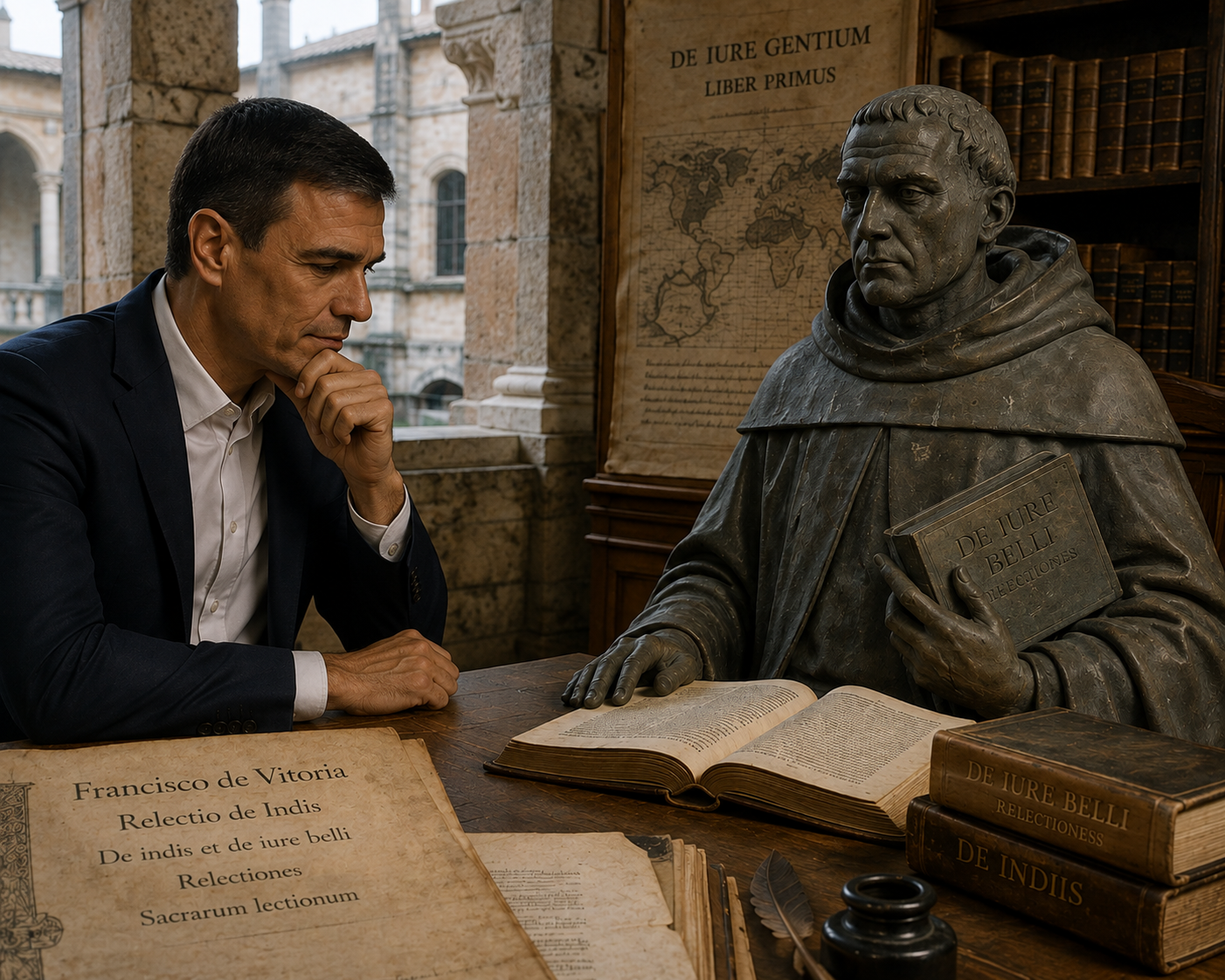
Vitoria, a Dominican jurist who taught theology at Salamanca, in Renaissance Spain, was familiar with migration issues. He lived at the time of the discovery of the New World when tens of thousands of Spaniards crossed the Atlantic. He was worried about the massacres they perpetrated against the indigenous people and he then devoted a relectio to clarifying the rights of Indians and of Spaniards. A relectio was an official lecture attended by the entire university, whose purpose was to apply the concepts studied in class to current affairs. Pronounced in 1539, De Indis argued that the Indians were the legitimate sovereigns over their territory – a claim that upset both the Papacy and the Spanish Crown.
Three perplexing questions
Vitoria would ask Sánchez three questions about Ceuta. First, why were there diplomatic tensions at all: had the newcomers cause any harm? But then, if they did not, why did Sánchez call their arrival a “violation of Spain’s territorial sovereignty”? Finally, will harmless foreigners who are refused entry wage wars of retaliation?
To clarify, Vitoria would find it hard to understand why these newcomers have caused any concern at all. Having just arrived, they could only be innocent and it is inappropriate to greet innocent people with fear or hostility. As they have swum to Ceuta with nothing but the hope to work, they appeared to be generous and perhaps too confident. That the Spanish government had deployed its armed forces against them would have stunned Vitoria. In his time, five centuries ago, the Spaniards did not arrive offering their labor; instead, many forced the Native Americans to work for them, at the cost of millions of lives. In spite of this danger, he had still advocated freedom of movement.
Second, Vitoria would not understand why Sánchez describes the arrival of almost naked newcomers as a violation of sovereignty. Vitoria does not underestimate sovereignty. In 1539, his lecture caused a political storm because he clearly recognized the Indians as the rightful masters of their lands. But in no way did sovereignty imply a right to prevent the arrival and settlement of innocent foreigners.
For Vitoria, human beings have a natural right to travel and settle abroad. This is partly for theological reasons: they are all children of God who gave them the Earth in common ownership. But Vitoria also thought that friendship is their natural condition and it would be “against nature to shun the society of harmless folk”. The only limit to free movement is harm: for while it is “inhumane to treat visitors and foreigners badly without some special cause, (…) the case would be different if the foreigners were to misbehave”.
Thirdly, Vitoria would worry that harmless foreigners, treated with unjustified hostility, might resort to wars of retaliation. Indeed, a long tradition (which I summarized here) drew on both biblical and secular sources to argue that such a war would be just. On Augustine’s view, this is exactly “how just wars were waged. For innocent passage was denied, which by the most equitable law of human society ought to have been open.”
Shouldn’t Pedro Sánchez be more concerned about the hostility his refusal is provoking than about a symbolic loss of sovereignty?
Short political answers
Pedro Sánchez did not expect this criticism. He is usually blamed for supporting migrants too much. Soon after becoming prime minister in June 2018, he had made a name for himself by announcing that Spain would welcome the hundreds of people aboard the rescue boat Aquarius, who had been refused entry to Italy and Malta. Not later than this year, he sparked again controversy among his European counterparts by deciding to grant legal status to half a million undocumented migrants living in a vulnerable situation and with no criminal record. More than a million applied.
As for Vitoria’s objections, Sánchez would be brief. First, innocent foreigners who do not misbehave individually can be perceived as harmful collectively when they are too numerous for a small place. Second, when he referred to a “violation of Spain’s territorial sovereignty”, he did not identify anyone responsible, merely mentioning the “mafia and human traffickers” who probably spread misinformation about open borders in Ceuta. Third, harmless foreigners whose entry is denied never retaliate, because in the 21st century, everyone knows that the right to travel and settle abroad is not recognized as a universal right.
Vitoria should accept that times have changed drastically. Contemporary law of nations no longer rests on religious duties of universal friendship, but on obligations entered on by sovereign states. While there is no acknowledged right to travel and settle abroad, the United Nations has adopted a Universal Declaration of Human Rights recognizing only a human right to “leave any country, including one’s own, and to return to it”.
Weaponizing respect for human rights
Much has changed since Vitoria’s time – and even more rapidly since 1948, when the Universal Declaration of Human Rights was adopted. At the time, the UN Commission on Human Rights had warned that a right to emigrate is not effective without facilities for immigration and transit, but had recommended that member states cooperate to provide such facilities. The right to leave any country was eventually adopted in this form with only three abstentions from communist countries which opposed emigration.
For a time, respect for the human right to leave any country allowed Western countries to claim moral superiority over the Communist bloc. After the fall of the Berlin Wall, that right was not merely ignored, but actively undermined. Rich countries conditioned development aid on the ability to curb irregular emigration, thereby denying the right to leave any country, including poor ones.
Today, the erosion of this human right has entered its final phase. A state that, deliberately or inadvertently, respects the right to leave by allowing people to exit its territory is now portrayed not as complying with a human rights obligation, but as threatening another state’s territorial sovereignty.
Political scientists have defined “weaponized migration” as the deliberate use of migration by a state or non-state actor to extract political or economic concessions from another state. The Ceuta incident suggests that political leaders no longer feel threatened only by the deliberate use of migration. They also see a state’s failure to prevent departures as a violation of another state’s territorial sovereignty. This interpretation has applied not only to Morocco but also to Spain which some European leaders have sought to exclude from the Schengen Area. They are thus contributing to the weaponization of compliance with a human right.
Vitoria observed the disregard of a right that the states themselves have recognized. Yet, in his view, the law of nations did not rest on the states’ consent alone. It derived from the authority of the universal community of humankind to establish norms that are just and binding for all. His ideal may have fewer followers today, but Vitoria’s bust still stands at the United Nations headquarters in New York.
{ 10 comments }
D. S. Battistoli 08.19.26 at 5:37 pm
How should we respond to the contrast Vitoria offers between Spain’s engagement in the Americas and Portugal’s in Africa, regarding the latter of which which he said in De Indis, “Lusitani magnum commercium habent cum similibus gentibus, quas non subiecerunt, et cum magno commodo.”
The Portuguese were in the early stages of establishing in Africa what would eventually become plantation slavery for the production of sugarcane.
Now, Vitoria and the Salamanca school seem to have at least started on the same page as Paul III’s Sublimis Deus in showing concern for the souls of Amerindians, even as they went further to express concerns for their territorial rights. To what extent do we say, “ok, they’re doing something fascinating as relates to international law when we look at the Europe–Americas dyad”? Is it that there are separable features to their total-concept of dominium, and if so, how and where does the split get made?
I want to be clear that I intend this as a sympathetic question. I imagine that the answer might lie in something about the difference between the early sixteenth-c. Portuguese engagement with Northwest African polities and the early twentieth-c. Spanish engagement with Morocco, but I’m not well enough read in that period to know it.
D. S. Battistoli 08.19.26 at 5:41 pm
gosh, *early twenty-first-c. Spanish
My inability to preview more text than fits in the compose frame enables me to leave all sorts of infelicities in my posted comments.
Speranta Dumitru 08.20.26 at 2:57 pm
Thank you for this insightful and fascinating question. I must first say that I am not an expert on Vitoria, and my interest in the history of ideas stems mainly from a desire to develop a new philosophy of migration (using old arguments that seems more progressive than the current ones).
Regarding Vitoria, he often illustrates his arguments with examples from other countries (sometimes France) in order to make his point more universally acceptable. This sentence about the Portuguese appears in the conclusion of De Indis and aims to convince the Spanish crown – which was in competition with the Portuguese – that trade is in their best interest and that it is possible without conquest. Does Vitoria ignore or condone the Portuguese slave trade? I don’t know.
If there is a split between the concept of dominium as it applies to America and Africa, I don’t think so: The Treaty of Tordesillas (1494), arbitrated by the Pope, divided the whole world between Spain and Portugal, and all of Africa was reserved for Portugal.
What I see as a major shift in history is the way people are viewed: for many centuries, people were seen as a source of wealth – slavery is an extreme case, but many modern thinkers were considering various ways to increase population (attract foreigners, stimulate marriages etc.). And suddenly, probably in the 20th century, people are no longer wanted, not even workers! I don’t understand why. I wrote a short article that ends with the 19th c. to show that those who valued people were not all populationists but of various theoretical orientations.
Anyway, for them, watching people arriving at Ceuta would have been a moment of joy rather than an occasion to panic.
I may be wrong, but my feeling is that the change has to do with people’s value, and less with sovereignty and colonial ties. feel free to correct me.
Lucas S. 08.20.26 at 3:02 pm
The distinction between a right to leave and a right to enter also suggests a useful way to evaluate claims of “weaponized migration” without treating every departure as hostile action. It may help to separate three questions: whether an origin state actively organized or coerced movement, whether it merely declined to prevent departure, and whether the receiving state followed its own asylum and border procedures. Those categories call for different evidence and different remedies. Publishing the indicators used for attribution—such as official financing, coordinated transport, or unusual border facilitation—would make the label more reviewable and less rhetorical while preserving the article’s central human-rights distinction.
Speranta Dumitru 08.20.26 at 4:24 pm
Interesting approach, thanks. But if a state subsidize a human right, can that be a bad thing?
John Q 08.21.26 at 7:39 am
Relatedly, social contract theory depends critically on an assumed right to leave. As in Locke “Whenever the owner, who has given nothing but such a tacit consent to the government, will, by donation, sale, or otherwise, quit the said possession, he is at liberty to go and incorporate himself into any other commonwealth; or to agree with others to begin a new one, in vacuis locis, in any part of the world, they can find free and unpossessed.”
Of course, for Locke any land not already occupied by white men was free and unpossessed.
equalitus 08.27.26 at 5:24 pm
Since there is tremendously too high unemployment & relative poverty in Spain, my obvious political opinion is that unless Spain & the national Parliament [or the province governments] by economic policy reduces the unemployment rate substantially with or without a general conditional level of equalizing economic distribution, then Spain should reduce immigration from outside the EU area.
Jimmy 08.31.26 at 2:58 pm
Coming at this as a reader from the sports-data side of the internet rather than political philosophy, but the Vitoria frame stuck with me: the ius peregrinandi in De Indis is exactly the argument the conquistadors abused – harmless travel as a Trojan horse for something else. Which cuts both ways at Ceuta. If Sanchez can treat harmless arrival itself as a “violation of territorial sovereignty”, the definition does all the work, which is what Vitoria warned against. On the subsidization question raised above: paying third countries so that people never reach the border is not subsidizing a human right, it is paying for its non-exercise – the EU-Turkey statement always seemed like the paradigm case. I’d be curious whether the author reads Vitoria’s right of hospitality as a floor (something close to non-refoulement) or as a fuller claim to admission.
J-D 09.01.26 at 12:27 am
Are unemployment rates higher in places where there are more people? Are they lower in places where there are fewer people? No? In that case there’s no reason to think that increasing the population increases the unemployment rate or that decreasing the population decreases the population rate, and therefore no reason to think that reducing immigration will help deal with the problem of unemployment.
MisterMr 09.01.26 at 7:58 pm
@equalitus 9
Spain is AFAIK one of the fastest growing economies in the EU, arguably because of immigration, so there is this thing, that immigration dosn’t actually cause unemployment. OTOH other european countries (mostly Italy and Denmark, but also others) did put a lot of pressure on Spain on migration (even if Spain did in fact block immigration in Ceuta), so it’s not like the spanish government could act much differently.
Comments on this entry are closed.