I finished Elena Ferrante’s Neapolitan quartet yesterday. I know there’s been a lot of hype about these novels, but it is entirely justified. Actually, I write “these novels” but this is actually just one long novel, distributed across four printed volumes. For those who don’t know, it concerns the relationship between two women, Elena (or Lenu or Lenuccia) – the narrator – and Lila (or Lina) from childhood to early old age, and their mutual relationship to “the neighbourhood”, a working-class district of Naples and the many other families who live there. It is a difficult friendship, infected with rivalry, jealousy and resentment from the start. Lila is both intelligent and impulsive, spiky and demanding, capable of both extraordinary determination and of self-neglect and remains forever tied to the district; Lenu eventually enjoys worldly success and social evelation, but, in her own mind, is forever in the shadow of her “brilliant friend”.
[click to continue…]
Posts by author:
Chris Bertram

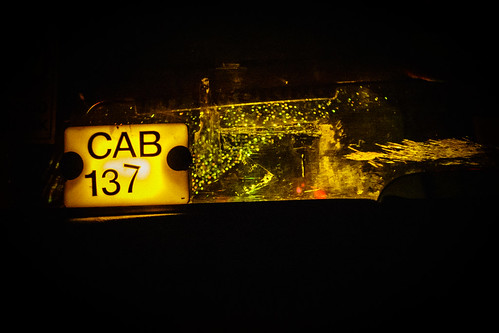
With the time of year, it is hard to remember which day of the week it is. So here, one day late, is a shot in our cab on a rainy night after watching Liverpool beat Leicester 1-0.

Thomas Piketty’s Capital in the 21st Century tells us a great deal about the evolution of inequality in wealth and income over a long period and how that distribution is likely to evolve unless we intervene. What Piketty does not do is to tell us why inequality is bad or why people care about inequality, although we can glean some knowledge of his personal beliefs here and there. In what follows I draw on some aspects of Rousseauvian moral psychology to suggest that the reasons people care about inequality matter enormously and that because some people value inequality for its own sake, it will be harder (even harder than Piketty thinks) to steer our societies away from the whirlpool of inequality.
In the book, Piketty argues that, without significant political intervention, it is likely that wealth inequality will increase dramatically in the coming century and that a class of rentiers will come to dominate over those who earn their incomes from labour, just as previous classes of rentiers did before the twentieth century. His book tells of a U-shaped pattern in the evolution of inequality in the past hundred years, with high levels of inequality being reduced but then bouncing back. Striking levels of economic growth coupled with the destruction by war and revolution of the wealth that formed the background to previous inequality, led to societies that were an unprecedented combination of egalitarianism and meritocracy, where those who worked hard could do well for themselves and where the domination over the living by wealth inherited from ancestors had become greatly diminished.

(co-written with Sarah Fine, Lecturer in Philosophy at King’s College London)
Only two months ago Europeans were shocked by the picture of Aylan Kurdi, the three-year-old Syrian refugee lying dead on a Turkish beach. Then, there was a profound sense that more should be done to help people fleeing Syria’s civil war. Now, in the immediate aftermath of the ISIS murders in Paris and with unconfirmed reports that at least one perpetrator may have travelled through Europe disguised as a Syrian refugee, there are loud calls to close our doors. For some of Europe’s politicians, such as UKIP’s Nigel Farage, Marine Le Pen of France’s Front National, and the new right-wing Polish government, enough is enough: refugees trying to get to Europe should be stopped and nobody should be resettled here. There are demands for Schengen to be abandoned, together with current rules about freedom of movement within the European Union. In the United States, a similar debate is playing out, as a number of Republican governors, Presidential candidates and members of Congress push back against President Obama’s plans to welcome thousands of Syrian refugees. With so many in Europe and across the world outraged at the atrocities in Paris, these voices will be seductive, but if heeded they will lead us towards policies that would be profoundly mistaken and counterproductive.
Clamping down on refugees fleeing the region will not prevent acts of terror. In the European case, if ISIS and similar organisations wish to engage in further attacks, they do not need to bring anyone in from Syria to do so. The perpetrators who have been positively identified turn out to have been lawful residents of France and Belgium.
[click to continue…]
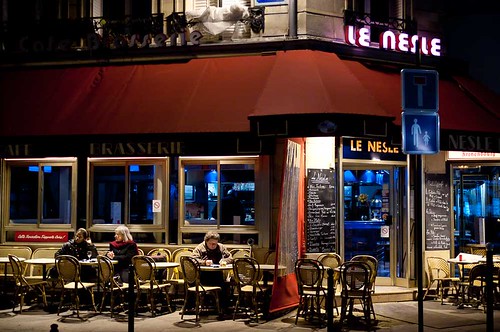
I’ve no words to add to what others have written. Solidarity and care for the dead and those who mourn them and for the wounded and those who care for them are the most important thing right now. Here’s a picture of ordinary life, people in a café.
Here’s one I took on Friday night. One of the swing bridges that connect the north and south of the city is closed for repair, so there’s a temporary replacement for cyclists and pedestrians that takes you much higher than usual and affords a different vista of the water.