Posts by author:

Harry

John Lawton’s Second Violin

by Harry on May 3, 2010

I’ve read all John Lawton’s novels, and have never discussed them with anyone. I remember formulating a post in my head several years ago asking why on earth publishers give novels different names in the US and the UK, after enthusiastically buying Bluffing Mr. Churchill only to discover that it was Riptide (and, no, I am not going to buy the claim that “Churchill” was added to make the book more familiar to Americans, any more than I buy the claim that Brits know better than Americans what a philosopher’s stone is — the number of Britons who buy a book because it is named after an Al Bowlly hit is vanishingly small). The animating device in each book is that Frederick Troy of the Metropolitan Police, son of a very wealthy Russian emgire, and brother of a future Labour MP, is confronted by some mystery that is connected to some major historical event or character (WWII, Suez, fictionalized versions of Profumo and the Kray twins). This presents lots of opportunity for rich and seemingly authentic historical detail, which is the real attraction of the books (the mock-Profumo case is done especially well). Real people, major and minor, appear here and there, always well drawn and just about plausible. They’re tautly written and literate. But I’ve never felt able to recommend one without reservation — they’re very, very well done, but the central drawback is the amorality and, frankly, the unlikeability, of Troy himself, who seems, at best, to have some sort of a screw loose. I confess that I found the last one (Flesh Wounds or Blue Rondo, depending on your preference) sufficiently unpleasant that I almost gave up (to see why it was so unpleasant you have to read the others first, unfortunately).

I’m glad that I came back. Second Violin is by some distance the best of the books. Set earlier than the others, in the mid-thirties (but hinting that an even earlier book might be on its way) it focuses almost exclusively on Troy’s brother Rod, a journalist friend of Hugh Greene’s, and still a future MP, and the efforts of a young and rather mysterious Jewish tailor called Joe to escape Austria after the Anschluss to Britain, escaping death several times only, eventually, to be sent to one of the Isle of Man internment camps, along with Rod. The mystery Troy, who is not the second violin of the title but might as well be, investigates seems to be a bit an afterthought for most of the book. The journeys from Vienna — Joe’s, Rod’s, and Sigmund Freud’s — dominate the book. In the other books the mysteries and the portraits of the age vie for attention — in this one the portrait dominates. Several slightly unlikely coincidences drive the plot forward, but Lawton cleverly distracts the reader by embedding them in quite realistic accounts of real and traumatic events — outrageous as the internment of a significant number of people who were only in Britain because they opposed, or had reason to fear, the Nazis, has always seemed to me, Lawton’s harrowing account of the train journey north really brings home how cruel and destructive it was. The mystery is successful and satisfying, not least because, for once, Lawton doesn’t let Troy get in the way at all.

Very curious what others who have read these (if anyone has — I’ve never met anyone!) think.

Early Lessons

by Harry on April 30, 2010

Thanks partly to James Heckman’s work there is suddenly a great deal of interest in High/Scope Perry PreSchool in Ypsilanti. Perry Preschool was an intervention with an experimental design, study of which is continuing, nearly 50 years after it started. The results are remarkable. The children involved were mainly African-American, and all poor, all with low IQs, and the initial idea was that the right kind of early education would raise their IQs and, indeed, they gained an average 15 IQ points. But the gains faded, rapidly, which is a common story. However, later follow ups have continued to show that the kids who went to the preschool have done much better than the control children with respect to various bad outcomes — they have higher incomes, higher graduation rates, lower levels of involvement with the criminal justice system, etc. (The findings have recently been replicated for Head Start by David Deming (pdf)).

Emily Hanford has made a remarkable radio show about it, with American Radio Works. Full website here. Listen here. Transcript here. It’s radio at its best — she has interviewed some of the original teachers, describes the social science clearly but meticulously, and interviewed Heckman on what the implications are. A great resource — I’d recommend using it with college students, and even with high schoolers (not, perhaps, with pre-schoolers, though maybe I should give that a try).

And it’s well worth reading Hanford’s account of why, in the end, she chose not to seek out the subjects of the study.

Bigots

by Harry on April 28, 2010

Well, its very hard not to feel sorry for Gordon Brown right now, but I seem to be managing it. On the one hand, how unlucky to be caught off-guard like that, after being confronted with such unpleasant and ignorant views. There’s a lovely passage in James Cannon’s The History of American Trotskyism in which, talking about the dog days in the early thirties and describing the cranks and nutters who passed through his group, he says something to the effect of (I’m quoting from memory here) “If, despite my unbelief, there is an afterlife I think I will go to heaven, not because of anything I have done, but because oif everything I have had to listen to”, and I often feel sorry for politicians whose job it is to listen to people like that drivel on, even though I know they chose the job. Still, it seems to me there was only one course of action which would have created a chance, however small, of salvaging the situation, which would have been displaying a little integrity and saying, well, something to the effect of what Cannon said. It probably wouldn’t have worked, but the particular way he’s gone about seems to me like just digging deeper.

Cameron and Blair

by Harry on April 27, 2010

A clarifying (for me) piece by Chris Brooke at the Virtual Stoa, comparing Cameron and Blair:

The reason Blair was far more successful as a centrist politician than Cameron is managing to be is that he went out of his way to humiliate the Left of his party in public as a part of his move to the right. He chose to pick fights that he really didn’t have to fight, with the result that it made it all much easier for former Conservative voters to think that it was safe to vote Labour after all.

Cameron, by contrast, has made a lot of centrist noises, and he’s done various things that the Tory headbanger tendency doesn’t much like (stuff on the website about tackling homophobic bullying in schools, running more women candidates or candidates from ethnic minorities in winnable seats, banging on about the environment, usw), but he’s never seriously tried to stage a meaningful fight with the party’s Right, to lure them out into the open, and to slap them down in public.

Going Swedish

by Harry on April 27, 2010

The headline Tory education policy is introducing Swedish style school vouchers — basically, making it easy for non-profits to set up schools, and funding them strictly on a per-pupil basis (see manifesto p53). I’ve criticized earlier version of this proposal in the past (as an out-of-the-blue email reminded me yesterday — its nice to know that people read 6 year old CT posts). Swift and I (PDF) wrote a piece recently about the latest version of this proposal, not criticizing it, but offering unsought advice about how to implement it in a way that is most likely to produce some benefits for less advantaged children. When we wrote it, it really did seem relevant to something: right now it seems like something written in another age, to me. Still, in case that age ever returns, I thought I’d point to it for people to consider.

What is happening in the UK election?

by Harry on April 24, 2010

Well?

Listening to the BBC and reading the papers I get no sense of the level of panic that it seems to me that the two major parties ought, it seems to me, to be feeling, nor of whether the pollsters have any idea how to model the sudden change in the LibDem popularity. (Fiddling with the BBC site indicates that the LibDems wouldn’t get many more seats even with 30% of the vote — I find it hard to believe that the designers have really thought out their assumptions beyond a 25% or so showing, which itself would be historic). 6 days in, the poll bump seems not to be going away. I’ve no idea whether the polled support for the LibDems will translate into actual votes or gain them more. Is the apparent absence of panic premised on a good understanding that this is all fake? Or is it just impressive acting?

More or less open thread.

I’ve mentioned our First Year Interest Group program at Madison before. (More here). It is well-designed, and we now have a good deal of data indicating that participation in it decreases the likelihood of students dropping out, and improves their academic performance. The participants are, on average, less well prepared than the average freshman and, on average, do better in terms of GPA, time-to-completion, not dropping out, etc.

So what next? The university is committing resources to increase pretty dramatically the numbers of FIGs being offered (doubling the number of students involved over the next two years). And some of the involved faculty are interested in starting up a bi-weekly discussion during the Fall semester, to discuss instruction. As Derek Bok points out, whereas faculty members in research universities solicit, and if they are lucky get, lots of diverse and hard-to-ignore feedback on their research which they can use to improve it, they spend very little time engaged in a community of teachers trying to learn how to improve their teaching. The aim is to establish a place where we can begin to improve our teaching in the ways we try to improve our research.

I, perhaps rashly, volunteered to lead the group (well, it was my idea, so I didn’t have much choice – my task is to come up with things to read and do over the semester, and get people to do them). So, I need ideas of things to do. This is a group of people who have very little in common – very different disciplines and different schools across the university – what we have in common is just that we are teaching one course with just 20 freshmen in it. I’m quite inclined to start out with some general reading about the university and what our aims should be for students (I find that everyone who reads Our Underachieving Colleges (review still pending…) is glad they did so, but there’s also a terrific essay by Susan Engel (thanks Sabina’s Hat) in College Success: What It Means and How to Make It Happen on what makes for good college teaching) but I want to get onto more concrete exercises pretty soon. One suggestion (from Susan Engel, whom I just emailed on the basis of her essay) was setting up sessions so that we actually teach one another things (not necessarily something we are teaching the students, but how to bake a cake, or something like that) and discuss how we do it. I’d really welcome more suggestions of reading and activities, either from people who have done this sort of thing before and know what has worked (and what hasn’t) or from people just think they have something useful to add. Please don’t feel inhibited from making suggestions because you are not a faculty member – I am roughly 100% confident that we have things to learn from other professions and non-professions (one of the most useful discussions I’ve had about teaching was with a U.S. Marine who spent several years leading a unit teaching fighter pilots).
My friend Tony Laden says, “I am toying with an idea for a new upper-level undergraduate ethics class that would take as its reading a group of about 10-15 really fantastic papers in ethics that are accessible to undergrads, and then working through them one at a time at whatever pace the class finds worthwhile. So they don’t have to survey the field or hang together on a topic or in a tradition. They just have to be really good pieces of philosophy and/or really good pieces of ethics.”

I think it’s a great idea. My top-of-the-head suggestions are below the fold. Some of these would be on any list I made, but another day other papers would have come to the top. Feel free to add, debate, etc.

[click to continue…]

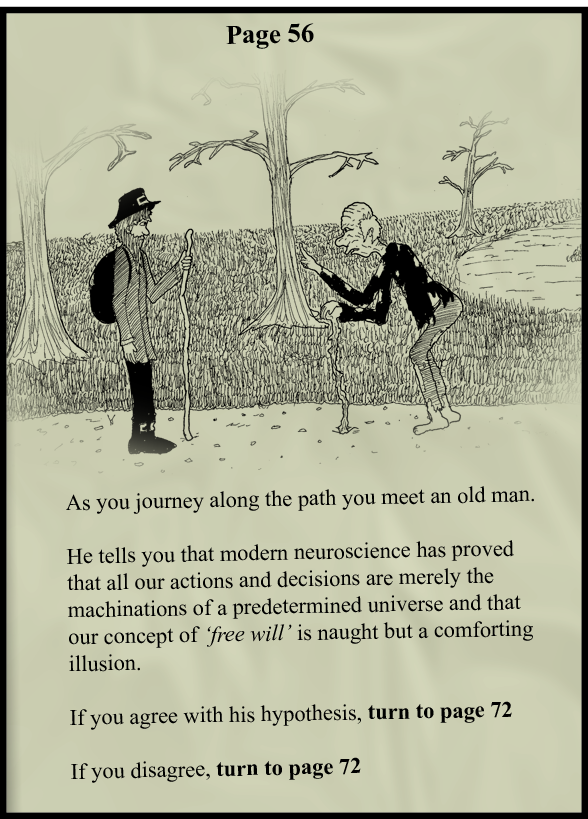
Determinism

by Harry on March 12, 2010

(found at Luke Surl: H/T to CT commenter, tiredofblogs)

This story (via Leiter) concerns the requirement in Pennsylvania that any university department within the PASSHE system that graduates fewer than 30 majors over five years justify its existence. A theater and dance department chair is quoted as follows:

“This is an insult to many of our faculty who feel what they do is central to the life of the university,” said Dr. Slavin, who also is vice president of the campus chapter of the faculty union, the Association of Pennsylvania State College and University Faculties. “Challenging them to justify their existence is really a slap in the face.”

It is odd that in “normal” times it is just assumed that the departmental units can carry on without ever having to justify or even reflect very much on their existence or what they are supposed to be doing? It is entirely un-obvious why many departments should continue to exist (and some of the most un-obvious graduate huge numbers of majors); and one might have thought that it was a good idea even in normal times to review the justifications of their existence. The fact that there is so little reflection on the missions of departments is down, in part, to a failure of management; a failure that is just made starker by the demand that departments picked out by some arbitrary feature which, until this moment, they have been given no reason to think was a problem.

The issue made it to Leiter because several of the Philosophy departments in those institutions fall into the low-major category. But is producing Philosophy majors the point of having a Philosophy department? In Our Underachieving Colleges (CT review still on its way: DD to blame if I never get round to it) Derek Bok claims that the standard assumptions within most departments in research universities is that the undergraduate curriculum is for attracting and then teaching majors, and, further, that our attention to the majors should be shaped by the aim of preparing them well for graduate school. This means that the curriculum is designed for a tiny minority of the students who take classes, and even many of them, probably, would be better off doing something other than going to graduate school (that’s me, not Bok, saying the last bit).

I don’t think of the curriculum, or the mission of my department in my institution, that way at all.

[click to continue…]

Building Better Teachers

by Harry on March 5, 2010

A riveting piece by Elizabeth Green in Sunday’s Times magazine on the coming revolution in teacher preparation. Rarely for a Sunday magazine piece it is well worth reading the whole thing. She takes as her starting point the movements for deselection (firing teachers — my rule of thumb is that the more someone talks about firing teachers the less likely it is that they will actually do it) and merit pay, and points out:

So far, both merit-pay efforts and programs that recruit a more-elite teaching corps, like Teach for America, have thin records of reliably improving student learning. Even if competition could coax better performance, would it be enough? Consider a bar graph presented at a recent talk on teaching, displaying the number of Americans in different professions. The shortest bar, all the way on the right, represented architects: 180,000. Farther over, slightly higher, came psychologists (185,000) and then lawyers (952,000), followed by engineers (1.3 million) and waiters (1.8 million). On the left side of the graph, the top three: janitors, maids and household cleaners (3.3 million); secretaries (3.6 million); and, finally, teachers (3.7 million). Moreover, a coming swell of baby-boomer retirements is expected to force school systems to hire up to a million new teachers between now and 2014. Expanding the pool of potential teachers is clearly important, but in a profession as large as teaching, can financial incentives alone make an impact?

There is no alternative but to prepare teachers better for the task.

[click to continue…]

Radio Ballads: The Miner’s Strike

by Harry on March 4, 2010

And today (still today as I write in the Midwest; I realize it is over in the UK) is the 25th anniversary of the end of the Miner’s Strike. The Radio Ballad is quite moving (although, no doubt, designed to provoke cries of BBC bias). Chris marked the 20th anniversary of it’s start here.

A week or so before the end there was a large demonstration in London.

[click to continue…]

Michael Foot is dead

by Harry on March 3, 2010

BBC obit here (with weird comment from Gordon Brown — “unifying leader” — what party was he in during the 1980s I wonder?). FWIW my own thoughts about Foot are here.

Measuring Justice

by Harry on February 28, 2010

Cambridge has just published a new book, Measuring Justice: Primary Goods and Capabilities (UK), which Ingrid and I edited (the idea of doing it was entirely Ingrid’s, I should say, and a brilliant idea it turned out to be). Its a fairly tightly focused collection, for which we invited two kinds of contribution. It opens with a shortened version of Pogge’s essay “Can the Capabilities Approach be Justified?” which many of the contributors refer back to, and the first part continues with a series of chapters considering the relative merits of Rawls’s social primary goods approach and the capabilities approach to the metric of justice; for this we invited contributors whom we believed would defend one or another of these metrics while giving careful criticisms of the rival, plus Dick Arneson whom we believed (rightly) could be relied on to help make progress despite not being associated with either view. For the second part we invited contributors who would think about some specific issue of justice (in health, education, gender, the family, disability) and consider the relative merits of the approaches with respect to that specific issue. We wrote a short analytical introduction which locates the debate in a broader context, and which, we hope, helps guide the reader through the book (the CUP page has a pdf of it, so you can judge for yourselves); the book concludes with a nice, partly autobiographical, essay by Sen engaging with the chapters in the first part of the book. The contributors so far unmentioned are Erin Kelly, Elizabeth Anderson, Norman Daniel, Lorella Terzi, Colin MacLeod, and Elaine Unterhalter. This is the second volume I’ve co-edited for Cambridge, and both times they have come up with much better titles than the editors would have done, good-looking but demure covers, and, most importantly, a reasonable price.

One here, but there must be many more. (Hat Tip my friend Matt who found it at Marginal Revolution). They don’t get the concept quite right, of course. But who cares?