Posts by author:

Henry

Wingnuts of the World Unite!

by Henry Farrell on March 4, 2009

Some people are laughing at wingnuts who are ‘going Galt’ by signing up for Medicare early. Me, I think it’s wonderful that the right is discovering the joys of solidaristic (well, sort of) strike action. So much so that I’m asking readers to encourage the leaders of this movement (Facebook group1 – I hope but don’t know whether this link will work for everyone) to take the obvious next step.

The ‘Go Galt, Go!’ Manifesto

We proudly salute “Dr. Helen,” Glenn Reynolds, and Michelle Malkin, for identifying the only possible response to Barack Obama’s victory – ‘going Galt.’ By withdrawing their creative and intellectual achievements from the economy and stopping tipping waitstaff, the schmibertarian right can surely bring the parasites and Democrats to their knees. We look forward to these three thought leaders striking the obvious first blow, by refusing to blog for the ungrateful masses and withdrawing to a secret compound until the world capitulates to their demands! Only a universal wingnut blogging strike can bring the moochers to their senses. John Galt lives!

1 We also have a Crooked Timber group by the way.

Mormon beefcake

by Henry Farrell on March 3, 2009

From the Chronicle of Higher Education

Brigham Young University has rejected an appeal from a student who had completed all the requirements for a degree but saw his diploma withheld last year after he published Men on a Mission, a calendar of buff Mormon missionaries without shirts, the Associated Press reported.

The student, Chad Henry, was excommunicated from the Church of Jesus Christ of Latter-day Saints, which owns the university, over the calendar last July. In September he was told that, to receive his degree, he would need to be reinstated as a member of the Mormon church.

Which reminds me that anyone who hasn’t read Teresa Nielsen Hayden’s wonderful account of how she came to be excommunicated by the Church of Jesus Christ of Latter-Day Saints really doesn’t know what they are missing.

Moderation for moderation’s sake

by Henry Farrell on March 3, 2009

David Brooks has been getting a lot of flak for this column (which is a follow up from this one a week earlier).

We [moderates] sympathize with a lot of the things that President Obama is trying to do. … But the Obama budget is more than just the sum of its parts. There is, entailed in it, a promiscuous unwillingness to set priorities and accept trade-offs. … a party swept up in its own revolutionary fervor … an agenda that is unexceptional in its parts but that, when taken as a whole, represents a social-engineering experiment that is entirely new. … U.S. has never been a society riven by class resentment … All the costs will be borne by the rich and all benefits redistributed downward. … U.S. … skeptical of top-down planning. … U.S. has traditionally had a relatively limited central government. … Obama … actions betray a transformational liberalism that should put every centrist on notice. …The first task will be to block the excesses of unchecked liberalism. … up to moderates to raise the alarms against these ideological outrages. … moderates will have to sketch out an alternative vision. This is a vision of a nation in which we’re all in it together — in which burdens are shared broadly, rather than simply inflicted upon a small minority.

[click to continue…]

Do Churchgoers and Republicans Consume More Porn?

by Henry Farrell on February 28, 2009

Andrew Sullivan links to a New Scientist story suggesting that they do.

However, there are some trends to be seen in the data. Those states that do consume the most porn tend to be more conservative and religious than states with lower levels of consumption, the study finds. … Eight of the top 10 pornography consuming states gave their electoral votes to John McCain in last year’s presidential election – Florida and Hawaii were the exceptions. While six out of the lowest 10 favoured Barack Obama.

But if you look at the actual study (PDF), not so much.

bq. The fourth column reports that in regions where more people report regularly attending religious services (per National Election Studies 2004), overall subscription rates are not statistically significantly different from subscriptions elsewhere (p 0.848).

bq. … Furthermore, I found no significant relationship between subscriptions to this adult entertainment service and presidential voting in 2004, based on poll data by congressional district. However, using individual-level data from a Hitwise sample of ten million anonymized U.S. Internet users, Tancer (2008), finds that adult escort sites are more popular in blue states that voted for Gore in 2004, while visitors from the red states that voted for Bush in 2004 are more likely to visit wife-swapping sites, adult webcams, and sites about voyeurism.

What evidence there is in the paper of a relationship between religious faith and porn consumption seems, as best as I can interpret the relevant table, to be based on a simple OLS regression with no reported control variables. Nor does there seem to be _any_ discussion in the piece of correlations between porn consumption and voting patterns in the most recent presidential election.

I’m not sure whether to blame the New Scientist or the paper’s author, who perhaps seems (if quoted fairly and accurately, which is of course by no means certain – he could have made a few vague handwaves that were taken completely out of context) to have hammed up his results a bit in the interview. But even if there _were_ strong results, they wouldn’t necessarily tell us much. The data is all aggregated at the state or zipcode level, but the decision to purchase or not purchase porn online is obviously an individual one. There are _all sorts_ of obvious ecological problems in drawing inferences about religious people’s individual propensities from aggregate data. This is directly analogous to Heritage horseflop claiming that because rich states tend to support Democrats, therefore the Democrats are the party of the rich. As Gelman, Park et al. showed, that inference was directly misleading. Similarly, even if people in more religious or Republican states _were_ more inclined to purchase porn online, this doesn’t imply that religious _people_ or _individual_ Republicans were more inclined to purchase porn online, and I can think of at least two or three plausible alternative causal mechanisms that would explain the observed correlation.
Political geology

by Henry Farrell on February 27, 2009

I liked this piece of writing from Arthur Goldhammer’s consistently excellent blog on French politics.

It’s always interesting to watch the fissures develop in the Socialist Party. It’s almost a geological process. Each aspirant is a tectonic plate moved by the immense pressure of his or her ambitions. For a time a couple of these plates may move in tandem, but then an opposing force impinges from some odd angle, subduction occurs, and one begins to witness surface changes: a ridge or wrinkle developing here, a fissure there.

No sooner did Martine Aubry open the party leadership to a dozen or so Royalistes than we witness[ed] the emergence of a first fissure …

Netroots lefties

by Henry Farrell on February 26, 2009

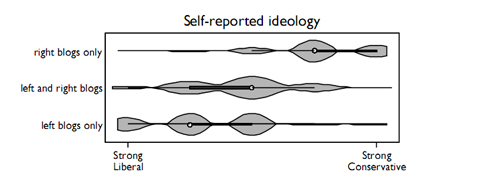
The New York Times has an article today talking about a new alliance between netroots-type left bloggers, MoveOn and SEIU to start challenging conservative Democrats in primaries. The fact of this alliance plausibly doesn’t fit well with arguments that I and others have made to the effect that netroots types are not especially left-leaning. And the reason that it doesn’t sit well is that I and the others were wrong. Netroots blog readers may _identify themselves_ as being a mixed bag of ideologies. But in fact, they’re very strongly and coherently to the left.

These graphs, taken from Eric Lawrence, John Sides’ and my paper on blog readers and polarization, illustrate this pretty well. Start by looking at a graph showing how readers of leftwing blogs, rightwing blogs, and people who read both identify themselves when they are asked where they fit on the liberal-conservative spectrum.

netroots1

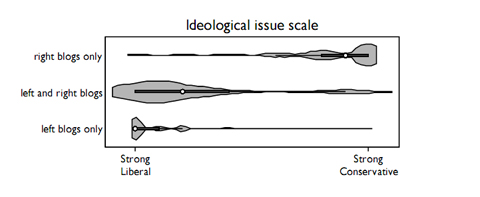
There are a fair number of left-leaning blog readers who identify themselves as strongly liberal. But there are less of them then there are of readers who identify themselves as only somewhat liberal, or as centrists. But self-identification here is misleading, as we can see if we look at a scale measuring blogreaders’ attitudes to a number of hot-button political issues such as abortion and the Iraq war, where left and right disagreed strongly at the time the data was gathered (nb that this scale has more points at which readers’ ideologies may be located than the first one).

netroots2

Here, we don’t see anything like an even spread between those who are strongly liberal (i.e. inclined to take the ‘liberal’ position on all of these issues), and those who are moderate liberals or centrists. Instead, left blog readers tend to clump heavily at the strongly liberal end of the spectrum, with pretty well no centrists worth talking about. If we look specifically at readers of netroots blogs, such as Daily Kos and Crooks and Liars (rather than readers of leftwing blogs as a whole), we see roughly the same pattern.

netroots3
What this suggests is that readers of left wing blogs are much more liberal (when you look at their attitudes to hot-button political issues) than they identify themselves as being. Hence, a claim that I thought was true – that netroots types didn’t have a coherent ideology – is in fact false (or at the least, somewhat misleading). Hence too the plausible viability of coalitions between netroots types and others to try to move the Democratic party to the left.

Our comments are down

by Henry Farrell on February 22, 2009

We’re trying to figure out what is wrong …

Update: fixed, by Kieran, with database CLI-fu

The cute-hoor party

by Henry Farrell on February 21, 2009

Americans who think that their economy in bad shape should be glad that they don’t live in Ireland, where the economy seems to be completely melting down. Matthew Engel has a grimly entertaining article on the collapse of the housing market, which has a bit too much stage-Irishry for my liking, but gets at the underlying political economy of the final years of Ireland’s economic boom.

the desperate developers of one estate, Athlumney Wood, did what practically every retailer in Ireland is doing: they held a sale and slashed prices by half. Last week they got rid of 25 properties. Semi-detached houses that once touched €330,000 ($416,000, £291,000) sold for €175,000. … Unlike anyone else’s, the Irish boom was essentially construction-led, and places like Athlumney Wood are the new Ireland. …

Indeed, it’s easy to believe that the cute-hoor party, covering politicians, builders, financiers, bankers, senior civil servants and every chancer in Christendom, has been running the place for their own benefit for years. Here, everyone who matters knows everyone else. But careful observers are more specific in their analysis. “There was an alliance between Fianna Fáil and the property developers,” says Jane Suiter, who teaches politics at Trinity College, Dublin. “The government saw light-touch regulation as giving Ireland competitive advantage. And as far as Ahern was concerned, the biggest multiplier for votes was construction jobs.”

[click to continue…]

Social democrats and capitalism

by Henry Farrell on February 18, 2009

While we’re waiting for Jonah to pronounce, Sheri Berman, whose arguments about 1930s social democrats and fascists is the issue of debate, has a piece in _Dissent_ that I’d like to respond to. Sheri argues that the current crisis is a major opportunity for the left, but that it is hampered in its ability to respond because of internecine arguments over whether we should try to reform capitalism, or get rid of it altogether. She singles out Michael Harrington as her main exemplar of a leftist whose failure to appreciate the benefits of capitalism led him to irrelevance and political near-incoherence.
[click to continue…]

In Eager Anticipation

by Henry Farrell on February 18, 2009

A correspondent tells me that Jonah Goldberg is preparing a very serious, thoughtful, rebuttal that has never been made in such detail or with such care to some of the impolite things that I have said about his magnum opus, _Liberal Fascism._ I just want to make a public note of this, as a class of a general spur and reminder to reinforce Jonah’s good intentions. I would be _very disappointed indeed_ if his refutation were to be postponed until the never-never …

Opinion Laundering

by Henry Farrell on February 16, 2009

John’s post below reminds me of one of the odder conventions of American journalism. Because US journalists aren’t supposed to express their own opinions, they often need other people to express those opinions (or the opinions that will ‘balance’ out their story) for them, so that they can use quotes from these people to spin the interpretation of the facts in the one way or another. This leads to some very peculiar interview techniques from journalists. About two out of every three calls I get from journalists have a strong line in directly leading questions of the ‘would you agree that _x_ ‘ variety.

This is of course a minor example of a much more general phenomenon. A very large part of the communications and public relations industry is devoted to what you might call ‘opinion laundering’ – the job of disguising the origins of self-interested or otherwise problematic policy positions by getting apparently legitimate third parties to validate and repeat them. Which is why I get nervous every time I see a survey that purports to tell us that academics are the most trusted interlocutors on this or that issue. While this may sound very nice, it increases the relative returns to using academics as flacks rather than some other profession, and hence helps screw up further a set of professional norms that are valuable ones to have.

Something here does not compute

by Henry Farrell on February 15, 2009

knuffle
knuffle2

(readers who don’t have children of a certain age shouldn’t worry if they don’t understand this post).

The Mysteries of Textbook Economics

by Henry Farrell on February 11, 2009

Andrew Gelman is puzzled.

I received a free copy in the mail of an introductory statistics textbook. I showed the book to Yu-Sung and he said: Wow, it’s pretty fancy. I bet it costs $150. I didn’t believe him, but we checked on Amazon and lo! it really does retail for that much. What the . . . ? I asked around and, indeed, it’s commonplace for students to pay well over $100 for introductory textbooks.
Well. I’m planning to write an introductory textbook of my own and I’d like to charge $10 for it. Maybe this isn’t possible, but I think $40 should be doable. And why would anybody require their students to pay $150 for a statistics book when something better is available at less than 1/3 the price?

… It just mystifies me that, in all these different fields, it’s considered acceptable to charge $150 for a textbook. I’d think that all you need is one cartel-breaker in each field and all the prices would come tumbling down. But apparently not. I just don’t understand.

Well, perhaps crack economist Greg Mankiw might be able to solve this particular mystery. Or, perhaps, not so much. But more simply, I think that the obvious public choice answer is that the costs of this particular arrangement are borne by the students, who constitute a captive market, rather than by the professors, who actually choose the textbook that is required. All that you need are some very moderate side-payments to persuade self-interested professors to adopt particular textbooks (perhaps even just lowering their search costs by sending them free copies). So the cartel-breaker would have to provide sufficient inducement to the professors, which seems rather unlikely given that they would not be making monopoly profits, and hence would be outbid by those who _are_ in a position to capture them.

Of course, if the professor is teaching their own textbook to large undergraduate intro classes and making large amounts of money from each semi-compelled purchase, then no sidepayments at all are needed (not all professors being as conscientious as Andrew Gelman). There’s clearly an opening for some enterprising grad student to write a paper (perhaps for the _Journal of Economic Perspectives_ or some such) on the characteristics of this very interesting market …

Are blogs ruining economic debate?

by Henry Farrell on February 10, 2009

Clive Crook suggests that they’re at least part of the problem.

I used to have no time for the idea that economists never agree, so economics must be a bogus science and a waste of time. Of course economists disagree, I would say. … But my earlier confidence that economists are not wasting their own and everybody else’s time is diminishing. Are the leaders of the profession measuring up to the standards I just mentioned? Are they helping to improve policy, or raise the standard of public understanding? You could easily argue the opposite. … This impression of disarray – that economics has nothing clear to say on these questions – is not the fault of economics as such. It is a mostly false impression created by some of its leading public intellectuals, Mr Krugman among them. …

[click to continue…]

Cato Unbound

by Henry Farrell on February 9, 2009

My response to Nancy Rosenblum is up at <em>Cato Unbound</em> as is that of James Fishkin. It would be fair to say that we have significant political disagreements …

Me:

[Rosenblum] argues that these implicit biases also afflict the arguments of contemporary political theorists such as James Fishkin (also participating in this seminar), who prize political deliberation.

Again, blogs provide an interesting test case. Fishkin harks back to a Madisonian vision of politics that he suggests has been corroded by political parties more interested in winning elections than in thoughtful deliberation. He seeks to structure deliberation so as to minimize what he sees as disruptive partisan extremism and maximize the potential for disinterested discussion. Blogs are anathematic to this vision of politics. Bloggers are typically at least as interested in winning the argument as in discerning the truth. The empirical evidence that political bloggers and blog readers are sharply divided along partisan lines is emphatic. However, as Rosenblum suggests, partisan argument of the kind that blogs engage in can play a valuable democratic role. They help structure a “system of conflict” in which “discordant values, opinions, issues, and policies” are “identified, selected, and refined.

Fishkin:

if one is concerned about some minimally rational process of collective will formation, the impact of party ID is to make voting and policy choice predictable, not to make them thoughtful. A thoughtful process of collective will formation, whether by elites (representatives) or the mass public themselves, requires a disposition not to make a partisan judgment, but an independent judgment about the public interest. Of course, real world judgments reflect some mix of partisan interests and independent judgment. But to the extent one is just focusing on what will serve one’s party, what will contribute to electoral competitiveness and effective mobilization, one is not acting on the disposition that will assist deliberation in the public interest. Competitive elections can be won by misleading the public, by demobilizing it with negative ads (as my colleague Shanto Iyengar has demonstrated) by the MAD politics of the trivial but sensational sound bite — a politics of Mutually Assured Distraction. These techniques win elections and mobilize participation, but they do not add up to any collective weighing of substantive arguments about what should be done. Rather they add up to pseudo-mandates and a very thin form of democracy.

I’m pretty skeptical about many claims for the empirical benefits of deliberation, for a variety of reasons that perhaps I’ll cover in a future post. But it seems to me that much of this disagreement turns on a fundamental divergence as to what politics is about. I see it as involving stark divergences between people with very different interests and ideals, where the room for common agreement on the public interest is limited. Fishkin sees it as a realm where the potential for rational identification of extensive shared values and the public interest is obscured by television advertising and the other paraphernalia of competitive electoral politics. Different understandings of politics give rise, unsurprisingly, to different normative prescriptions.