It turns out that short Nature Neuroscience paper discussed before, “Neurocognitive correlates of liberalism and conservatism”, is available free (PDF). In case you were curious.
Posts by author:
John Holbo
I went and downloaded that Nature Neuroscience [subscribers only – sorry] paper that’s been written up and linked around: “Neurocognitive correlates of liberalism and conservatism”. [click to continue…]
I just finished The Professor’s Daughter
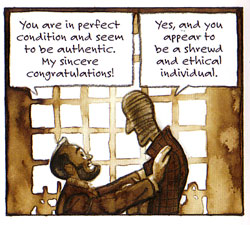
Imhotep IV takes refuge in the shop of an antiquarian, before resuming pursuit of his beloved – Lillian, daughter of renowned Egyptologist, Professor Bowell, who is owner of Imhotep IV. As the defense attorney sincerely declaims, a few pages on: “It was love that caused Pharaoh Imhotep IV to cross the centuries and attempt to breach the west wall of the central police station, and it was hastiness that caused Miss Bowell to confuse arsenic and chamomile.” Further complications ensue upon arrival of Imhotep III, who kidnaps Queen Victoria. Love conquers all, the watercolors are lovely.
You can read the first dozen pages at First Second books – purveyors of fine comic product all-around. (But Amazon will give you a better price. But maybe it’s better to buy from the publishers.)
In other art news, I just noticed that Hirst sold the skull:
Damien Hirst’s diamond-encrusted cast of a human skull has been bought by a group of anonymous investors for its asking price of £50 million, the artist’s representatives claimed yesterday.
It is, by a huge margin, the most paid for a work by a living artist.
Entitled For the Love of God, the skull was first displayed at the White Cube Gallery in Mayfair, Central London, in June where thousands queued for a two-minute viewing in a high-security darkened chamber.
Studded with more than 8,500 ethically sourced diamonds, it has been variously described as “an anthropomorphised disco ball”, “the first 21st-century work of art”, “a cosmic wonder”, “the vulgar embodiment of modern materialism” and, by Hirst himself, as “quite bling”.
And Texas can’t decide whether the grammar/penmanship is wrong enough for it to be $550,000 worth of right.
What do we think of Mike “The Most Feared Man On the Hill” Rogers, and the ethics of outing? Defend your answer from first principles, if you would be so kind.
There is indeed a culture of corruption, and it extends well beyond any single politician. It swirls around big government. It always has and it always will. It has become institutionalized in many ways. And that culture of corruption celebrates clever word games used by unelected judges to exercise power they don’t have as they rewrite the Constitution; it demeans people of faith who speak out against the culture of corruption and for — dare I say — family values; it undermines and seeks to demoralize Americans in uniform as they fight a horrible enemy on the battlefield; it demonizes entrepreneurs and successful enterprises; it uses race, age, religion, gender, and whatever works to balkanize Americans; and so on. This is the real culture of corruption. Let’s call it what it is — modern liberalism. And its impact on our society is far worse than the disorderly-conduct misdemeanor to which Larry Craig pled guilty and for which he has now resigned.
Back in June, I wrote three columns (”The Three Atheists,” “Atheism and Evidence” and “Is Religion Man-Made?“) about the recent vogue of atheist books, books that accuse religion of being empty of genuine substance, full of malevolent and destructive passion, and without support in evidence, reason or common sense.
The authors of these tracts are characterized by professor Jacques Berlinerblau of Georgetown University as “the soccer hooligans of reasoned discourse.” He asks (rhetorically), “Can an atheist or agnostic commentator discuss any aspect of religion for more than thirty seconds without referring to religious peoples as imbeciles, extremists, mental deficients, fascists, enemies of the public good, crypto-Nazis, conjure men, irrationalists … authoritarian despots and so forth?”
In a similar vein, Tom Krattenmaker, who studies religion in public life, wonders why, given their celebration of open-mindedness and critical thinking, secularists “so frequently leave their critical thinking at the door” when it “comes to matters of religion?” Why are they closed-minded on this one subject?
But my question for you is: why can’t the likes of Stanley Fish go three paragraphs without insulting his opponents and adding injury in the form of the worst sort of brazen ‘why are they still beating their wives’ question? Riddle me that.
I would also like to request a moratorium on critiques of liberalism that consist entirely of a flourish for effect – with accompanying air of discovery – of the familiar consideration that liberalism is inconsistent with blanket, categorical tolerance of absolutely every possible act and attitude. That is, liberalism is incompatible, in practice, with any form of illiberalism that destroys liberalism. If something is inconsistent with liberalism, it is inconsistent with liberalism. Yes. Quite. We noticed.
Also, it might not be a half-bad idea to notice that liberalism is not incompatible with religion, merely with illiberal forms of religion. Just as liberalism is incompatible with illiberal forms of secularism. Which suggests that there may be a need to revisit Fish’s title: “Liberalism and Secularism: One and the Same”.
(Also, the sentence, “in liberal thought, ‘reasonable’ is a partisan, not a normative notion,” is conspicuously confused.)
I’m enjoying Bryan Talbot’s new – not exactly a graphic novel, is it? Alice in Sunderland
Anyway, it is set in the Sunderland Empire – that is, a theater – and the rabbit onstage explains to the lout in the audience, who is, oddly, a George Formby fan:
George Formby played here, and his father before him, from whom Chaplin steals his stick-twirling routine. All great northern comedy is drawn from tragedy. One of the biggest ever Music Hall stars, George Formby Senior – the Wigan Nightingale – is born into dire poverty and learns his trade as a singing beggar. His songs and jokes are punctuated by a hacking cough – a symptom of the tuberculosis that kills him in his forties – which he cleverly works into his act.
That’s fairly black. To be a tubercular Music Hall performer, hacking away on stage. The book says Formby, Sr., invented ‘Wigan Pier’ – see also, George Orwell – as part of a running gag to the effect that Wigan was a classy seaside resort, as opposed to a landlocked mining town. I never knew that. (Is it true? Talbott warns us that everything in the book is true except for one, which will be revealed at the end. I haven’t got to the end yet.)
Anyway, YouTube has some fine George Formby (Jr.) material: “When I’m Cleaning Windows”; “Fanlight Fanny”. So that’s where the Beatles learned to sound like that.
In Vanity Fair. Some excerpts:
No photograph of him has ever been published, but those who know Daniel Miller say that he resembles his father. Some say it’s the nose, others the mischievous glimmer in the eyes when he smiles, but the most telling feature, the one that clearly identifies him as Arthur Miller’s son, is his high forehead and identically receding hairline. He is almost 41 now, but it’s impossible to say whether his father’s friends would notice the resemblance, because the few who have ever seen Daniel have not laid eyes on him since he was a week old …
“Arthur was terribly shaken—he used the term ‘mongoloid,'” Whitehead recalled. He said, “‘I’m going to have to put the baby away.'” A friend of Inge’s recalls visiting her at home, in Roxbury, about a week later. “I was sitting at the bottom of the bed, and Inge was propped up, and my memory is that she was holding the baby and she was very, very unhappy,” she says. “Inge wanted to keep the baby, but Arthur wasn’t going to let her keep him.” Inge, this friend recalls, “said that Arthur felt it would be very hard for Rebecca, and for the household,” to raise Daniel at home. Another friend remembers that “it was a decision that had Rebecca at the center.”
Within days, the child was gone, placed in a home for infants in New York City. When he was about two or three, one friend recalls, Inge tried to bring him home, but Arthur would not have it. Daniel was about four when he was placed at the Southbury Training School. Then one of two Connecticut institutions for the mentally retarded, Southbury was just a 10-minute drive from Roxbury, along shaded country roads. “Inge told me that she went to see him almost every Sunday, and that [Arthur] never wanted to see him,” recalls the writer Francine du Plessix Gray. Once he was placed in Southbury, many friends heard nothing more about Daniel. “After a certain period,” one friend says, “he was not mentioned at all.” …
Marcie Roth remembers seeing Daniel for the first time when he was about “eight or nine.” Now the director of the National Spinal Cord Injury Association, Roth worked at Southbury during the 1970s. “Danny was a neat, neat kid,” she says, “a very friendly, happy guy.” Although there were close to 300 children at Southbury at the time, everyone, she says, knew Danny Miller. This was partly because they knew who his father was and partly because Daniel “was among the more able of the young children with Down syndrome,” Roth says. But mainly it was because of Daniel’s personality. “He had a great spirit about him,” she says. This was no small achievement, because, according to Roth, “Southbury Training School was not a place you would want your dog to live.” …
Bowen recalls the first time she met Daniel: “He was just a delight, eager, happy, outgoing—in those days even more so than now, because of his isolation.” He showed her his room, which he shared with 20 other people, and his dresser, which was nearly empty, because everyone wore communal clothing. “I remember very clearly trying to respond with happiness, but it was very hard, because there was nothing there,” she says. “He really had nothing. His sole possession was this little tiny transistor radio with earplugs. It was something you’d pick up at a five-and-dime. And he was so proud to have it. You couldn’t help but think, This is Arthur Miller’s son? How could this be?”
Quiet around here over the weekend. Anyway, following up on my Euthyphro post, another legal thought.
Euthyphro describes the case (4c): [click to continue…]
So it’s the time of year when I teach Plato’s Euthyphro and I’m getting ready to run through my usual very short history of Athenian homicide law: how before Draco there was no legal distinction between intentional and non-intentional killing; after Draco, the state began to take greater interest in what had previously been strictly family business; how after Solon it was possible, for the first time, for a citizen who was not a blood relation of the victim to bring suit. (I hope I got that right.)
And then I asked myself: pre-Solon (and even after) what did happen, in practice, if a stranger – some traveler – was killed, and there was no family to bring suit on his behalf? In the dialogue, Euthyphro explains to Socrates that it shouldn’t matter whether the victim is family or a stranger – the pollution is the same either way. And, theologically, that is a perfectly orthodox thing for him to say. More specifically (although Euthyphro doesn’t mention it) Zeus is well-known for having a soft spot for travelers. So if someone kills a traveler or stranger then, theologically, the public has a very legitimate interest in getting all that miasma cleaned up quick before lightning strikes.
So what did the ancient Athenians do in cases in which there was a killing – in which it may have been known who did the killing – and no family with standing to bring suit?
Specific follow-up question: suppose the victim was a guest-friend of an Athenian citizen. Would the citizen then have had legal standing to bring suit on the victim’s behalf?
In the 19th Century, Romnementum was a patent medicine compounded of equal parts chaff, opium and horse liniment.
Romnementum was also Agamemnon’s ne’er-do-well brother. Before that, I believe he was a Babylonian demi-god who met a sticky end. (Possibly I’m confusing him with some or other Jack Kirby character?)
But after the Ames straw poll, has Romney given new life to this old notion? What do you think? Does the man have …. Romnementum?
Hugh Hewitt is trying to sell it. As of this posting, his commenters are running cold. Let’s make this a Republican horse-race thread.
We might test judgment by asking, on the issue of Iraq, who best anticipated how events turned out. But many of those who correctly anticipated catastrophe did so not by exercising judgment but by indulging in ideology. They opposed the invasion because they believed the president was only after the oil or because they believed America is always and in every situation wrong.
The people who truly showed good judgment on Iraq predicted the consequences that actually ensued but also rightly evaluated the motives that led to the action. They did not necessarily possess more knowledge than the rest of us. They labored, as everyone did, with the same faulty … [ok, enough of that.]
Others have picked on him already, but this Ignatieff fellow, with his ‘yes, they had justified, true belief that the war was a bad idea, but it didn’t amount to knowledge‘ line, is … well. (Alternative post title: when life gives you lemons, make false lemma-ade. Maybe that’s the analytic philosopher in me talking.)
Kip Manley directs us to a very worthwhile discussion of the ‘intentional fallacy’ and ‘bad readers’, Helen Vendler and Plato’s “Euthyphro”. I’ll just dunk you in the middle: [click to continue…]
Someone has gone and collected some numbers (or, rather, has finished the job started here and, before that, here).
Caveat: I know not who ‘Largo’ is, nor what Phreadom is all about (but they have a Friends of Ron Paul thing in their sidebar). The data is collected from here, hence verifiable (I assume). It turns out Ron Paul is the candidate who has collected the most financial contributions from military personnel (across all branches; presently serving and retired.) I’ll pass along the totals, going just far enough down the list to give us our major players: [click to continue…]