From the category archives:

Audio/Video

What do college students do online?

by Eszter Hargittai on June 14, 2006

How does the popularity of Facebook compare to MySpace among a diverse group of college students? What types of blogs are students most likely to read? How many have ever visited Instapundit or Daily Kos?

As mentioned earlier, last month I gave a talk at the Beyond Broadcast conference hosted at Harvard Law School. The conference folks have now made the presentations available in both audio and video format. You can listen to or watch my talk misleadingly titled “Just a Pretty Face(book)? What College Students Actually Do Online”. (The title is misleading, because the talk is not about Facebook or even social-networking sites more generally speaking. Rather, it’s about what young people do online and how it differs by type of background.) I have put the presentation slides online in case you are curious to see the specifics (those are hard to follow on the video and there wasn’t enough time for me to mention stats in the presentation).

I should note that these are all still preliminary findings as I need to do more data cleaning and there’s tons more to do on the analysis front. But I don’t anticipate major changes in the findings presented given the size of the sample.

If you prefer text over these various other options I will be writing up the findings this summer and will post a link once it’s done. But if you can’t wait to find out the answers to the above questions then I recommend clicking on one of the above links. (All this information is toward the end of the presentation.)

Okay, fine, I won’t make it that difficult. The quick answers to the above questions are (again, for this group of college students):
1. Facebook is more popular (Facebook 78%, MySpace 51%)
2. Political blogs are the least popular type of blogs (from among the ones asked, which included personal journals, arts/culture/music, technology, sports)
3. 1% have ever visited each, Instapundit and Daily Kos that is (as per the third question above)

There’s lots more info in the presentation.

Recall that many of you took a survey back in January here on CT about your use of various sites and services. I haven’t forgotten that I still owe you a summary of the responses and that is forthcoming as I analyze the college student Internet use data. I thought reporting the former may be more interesting in the context of the latter thus the delay.

Berkeley Webcasts

by Jon Mandle on June 2, 2006

The University of California Berkeley has run a trial program this past semester that makes webcasts available from around 30 courses. (MIT also has had some course videos and other material available for some time.) They also have special lectures and events available here. The courses range from Art 32, “Foundations of American Cyberculture”, to EE 240, “Advanced Analog Integrated Circuits”, to Psych 130, “Clinical Psychology”. There is one philosophy course – Phil 7, “Existentialism in Literature and Film” by Hubert Dreyfus. His course has 27 lectures; each appears to be a little over one hour. Video is available for many of courses, but not Dreyfus’s.

Dance dance evolution

by Eszter Hargittai on May 28, 2006

As the resident danceoholic I have to link to this video on the Evolution of Dance. It’s been viewed millions of times so I suspect it’s not new to all of you, but perhaps some of you haven’t seen it yet.

I’m not sure if I should be proud of, embarrassed, excited, or feel pathetic about the fact that of the approximately thirty songs featured in the clip, I have definitely danced to most at parties or clubs in the past (there were 3-4 that I don’t recall). To be sure, I certainly had not used most of the moves featured on the video. I’m more confident that that part is probably a good thing.

Watching the clip is a trip down memory lane as the various moments from life rush back when the particular songs were popular at parties and clubs. For example, Cotton-Eyed Joe by the Rednex will forever transport me back to the Arcade 46 bar and dance floor in the basement of our dorm in Geneva where I spent my junior year in college. Just imagine hundreds of people in this hole dancing away to this and other songs (Macarena anyone?). Those were the days…

Kate Rusby and….Ronan Keating?

by Harry on May 24, 2006

I took Little Lights out of the local library a couple of years ago on the way to pick up my daughter. I was almost late; hearing Kate Rusby singing “Withered and Died” had me almost in tears and I had to pull of the road to compose myself. I don’t think there is a more beautiful voice in popular music than hers; better even than Christine Collister‘s. Oh, except that neither of them are singers of popular music; they are folk singers; Rusby more so than Collister.

Until now, it appears. Kate Rusby teaming up with Ronan Keating is the most unlikely thing to happen in popular music since Robbie Williams simultaneously plagiarised Woody Guthrie and Loudon Wainwright III. The single comes out in the UK on Monday, and Radio 2 has already decided to make it a hit. If I could buy stock in a singer, it would be Rusby. And if I wanted to appear to be cool I’d stock up on all her records (UK)… except that I’ve no interest at all in seeming cool, and I’ve already stocked up.
The Tribe

by Eszter Hargittai on May 23, 2006

An interesting short film on Barbie, Jews, identity and about a million other topics. It is so packed with material – some of which seems extremely random – that it is hard to know where to even start with any commentary. See what you think.

An Interview, By Timothy!

by Harry on May 22, 2006

I’m sure I’ve mentioned before that BBC7 could have been devised just for me; no news, no music, no sport, no ads, just a lower-middle-brow selection of comedy and drama from the radio archives. I tape the classic comedies for the kids (ISIRTA, The Goons, and, a bit worryingly, Steptoe and Son, are top of the pops in our house, on which more another time) and listen to the dramas myself. The best part of the station finding its feet has been hearing the announcers grow into their material. Initially only Jim Lee seemed to know and love the classic shows (I gather he is considered eccentric for being a Clitheroe Kid enthusiast; I can’t imagine why). My favourite announcer was openly bemused — even a little mocking — when she first started presenting the Paul Temple shows, and it has been a lot of fun hearing her come to love them, a love which is sweetly on display in this interview with Peter Coke (pronounced Cook) who played Temple in the 50’s and 60’s. At 92 Coke is stunningly energetic and on the ball — I caught him misnaming Coronation Scot, but he was otherwise enviously youthful, and obviously delighted to have such a young fan. Example of Coke’s amazing shellwork here (John Q might want to take note); a picture of the great man himself here if you scroll down the page a bit (he was born the same year as Ted Grant!).

BTW, I’ve probably listened to all but one of the extant Paul Temple adventures at least 3 times each, having been introduced to them not by the BBC but by KCRW in the late 1980s. I have only found a couple of the books, neither of which I could struggle through; Durbridge might have been one of our greatest radio writers but it doesn’t work on the page. The quality gap between the books and the radio show is comparable only with the gap between Colin Dexter’s novels and the Morse series.

Update: after some trawling I thought I’d throw in this link to prove that others are nerdier about Paul Temple than I am.

Alpha Bravia Tango

by Kieran Healy on May 19, 2006

Friday fun: You’ll remember the “Sony Bravia Ad”:http://www.youtube.com/watch?v=2Bb8P7dfjVw&search=bravia from a while back, with all the bouncing balls, melancholy José González music and sunny San Francisco streets. Well, Swansea is not San Francisco, and fruit doesn’t bounce all that well, but “apart from that it’s pretty close”:http://www.youtube.com/watch?v=CjHzS_twDVY. Local, uh, residents “spoke out in protest.”:http://www.swansea-res.org.uk/news.html (Note also the news of Fr Vincent’s departure at the bottom of that page.) Elsewhere there’s also “this”:http://www.youtube.com/watch?v=sl5Nv2hOkYE (somewhat less interesting) and “this effort”:http://www.youtube.com/watch?v=tjOgFRMobMk.

Campaign songs

by Eszter Hargittai on May 14, 2006

For your weekend listening pleasure, some Hungarian political campaign music. I had meant to blog about this a few weeks ago during the elections (it’s just one of about a dozen posts I haven’t managed to get around to recently), but it’s not as though it’s any less relevant now.

The song was written explicitly for the Hungarian Socialist Party‘s campaign in the recent parliamentary elections. I like it – it’s reminiscent of Hungarian pop/covertly political songs from the 1970s. I didn’t like it the first time I listened to it, but got pretty hooked the second time. I wonder if it’s at all of interest if you do not understand the language and/or are not familiar with the style. (No need to get into how unique the style is, maybe it’s not, but it still reminds me of lots of Hungarian songs from a while ago, songs that don’t tend to make it to the Billboard charts despite being quite good.)

The most commonly recurring words are “igen”, which means “yes” and “Magyarország”, which means “Hungary”. The bottom of the page suggests that the song was also made available as a ring tone for cell phones, which seems like an interesting idea.

So what are other exampes of political campaigns creating their own songs? I can think of campaigns adopting songs for their purposes and playing them at victory time, but those songs weren’t written for the campaigns explicitly. Bonus points if you can link to the examples.

Beyond Broadcast

by Eszter Hargittai on May 12, 2006

Berkman in Second Life
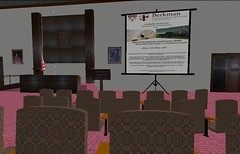
Today (Friday), the Berkman Center for Internet & Society at the Harvard Law School is hosting a conference on Reinventing Public Media in a Participatory Culture. In addition to the face-to-face discussions, the conference is also integrating digital media in neat ways for participation by those who can’t be at the meeting physically. For example, there is a Berkman Island (including a 3D replica of the Ames Courtroom at the Harvard Law School) in Second Life. If you get a chance, come join us, it looks like there will be some very interesting presentations and discussions.

Napster

by Jon Mandle on May 3, 2006

In a desperate effort to stay afloat bold and forward-looking move, napster (which shares only a name with the program from the glory days of 2000 and 2001) has made (most of) its 2 million tunes available for free. The catches: 1. you need to register (or find a clever way around registration); 2. it pops up a flash player so you can’t download them (unless you’re much more clever about these things than I am); 3. there’s an occasional ad; 4. you can only play each tune 5 times (on each registration, I’m guessing); 5. it is relatively low quality.

It may not be as convenient as various internet radio stations (especially customizable ones like launchcast) that you can just leave on, but if you’re looking for a particular song – say, after soaking in Bruce Springsteen’s version of “How Can a Poor Man Stand Such Times and Live?” you want to hear Ry Cooder’s version, or the original by Blind Alfred Reed (or the one by the Del Lords that I just found) – this is the place for you.

Apple meets the enemy

by Henry Farrell on May 2, 2006

“Austan Goolsbee”:http://www.nytimes.com/2006/04/27/technology/27scene.html?ex=1303790400&en=37d41d9406c1d512&ei=5090&partner=rssuserland&emc=rss writes in the _NYT_ that France’s efforts to make iTunes inter-operable with non-Apple music players is a bad idea.

bq. In iTunes War, France Has Met the Enemy. Perhaps It Is France.

bq. … The legislature paid no mind to such analysis and seems not to have considered innovation at all. Therein lies the danger. Apple largely created the online market for legal music. The record labels’ own attempts flopped embarrassingly. Until iTunes, virtually no one paid for online music. Since then, iTunes has sold more than one billion songs. Its success comes largely from two crucial innovations. First, Apple’s music store is simple and works extremely well with the iPod. Find the music. Click “Buy It.” Drag the files onto the iPod icon. That’s it. Experiences with other players and music stores are far more complicated. Further, iTunes keeps getting better. Apple has added video capability, celebrity play lists, exclusive music, the ability to convert home movies into iPod format, and many other features — all free. Second, iTunes has lots of music. Largely because of the innovative iTunes FairPlay copy protection and digital rights management software, Apple persuaded major record labels to let them sell much of their best content online. The combination of simplicity and variety proved a huge winner. … If the French gave away the codes, Apple would lose much of its rationale for improving iTunes. … Opening the codes threatens that link. Apple would need to pay for iTunes features with profits from iTunes itself. Prices would rise. Innovation would slow. Even worse, sharing the codes could make it easier for hackers to unravel Apple’s FairPlay software. Without strong copy protection, labels would not supply as much new music.

The issue is moot – it appears that the French proposal has been very substantially weakened – but I’m not convinced by Goolsbee’s underlying claims. There seem to be two elements to Goolsbee’s arguments. First he makes a claim about the need to protect Apple’s quasi-monopoly in order to protect innovation. There’s a reasonable argument to be made here, but as far as I’m aware, economists have very considerable difficulty in coming up with convincing arguments about the appropriate level of protection necessary to encourage innovation. Even if you buy the basic claim, it’s hard to come up with a convincing rationale for the claim that Apple’s protections are just right for encouraging innovation, and that a weakening of those protections mightn’t have salutary effects. Indeed, there’s a plausible economic case for skepticism about the value of intellectual property protection _tout court_: see the discussion in Benkler’s _Wealth of Networks_.

Second, Goolsbee claims that sharing codes would make it easier for hackers to break FairPlay. This seems to me to be even less convincing. As best as I can tell, the main reason why hackers aren’t interested in breaking FairPlay isn’t because it would be difficult, but because it’s unnecessary. There is a very well known security hole in Apple’s system – you can burn your music to an unprotected CD, and then make mp3s, Ogg Vorbis files or whatever to your heart’s content. Hence, I suspect, the abandonment of PyMusique and other efforts to circumvent Apple’s controls – there’s no point to them.

All this said, I think that there’s a plausible rationale to support Apple’s power, but it doesn’t flow from mainstream economics or from the purported virtues of DRM. It comes instead from Galbraith’s idea of countervailing powers. As the “FT”:http://news.ft.com/cms/s/297eecc2-d934-11da-8b06-0000779e2340.html reported yesterday, Apple seems to have done what antitrust authorities on both sides of the Atlantic have failed dismally to do – to make it more difficult for record companies to collude in setting prices and reap the ensuing oligopoly profits. It’s forced the record labels to commoditize albums by selling them at a price which is considerably lower than the price that the record companies would prefer – given sagging sales of CDs, the labels have had little choice but to accede to Apple’s terms. None of this is to say that Apple may not abuse its position in the future – but for the moment at least, it appears to be having a valuable chastening effect.

How Can a Poor Man Stand Such Times and Live?

by Jon Mandle on April 29, 2006

This is the title of a 1929 song by Blind Alfred Reed that was covered by Ry Cooder on his first album. Bruce Springsteen now has a version that includes one original verse and three new ones, (apparently) written in preparation for his performance at the New Orleans Jazz and Heritage Festival. The key lyric:

He says “me and my old school pals had some might high times down here
And what happened to you poor black folks, well it just ain’t fair”
He took a look around gave a little pep talk, said “I’m with you” then he took a little walk
Tell me, how can a poor man stand such times and live?

It’s not included on his new cd, but is available (at a low bitrate), recorded live at one of his rehearsals, here (turn down your volume and stop the tracks that play automatically – then play the tune in the format of your choice.)

Mustafa Barghouti (and others).

by Harry on April 26, 2006

Mustafa Barghouti, who is Secretary General of the Palestinian National Initiative, and was recently elected to the Palestinian parliament as an independent, is in Madison at the Havens Center. His first talk (yesterday) is already on the web (audio); my guess is that today’s talk will be up within 24 hours.

Havens Center talks are now routinely recorded and made available on the web, so you might be interested to check out the list here. Two that I would particularly recommend are our own Chris Bertram, and also Richard Miller, both on global justice issues.

The Prehistory of Python

by Harry on April 13, 2006

I’ve promised to give a talk at the local High School on the pre-history of Monty Python’s Flying Circus. This is something I know a depressingly large amount about, not least from endless listening to the nostalgia strands on BBC7. But I wouldn’t have agreed to give a talk on it but for the delightful discovery that there are surviving episodes of both the immediate predecessor shows, Do Not Adjust Your Set and At Last the 1948 Show (Region 1, NTSC, believe it or not: Brits here and here). 1948 is more like Monty Python, not quite as good but containing, for example, the original version of the 4 Yorkshiremen sketch (with Marty Feldman!). DNAYS, though, is wonderful. It was a kid’s show, with Idle, Jones, Palin, David Jason, and Denise Coffey, and the Bonzo Dog Doo Dah Band appearing in various roles as well as themselves. The legend is that they did whatever they wanted because the kiddie-time slot meant that the executives didn’t bother to watch (those were the days!). I’d heard a great deal about it, and have long owned the album from the show (but the more or less complete bonzos is a better deal and contains Tadpoles), but I always imagined that it was lost to posterity. Wrong. 9 episodes survive and they are, really, exactly as the legend suggests. In fact, apart from not being in colour, they have aged better than Monty Python itself. The sketches are shorter, better structured, end with punch-lines, and the sense of anarchy is more palpable. You can see them enjoying themselves, and there is no sense, as there is in the later Pythons, that they are straining rather to get a laugh. The other marvel, though, is seeing the late lamented Viv Stanshall perform; I’ve always preferred Neil Innes to Stanshall, in the same way that I prefer McCartney to Lennon, but Stanshall commands the screen whenever he is on it. Brilliant. The local high school kids have a treat in store.

Bird mimics

by Chris Bertram on March 22, 2006

The British Library has just released a “CD of bird mimicry”:http://www.bl.uk/acatalog/wildlifecds.html?EMK_LK01_pubshopx_bl_home_wildlife from around the world. Both the “Independent”:http://news.independent.co.uk/world/science_technology/article352784.ece and the “Times”:http://www.timesonline.co.uk/article/0,,2-2097400,00.html have articles, and the Times has a few soundclips (I liked the German bullfinches best, though the modem-connecting blackbird is startling.)