by Eszter Hargittai on August 17, 2008
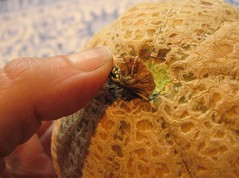 I just had a deliciously sweet cantaloupe. How did I know how to pick it? My favorite* chef, Chef Susan aka Chef Q posted some advice on the topic recently. Not only is she an amazing cook and baker, she is also an excellent photographer so her posts are illustrated with helpful images. I forgive her for all the pounds I gained last year due to her cooking (hey, at least I finally started a regular exercise regime) and thank her not just for all the great meals I’ve had the good fortune to experience, but also the helpful material she shares online.
[*] It’s actually a tie with my Mom, but she’s not officially a chef. Of course, that hasn’t stopped her from publishing a cookbook (see some of her recipes here).
Photo credit: Susan Beach
by Henry Farrell on August 1, 2008
Norm Geras has put up a profile of me – if you’re interested, click over. The bit I’d recommend really has nothing to do with me, except that I was there when it was uttered – my favorite take on a proverb. It came from an Australian friend whom I’ve fallen out of touch with, Mac Darrow. Off the cuff, he glossed _in vino veritas_ as
Many a true word
Is slurred
which I’ve always thought was a translation tinged with genius.
Also, two very good appreciations of writers. First, Julian Barnes has a lovely piece on Penelope Fitzgerald both as a person and as a novelist. I fell in love with _The Blue Flower_, less for the portrait of Novalis than for the quiet tragedy of Karoline Just, and read everything else by her that I could get my hands on. As an aside, while she may seem as far from genre as a writer could be, her pastiche of an M.R. James short story in _The Gate of Angels_ is uncanny and brilliant. Second, Kathy G. has a great discussion of Tom Geoghegan. His _Which Side Are You On?_ (Powells, Amazon ) is a wonderfully written contrary class of a book about the union movement. As Kathy says:
bq. a lot of people just don’t get his charmingly idiosyncratic writing. He writes about politics, and about policy, but God knows his books and essays don’t read like formal scholarly papers or dry think tank reports — they’re far more fluid, inventive, and playful than writing about policy has any right to be. But the problem is, political types often don’t appreciate the literary qualities of his writing, and the literary types don’t get the politics.
I suspect that’s right – his books don’t have arguments so much as they _are_ arguments – going backwards and forwards between different points of view, looking at different aspects of the issue, proposing viewpoints and counter-viewpoints. For those who haven’t read him, he’s really wonderful; one of the best and most original political writers alive.
by John Holbo on July 29, 2008
My friend Doug Wolk just won an Eisner for best comics-related book for Reading Comics . And, I might add, we’ve been hosting a little book event in his honor over at the Valve the last couple weeks. Kip Manley just write a very nice little essay, for example.
In other news, somehow I missed the news a few weeks ago that long-lost footage from Fritz Lang’s Metropolis had turned up in Buenos Aires. That’s almost as good as when they found a nice print of Dreier’s The Passion of Joan of Arc (1928) in a Norwegian insane asylum, eh?
Although the new material is in a terrible condition, according to the first appraisals by the German film historians, including Rainer Rother, the director of the Deutsche Kinemathek Museum in Berlin, the newly discovered scenes give a surprising insight into the characters’ motivation. They finally give “Metropolis” a coherent story-telling rhythm, whose absence was often criticized. For example, characters who were practically extras in the shorter version, such as the spy Schmale or Josaphat, Freder’s friend, actually had significant supporting roles and the original dramaturgical concept, which before could only be reconstructed using textual sources and photographs, is now apparent on film for the first time since 1927.
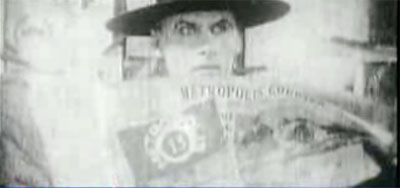
I don’t think we even knew the spy Schmale’s name. He’s always just been ‘the thin man’, right? And he’s onscreen for all of 3 seconds, looking very tall and sinister. I’m looking forward to seeing a bit more. Here’s a YouTube video that includes tidbits of the new stuff, starting with Schmale, I presume, peeking over a Metropolis newspaper:
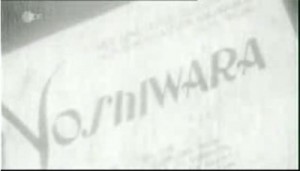
And, in other German typeface-related news, we are finally going to get to see the lost Yoshiwara district scene.
by John Holbo on July 26, 2008
So, about that Obama-in-Berlin poster.
 No, I’m not going to make fun of the small handful of right-wing blogs that got fake-alarmist about it, hinting that it kinda sorta looked Fascist. My question is related, however. Being a sensible and knowledgeable sort of person, as opposed to some sort of crazed wingnut, when I look at the poster I see not Fascist art but an homage to German modernist styles of the 1910’s and 20’s. Being the sort of person who futzes with fonts, I also see an example of art that would have been actually illegal under the Nazis. Quoting from German Modern, by Steven Heller and Louise Fili [amazon]: [click to continue…]
by Kieran Healy on July 22, 2008
Henry beat me to the punch by about five minutes, dammit. Here’s my wordley representation of my book, Last Best Gifts.

I didn’t look at the site closely enough to see if I could get a PDF of the output, but it would be nice to have one.
by Henry Farrell on July 20, 2008
I’m moderating a discussion at Firedoglake on Cory Doctorow’s new book Little Brother, starting about now (with Cory himself as main attraction). If you’re interested, drop by.
by Chris Bertram on July 19, 2008
Steve Fuller gets a good kicking from the excellent Steven Poole:
bq. … Fuller happily adopts ID’s rhetorical tactics: speaking of biologists’ “faith”; forgetting to mention (or merely being ignorant of) the wealth of evidence for evolution in modern biology that wasn’t available to Darwin himself; and even muttering about the “vicissitudes” of fossil-dating, thus generously holding the door open for young-Earth creationists, too. The book is an epoch-hopping parade of straw men, incompetent reasoning and outright gibberish, as when evolution is argued to share with astrology a commitment to “action at a distance”, except that the distance is in time rather than space. It’s intellectual quackery like this that gives philosophy of science a bad name.
(Hat tip: SO)
by John Holbo on July 13, 2008
Three unique books by Taro Gomi (that’s a link to the author’s site): Squiggles: A Really Giant Drawing and Painting Book [amazon]. Then click around to find the companion volumes, entitled Scribbles and Doodles. Each page gives the kid a partial, starter-scribble and an assignment. ‘Draw the flag of the bunnies’. Or ‘add water’ to a picture of a bunch of fire fighters. Or ‘add some leaves’ to a page of bare trees. Or a simple line of stairs with ‘draw people walking down, some of them falling!’ The books are big – 350+ pages. Not expensive. Good for trips. (I just sent my kids state-side with Belle, each armed with a Gomi book.)
The books do a great job of providing lots of great ideas for kid art without the instructions becoming bossy and boring, a happy balance struck in virtue of the author/illustrator’s talent for whimsical, back-to-basics simplicity.
Gomi is author of the immortal Everybody Poops
by Chris Bertram on July 7, 2008
I just finished Gregory Gibson’s Hubert's Freaks (subtitle “the rare book dealer, the Times Square talker and the lost photos of Diane Arbus”). It was one of those strange books which sounds interesting but then has you thinking you made a mistake in starting, but suddenly hooks you and has you reading to the end. Gibson tells three intertwined stories: first, that of Bob Langmuir, a neurotic Philadelphia-based antiquarian book-and-miscallaneous-stuff; second, more briefly, that of Diane Arbus, her career, her photographs, suicide and posthumous rise to cult status; and, uniting the other two, Hubert’s Museum, a Times Square freak show (complete with bogus African tribespeople, amputees, tattooed men &c.). Arbus had become involved with the people at Hubert’s in the 1960, and especially with the black couple known as Charlie and Woogie who ran the place, and had taken a whole bunch of pictures there. It is these pictures that Langmuir discovers chez another dealer, amid a pile of other paraphenalia. Part of Gibson’s story is Langmuir coming to terms with what he has, and then struggling to get the difficult (to understate the case considerably) Arbus estate to authenticate the material so that he can bring the pictures to market. But Langmuir is also an archivist of African-American history and he is fascinated by the people at Hubert’s and by the comprehensive phonetically-spelled diaries that Charlie kept for most of his life. Gibson does an excellent job of stitching the various narratives together and using them to evoke a strange and marginal side of America. In passing he gives us some interesting insights into how the market for art photography got started (a combination of scarcity of other art objects giving rise to a need for new outlets for the connoiseur’s passion and institutional hype from curators like John Szarkowski at MoMa and critics like Sontag).
(When I bought the book on a recommendation, I hadn’t realised that it had only recently come out. In fact the story is still short of a denoument as Okie, the Nigerian dealer from whom Langmuir bought the trunk, is suing on the grounds that he was somehow illicitly deprived of valuable items. Since _caveat vendor_ would seem to be to relevant principle for trades between dealers, and since Langmuir did the work of recognising the Arbus material and then establishing authenticity, it is hard to believe the Okie has a case. But where (possibly) millions of dollars are at stake, it is probably worth him trying it on. Pending resolution, the Hubert’s archive can’t be sold.)
by John Holbo on July 2, 2008
I’m organizing a book event for Doug Wolk’s Reading Comics [amazon], which is now out in paperback. The event will be nominally hosted at the Valve. I got to know Doug on the strength of mocking him with my masterful New Skrullicism post of yore. Then I read this great book of his, which only made me like him more. I posted about it here. Anyway, this post is mostly a heads-up that the event is going to happen round aboutish July 10. I’ve already got participants lined up, but several people are going to participate just by posting on their own blogs so you are welcome to show up in the usual ‘I’ve got a blog too’ way.
In other news: I’ve really been enjoying a lot of music by people named Finn. The two albums currently on heavy rotation are The Hold Steady’s Stay Positive (lead singer Craig Finn) and Liam Finn’s I’ll Be Lightning. A couple YouTube links: Liam Finn’s “Second Chance” and The Hold Steady’s “Little Hoodrat Friend” and “The Swish”. But the one you really need to listen to and watch is “Stuck Between Stations”. Bruce Springsteen wishes he was as awesome as vaguely Randy Newmanesque Craig Finn. Who is apparently starved for groupies. I’m not really eligible myself.
by John Holbo on July 1, 2008
“The safest general characterization of the European philosophical tradition is that it consists of a series of footnotes to Plato.” You’ve all heard that. It’s A.N. Whitehead. At some point I read something which suggested that the thought continues: ‘because he had the foresight to write out all the heresies in advance.’ Or words to that effect. I thought that was rather witty. Now I bother to look at the original source, Whitehead’s Process and Reality (Amazon has an edition you can search inside.) And apparently the witty, heretical sting in the tail isn’t there. Curious. Does anyone know what’s going on? I’d sort of like to go one quoting the thing. I’ve done so informally on a few occasions. I didn’t think of it. Did someone else famous say it?
I have also discovered that if you Google Whitehead you get sponsored ads that promise: “No More Whiteheads! Whitehead Removal for under $25 Satisfaction Guaranteed.” Ha! You could never do that to Plato.
by John Holbo on June 25, 2008
Some good reads. The Locus Award winners have been announced.
Michael Chabon won for Yiddish Policemen’s Union. I thought it was ok – fun – a bit of a disappointment after Kavalier and Clay. What did you think? OK, I’ll write a short review to finish this post out. Now, on down the list.
Terry Pratchett, Making Money. Very funny, as usual, but sort of by-the-numbers.
I haven’t read Miéville’s Un Lun Dun or Joe Hill’s Heart-Shaped Box. (Put them on the to-read list.)
Cory Doctorow’s “After The Siege” is magnificent. It’s a harrowing tale. It will definitely give you that ghastly, crazy, infowar siege of neverland feeling. I listened to it as a podcast, read by the author himself. I see that someone else has re-recorded it. Throw it on the iPod.
“Witch’s Headstone”, by Neil Gaiman. Haven’t read it.
“A Small Room in Koboldtown”, by Michael Swanwick. You can download it as a free PDF. (And here’s a podcast.) I guess I’m a bit surprised it won. It’s a funny genre mash-up. Hardboiled detective fiction, locked-room murder mystery, meets … well, I’ll quote the first paragraph: [click to continue…]
by Eszter Hargittai on June 23, 2008
Like Henry, I also participated in the TPM Cafés Book Club discussion of Clay Shirky‘s Here Comes Everybody last week. My contribution continues along the theme of some of the earlier posts concerning inequalities, but my particular focus is why some online organizing efforts are more successful than others and what factor the organizer’s resources play in all this.
In related news, Clay will be joining us as a guest here in a couple of weeks. This advance warning should give you enough time to go and read his book although it’s not a requirement for commenting on his posts.:)
by Maria on June 11, 2008
Fans of Captain Laurence and Temeraire will be delighted to hear the latest installment of Naomi Novik’s wonderful Napoleonic dragon series is almost here. And in the meantime, there’s a teaser chapter to enjoy. Roll on the 8th of July!
by Ingrid Robeyns on June 3, 2008
Amartya Sen turns 75 later this year (on November 3rd, to be precise), and we are going to celebrate this. In academic style, of course. Kaushik Basu and Ravi Kanbur have edited a 2-volume Festschrift, aptly called <em>Arguments for a Better World</em>. I am not sure when Sen is going to read those 1400 pages, but that detail shouldn’t spoil the party. And Basu and Kanbur are also organising, together with the Institute for Human Development a conference to celebrate his birthday. That event will take place in New Delhi on the 19th and 20th of December. The Call for Papers, which so far I haven’t seen circulating, is only open to young economists and social scientists, with ‘young’ being defined as those under 40. It’s a pity, though, that political philosophers are not invited to submit papers, given Sen’s important contributions to that field.