A while ago I asked for picture suggestions to advertise a talk I would be giving at the Humanities Center in Madison, and a couple of people asked that I post the text of the talk here. I apologise for the delay, which is not, for once, due to my laziness, but my reluctance to be seen to be breaking the anonymity of peer review. Absurd, really, because it is hard for me to believe that the referees had no inkling of the authors of the relevant manuscript, which manuscript anyway bears a very tangential relationship to the talk, but there you are. That’s all done with (so, I don’t have to feel so guilty about Ingrid’s complaint!), so here it is. I’ve tried to incorporate some aspects of the powerpoint presentation through judicious use of links. Also, bear in mind that it was an informal talk, and it is for the most part written that way. It’s long (4000 words), so it’s all below the fold. It was given in December, hence the two or three seasonal references.
From the category archives:
Feminism
A “study”:http://www.admin.cam.ac.uk/news/dp/2008080601 conducted by sociologists from Cambridge University seems to suggest that the support for working mothers is weakening. The researchers compared survey results from the 1980s till recently, and found “growing sympathy for the old-fashioned view that a woman’s place is in the home, rather than in the office”, caused by “mounting concern that women who play a full and equal role in the workforce do so at the expense of family life.”
[click to continue…]
I keep referring to this cartoon in conversations and people keep telling me they have no idea what I’m talking about so I’m just going to put it here with the hope that it spreads to more and more folks. (I know some of you have already seen it, Vivian linked to it in her comment here. Nonetheless, it deserves its own post.)
It’s amazing how well it tells so much. It reminds me of specific experiences throughout my life from high school through graduate school (although the latter not in my department, to be fair). Plus one encounters this type of attitude online all the time.
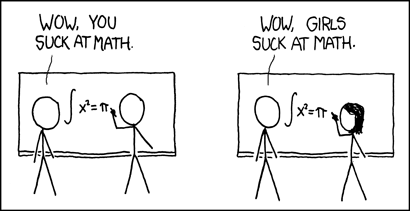
Thanks to xkcd. I’d buy this one on a T-shirt, but it’s not in the store. The college-style XKCD is tempting.
Recently I was talking with a political philosopher, who is based in Italy, about “my reasons for supporting birthleave for fathers”:https://crookedtimber.org/2008/01/03/2-weeks-of-birthleave-for-fathers/. He told me that in Italy parenthood is strongly gendered, and gave the example of a note put up at his kids’s school, stating that ‘Today Mothers should pick up their children at 2 pm rather than 4 pm’ (or something very similar). If I ever were to read such a note, I would be outraged that the school would assume that it could only be mothers who would get the kids from school; he, as a father, was outraged that the school assumed that there would be no fathers picking up the kids from school.
In my view there are plenty gendered messages in daily life, and many of the people I encounter are not aware of the gender codes they create, reinforce, and spread. I few months ago I thought I should write down during one year all the public and private gendered codes and messages that I encountered in daily life and explain why I find them problematic (or not). For time reasons, and perhaps also because it would be difficult pursuing such a project without violating people’s right to privacy, I haven’t embarked on that project yet, though I may do so one day. I think such a gender codes diary would show how many gender codes surround us, many of which are uncritically absorbed by consumers and citizens. Which was the last one you encountered?
By Kathy G.
The decision on the part of Washington University, the highly respected research university located in St. Louis, Missouri, to award an honorary degree to the odious Phyllis Schlafly is deeply distressing to me. One reason why is that this story has gotten nowhere near the attention it deserves, either from the mainstream media or from the left blogosphere (although there are a few blogs that, against the grain, have been on the case).
I think part of the problem is that, these days, many people have no idea who Phyllis Schlafly was and is. And, compounding that, a lot of folks don’t understand what awarding an honorary degree means. I will try to correct what I see as those lacunae, or misunderstandings, in this post (which I’ll warn you right here, is exceedingly long).
Let me start by posing a question: how would you feel if a great university decided to bestow its highest award — an honorary doctoral degree — on Ann Coulter? Or on Karl Rove? Well, the reprehensible Schlafly is very much their equivalent, as I’ll explain later.
Washington University has defended its outrageous decision to honor Schlafly with these disgusting weasel words:
Alumna Phyllis Schlafly’s articulation of her perspectives has been a significant part of American life during the last half of the 20th century and now the 21st century, serving as a lightning rod for vigorous debate on difficult issues where differences of opinion are profound and passionate. Not only should a university serve as a place where such discussions take place, but it may also choose to recognize those who provide leadership and articulation — both pro and con — on vital issues.
Well, yes, there can be doubt that Phyllis Schlafly has been a “significant part of American life,” that she has been a “lightning rod,” that she has shown “leadership.” As Alan Wolfe pointed out in a 2005 review of a biography about Schlafly that appeared in The New Republic (but which, unfortunately, is unavailable online, because the TNR archives are still screwed up, as they have been for about a year now):
If political influence consists in transforming this huge and cantankerous country in one’s preferred direction, Schlafly has to be regarded as one of the two or three most important Americans of the last half of the twentieth century. . . Had she never been born, the Constitution would now include an Equal Rights Amendment.
I am in complete agreement with Wolfe here — Phyllis Schlafly is indeed probably “one of the two or three most important Americans of the last half of the twentieth century.” That is a bitter and painful truth, but a truth nonetheless. Wolfe again:
Critchlow [author of the Schlafly biography Wolfe is reviewing] is right to insist on Schlafly’s influence–but influence is a neutral category. It may be a force for good or a force for ill, depending upon the ideas that animate it. Let it be said of Phyllis Schlafly that every idea she had was scatter-brained, dangerous, and hateful. The more influential she became, the worse off America became.
Surfing over to Charles Dodgson‘s site yesterday, I happened upon Elizabeth Warren’s lecture on the squeeze on the American middle class since the 1970s. Then you could bring up a family on one income; now you can’t. Then non-discretionary spending made up a smaller proportion of household spending; now, it dominates. Result: if a parent loses their job or gets sick, bankruptcy looms. I didn’t expect to sit watching a YouTube video for whole hour but I was riveted by the story Warren tells with the consumption statistics.
I was kind of reluctant to blog this too. After all, there are others at CT who do sociology or economics or family policy and I don’t do those things. And I’m not an American resident either. Still, it struck me as pretty compelling. I wonder how similar the change has been in the other OECD countries?
I bought some Girl Scout Cookies on a street corner yesterday. The box says: “The Girl Scout Cookie Program promotes financial skills such as goal setting, decision-making, customer-service and money management.” Okay, I buy it. I mean, literally, I have bought numerous boxes this season (and the last, and the one before that, etc.).*
But there was an interesting part of the experience this time that I thought was worthy of a note. Two girls were selling the cookies (with two women who were presumably their mothers behind them), but a little boy was next to them handling the money. The boy was clearly younger, probably the little brother of one of the girls. I think it’s great that he’s learning math and dealing with money. He should learn about things of that sort. But wait, wasn’t the purpose of this program to help girls learn such skills?
The incident reminded me of an anecdote in Babcock and Leschever’s book Women Don’t Ask
Once, when their daughter was three, Linda stopped in a drugstore for something and the child saw a stuffed animal she wanted. “Do you have enough money to buy that for me, Mommy?” she asked. “Do girls have money, or is it just boys that have money?” Linda was horrified. Their family habits had unwittingly communicated to their daughter that men control money, not women. She and her husband now make sure that their daughter sees Linda paying for things frequently; they also bought their daughter a piggy bank so that she can have money of her own.
Again, I’m all for little boys learning about money and arithmetic, but the purpose of this program is that girls learn related skills. Given all the situations in everyday life where men are the default for handling money, it would seem important to emphasize girls’ exposure to it in the context of a Girls Scouts program.
To be sure, the girls were quite active in the selling process (attracting folks to the table, offering samples) so it is not as though they were passive observers. But if anything, this suggests that they were not shy to interact with the customers and thus could have been given the responsibility of handling the money. I only recognized these dynamics after I left the table. If I’d been paying more attention, I would have just handed one of the girls the money. Next time.
[*] No worries, I don’t eat most of these cookies myself, I give them to the students in my lab. I also try to make some healthier snacks available as well, but these cookies tend to be pretty popular.
It’s the international women’s day today – but with “a 6-weeks old baby”:https://crookedtimber.org/2008/01/30/born-under-a-full-moon/, a 2-year-old toddler, and a close family member in hospital (nothing to panic about), I didn’t have the time or energy to go to any activity or debate. Luckily I have a long list of feminist and women’s issues that I want to blog about in the near future (but with the little one, I think I shouldn’t make too many promises about timing). So in the meantime let me turn this into an open thread. If you celebrated women’s day, what did you do? Any other thoughts or stories on international women’s day? And what should be the priorities of the women’s/feminist movement for the years to come — locally, regionally, internationally?
When last September “Ronald Plasterk”:http://www.minocw.nl/ministerplasterk/index.html, the Dutch minister of Education, Culture and Science, who also holds emancipation in his portfolio, “released his Policy Paper on Emancipation”:http://www.minocw.nl/ministerplasterk/nieuws/35434/Meer-kansen-voor-vrouwen.html, he was criticized for not mentioning men at all. Basically his view is that women should be encouraged to perform more paid work so that they can be ‘financially independent’, and the government should provide the conditions for making this possible, for example by expanding the supply of formal child care facilities. I agree with the critics that what is missing is a vision of what fathers need to be offered, both as a matter of justice for fathers, but also as a precondition for women’s emancipation. So I would like to suggest to Mr. Plasterk, as a first and minimal step towards the inclusion of men in his emancipation policies, that he introduces the right for fathers of a minimum of 2 weeks of fully paid birthleave (and, of course, also for co-mothers in the case of lesbian parents).
[click to continue…]
A rich post over at Scatterplot.
bq. I spent a lot of those years exhausted and angry. We continued to have only part-time child care. Some nights I put the children to bed crying because I knew they were better off crying alone in bed than interacting with an angry sleep-deprived mother. I was furious that I had to make constrained choices and could not have the life I wanted. When he was home, my spouse was “superdad,” who did a lot of the work and played a lot with the children, so there was a big hole when he was gone. He was aware of how much he did when he was around, but not of what it was like when he was not around. I wanted him to confront the consequences of the work-home choice he was making and feel just as bad as I did. In retrospect, I probably should have used more paid child care and household help, as the children would probably have been better off with a saner mother, but I did not want to concede defeat to the constraints in my life. I preferred feeling angry to adjusting.
I haven’t said “Read the whole thing” in a while. This one’s worth it.
Dennis Perrin, who I’ve just realised is the same bloke as the Dennis Perrin I used to have really nasty flamewars with on a mailing list five years ago, has a post up which, among other things, mentions a bumper sticker he recently saw which read:
“As Hillary, Nancy and Jennifer Rise In Stature, They Give New Meaning To The Phrase Ho Ho Ho!”
Well it got me thinking. Quite a number of points, below. I tried, but failed, to keep the footnotes under control this time.
[click to continue…]
Thanks to Tina over at the new Scatterplot, I just found a fantastic blog: outside the (toy) box. Here is an excellent post about gender socialization through toys. Plus the author maintains a helpful list of anti-sexist/anti-consumerist children’s books. Additions to that list here or there are welcomed.
A little while ago, when “Harry discussed the latest addition to the Real Utopias Project on basic income and stakeholding”:https://crookedtimber.org/2007/02/28/redesigning-distribution/, some commentators raised the issue of the gender effects. I promised at that time that I would write a post about it. Well, finallly the time has come — thanks to a workshop on this topic that the “Heinrich Boell Foundation”:http://www.boell.de/ organised last Thursday in Berlin. They are the think-thank of the Green German Party, which is currently seriously debating whether they should advocate a basic income as (part of) a welfare state reform strategy. The workshop addressed the question whether a basic income would have different implications for women and men, and whether, all things considered, it would be a policy reform that feminists may want to support. [click to continue…]
My little daughter Violet was playing that she had a loose tooth the other day. “let’s pretend you put it under the pillow and the Tooth Fairy brings you money”, I suggested. “Don’t be silly, mommy. The Tooth Fairy can’t bring you money.” “What does she bring you, then.” She looked at me, exasperated at my tomfoolery: “she brings you adult teeth!” Hmm, that is more plausible.
This afternoon Zoë asked me in the elevator why most Barbies have blonde hair, and I said it’s the most popular sort of Barbie, but they do come in other colors. “I think that’s not good,” she said. “Because most people have brown or black hair, and brown eyes, and different colors of skin. If somebody wasn’t very smart and they played with those blonde Barbies they might think that they can’t be pretty. That makes me feel weird. Next time if we get a Barbie I want her to have brown skin and black hair like LeAnn, or dark skin like Fope.” Yay Zoë! This was music to my ears compared to the time I overheard her playing that the biggest Russian nesting doll was so fat that she couldn’t wear any nice clothes, and then she went away and lost weight and came back as Barbie. Great, let’s just get the eating disorder started now!
A “time capsule in Tulsa”:http://edition.cnn.com/2007/US/06/15/buried.classic.ap/index.html contained a 1957 Plymouth Belvedere, which had been intended to be started up and driven off by someone once it was opened this week. But time, chance and especially groundwater happeneth to them all and the thing turned out to be a rusted-out wreck. But the best bit was this: “The contents of a ‘typical’ woman’s handbag, including 14 bobby pins, lipstick and a bottle of tranquilizers, were supposed to be in the glove box …” Sadly, “all that was found looked like a lump of rotted leather.”