by John Holbo on January 31, 2010
This one comes up from time to time, so let’s consider: “America is a center-right nation.” In some sense, this is probably right. Yglesias, a year ago: “I would go stronger than that, actually, and posit that American politics in the future will mostly be dominated by a center-right political coalition just as it always has. This is just how things work. A political coalition grounded in the social mores of the ethno-sectarian majority and the ideas of the business class has overwhelming intrinsic advantages against contrary movements grounded in the complaints of minority groups and the economic claims of the lower orders.” (But is that too strong? Was the U.S. a center-right nation at the height of the New Deal?)
But there are clear senses in which it is not right that the U.S. is a center-right nation. For example, it’s at least odd to have a center-right nation that lacks a center-right. There aren’t that many Olympia Snowes around – not even Olympia Snowe herself, during this whole health care business. It’s not as though America is the country where, when you elect a guy like Obama, you have to beat the center-right off with a stick, compromise-wise, when the center-left is plainly crying out to meet somewhere in the middle.
I have my own thoughts about this, but I’ll just throw this out. How is it possible, and what does it mean, to have a center-right nation, ideologically and electorally, that lacks a center-right, ideologically and electorally?
by Michael Bérubé on January 22, 2010
Scott Brown’s election this past Tuesday offers the Democratic Party a new hope. A new hope for a politics of modesty in place of the politics of arrogance; a new hope for a politics of cooperation in place of the politics of demonization. Democrats might not realize it now, but they have before them a historic opportunity to seize the day and regain the trust of the American people for at least a generation. By turning their backs once and for all on the scorched-earth approach of the party’s liberal wing, Democrats can consolidate their legitimate gains while cutting loose their least reliable partners. They have the ability; all they need is the will.
The problem — if there is one — is that time is tight, and the party will need to move on several fronts at once. What follows is not an exhaustive list, but rather a series of first steps Democrats will need to take if they are to remain a meaningful majority party.
[click to continue…]
by Henry Farrell on January 15, 2010
There’s been a fair amount of “debate”:http://www.google.com/search?q=manzi+european+economic+model&ie=utf-8&oe=utf-8&aq=t&rls=org.mozilla:en-US:official&client=firefox-a around “Jim Manzi’s recent piece”:http://nationalaffairs.com/publications/detail/keeping-americas-edge on the differences between Europe and the US. I contributed a bit myself in the Bloggingheads with Dan Drezner linked above (with discussion of Iceland, Stephen Cohen and Brad DeLong’s recent book, and other stuff too). In this wrap-up reply to his critics, Manzi maintains that some of the criticisms that have been made by e.g. Paul Krugman are flat out wrong (Paul seems to have misattributed the data series that he was using), while saying that he was not in fact setting out to prove empirically that European style welfare redistribution systems limit innovation and growth (if I understand him correctly, he still believes this to be true, but doesn’t claim that the figures he adduces show it). As he notes, he is actively advocating that the US turn to redistribution – but is also claiming that there are trade-offs involved. I should also note that I’ve met him a few times, and always found him to be a straightforward, decent and, fwiw, mildly Europhilic guy (with whom I disagree, obviously, on multitudes of things). But as per my original Bloggingheads, I am dissatisfied with one of the most basic claims of the argument – that there is a distinct “European model,” followed by all states within Europe, which can readily be distinguished from the American approach. This is a claim that you sometimes see on “both left and right”:https://crookedtimber.org/2007/10/08/alesina-and-giavazzi-have-a-point/#more-6279 – but it is one that I think is very wrong indeed.
[click to continue…]
by Henry Farrell on January 15, 2010
“Chris Blattman”:http://chrisblattman.com/2010/01/14/whats-even-better-than-giving-money-to-haiti/ passes on a suggestion (for American readers).
Giving money to Haiti doesn’t seem like enough? Katmanda have another suggestion: grant Haitians Temporary Protected Status.
TPS is a form of temporary humanitarian immigration relief given to nationals of countries that have suffered severe disasters, natural or man-made. (For example, El Salvador got TPS was after the country was hit by a terrible earthquake in 2001, Honduras after Hurricane Mitch in 1999, and Burundi, Liberia, Sudan, and Somalia were designated because of ongoing armed conflicts.)
Once a country has been given TPS, its nationals who are in the United States can apply for work authorization (a very useful thing to have if, say, one needs to send money home to family members in need of medical care or a house that has not been reduced to rubble), can’t be deported or put into immigration detention (also quite handy if you’re trying to work and send money home), and can apply for travel authorization, which allows them to visit their home country and return to the US, even if they wouldn’t otherwise have a visa that would allow them back into the country (incredibly important if you have loved ones who have been badly hurt and need to visit them, or if you need to go home to attend funerals).
To support TPS, contact the White House “here”:http://www.whitehouse.gov/contact. You’ll need to select “I have a policy comment”, and “Immigration” from the drop-down menu.
by Henry Farrell on December 28, 2009
Perhaps the recent “terrorist outrage in the skies”:http://www.nytimes.com/2009/12/27/us/27terror.html?hp=&adxnnl=1&adxnnlx=1261890636-QVFR8dRHo8PyDIMOJsWiaA will bring the delusional opponents of group profiling to their senses. But I fear not. It should be a cut and dried case. A “member of a group”:http://www.google.com/search?q=Abdulmutallab+engineering&ie=utf-8&oe=utf-8&aq=t&rls=org.mozilla:en-US:official&client=firefox-a that is “notoriously”:https://crookedtimber.org/2007/11/10/engineers-of-jihad/ “associated with terrorist violence and fundamentalist political beliefs”:http://www.nuff.ox.ac.uk/users/gambetta/Engineers%20of%20Jihad.pdf tries to set off a bomb in a plane and only fails because of sheer luck. The nabobs of political correctness will try to convince us yet again that there are many strains of thought among these people, that most of them are non-violent, that compulsory cavity searches will alienate them and so on, and on, and on. But the PC mafia will be ignoring these people’s plans to “build temples that dominate our major cities”:http://web.mit.edu/facilities/construction/completed/completed.html, and “actions taken deliberately to flout our common norms”:http://hacks.mit.edu/. A strong country has a strong culture that it is willing to defend against the enemy – and a willingness to ignore the natterers of multiculturalism when its citizens’ lives are in danger. We were lucky this time. We may not be so lucky the next.
by Maria on December 10, 2009
On Monday I went to The Economist’s World in 2010 Festival, on the invitation of erstwhile CT guest-blogger, Matthew Bishop. It was a witty and thought-provoking romp through a range of issues such as the global economic crisis and the prospects for unemployment, global warming and Copenhagen, whether the Republicans will storm next year’s mid-term elections and, of course, who will win the 2010 World Cup. The panels were sprightly with lots of back and forth, and were interspersed by 10-minute talks from all sorts; DC schools chancellor Michelle Rhee, celebrity chef Joses Andres, the buyer for Politics and Prose, Mark LaFramboise and a fascinating graphic and information designer, Nicholas Fenton, whose work is as beautiful as Edward Tufte’s and who produces his own Personal Annual Report (comparison of prices paid per mile in 2008: airline: $0.05; driving:$0.15; New York subway: $0.93; gym: $5.26. Sightings of Michael J. Fox: 1. My boyfriend helpfully pointed out that a proper bloke’s personal annual report would also include helpful stats such as how much sex was had, solo or otherwise, average time, some quality measures, etc. etc. But I’m sure Felton was far too busy cataloguing belly button lint for that.)
Each speaker had to make a prediction for 2010. Predictions are good ways to extrapolate present trends, but I’ve been wary of their usefulness since I attended a conference in August 2001 and we predicted the biggest threat to the world was tension between India and China.
Lest I be accused of burying the lead, the combined predictions for 2010 were: [click to continue…]
by Kieran Healy on November 25, 2009
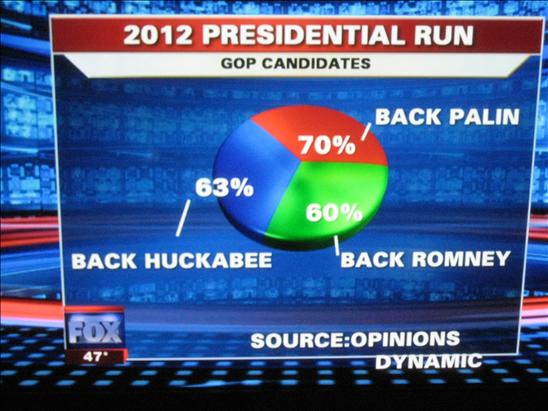
I’d almost be happier if this turned out to be some kind of fake. But in the meantime, while you may think of it as a badly flawed and unfair pie chart, I prefer to see it as actually just an extreme version of a genuine pie chart.
by John Holbo on November 19, 2009
I just listened to an EconTalk podcast interview with Richard Posner about his new book, A Failure of Capitalism: The Crisis of ’08 and the Descent into Depression [amazon]. The book has gotten a bit of buzz for the way in which Posner semi-recants certain libertarian or Chicago-style economics positions he is known for. But certain other positions he has not recanted, such as his narrow view of economic actors’ duties to consider negative externalities of their activities (discussed at CT before here and here). In the podcast, Posner basically asserts that those actors in the financial sector who almost crashed the world economy were right to do so, in the sense that it was rational for them, individually, to be massive ‘risk polluters’ (to coin a phrase someone else has probably coined already.) He would probably go further, although he isn’t actually asked to in the podcast: some of these actors were obliged to take the risk. In at least some cases it would have been their strong, positive fiduciary duty, under the circumstances, to do something which – taking a larger view – seriously threatened to run the whole world economy off a cliff. Because that was the apparent route of profit-maximization. It was their job not to take the larger view. Posner blames regulators, not these profit-maximizing actors, for the market failure; for not seeing that the damage to everyone downwind of all that toxic risk was so great that it should not have been permitted. [click to continue…]
by Henry Farrell on November 18, 2009
bq. I’m not sure what Sarah Palin’s favorite work of postmodern theory might be (all of them, probably) but she seems to take her lead from Jean Baudrillard’s _Seduction._ Other political figures use the media as part of what JB calls “production.” That is, they generate signs and images meant to create an effect within politics. For the Baudrillardian “seducer,” by contrast, the power to create fascination is its own reward.
More from Scott, “here”:http://www.insidehighered.com/views/mclemee/mclemee265.
by Henry Farrell on November 12, 2009
I wrote a couple of “blog”:https://crookedtimber.org/2008/06/24/annals-of-stupid-lawmaking/ “posts”:https://crookedtimber.org/2008/06/30/taking-the-mickey/ last year on the Mickey Tax, or, as its promoters would prefer to describe it, the ‘Travel Promotion Act’ bill, which would seek to ‘promote’ travel to the US by imposing a fee on anyone entering the country which would in turn be handed over (after costs were deducted) to an advertising slush-fund. Now the “FT is reporting”:http://www.ft.com/cms/s/0/1fa32e7e-ce05-11de-95e7-00144feabdc0.html that the European Union is threatening to retaliate against it by imposing visas on US visitors.
bq. US plans to levy fees on European Union tourists and business travellers visiting the US have come under fire in Brussels and could prompt the EU to enact its own visa-like system for US travellers, according to diplomats. … In the past, most Europeans visiting the US for less than 90 days have not had to make pre-departure arrangements. The same applies to US visitors to the EU under visa-reciprocity guidelines. “If this tax is indeed introduced, the Commission will have to re-evaluate once again whether it is tantamount to a visa,” said a spokesman for Jacques Barrot, the commissioner for justice and home affairs, on Tuesday.
If the EU carries through on this threat, American tourists to Europe who have to pay visa fees, wait in queues at overworked consulates etc, should know who is responsible – the “Walt Disney Corporation of America”:http://www.washingtonpost.com/wp-dyn/content/article/2008/02/13/AR2008021302837_pf.html.
bq. JAY RASULO STOOD IN FRONT OF TWO MASSIVE SCREENS, each projecting his balding visage, and did what he loves to do: sell a big idea. The dapper, diminutive chairman of Walt Disney Parks and Resorts implored 500 tourist industry executives to ask the federal government for an expensive favor. … Executives from tourism giants such as Marriott, American Express and Hertz buzzed with excitement — and skepticism. Getting taxpayers to underwrite overseas commercials had been the travel industry’s Holy Grail for decades. But the idea had never gotten very far in the councils of government. … A big lobbying push was needed for a big Ask — the term lobbyists use to describe what they are pleading for from Congress.
It’s an interesting story. When it became clear that the travel industry was unlikely to get US taxpayers to pay for a $200 million travel promotion campaign, lobbyists started looking for alternative ways of raising money – and the most obvious was to top up the industry’s own efforts with the Mickey Tax. Hence the bill, and hence the possible retaliatory measures from Europe. All thanks to Jay Rasulo and his balding visage.
by Henry Farrell on November 9, 2009
“This Boston Review piece”:http://bostonreview.net/BR34.6/barry.php by Tom Barry is very much worth reading, as a background briefing to the “prison funding shenanigans”:http://tpmmuckraker.talkingpointsmemo.com/2009/10/behind_hardin_jail_fiasco_private_prison_salesmen_prey_on_desperate_towns.php recently described by _Talking Points Memo._
These immigration prisons constitute the new face of imprisonment in America: the speculative public-private prison, publicly owned by local governments, privately operated by corporations, publicly financed by tax-exempt bonds, and located in depressed communities. Because they rely on project revenue instead of tax revenue, these prisons do not need voter approval. Instead they are marketed by prison consultants to municipal and county governments as economic-development tools promising job creation and new revenue without new taxes. The possibility of riots usually goes unmentioned. … Initially, most speculative prisons were privately owned, a case of the federal government outsourcing its responsibilities. But prison outsourcing is rarely that simple anymore. The private-prison industry increasingly works with local governments to establish and operate speculative prisons. Prison-town officials have a mantra: “If you build a prison the prisoners will come.”
Most of the time, these public-private prisons are speculative ventures only for bondholders and local governments, because agreements signed with federal agencies do not guarantee prisoners. For the privates, risks are low and the rewards large. Usually paid a set fee by local governments to operate prisons, management companies have no capital investment and lose little, other than hefty monthly fees, if inmate flows from the federal government decline or stop.
… Prisons are owned by local governments, but local oversight of finances is rare, and the condition of prisoners is often ignored. Inmates such as those in Pecos are technically in the custody of the federal government, but they are in fact in the custody of corporations with little or no federal supervision. So labyrinthine are the contracting and financing arrangements that there are no clear pathways to determine responsibility and accountability. Yet every contract provides an obvious and unimpeded flow of money to the private industry and consultants.
The piece isn’t perfect – it can’t quite decide whether it is a story about the problems of the prison system or about the problems of the US approach to immigration. The two are of course closely connected, but each is very complicated in its own right, and trying to explain both at once makes for a top-heavy account. I would also have liked to have seen more aggregate data to support the specific arguments that the author is making (I suspect though that one of the problems with keeping this metastasizing system under control is that there isn’t any source of good general data out there). But it is an eye-opening piece of investigative journalism, looking at a story that doesn’t get nearly as much attention as it deserves. Recommended.
by Harry on October 28, 2009
by Kieran Healy on October 18, 2009
Andrew Gelman discusses Superfreakonomics saying,
The interesting question to me is why is it that “pissing off liberals” is
delightfully transgressive and oh-so-fun, whereas “pissing off conservatives” is boring and earnest?
Several years ago bumper stickers appeared that read “Annoy a Liberal. Work hard. Succeed. Be happy.” I was living in Arizona at the time, so they became a routine part of my commute. Possessing neither the blunt empirical thesis of “Guns Bought Your Freedom” nor the slow fuse of “Body Piercing Saved My Life”, the barefaced cheek of the non sequitur made the sticker absurd and irritating at the same time. I remember wondering what a parallel message to conservatives would look like. Sure enough, attempts at rebuttal soon started appearing on (other) bumpers. They were lame — stuff like “Annoy a Conservative. Think for yourself. Defend the Constitution. Balance the Budget.” Noble sentiments, but watery stuff by comparison.
Why did they seem so ineffective a response? Perhaps stronger material was needed. Might “Annoy a Conservative. Burn the Flag. Convert to Islam. Have an Abortion” work better? No. While that kind of thing can have some punch (“Jesus Loves You, But Everyone Else Thinks You’re An Asshole”), it doesn’t seem like the right tack. Instead, the best riposte to the “Annoy a Liberal” sticker is simply the same thing with the target swapped out: “Annoy a Conservative: Work. Succeed. Be Happy”. The effect is more or less the same as the original, especially if placed on the back of your Lesbaru. Temporarily suspending my longstanding irritation at divisions of this sort, much of what passes for “Pissing off Conservatives” is really an effort to rebut some ridiculous charge or other, instead of a genuinely symmetrical attempt to piss someone off. Or, as the story has Lyndon Johnson arguing, it’s better to kick off the conversation in a way that forces the other guy to deny that he’s a pig-fucker.
by Belle Waring on October 10, 2009
Jonah “organic honey at Dachau” Goldberg wonders, “Is ‘Nazi’ the only label our culture understands as irredeemably evil?”
Additional Corner hilarity: someone ought to tell n00b Lee Edwards about his colleague Andrew McCarthy’s views. Edwards puts forward Uighur activist Rebiya Kadeer as a more plausible Nobel Peace prize-winner, as she supports peaceful dissent from the Chinese government over its “deliberate and often brutal campaign to suppress the Uighur language, culture, and religion (the Uighurs are Muslim).” I couldn’t agree more, but there’s that niggling “Muslim” detail. McCarthy opposed the release of any of the 17 Uighur detainees at Guantanamo, calling them “alien jihadists” who are “affiliated with a terrorist organization and have received terrorist paramilitary training.” Likewise, during the recent conflict between Uighurs and Han Chinese in Xinjiang, McCarthy deferred to “accounts of some witnesses to state-controlled media” in his sober assessment entitled “Hard to Believe the Lovable Uighurs Could Be Involved in Terrorism . . . ” Then again, this is the same McCarthy who observed that “as a man of the hard Left, Obama is more comfortable with a totalitarian Islamic regime than he would be with a free Iranian society.” Thus, as a man of the hard Right, McCarthy is more comfortable with a totalitarian Communist regime than he would be with a free Chinese society. I feel something has gone sort of wrong there, but–SCARY MUSLIMS OMG!
by Henry Farrell on October 9, 2009
I’ve been doing my best to resist getting pulled back in by Clive Crook. I really have. I nearly succumbed when I read “his Monday FT column”:http://www.ft.com/cms/s/0/2ca5e1e4-b112-11de-b06b-00144feabdc0.html, in which otiose self-congratulation dukes it out with utter lack of self-knowledge for seven hundred words but pulled myself back from the brink (self-congratulation wins, but it’s a very close call). But his “follow-up blog post”:http://clivecrook.theatlantic.com/archives/2009/10/history_legitimacy_and_reason.php has propelled me into the abyss.
Mr. Crook has a theory of what is wrong with American politics. It involves partisanship, of the kind not practiced by himself and his friends.
[click to continue…]