Hullo again … delayed by a frankly inexcusable three weeks, this episode brings together some of the things I noticed and wrote notes on while in New Zealand. It’s the longest one so far, and might have been a lot longer if I hadn’t just despaired of ever doing it justice. I don’t think I’m ever going to fall for a country as hard as I fell for Greece, but man, New Zealand is very nice. Next episode will cover Polynesia …
(PS: Attentive readers may note that the word “Maori” is consistently misspelt. This is because I don’t know how to do the flat line accent over the a. Sorry)
{ 80 comments }
Yousef Munayyer in the New York Times:
This might seem counterintuitive, but the political dynamics in Israel and internationally mean that another term with Mr. Netanyahu at the helm could actually hasten the end of Israel’s apartheid policies. The biggest losers in this election were those who made the argument that change could come from within Israel. It can’t and it won’t.
Israelis have grown very comfortable with the status quo. In a country that oversees a military occupation that affects millions of people, the biggest scandals aren’t about settlements, civilian deaths or hate crimes but rather mundane things like the price of cottage cheese and whether the prime minister’s wife embezzled bottle refunds.
For Israelis, there’s currently little cost to maintaining the occupation and re-electing leaders like Mr. Netanyahu. Raising the price of occupation is therefore the only hope of changing Israeli decision making. Economic sanctions against South Africa in the 1980s increased its international isolation and put pressure on the apartheid regime to negotiate. Once Israelis are forced to decide between perpetual occupation and being accepted in the international community, they may choose a more moderate leader who dismantles settlements and pursues peace, or they may choose to annex rather than relinquish land — provoking a confrontation with America and Europe. Either way, change will have to come from the outside.
…
The re-election of Mr. Netanyahu provides clarity….The two-state solution, which has seen more funerals than a reverend, exists today only as a talking point for self-interested, craven politicians to hide behind — not as a realistic basis for peace.
…
Mr. Netanyahu’s re-election has convincingly proved that trusting Israeli voters with the fate of Palestinian rights is disastrous and immoral. His government will oppose any constructive change, placing Israel on a collision course with the rest of the world. And this collision has never been more necessary.
{ 226 comments }
 |
|
| Forthcoming in September, from Basic Books |
As readers of this blog know, Franklin Roosevelt declared he had taken the US off the gold standard on March 6, 1933, as the first substantial act of his presidency. But scholars have not been so quick to accept this date or, with firmness, any other.
When Roosevelt first said he had taken the US off the gold standard, he didn’t want to make too great a fuss about it because he was trying to quiet a panic that had nearly broken the Federal Reserve System. He hoped Americans would bring their gold back for deposit in the nation’s vaults. And they did. Even though the papers were reporting that the president might issue scrip for temporary currency; even though the Emergency Banking Act provided that Federal Reserve notes could be backed by commercial bank assets, people generally preferred paper money to gold, so long as they trusted the paper money – which, with Roosevelt’s assurances, they did, as you can see from the chart. [click to continue…]
{ 29 comments }
And as a St. Patrick’s Day present, a lengthy article on Ireland, written by an American journalist, which (a) hasn’t a hint of stories about fairy rings and the Little People, and (b) actually gets things right. Patrick Radden Keefe’s story on Gerry Adams and the murder of Jean McConville does an excellent job at summarizing multiple perspectives on a complex story, while making it clear which of those perspectives is most believable. And this, on Gerry Adam’s Twitter account:
Adams is now sixty-six and a grandfather, and his evolution into an approachable grandee has found its surreal culmination on Twitter. He intersperses studiously boring tweets about small-bore political issues with a barrage of cat pictures and encomiums to sudsy baths, rubber duckies, and Teddy bears. (“I do love Teddy bears,” he told the BBC. “I have a large collection of Teddy bears.”) One characteristic tweet, from last January: “Dreamt I was eating Cream Eggs. Woke up this morn. Pillow & beard covered in chocolate & cream thingymebob.” The Irish writer Damien Owens has likened all this to “Charles Manson showing you his collection of tea cosies.”
{ 740 comments }
In the old Blind School on Hardman Street, Liverpool, subsequently trade union offices and the home of the Picket (a music venue), there’s a cupola with a mural celebrating the workers’ movement. Sadly, the damp is getting to it. The mural was painted by artist Mick Jones, son of Jack Jones the trade union leader. Arthur Scargill leads Karl Marx and there is much other detail of interest. The owner of the nearby Hope Street Hotel owns the building now and has plans for to turn it into a gastropub, so let’s hope it gets restored rather than destroyed. (There are move shots of the mural in the adjacent sections of my Flickr stream.)
{ 5 comments }
Having made one recent post that topped 1000 comments, I thought I would try to be more abstruse for a time.
I have a trivia question for you. I’m reading Volney’s The Ruins. Why? Because it’s one of the books that Frankenstein’s monster overhears: [click to continue…]
{ 41 comments }
I made this observation in comments on Chris’ ideal theory post, and got some pushback, so I thought I’d take a look back at the data
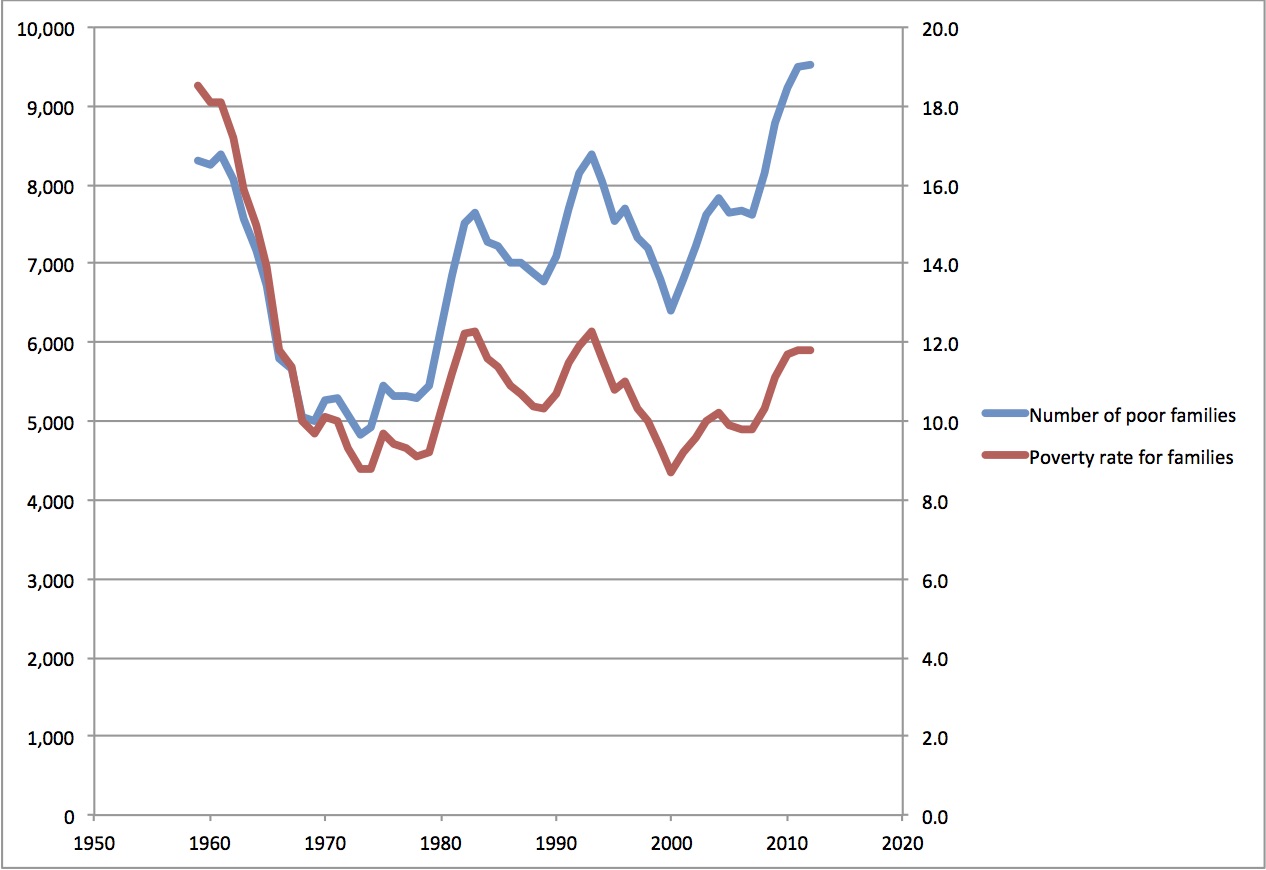
US Households in Poverty, 1959-2013
Both the number and the percentage of families in poverty dropped sharply during the 1960s when the “War on Poverty” was being waged actively, and remained near their all-time lows through the Nixon and Carter years until 1979, when the Volcker recession hit, followed by the election of Ronald Reagan. These events can reasonably be said to mark the point at which the government unequivocally changed sides.
The number of households in poverty has risen steadily since then and is now higher than in 1959, the year for which the poverty level was first defined by Mollie Orshansky. The poverty rate has remained consistently higher than in the 1970s, except for a brief deep at the peak of the late-1990s boom.
[click to continue…]
{ 120 comments }
Well, almost. The British government has just produced [the guidance for its “Prevent” scheme for education](http://blog.sghmartineau.com/archive/2015/03/13/final-version-of-prevent-guidance-published.aspx), which aims to stop young people from being drawn into “extremism”. The elite at Oxford and Cambridge have been granted a specific exemption, allowing them to hear dangerous ideas that might corrupt the ordinary youth, and universities haven’t been given specific guidance on what they may teach. Colleges of further education, on the other hand, have been told that “All relevant curriculum areas will need to be engaged, with a single contact point for delivery of Prevent-related activity.” This so that students are not exposed to arguments that involve
> “active opposition to fundamental British values, including democracy, the rule of law, individual liberty and the mutual tolerance of different faiths and beliefs.”
I suppose it will be news to some that these are “British” values, particularly if they are Irish or live in the former colonies. But leaving that aside, it looks like Plato is off the menu and to make sure:
> “Compliance with the duty will be monitored centrally via the Home Office and through appropriate inspection regimes in each sector.”
Well, that’s freedom for you.
{ 200 comments }
Fuck. Although we knew it was coming, and I am glad if he went out (as I am guessing) on his own terms. Guardian obituary here. I’m pretty sure that his books will continue to live, just as PG Wodehouse’s books have continued to live, although they were very different comic writers. Both were liberal in a small-l sense of the word, but Pratchett’s liberalism was very much more worldly. I’ll always have a particular fondness for the enlightened despot, Lord Vetinari and for the model of hydraulic Keynesianism in Making Money. And for the Ramtop Mountains, an antiquated technology joke that has long outlived its original meaning. And the constellation of the Small Boring Group of Faint Stars, which I bored my nine year old with the day before yesterday. And where Rincewind has seen his life flash before his eyes so many times that he can nap during the boring bits. And the gods’ celestial habitation – Dunmanifestin. And Wyrd Sisters, which is perfectly paced as a novel, with particular attention paid to the standing stone that refuses to be counted and the castle (if my memory is correct) designed by an architect who had heard of Gormenghast but didn’t have the budget. And I could keep on going, and going, and going, which is the point.
{ 69 comments }
One of the most familiar and irritating moves in political philosophy is when a person says “oh, but my point was in ideal theory” as a response to some objection that references the grim and complicated real world. Not that I object in principle to ideal theory. But I do want to write this blog post to share a hypothesis about the ideal/non-ideal distinction and about why it has become more of a problem over time. The hypothesis is this: that in 1971 the gap between the ideal and the actual was a lot smaller than it is now. The world resembled Rawls’s ideal of the well-ordered society a lot more than it does now. Or at least, the North American bit of the world did.
Given that closer resemblance, people could do ideal theory without it looking like they were engaging in arcane hypotheses about a distant possible world. Political philosophy of the ideal variety looked a lot more relevant to what ought to happen.
[click to continue…]
{ 85 comments }
|
|
| Forthcoming in September, from Basic Books |
On this day in 1933, it was the first Friday of Franklin Roosevelt’s administration, and the new president met reporters to talk to them about ending the bank holiday with which he had begun his term. The Federal Reserve Banks would open on Saturday so that member banks of the Federal Reserve System could open on Monday. A reporter asked if the banks would be open “[a]ll along the line, Mr. President; that is, all functions?” Roosevelt replied, “Yes, all functions. Except, of course, as to gold. That is a different thing. I am keeping my finger on gold.”
The president’s week had started with his inauguration on March 4, the previous Saturday, when he had told the American people they had only fear itself to fear, and promised them an “adequate but sound currency.” The next day Roosevelt worked all through the day with members of his team and holdovers from Herbert Hoover’s to draft orders to close the banks and halt all payouts of gold. They worked so hard that Sunday that it was late by the time the order was ready for presidential signature – so late that Federal Reserve counsel Walter Wyatt urged the president to wait a little longer to sign, so that it would be Monday, and not so sacrilegious. Roosevelt did wait, and then, on signing the order said – gleefully, according to one account – “We are now off the gold standard.” That was in the wee hours of March 6; later that morning, Americans began a week of doing business without access to banks.
{ 35 comments }
Aleksandr Dugin has come to public attention as “Putin’s Brain,” as Foreign Affairs memorably dubbed him – that is, as the ideological mastermind behind Russia’s moves towards reasserting imperial ambitions, notably with respect to Ukraine. Is this accurate, or is it just media hype? The truth is that it’s extremely difficult to judge with confidence exactly to what extent Vladimir Putin’s more aggressive policies towards, for instance, Ukraine reflect Dugin’s influence (or supposed influence) as an omnipresent publicist and behind-the-curtain advisor to aspiring czars. (The suspicion easily arises that Putin uses Dugin – lets him rant on state TV – without himself buying into the crazy worldview.) But whether Dugin really is influencing Russian policy or is simply the object of excessive hype, either way intellectuals as well as ordinary citizens in the West need to be aware of him, lest they be taken in by his pretensions as a theorist and his claimed interest in civilizational dialogue and pluralism, which functions as a rhetorical cloak. Either way, he’s dangerous.
[click to continue…]
{ 151 comments }
The UK’s Foreign Secretary, Philip Hammond, made a speech this morning at RUSI, the main military-focused think tank in the UK. That’s the same Foreign Secretary who when at the Ministry of Defense decided to can one fifth of the army, speaking at the same think tank that put out a report yesterday saying Hammond’s government will cut about 43,000 more soldiers – from an army of less than 100,000 – if it’s re-elected. That’s the Foreign Secretary presiding over an FCO whose Russia experts have been let go and scattered to the four winds of oil companies, think tanks and academia, because God knows the UK doesn’t need that kind of expertise. That’s the same Foreign Secretary who can barely spell Brussels, let alone bear to go there, and who is quite satisfied leading the foreign service of a country that increasingly distrusts and fears all things foreign. That one.
Hammond’s speech is easy to summarise: Russia is very mean and bad; ok fair enough, we didn’t foresee ISIS; but if only people would stop all this pointless bleating about the security services’ oversight and transparency, we could get on with our job of protecting the people of Britain. How strong. How plausible. How brave.
It’s only at the level of detail, or rather its self-serving and specious claims, that Hammond’s speech breaks down.
What Hammond says: ‘We said we would legislate to ensure that cases involving national security information could be heard fairly, fully and safely in our courts. And we did.’
What the government did: further entrenched secret courts and a parallel justice system where evidence against individuals cannot be seen by them or their lawyers, destroying the principle and practice of fair trial.
What Hammond says: ‘We said we would strengthen independent and parliamentary scrutiny of the agencies. And we have by making the Intelligence and Security Committee a statutory committee of Parliament.’
What the government did: Make Parliament’s Intelligence and Security Committee a statutory committee. Whoopee. Anyone who thinks the ISC provides effective oversight should watch some video of its fawning audiences security service leaders or examine the politicised timeline and gutless redactions of its report on the murder of the soldier Lee Rigby. Failing that, examine the record of career securocrat Malcolm Rifkind, its Chair who just resigned for peddling access to the Chinese. [click to continue…]
{ 89 comments }
I haven’t been posting, so I figure I should show my work – that is, establish that I’ve been toiling on some sort of important intellectual project behind the scenes.
So here’s the thing. I always figured Jack Kirby just made up ‘weirdies’ – like he invented most things that matter to us today: [click to continue…]
{ 7 comments }