Pope Benedict steps down and surely Mitt Romney thinks, “One door closes, another door opens”. Or maybe the FAI could engineer a swap for Giovanni Trappatoni. Either way, the field seems wide open.
“Charlie Stross”:http://www.antipope.org/charlie/blog-static/2013/02/political-failure-modes-and-th.html argues that we’re living in a post-democratic system.
bq. Institutional survival pressure within organizations — namely political parties — causes them to systematically ignore or repel candidates for political office who are disinclined to support the status quo or who don’t conform to the dominant paradigm in the practice of politics. … The status quo has emerged by consensus between politicians of opposite parties, who have converged on a set of policies that they deem least likely to lose them an election — whether by generating media hostility, corporate/business sector hostility, or by provoking public hostility. … The news cycle is dominated by large media organizations and the interests of the corporate sector. … Overall, the nature of the problem seems to be that our representative democratic institutions have been captured by meta-institutions that implement the iron law of oligarchy by systematically reducing the risk of change. … So the future isn’t a boot stamping on a human face, forever. It’s a person in a beige business outfit advocating beige policies that nobody wants (but nobody can quite articulate a coherent alternative to) with a false mandate obtained by performing rituals of representative democracy that offer as much actual choice as a Stalinist one-party state. [click to continue…]
{ 152 comments }
I read Jonah Goldberg op-eds; also Media Matters; thus, back to back, this: [click to continue…]
{ 65 comments }
As Crooked Timber readers will already know, there was a memorial service for Aaron in DC this week. Like “Rick Perlstein”:http://www.thenation.com/blog/172761/aaron-swartzs-dc-memorial-radical-brings-bipartisanship-washington, I wasn’t able to go. Unlike Aaron’s funeral, it was a specifically political event, intended to draw publicity both to Aaron’s causes and the causes of Aaron’s death.
Public deaths are strange. When someone dies, what is left is an imperfect aggregation of different people’s memories, which can never surprise you in the way that the real person could. But when the aggregation of memories is mostly made up of the memories of people who never knew Aaron directly, it is stranger again. The person whom you knew becomes a mythological figure, onto whom others map all sorts of things that may, or may not, have anything to do with the actual individual. It must be much stranger for the people who knew Aaron much better than I did (we were good friends, but not intimate ones).
[click to continue…]
{ 6 comments }
While I was looking at sources for my post on declining middle class access to first-tier college education, I came across this piece by Arthur Brooks, President of the American Enterprise Institute His main point is the possibility of reducing education costs through low-cost distance/online learning, on which I might say more another time[1]. What struck me, though was this passage (emphasis added)
my 10K-B.A. is what made higher education possible for me, and it changed the course of my life. More people should have this opportunity, in a society that is suffering from falling economic and social mobility.
The change on this point has been striking in a matter of a few years. When I was writing Zombie Economics in 2009 and early 2010, I spent a lot of time citing work going back to the 1980s and 1990s to show that the US has less intergenerational income mobility than most European countries. At that time, the conventional wisdom was definitely that the US was characterized by equality of opportunity – there were still plenty of hacks willing to deny that inequality of outcomes had increased, including plenty at AEI.[2]
The Occupy movement played a big role in focusing attention on the general issue of inequality, and once attention was focused, the facts pretty much spoke for themselves. At the other end of the political spectrum, the intellectual collapse of the political right became more and more evident, to the point that they were unable to put up any effective resistance. Instead we got arguments like this from Tyler Cowen, suggesting that maybe social immobility isn’t so bad after all.
{ 130 comments }
Hi everyone. Just a quick note because I’m completely exhausted. Long story, short: we won. This morning, Mayor Michael Bloomberg came out strongly in defense of my department’s position on the Brooklyn College/BDS controversy. Then the “progressive” politicians followed suit. I’ll just give you the links to my blog, in reverse chronological order, which you can read if you want to get caught up. Many thanks for all the support! [click to continue…]
{ 39 comments }
City Council Speaker—and leading mayoral candidate—Christine Quinn is a signatory to that “other” letter about the Brooklyn College BDS panel from the “progressive” government officials and politicians.
In that letter, Quinn and four members of Congress, Bill de Blasio, and many more, call upon my department, political science, to rescind our co-sponsorship of the BDS panel at Brooklyn College because, well, read it for yourself:
We are, however, concerned that an academic department has decided to formally endorse an event that advocates strongly for one side of a highly-charged issue, and has rejected legitimate offers from prominent individuals willing to simultaneously present an alternative view. By excluding alternative positions from an event they are sponsoring, the Political Science Department has actually stifled free speech by preventing honest, open debate. Brooklyn College must stand firmly against this thwarting of academic freedom.
(Set aside the fact that the department is not excluding anyone since we did not initiate, conceive, organize or plan this event. Also set aside the fact that we did not reject legitimate offers from prominent individuals willing to present alternative views because we were never asked to do so, and even if we had been, we would have been in no position to reject those offers. Because we did not initiate, conceive,…you get the idea.)
No, here’s what’s interesting about Quinn’s signature.
For many years when she was a member of the City Council, Quinn and her office financially supported—to the tune of roughly $4,000 a year—the Center for Lesbian and Gay Studies (CLAGS) at the CUNY Graduate Center. The money, according to one representative request letter from CLAGS that I have seen (from 2004), was supposed to fund publicity and outreach for CLAGS talks, panels, and events.
Talks like this one (see p. 13 of this newsletter): “Unzipping the Monster Dick: Deconstructing Ableist Penile Representations in Two Ethnic Homoerotic Magazines.”
Or this talk from February of that same year (see p. 12). Well, it had no title, but it was given by one Judith Butler, who will be speaking at the BDS event and whose views on Israel/Palestine and BDS—like her views on gender, free speech, and so much else—have aroused such controversy.
(See p. 22 for Quinn’s name under a list of “foundation and institutional supporters.”)
Don’t get me wrong. I think it’s terrific that Christine Quinn used her office and its monies to support talks like those that are sponsored (and not just co-sponsored!) by CLAGS.
I just wonder how she can criticize my department’s co-sponsorship of a panel (to which we donated no money at all)—however one-sided that panel may be (and check out the CLAGS talks in that newsletter; not much balance there!)—when she actually used the city’s money to subsidize and promote talks at CUNY that were sponsored not by student groups but by an official university program and that were equally controversial and “divisive,” that excluded alternative positions, and that advocated strongly for one side of an issue.
Given her own history of supporting, not just with her name but with her office’s dollars, such official CUNY programming, I think she should rescind her name from that letter.
I urge all of you to write or call her office and ask her to do so immediately. Her office phone numbers are (212) 564-7757 and (212) 788-7210; you can email her here.
{ 65 comments }
This morning, Karen Gould, the president of Brooklyn College, issued an extraordinarily powerful statement in defense of academic freedom and the right of the political science department to co-sponsor the BDS event. I don’t have a link yet (will post when I do) but this is the critical part of her statement: [click to continue…]
{ 81 comments }
Dave Weigel calls this, from Yuval Levin, the ‘best riposte’ to the new HHS regulations. I must say: if this is the best they can do …
Levin’s objection is that HHS is just looking for a way in which they can say that, technically, we’re not doing this thing people say infringes their religious liberty. HHS is hereby neglecting to address the larger spiritual issue of religious freedom. But the original complaint about the contraception mandate was that technically you can be made out to be making us do this thing. Technical hitch calls for technical fix. It ain’t pretty, but what were you expecting from a lawyerly work-around? [click to continue…]
{ 88 comments }
In 1942, Brooklyn College hired a young instructor to teach a summer course on Modern European history. Though academically trained, the instructor was primarily known as the author of a series of incendiary articles in the Jewish press on Jewish politics and Zionism. [click to continue…]
{ 43 comments }
The Political Science Department at Brooklyn College is co-sponsoring a panel discussion about the BDS Movement against Israel, featuring Omar Barghouti and Judith Butler. The other co-sponsors—as is typical of such events—include various student groups. The Department and University as a whole have come under strong and increasingly political pressure to either cancel the event, revoke the department’s co-sponsorship, or add a speaker who is strongly against the BDS movement. I won’t rehearse the details. Glenn Greenwald has a characteristically exhaustive discussion and defense of the BC department’s academic freedom. Crooked Timberite Corey Robin is a member of that Department, but I haven’t spoken to him about this. (In fact, I’ve never spoken to him about anything. We haven’t met.) As for other CT members, as usual I am only representing myself here.
The short version is that I think the pressure the Department is coming under is undeserved, their co-sponsorship of this panel is a simple question of academic freedom, and I invite you to write a polite note to that effect to Brooklyn College President Karen Gould, Provost William Tramontano and Director of Communications and PR Jeremy Thompson.
{ 56 comments }
A big sporting weekend ahead. First up, the competition that probably counts the most here at Crooked Timber: the Six Nations. We kick off with, inter alia, Wales v Ireland and England v Scotland (the Calcutta Cup). I think England could do it this year, but you can’t really write anyone off. The Africa Cup of Nations is still going of course, and we’re into the quarter-finals, where the highlight of the weekend is Ivory Coast v Nigeria. Ivory Coast still look like winning the competition, but they have a tougher route to the final than Ghana do (they’ll probably have to beat Nigeria and South Africa in succession – assuming I’ve understood the draw, of course). That match also clashes with Man City v Liverpool, which is unfortunate. (And then there’s the Superbowl, but I have no clue what’s going on when I watch American football.)
{ 73 comments }
The current issue of the online journal Intereconomics features stories about the politics of adjustment in Greece, Ireland, Spain, Italy, and Portugal. Aidan Regan and I contributed the article about Ireland. Each paper outlines the measures that have been taken in recent years, and the major challenges each country now faces. All five countries share many common features of course, including the difficulty of keeping on track with deficit reduction targets in the context of no growth and truly awful unemployment figures. But the challenges discussed by authors are quite varied too: in Greece, for example, it’s governance problems that are highlighted; in Portugal and Italy, productive capacity and export performance; in Spain, problems over sustaining the revenue base of the state.
In Ireland’s case, we outline the ongoing problems involved in trying to reduce the large government deficit. We also note that the legacy of the financial crisis complicates Ireland’s recovery strategy. The government has staked a great deal on getting some relief on a portion of the deficit and debt issues that arise from recapitalizing the banks. What the government is looking for at the moment is not a debt restructuring or a default by this or any other name, but a rescheduling of a portion of the costs of unwinding the full liabilities of the now-defunct Anglo Irish Bank. From the Irish point of view, the ECB has given mixed signals on this: positive indications about the design of the ESM in June 2012, but in September, a statement that was construed by UCD Professor of Economics Karl Whelan as ‘Germany to Spain and Ireland: Drop Dead’.
Yet the backroom diplomacy continued, and the government certainly seemed to that that an agreement would be possible before the next critical deadline for Ireland of 31 March. Right now though, things are not looking so good. There are fears that, as in other areas of crisis management, there is a tendency for EU decision-makers to pull back from new commitments unless crisis is staring them straight in the face. ‘They are under-performing again’, a senior EU official said in December. Even as Germany reported a downturn in economic activity earlier this month, José Manuel Barroso said that ‘the existential threat against the euro has essentially been overcome’. Well, that’s alright then.
For all that, the game is not over yet in Ireland’s negotiations with the ECB. The Irish Congress of Trade Unions has taken up the case too. With the call to ‘Lift the Burden: Jobs not Debt‘, it’s calling for protests on 9 February. We’ll wait and see.
{ 44 comments }
In his (relatively) new gig as business and economics correspondent at Slate, Matt Yglesias is really churning out lots of material. Often, it’s useful and insightful, but, inevitably quality control is imperfect. Arguably, there’s still a net benefit from the increase in output, provided readers apply their own filters. Nevertheless, I got a bit miffed by this post, which makes a mess of a topic, I’ve covered quite a few times, namely the question of whether US middle class living standards are declining as regards services like higher education.
As I’ve pointed out, the number of places in most Ivy League colleges has barely changed since the 1950s, and many top state universities have been static or contracting since the 1970s. In addition, the class bias in admissions has increased. College graduation rates have increased modestly since the 1970s, but an increasing proportion of post-school education is at lower-tier state universities as well community colleges offering only associate degrees.[1]
(Added in response to comments): Given static numbers at the top institutions, increasing populations, and a reduced share of admissions going to the middle class, education at the kinds of colleges usually discussed in this context (the top private and state universities) is an example where the middle class (roughly, the middle three quintiles) are getting less than they did 40 years ago. They’ve substituted cheaper second-tier and third-tier institutions where tuition, while rising fast, is much lower than at the Ivies, top state unis etc. But the chance of getting into the upper middle class (top quintile) with a degree from these schools is correspondingly lower. So, education as a route out of the middle class and into the top quintile is less accessible than forty years ago – this is leading to a reduction in already limited social mobility.
Yglesias says “Colleges charge much higher prices today than they did 40 years ago but many more people have college degrees” and backs this up with the following graph
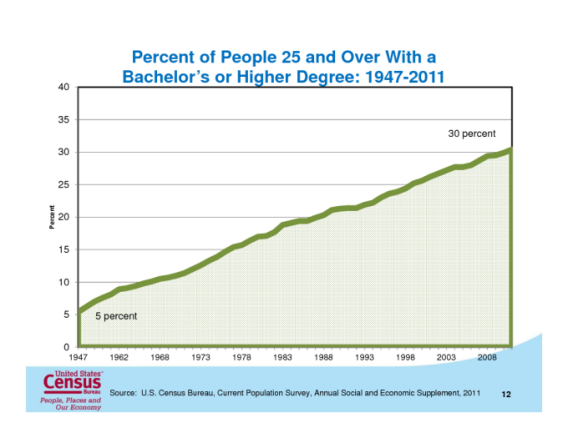
What’s wrong with this picture?
[click to continue…]
{ 169 comments }
For those who can be there:
Members of House, Senate Join Family and Friends of Aaron Swartz for Public Memorial Event at the Cannon House Office Building in Washington, DC
WASHINGTON, DC – On Monday, February 4th, family and friends of Aaron Swartz will join members of Congress at the Cannon House Office Building to honor and celebrate the life, work, and legacy of Aaron Swartz, the accomplished activist and technologist who took his own life on January 11. Aaron’s supporters will also discuss possible reforms and other steps that can be taken to honor his memory
WHAT: Public Memorial Event for Aaron Swartz in Washington, DC, free and open to all
WHO:
Aaron’s father Robert Swartz, his partner Taren Stinebrickner-Kauffman, his friends David Segal and Ben Wikler, and several members of Congress. Likely attendees include Sen. Al Franken (D-MN), Sen. Ron Wyden (D-OR), Rep. Darrell Issa (R-CA), Rep. David Ellison (D-MN), Rep. Alan Grayson (D-FL) and Rep. Jared Polis (D-CO), as well as others to be announced.
WHERE:
Cannon Office Building, Room TBA,
Independence Avenue SE. Washington, DC 20515
WHEN:
Monday, 4 February 2013. 7:00pm – 9:00pm EST
For details or to RSVP, please visit http://bit.ly/aaronswDC
For more information, or for interviews please contact Trevor FitzGibbon at 202-406-0646 or by email at trevor@fitzgibbonmedia.com.
# # # # #
Remembrances of Aaron, as well as donations in his memory, can be submitted at http://rememberaaronsw.com.
{ 1 comment }