My understanding is that organizers are hoping for 100,000 at the State Capitol tomorrow. There is also word of counter-demonstrations, which should be fun. So if you’re within a reasonable distance of Madison and can come, you’re welcome. Bring your friends.
It’s a bit of a surprise to suddenly be in the midst of the biggest protests I’ve seen in my 25 years in the US. Wisconsin old-timers are saying they’ve never seen anything like it — not the Vietnam War protests, not even the earlier civil rights demonstrations in Wisconsin over housing. A sea of red surrounds the Capitol all day long, and the Capitol itself is chock full, tens of thousands of people chanting, joking, and occasionally bursting into loud applause which is entirely incomprehensible given that no-one can hear anything that speakers say.
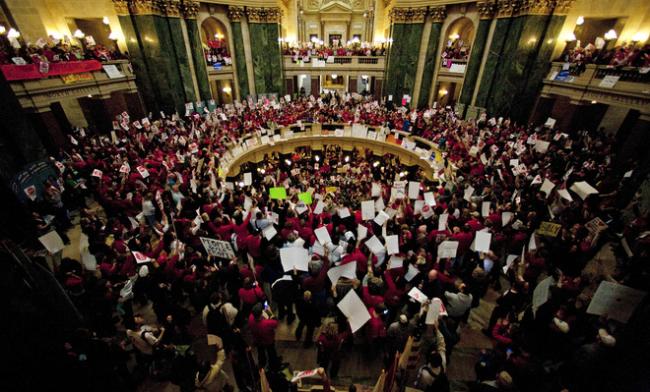
The best news-gathering source I’ve found is at GlobalHigherEd where my colleague Kris Olds is regularly updating the links, and has a lot of background information. But the short story is this: last Friday our new Governor, Scott Walker, proposed a budget repair bill which includes considerable reductions in benefits for public sector workers, the removal of collective bargaining rights over anything but pay for public sector workers, and a provision disallowing payroll deduction union dues and a requirement that workers be allowed to be union members without paying dues. With majorities in both houses he assumed he could pass the bill within the week — the plan was that he would be signing it tomorrow (I’m writing on Thursday). Last weekend it was not at all clear that the opposition would be strong, and it wasn’t really until Tuesday night, when the local teacher’s union announced a sick out for Wednesday (widely thought to be a tactical error, including, I understand, by some of the leadership) that things really got moving. The Republicans have a large majority in the Assembly, but a majority of just 5 in the Senate, so all the action is in the Senate vote. Wednesday was when it all started to happen. The estimates of 15-30,000 demonstrators are probably on the low side — at any given time there may be 15,000 at any given point in the day hundreds are walking toward the Capitol, while hundreds are marching away. Although the teachers have been in the forefront of this (many more districts were closed today), other unions have been fully involved, including the police and firefighters unions which are exempted from the bill’s provisions [CORRECTED]

Thursday’s demonstrations were larger than Wednesday’s, and tomorrow’s (Friday’s) will be bigger still. Contrary to the impression given by the national reports I have seen, hardly any of the protest or rhetoric concerns the cuts in benefits; almost the entire movement is about protecting collective bargaining rights.
{ 50 comments }
So, we are to have a referendum in the UK on the alternative vote system. Tempting though it might be, I suppose I shouldn’t decide my view on the basis of my desire to stick it to the vile Nick Clegg. The fact that AV (like the French two-ballot runoff system) requires MPs to secure (eventually) a majority in each constituency certainly has _prima facie_ attractions, and it is troubling that most MPs are now elected on a minority vote. (In 1951 and 1955 only 39 and 37 seats in the Commons were held without a majority, so things have changed.) So on the plus side, there’d be more work work for candidates to do in more constituencies in order to secure election. On the other hand, AV can get you dramatically non-proportional outcomes (worse, in fact than FPTP). This will be familiar to Australians from (for example) the 1977 elections where the Liberals managed a majority of seats with considerably fewer first preferences than Labour and where the coalition of which the Liberals were part got two-thirds of the seats (a landslide) with only a minority of the vote.
I’m culling these facts from Vernon Bogdanor’s 1984 book _What is Proportional Representation?_ Bogdanor (David Cameron’s tutor at at about that time, incidentally) believed the system would hurt the Tories on the grounds of the their geographical distribution. John Curtice, on the other hand, “thinks”::http://www.independent.co.uk/opinion/commentators/john-curtice-this-could-make-cameron-the-winner-from-electoral-reform-2124667.html that Labour would suffer. Any more reliable indications out there? Psephological guidance please.
{ 155 comments }
A recent report on a poll finding that a majority of Republicans (that is, likely primary voters) are “birthers”, with only 28 per cent confident that Obama was born in the United States has raised, not for the first time, the question “how can they think that?” and “do they really believe that?”.
Such questions are the domain of agnotology, the study of culturally-induced ignorance or doubt. Agnotology is not, primarily, the study of ignorance in the ordinary sense of the term. So, for example, someone who shares the beliefs of their community, unaware that those beliefs might be subject to challenge, might be ignorant as a result of their cultural situation, but they are not subject to culturally-induced ignorance in the agnotological sense.
But this kind of ignorance is not at issue in the case of birtherism. Even in communities where birtherism is universal (or at least where any dissent is kept quiet), it must be obvious that not everyone in the US thinks that the elected president was born outside the US and therefore ineligible for office.
Rather, birtherism is a shibboleth, that is, an affirmation that marks the speaker as a member of their community or tribe. (The original shibboleth was a password chosen by the Gileadites because their Ephraimite enemies could not say “Sh”.) Asserting a belief that would be too absurd to countenance for anyone outside a given tribal/ideological group makes for a good political shibboleth.
{ 138 comments }
Just listened to an interesting bloggingheads exchange between our Henry and Robert Farley on Egypt and zombie international relations.
Two responses: Robert Farley reads a WSJ piece on Egypt and suggests, in effect, that the effect of internet social networking might not be to allow for more connections between protesters – ‘just connect’, as the slogan might be – but to enable aggregate overwhelming of the security response; which, in the end, couldn’t be quite ‘dexterous’ to be in enough places, with enough force, at once. I have no idea whether this is right or not but, as a thesis, it deserves a name, which will obviously be ‘Denial of Service Attack’, DoS for short. Denial of Security Service, that is.
Then they are on to zombies, and Drezner’s book
{ 7 comments }
Stephen Walt writes a quite odd post on realism, liberalism and the future of the euro.
bq. Over the past few months, however, German Chancellor Angela Merkel and French President Nicolas Sarkozy have been negotiating a joint proposal for deepening economic coordination within the EU (and especially the eurozone) in an attempt to solve some of the problems that produced the crisis in the first place. … Not only does this question have obvious implications for politics and economics in Europe itself, but it also raises some fundamental questions about IR theory and might even be a revealing test of “realist” vs. “liberal” perspectives on international relations more generally. Realists, … have been bearish about the EU and the euro since the financial crisis, arguing that European member states were more likely to pursue their individual national interests and to begin to step back from some of the integrative measures that the EU had adopted in recent years. … By contrast, institutionalists, and EU-philes more generally, have suggested that the only way forward was to deepen political integration within Europe. … So what we have here is a nice test of two rival paradigms, and students of international politics should pay close attention to how this all plays out.
{ 11 comments }
Some observers have wondered why Ireland’s dramatic economic crash has not produced more visible anger. Where are the street riots, they ask. The Greeks, they say, do this sort of thing better, the Icelanders managed to rise up as one – what is wrong with us? The Irish banks are a vast financial black hole and taxpayers are looking at crushing liabilities stretching into the future. Unemployment is over 13%. For those in work, pay packets have shrunk yet again as new taxes and charges kick in. Many households carry huge debt. Emigration is making a return. The terms of the EU-IMF loan constrain the terms of economic debate: we are not a sovereign economic state. Yet everyday life looks like business as usual.
The election campaign is slightly surreal for this reason. Last night saw a US-style TV discussion involving the five main party leaders, all men and all wearing identikit business suits. The studio audience, picked by a PR company to represent undecided voters, was pained yet polite.
But these are surface impressions. Out there, as the parties well know, all the evidence indicates that the voters are merely biding their time, ‘waiting in the long grass’. This could be a realigning election, a shape-shifter for the Irish political system.
{ 36 comments }
We won’t know for some time yet whether we are living through a game-changing period in which a dominant economic paradigm is replaced by something else. We don’t yet know what the catchy label will be for it.
Yet some of our conventional notions about how states manage market expectations have already been upended in recent times. One of these concerns the politics of credible commitment, which doesn’t always work the way we think it should.
{ 5 comments }
I like it! The new Jim McCann authered/Janet Lee illustrated graphic … well, it’s too short to be a novel, Return of the Dapper Men
As the introduction by Tim “Project Runway” Gunn makes clear, it’s in a fairytale line that includes Alice, The Wizard of Oz, Pinnochio. I would add: Hans Christian Andersen, E.T.A. Hoffman. This bit from Andersen’s “The Ice Queen”, for example, in which Gerda is uselessly interrogating the solipsistic and surreal-minded flowers about where Kay might be: [click to continue…]
{ 26 comments }
Will Wilkinson has a post at The Economist, taking issue with Orrin Kerr, re: the Vinson decision.
Kerr:
The core problem, I think, is that Supreme Court doctrine has strayed far from the original meaning of the scope of federal power granted by the Constitution. Today’s constitutional doctrine permits a scope of federal power that is much broader than the original meaning of the Commerce Clause and Necessary and Proper clause would allow. When interpreting the scope of federal power, then, you need to decide what you will follow: The original meaning or case precedents. As I read Judge Vinson’s opinion, he mixes the two. Judge Vinson jumps back and forth between purporting to apply Supreme Court precedents and purporting to interpret the Commerce Clause and Necessary and Proper clause in light of its original meaning. Judge Vinson spends about half of the legal analysis on original meaning and about half of the legal analysis on precedent, and he seems to treat both as important.
Wilkinson:
I agree with Mr Kerr that the freshest, topmost layer of the body of constitutional interpretation built up over the ages by the myriad sages of the Supreme Court is at best tenuously connected with the meaning of the hallowed document ordinary Americans imagine to govern their republic. What I don’t understand is Mr Kerr’s objection to mixing respect for precedent and original meaning in rendering judgments about the “constitutionality” of legislation
This is a perfect illustration of what I was talking about in this post – and the rather invigorating thread that went with it. Originalism is incompatible with respect for precedent. Kerr is getting at this, but he isn’t as clear as he might be. If you just substitute ‘originalism’ in that first passage for ‘the original meaning’ it becomes clear. Wilkinson’s objection is met: obviously you can combine combine respect for original meaning with respect for precedent (that’s Will’s objection). But the philosophy that sees and advocates this practical possibility is the ‘living constitution’ view, nemesis of originalism. What you can’t do is combine originalism with respect for precedent, in coherent philosophical fashion. [click to continue…]
{ 142 comments }
I’m in Melbourne for the conference of the Australian Agricultural & Resource Economics Society (in fact, I’m currently President-elect of the Society[1]. There have been a couple of great papers on long-term food supply from Phil Pardey and Tom Hertel. So, this seems like a good idea to write down some thoughts about (what ought to be, at any rate) the central issue of agricultural economics – whether the global food system can produce enough food for the world and deliver it to those who need it.
{ 67 comments }
This is perhaps unsurprising, but nonetheless interesting.
bq. According to e-mails obtained by ThinkProgress, the Chamber hired the lobbying firm Hunton and Williams. Hunton And Williams’ attorney Richard Wyatt, who once represented Food Lion in its infamous lawsuit against ABC News, was hired by the Chamber in October of last year. To assist the Chamber, Wyatt and his associates, John Woods and Bob Quackenboss, solicited a set of private security firms — HB Gary Federal, Palantir, and Berico Technologies (collectively called Team Themis) — to develop tactics for damaging progressive groups and labor unions, in particular ThinkProgress, the labor coalition called Change to Win, the SEIU, US Chamber Watch, and StopTheChamber.com.
From the PDF
bq. US Chamber Watch is one of the most active members of the opposition to the US Chamber of Commerce (CoC). Unlike some groups, members of this organization are politically connected and well established, making the US Chamber Watch vulnerable to information operations that could embarrass the organization and those associated with it. … we need to discredit the organization through the following. … Paint US Chamber Watch as an operative of CtW and the unions … Craft a message to combat the messaging propaganda of US Chamber Watch. …Create a false document, perhaps highlighting periodical financial information, and monitor to see if US Chamber Watch acquires it. Afterward, present explicit evidence proving that such transactions never occurred. Also, create a fake insider persona and generate communications with CtW. Afterward, release the actual documents at a specified time and explain the activity as a CtW contrived operation. … Connect US Chamber Watch’s radical tactics to Velvet Revolution … If needed, create two fake insider personas, using one as leverage to discredit the other while confirming the legitimacy of the second.
The Chamber of Commerce denies that it ever saw the document, or directly or indirectly hired the firm in question (which seems in fact to have been a number of firms, including Palantir Technology, which has been getting a lot of hype in cybersecurity circles over the last couple of years). This may be true, but I’ll be quite interested to see whether there is sufficient legal basis for the targeted organizations to sue the companies in question, and perhaps expand the lawsuit to the US Chamber of Commerce and its agents. In particular, I would be interested to see what further pertinent email communications might be uncovered if the potential plaintiffs manage to get discovery. There are perhaps some parallels to Dow and Sasol’s corporate spying efforts against Greenpeace, where we may see some quite interesting materials indeed emerge as the case wends its way through the courts.
Update: also see Glenn Greenwald, who was targeted by the same people.
{ 37 comments }
Am too busy writing a paper to blog, but if I were blogging, I’d be writing about …
(1) My happy discovery that George Scialabba’s website has an Atom feed, which is mentioned nowhere on the page, but which allows you to keep up with new Scialabba As It Arrives. Apparently, his website has been speaking xml all its life without knowing it …
(2) My review of Evgeny Morozov’s “The Net Delusion”:ttp://www.amazon.com/gp/product/1586488740?ie=UTF8&tag=henryfarrell-20&linkCode=as2&camp=1789&creative=390957&creativeASIN=1586488740 (short version: when it’s good, it’s very, very good. And when it’s bad, it’s horrid). [UPDATE: Cosma Shalizi emails to tell me that one of my criticisms of Morozov – viz. that it is impossible to later disentangle individual voices from the roaring of a crowd – is in fact wrong).
(3) The Reformcard effort to grade Irish political parties’ commitment to reform, whenever they get around to issuing manifestos. I will say that I am a little sceptical about the term ‘reform,’ which is frequently employed as a more or less direct euphemism for ‘cuts and marketization’ – I’ll be interested to see how it’s measured in practice.1 While Ireland could surely do with reform, it is likely to suffer far more ‘reform’ than could possibly be beneficial, regardless of who gets elected. Update 2: commentators tell me that the reforms that the site will emphasize are purely institutional ones.
(4) Scott McLemee’s thoughts on international politics and zombies. As xkcd pointed out recently, we’re all a little overexposed to zombies and other Internet trochees. So here’s a bit from Francis Spufford’s _Red Plenty_ (coming out in the US in a few months!) that freshens up (if that’s the right word) the metaphor nicely.
bq. But Marx had drawn a nightmare picture of what happened to human life under capitalism, when everything was produced only in order to be exchanged; when true qualities and uses dropped away, and the human power of making and doing itself became only an object to be traded. Then the makers and the things made turned alike into commodities, and the motion of society turned into a kind of zombie dance, a grim cavorting whirl in which objects and people blurred together till the objects were half alive and the people were half dead. Stock-market prices acted back upon the world as if they were independent powers, requiring factories to be opened or closed, real human beings to work or rest, hurry or dawdle; and they, having given the transfusion that made the stock prices come alive, felt their flesh go cold and impersonal on them, mere mechanisms for chunking out the man-hours. Living money and dying humans, metal as tender as skin and skin as hard as metal, taking hands, and dancing round, and round, and round, with no way ever of stopping; the quickened and the deadened, whirling on. That was Marx’s description, anyway. And what would be the alternative? The consciously arranged alternative? A dance of another nature, Emil presumed. A dance to the music of use, where every step fulfilled some real need, did some tangible good, and no matter how fast the dancers spun, they moved easily, because they moved to a human measure, intelligible to all, chosen by all.
1Far worse though, is ‘painful reform,’ which is invariably used as a term of approbation by those expecting to suffer _no pain whatsoever_ (and quite possibly anticipating substantial profits or consultancy fees) from the ‘reforms’ being tabled.
{ 12 comments }

A useful bit of interactive data visualization for Emmanuel Saez’s time-series on historical trends in income growth and distribution in the United States. As you can see, between 1970 and 2008 people in the bottom 90 percent of the income distribution typically chose not to partake of annual increases in total income, presumably because of a tendency to prefer and thus self-select into lower-paying jobs, or possibly because of an innate dislike for the more complex mathematics (surrounding tax calculations, car payments, and budgeting generally) that is associated with earning more money.
{ 51 comments }
Another film post: in teaching ‘philo and film’, I’m focusing mostly on sf, but branching into speculation in a more metaphysical sense, and spectacle in a more purely visual sense. One slightly oddball pick I’ve made is the Reinhardt/Dieterle A Midsummer Night’s Dream
It was released on DVD for the first time last year and I really cannot recommend it highly enough for sheer entertainment value, and several other values as well. It’s not exactly a forgotten film, but this late arrival on the DVD scene is a symptom of some slippage between the cracks. Yet it’s got a great, big name cast. James Cagney as Bottom, the Weaver: [click to continue…]
{ 16 comments }