by Ingrid Robeyns on April 26, 2010
A Belgian Bishop, “Roger Vangheluwe”:http://nl.wikipedia.org/wiki/Roger_Vangheluwe, has resigned last Friday. He admitted that in the 1970s and 80s he has, for many years, sexually abused a young male family member (a nephew, it seems). According to the newspaper reports, last Monday a family member of the victim wrote an e-mail to all Belgian Bishops informing them about the abuse, which caused Vangheluwe to “publicly confess”:http://www.kerknet.be/admin/files/assets/documenten/Teksten.pdf and to resign.
“According”:http://www.standaard.be/artikel/detail.aspx?artikelid=IP2PDM7C&_section=60732860&utm_source=standaard&utm_medium=newsletter&utm_campaign=krantenkoppen “to”:http://www.demorgen.be/dm/nl/989/Binnenland/article/detail/1097762/2010/04/26/Tientallen-klachten-misbruik-kerk-sinds-vrijdag.dhtml Peter Adriaenssens, a professor in pediatric psychiatry, who is heading a Commission that is investigating the accusations of sexual abuse in the Belgian Catholic Church, this case has triggered about 40 complaints to the Commission of other cases of sexual abuse in the Church since Friday evening. In the last two years there had been about twenty complaints.
Wondering what more will emerge. In Belgium a very large percentage of the population (officially more than 90%) is Catholic; but as I know from personal experience, this need not mean anything. In many cases it is social conformity, or (in the past, at least) primarily an admission ticket to a good school. Any Belgian who thinks this is a good moment to officially quit the Church, can find instructions on how to do so “here”:http://unievrijzinnigeverenigingen.be/nl/Faq/WatBetekentKerkuittreding.html.
by Maria on April 25, 2010
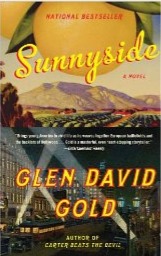 Just before Christmas, I wrote a piece discreetly titled “Sunnyside: Best Book of the Year“. I was surprised that one of the most inventive, funny and profound books I’ve ever read hadn’t made it onto the seasonal glut of ‘Best of 2009’ books. That post elicited an email from no less than Glen David Gold himself. And always with you, gentle reader, in mind, I asked Glen if he’d be willing to take part in a CT book event. He said he would.
So here we are, with (northern hemisphere) summer right around the corner and the paperback of Sunnyside due out in the US any minute. In a couple of weeks, I’ll be posting on CT a set of essays about Sunnyside. Some great writers are going to take part. We’ll have Stuart Evers, a writer many of you will know and love from the Guardian’s book review pages; New York comics guy Adam McGovern, the man behind Pood; deadlines permitting, Robert Hanks, who reviews films books and pretty much anything, often for the Independent; and of course Glen himself with an essay in response to all of ours, and plenty of badgering about in the comments.
Consider this a heads up to read that lovely hardback or rush out and buy a copy before the event kicks off. Sunnyside is a terrific read; fantastic fun, tugger of heartstrings, prompter of head-scratching thoughts on the meaning of life. You won’t regret it.
by John Q on April 25, 2010
We’ve had a fair bit of fun here lately, pointing out the silliness of those who are supposed to be the intellectual leaders of the right, in its libertarian, neoconservative and Republican tribalist versions. But, as quite a few commenters have pointed out (one using the same, maybe Oz-specific, phrase that occurred to me) the exercise does seem to savor a bit of flogging dead horses.
It seems to me necessary to go beyond this, which was one reason for my post on hope the other day. To make progress, we need to reassess where we stand and then think about where to go next. This is bound to be something of a confused and confusing process. Over the fold, I’ve made some (quite a few) observations, making for a very long post, which is mainly meant to open things up for discussion.
[click to continue…]
by Harry on April 24, 2010
Well?
Listening to the BBC and reading the papers I get no sense of the level of panic that it seems to me that the two major parties ought, it seems to me, to be feeling, nor of whether the pollsters have any idea how to model the sudden change in the LibDem popularity. (Fiddling with the BBC site indicates that the LibDems wouldn’t get many more seats even with 30% of the vote — I find it hard to believe that the designers have really thought out their assumptions beyond a 25% or so showing, which itself would be historic). 6 days in, the poll bump seems not to be going away. I’ve no idea whether the polled support for the LibDems will translate into actual votes or gain them more. Is the apparent absence of panic premised on a good understanding that this is all fake? Or is it just impressive acting?
More or less open thread.
by Henry Farrell on April 22, 2010
The calendar has once again rolled around to the date on which we commemorate Charles Krauthammer’s “pronouncement”:http://www.aei.org/events/filter.,eventID.274/transcript.asp that:
Hans Blix had five months to find weapons. He found nothing. We’ve had five weeks. Come back to me in five months. If we haven’t found any, we will have a credibility problem.
You’ve had seven years now, Charlie. How’s it looking? Hoping for a result sometime in year eight?
by Kieran Healy on April 21, 2010
The other week I wrote about a report that a philosopher accepted to an NEH Summer Institute overseas “been given 12 hours to ‘demonstrate’ that she has full-time childcare arrangements for her son for the month of July that ‘are to the [completely unspecified] satisfaction’ of the Institute directors; if she fails to meet this requirement, she has been told her accceptance in the program will be withdrawn.” At the time, it seemed clear that there was no way an NEH-funded operation should be doing this and that, while there was some slim possibility of an explanation that made the whole episode seem reasonable, the Institute director or directors were very much more likely to be completely out of line in making such a demand. Well, guess what?
The National Endowment for the Humanities has apologized to a grant recipient who was told by the director of an NEH-financed seminar in Europe that she had 12 hours to demonstrate that she had adequate child care arrangements in place for her son or she would lose her spot. … An NEH spokeswoman, via e-mail, said Tuesday that the investigation by the endowment determined that the report “was, unfortunately, true. NEH has accepted full responsibility and apologized to the professor involved. We believe we are in the process of resolving the issue to her satisfaction. We have assured her that she is welcome to attend the institute to which she applied and, at her request, we have also extended the deadline to make it possible for her to apply for another seminar if she so chooses.” The spokeswoman added: “Asking an applicant to provide information regarding child care was inappropriate and should have had no bearing on the selection process. Qualified applicants who tell the NEH that they will participate full time in our programs should be taken at their word. We erred and are determined that it will not happen again.”
Good.
by John Holbo on April 21, 2010
[UPDATE: One of the CAP authors, John Halpin, showed up in comments to complain – very reasonably – that I linked to the wrong part of their three part series, and failed to make clear it was part of a series. (I copied it from Goldberg, in composing the post! Why would I assume that anything he does is right?) Anyway, here is Halprin’s response to my post, with links. Halprin also argues that he and his co-author handled some of the stuff I wanted included in part 3. I admit that I had only read parts 1 & 2 before writing the post – I though part 3 was still forthcoming – but it doesn’t seem to me that the material from part 3 he quotes is quite forceful or extensive enough to do the job, even given that it must be done briefly.]
Jonah Goldberg links, approvingly, to a Damon Root post at Reason, complaining about a new Center For American Progress paper entitled “The Progressive Intellectual Tradition In America” (PDF). Root’s complaint is fair, but only up to a point. Here’s the fair bit: the CAP paper is a feel-good affair. Nothing about uglier aspects or excesses of American Progressivism: specifically, racism and sexism, hence eugenics. (And imperialism, but let’s just stick with eugenics for this post.) Of course the obvious objection to that is that there was nothing distinctively Progressive about racism and sexism. It’s just that we are talking about the late 19th/early 20th Centuries here. Still, if you combine eugenics – even if it’s only average for the era – with political philosophy and policy you sure can get bad results. There’s no reason whatsoever to paste this ugly history on every single contemporary formulation of progressive political philosophy. If Barack Obama is giving a stump speech, and he delivers some applause line about progressive ideals, there is no reason for him to pause and add a pedantic footnote about eugenics and how some Progressives, and some people some Progressives admired as scientific authorities, believed ugly stuff a hundred years ago. But if you are writing a history, the presumption is that you want people to learn from history, and some of the major lessons of the Progressive Era are cautionary ones, philosophically and in terms of policy. I doubt the authors of these papers would deny this, so including a ‘cautionary lessons’ subsection would have been a better scheme. (If I had to guess, they’re thinking tactically. ‘If we mention this stuff, being careful to get all the necessary nuance in, someone like Jonah Goldberg will find it and quote it, carving out the nuance, and it will sound like even CAP admits that Progressivism = Eugenics.’ Still, if you are damned if you do, damned if you don’t, you should do the right thing and be damned.)
Now we get to the unfair bit. Root and Goldberg seem to think that if you are advocating progressivism today – rather than writing history – there is some vital need to self-lacerate, early and often, over the whole eugenics-a-hundred-years-ago business. The Goldberg rule seems to be this: if some Progressive believed in eugenics – or if some really major, central figure of the Progressive movement admired someone who was a major proponent of eugenics – then Progressives have to “own up” to this. Goldberg (from the post linked above): [click to continue…]
by John Q on April 19, 2010
One reason that many on the left of politics preferred Obama to Hillary Clinton is that his rhetoric, at his best, promised something more than incremental reform, a promise summed up by slogans like “Change we can believe in” and “Yes we can”.
Given the political realities of the US, and the obvious fact that Obama is instinctively a pragmatist and centrist, it was never likely that this would translate into radical policy action in the short run. Still, it seemed at least possible that an Obama presidency would begin a renewal of a progressive project of transformation, setting out the goal of a better world. One respect in which this hope has been fulfilled, for me, is in Obama’s articulation of the goal of a world without nuclear weapons, and in the small but positive steps he’s taken in this direction.
I plan to talk about the specific issue of nuclear disarmament in more detail in a later post. The bigger point for me is that after decades in which the left has been on the defensive, it’s time for a politics of hope. We need hope to mobilise a positive alternative to the fear, anger and tribalism on offer from the right. Centrist pragmatism provides nothing to match the enthusiasm that can be driven by fear and anger, as we have seen.
What the politics of hope means, to me, is the need to start setting out goals that are far more ambitious than the incremental changes debated in day-to-day electoral politics. They ought to be feasible in the sense that they are technically achievable and don’t require radical changes in existing social structures, even if they may set the scene for such changes in the future. On the other hand, they ought not to be constrained by consideration of what is electorally saleable right now.
Over the fold, I’ve set out some thoughts I have for goals of this kind. At this stage, I’m not looking for debate on the specifics of these goals or the feasibility of achieving them (again, more on this later). Rather, I’d welcome both discussion of the general issue of what kind of politics the left needs to be pursuing, and suggestions of other goals we ought to be pursuing
[click to continue…]
by Henry Farrell on April 19, 2010
Greg Mankiw suggests that “he has identified the Anti-Mankiw Movement”:http://gregmankiw.blogspot.com/2010/04/anti-mankiw-movement.html. Apparently, it consists of a graduate student who doesn’t like his textbook very much. On the same expansive definition of social movement, I would like to formally announce that I am re-constituting myself as the Pro-Mankiw Movement. Our (or, rather, my) slogan: Let Mankiw Unleash His Inner Mankiw. In particular, “building on previous suggestions”:https://crookedtimber.org/2008/03/04/principles-and-practices-of-economics/ I would like to advocate in the strongest possible terms that Mankiw rewrite his popular textbook so that the relevant sections cover the intriguing case of N. Gregory Mankiw’s domination of the Harvard introductory economics textbooks market.
Since N. Gregory Mankiw returned to Harvard to teach the College’s introductory economics class, 2,278 students have filled his weekly lectures, many picking up the former Bush advisor’s best-selling textbook, “Principle of Economics” along the way. So, what has professor of economics Mankiw done with those profits? “I don’t talk about personal finances,” Mankiw said, adding that he has never considered giving the proceeds to charity. … Retailing for $175 on Amazon.com … Mankiw asserts that “Principles of Economics” has been the bible of Harvard economics concentrators since before he took over “Economics 10.”
Now this couldn’t possibly be an example of a public spirited regulator wisely choosing the best possible product on the market, and imposing it on his regulatees for their own good. As the N. Gregory Mankiws of this world know, such benign autocrats only exist in the imaginations of fevered left-wingers. So it _must_ be a story of monopolistic rent-seeking and regulatory collusion. And what could be more fitting than that these monopolistic abuses be documented in the very textbook that is their instrument!
I’ve suggested before that if I were N. Gregory Mankiw:
I’d claim that I was teaching my students a valuable practical lesson in economics, by illustrating how regulatory power (the power to assign mandatory textbooks for a required credit class, and to smother secondary markets by frequently printing and requiring new editions) can lead to rent-seeking and the creation of effective monopolies. Indeed, I would use graphs and basic math in both book and classroom to illustrate this, so that students would be left in no doubt whatsoever about what was happening. This would really bring the arguments of public choice home to them in a forceful and direct way, teaching them a lesson that they would remember for a very long time.
But this, in retrospect, seems far too lily-livered approach for the true Mankiw. Why not instead use the class as an experimental setting to see how far the price for the book can be jacked up before profits begin to decline? That would give Harvard econ 10 students a practical grounding in economic theory that they could genuinely claim as unique.
by Henry Farrell on April 19, 2010
This “post”:http://unlikelyworlds.blogspot.com/2010/04/above-us-only-sky.html by Paul McAuley expresses something that I’ve been groping to articulate to myself.
We live, some believe, in the anthropocene age, an era in which human beings have massively altered global ecosystems, and which may have begun with the invention of agriculture, but certainly accelerated during the industrial revolution of the nineteenth century, and the oil-based economy of the twentieth and early twenty-first. But Earth’s climate and geography, and human history, has also been shaped by more powerful processes. Volcanic activity has been implicated in the Permian-Triassic extinction event 250 million years ago, which wiped out more than 90% of marine species, and 70% of vetebrate animal species on land. The Toba supereruption between 69000 and 77000 years ago created a decade of global winter that could have caused the reduction in human numbers and the bottleneck in human evolution that marks our genomes to this day. Ashes and sulphur compounds injected into the stratosphere by volcanic activity is believed to have contributed to global cooling during the Little Ice Age between the 16th and mid 19th century, and the eruption of Mount Tambora in 1815 caused the Year Without Summer, ruining crops around the world and causing hundreds of thousands of deaths (and creating spectacular sunsets documented in paintings by Turner).
Eyjafjallajökull may have created all kinds of disruption to travellers, but compared to supervulcanism of the past, or to what might happen if the volcanic dome under Yellowstone Park lets go, it’s a mere blip. An inconvenience rather than a catastrophe. A useful reminder that the nemesis which may clobber us won’t necessarily be the product of our own hubris. Meanwhile, I’m off to enjoy a spot of peace and quiet while I can.
[click to continue…]
by Chris Bertram on April 18, 2010
That’s enough on libertarianism … now for something completely different.

I’ve taken up photography quite seriously over the past three years or so: a welcome distraction from other aspects of life, a source of great satisfaction when I get something right, and the occasion of new friendships (both off and on line). In one sense, photography in the digital age is easy, and it wasn’t hard for me to get to a level where I was producing pictures that I was very pleased with. But it some ways it is too easy, because you skip a proper understanding of why things are the way they are, because each additional picture is costless you can just shoot away and not worry as much as you should about technique and composition. So I’ve been shooting film more and more, and thereby discovering some things about the art and about myself.
[click to continue…]
by John Holbo on April 15, 2010
OK, I’m going to try to raise the philosophical tone of this whole libertarian thing. It’s the least I can do. Snarking is a base motive, after all.
Jacob Levy has earnestly maintained in comments that it is unfair to judge libertarianism by the standard of Bryan Caplan‘s attempts to turn the Gilded Age into a Golden Age of ladyfreedom, and I would just like to say that, in a sense, Jacob is perfectly correct. Let me make this first point briefly (because lord knows this post is going to be long enough). Sometimes people distinguish ‘thin’ and ‘thick’. ‘Thin’ is the kind of ‘propertarian’ libertarian that Caplan can’t be because the whole inability to make contracts/own your own property thing is a straight-up deal-breaker. ‘Thick’ is the kind of libertarian Caplan can’t be because of all the Mill stuff in my previous post: can’t let society play the tyrant. It’s perfectly reasonable for Jacob to maintain that if you are going to pillory libertarianism, in a theoretical sense, you should pick one or the other of these two sorts – or both. But Caplan is neither, in his arguments about women’s freedom under coverture. What is Caplan really? I dunno. I suppose he’s a momentarily strayed ‘propertarian’, although I’m happy for him to speak for himself on this point.
But Brad DeLong and others fire back that it’s reasonable to hold libertarianism to account for the bad company that keeps it. Well, I dunno. I agree that it calls for diagnosis, but you still want to keep the theoretical point separate. Maybe that will even help with the diagnosis. [click to continue…]
by Chris Bertram on April 14, 2010
Surfing around, listening to Neil Young, and thinking that, perhaps, someone should buy Bryan Caplan some Edith Wharton novels (or, failing that, Terence Davies’s film of The House of Mirth), when I came across J.K. Rowling’s “magnificent piece in today’s Times”:http://www.timesonline.co.uk/tol/comment/columnists/guest_contributors/article7096786.ece about what it was like as an impoverished single mother under the last Tory government, how her life changed when she became one of the richest women in Britain, her attitudes not so much:
bq. I chose to remain a domiciled taxpayer for a couple of reasons. The main one was that I wanted my children to grow up where I grew up, to have proper roots in a culture as old and magnificent as Britain’s; to be citizens, with everything that implies, of a real country, not free-floating ex-pats, living in the limbo of some tax haven and associating only with the children of similarly greedy tax exiles.
bq. A second reason, however, was that I am indebted to the British welfare state; the very one that Mr Cameron would like to replace with charity handouts. When my life hit rock bottom, that safety net, threadbare though it had become under John Major’s Government, was there to break the fall. I cannot help feeling, therefore, that it would have been contemptible to scarper for the West Indies at the first sniff of a seven-figure royalty cheque. This, if you like, is my notion of patriotism. On the available evidence, I suspect that it is Lord Ashcroft’s idea of being a mug
by Michael Bérubé on April 13, 2010
I’m not sure why Holbo thinks he should have all the fun when it comes to libertarians and history. Here’s <a href=”http://www.theatlantic.com/politics/archive/2010/04/whats-the-matter-with-fox-news/38736/”>Megan McArdle</a>, earlier today:
<blockquote>Conservatives are, not to overlabor the obvious, marginalized in the cultural elite, even though they are powerful in the political elite. (At least some of the time, anyway). Obviously there’s been an enormous amount of ink shed about why this is, but my experience of talking to people who might have liked to go to grad school or work in Hollywood, but went and did something else instead, is that it is simply hogwash when liberals earnestly assure me that the disparity exists mostly because conservatives are different, and maybe dumber. People didn’t try because they sensed that it would be both socially isolating, and professionally dangerous, to be a conservative in institutions as overwhelmingly liberal as academia and media.</blockquote>
It is indeed hard to be a conservative in American media. One is always wondering, <i>what if I get something wrong? About something important, like maybe a health care debate or a war? Will I lose my job and be subject to public ridicule for the rest of my life?</i> And then there’s the question of what kind of plane to buy, which country club to join, whether to vacation in the Caribbean, central America, or the south of France. It can be terribly socially isolating.
But that’s not why I stopped by today. Here’s why:
[click to continue…]
by Harry on April 13, 2010
I’ve mentioned our First Year Interest Group program at Madison before. (More here). It is well-designed, and we now have a good deal of data indicating that participation in it decreases the likelihood of students dropping out, and improves their academic performance. The participants are, on average, less well prepared than the average freshman and, on average, do better in terms of GPA, time-to-completion, not dropping out, etc.
So what next? The university is committing resources to increase pretty dramatically the numbers of FIGs being offered (doubling the number of students involved over the next two years). And some of the involved faculty are interested in starting up a bi-weekly discussion during the Fall semester, to discuss instruction. As Derek Bok points out, whereas faculty members in research universities solicit, and if they are lucky get, lots of diverse and hard-to-ignore feedback on their research which they can use to improve it, they spend very little time engaged in a community of teachers trying to learn how to improve their teaching. The aim is to establish a place where we can begin to improve our teaching in the ways we try to improve our research.
I, perhaps rashly, volunteered to lead the group (well, it was my idea, so I didn’t have much choice – my task is to come up with things to read and do over the semester, and get people to do them). So, I need ideas of things to do. This is a group of people who have very little in common – very different disciplines and different schools across the university – what we have in common is just that we are teaching one course with just 20 freshmen in it. I’m quite inclined to start out with some general reading about the university and what our aims should be for students (I find that everyone who reads Our Underachieving Colleges (review still pending…) is glad they did so, but there’s also a terrific essay by Susan Engel (thanks Sabina’s Hat) in College Success: What It Means and How to Make It Happen on what makes for good college teaching) but I want to get onto more concrete exercises pretty soon. One suggestion (from Susan Engel, whom I just emailed on the basis of her essay) was setting up sessions so that we actually teach one another things (not necessarily something we are teaching the students, but how to bake a cake, or something like that) and discuss how we do it. I’d really welcome more suggestions of reading and activities, either from people who have done this sort of thing before and know what has worked (and what hasn’t) or from people just think they have something useful to add. Please don’t feel inhibited from making suggestions because you are not a faculty member – I am roughly 100% confident that we have things to learn from other professions and non-professions (one of the most useful discussions I’ve had about teaching was with a U.S. Marine who spent several years leading a unit teaching fighter pilots).