I like to think that I know a little bit about contrarianism. So I’m disturbed to see that people who are making roughly infinity more money than me out of the practice aren’t sticking to the unwritten rules of the game.
[click to continue…]
{ 79 comments }
“From Hansard”:http://www.publications.parliament.uk/pa/cm200809/cmhansrd/cm091020/debtext/91020-0006.htm , in the context of the impending UK postal strike:
bq. Mr. Peter Atkinson (Hexham) (Con): Does the Minister have any idea how many postal workers, particularly in London, have second jobs? It is the threat— [ Interruption. ] It is the threat that they might have to work a full shift for which they are paid that is adding to the militancy. [ Interruption. ]
Second jobs? Leaving work without working a full shift? I can well see that British MPs would be outraged by such practices. Here’s to the success of Billy Hayes and the CWU!
{ 53 comments }
Another section from my book-in-progress. The book-so-far can be viewed here.
[click to continue…]
{ 19 comments }
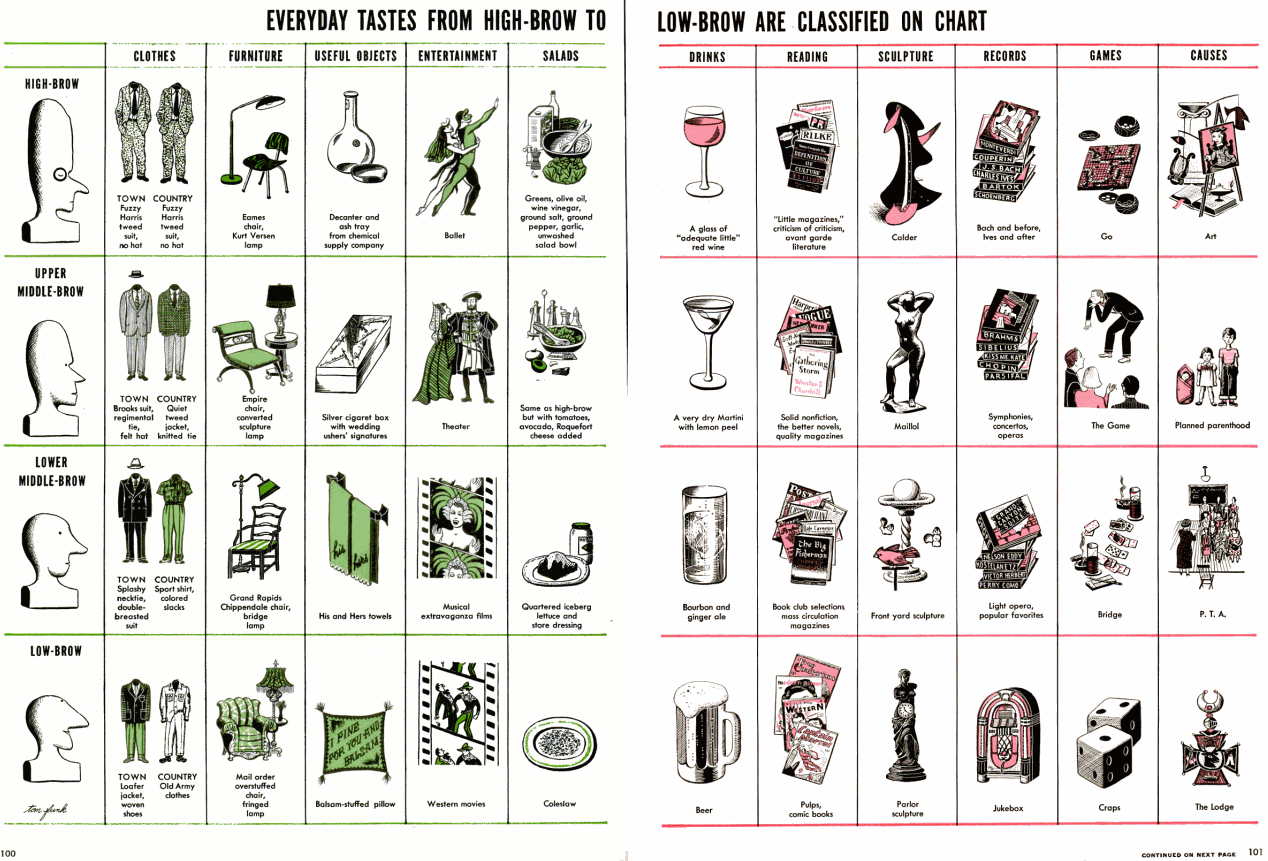
I have a coincidence to report. This morning, right before Kieran’s post went up, I was scanning (see this post, concerning my new hobby) selections from Russell Lynes’ classic essay “Highbrow, Lowbrow, Middlebrow”, the inspiration for the Life chart on brows. Here is how Lynes tells the story in a (1979) afterword to his book, The Tastemakers: The Shaping of American Popular Taste
{ 145 comments }
From a 1949 issue of Life Magazine, your guide to the “three basic categories of a new U.S. social structure — and the high brows have the whip hand”. With the rise of the cultural omnivore still well off in the distance, this is your must-have guide for the vagaries of mainstream culture in postwar America. Click for a larger version.
{ 95 comments }
It’s good if people ask for advice, but it’s not ideal if they ask for it too late. For example, when students ask me the year they are going on the job market how they should start thinking about the process, my first reaction (although I don’t say it since there is no point in stressing out the person at that stage) is that they should have started preparing years ago. Similarly, the year one is going up for tenure is not the right time to start wondering who could be on one’s list of tenure letter writers. Yet all too often this is precisely what happens, people don’t realize that some preparation over the years would have been extremely valuable if not crucial when approaching such important milestones in one’s academic career.
To help academics think about some of these matters, I have started a career advice column called Ph.Do over at Inside Higher Ed. In the first piece, More than Merit, I explain the reasons for the column. In the second, The Conference Scene, I discuss how to think about when and which conferences to attend. In the third, Conference Do’s and Don’t’s, I talk about how to maximize going to meetings without derailing one’s career. Any guesses as to which friend I refer to regarding the advice about dinners?
Future pieces will cover lots of topics ranging from collaborative work to making oneself marketable in several disciplines, applying for awards and fellowships and more. I welcome suggestions for what to address in upcoming pieces. Some of the ideas I have for future writing is already very much inspired by conversations we’ve had here on CT in the past.
I don’t think IHE has RSS feeds for specific columns, but for Twitter users, I’ve set up an account here and I’m also keeping this page updated with links although I haven’t set up a feed for it yet.
{ 111 comments }
My still-in-progress book (outline here) will have a chapter on privatisation. That reminded me of some thoughts on school privatisation and for-profit education that I thought might be of interest here. The near-total failure of the for-profit education ventures that proliferated in the 1990s is striking and to some extent mysterious. In part, I suspect that the whole enterprise (at least as regards school education) was based on a misdiagnosis of the problems of the public school system, focusing on organizational factors, rather than the more intractable effects of steadily growing inequality. The limited success of the charter schools movement would point in that direction. But I argue below (from a piece I wrote for Campus Review in Australia a couple of years ago) that there are more fundamental problems with the for-profit approach. Your thoughts appreciated.
{ 48 comments }
“Via Mark Thoma”:http://economistsview.typepad.com/economistsview/2009/10/the-pundits-dilemma.html, Mark Liberman presents us with “The Pundit’s Dilemma”:http://languagelog.ldc.upenn.edu/nll/?p=1824.
Overall, the promotion of interesting stories in preference to accurate ones is always in the immediate economic self-interest of the promoter. It’s interesting stories, not accurate ones, that pump up ratings for Beck and Limbaugh. But it’s also interesting stories that bring readers to The Huffington Post and to Maureen Dowd’s column, and it’s interesting stories that sell copies of Freakonomics and Super Freakonomics. In this respect, Levitt and Dubner are exactly like Beck and Limbaugh.
We might call this the Pundit’s Dilemma — a game, like the Prisoner’s Dilemma, in which the player’s best move always seems to be to take the low road, and in which the aggregate welfare of the community always seems fated to fall. And this isn’t just a game for pundits. Scientists face similar choices every day, in deciding whether to over-sell their results, or for that matter to manufacture results for optimal appeal.
In the end, scientists usually over-interpret only a little, and rarely cheat, because the penalties for being caught are extreme. As a result, in an iterated version of the game, it’s generally better to play it fairly straight. Pundits (and regular journalists) also play an iterated version of this game — but empirical observation suggests that the penalties for many forms of bad behavior are too small and uncertain to have much effect. Certainly, the reputational effects of mere sensationalism and exaggeration seem to be negligible.
(to avoid falling into my own version of this dilemma, I should acknowledge straight up that while I’m disappointed with the Freakonomics phenomenon _ex-post_, I was quite optimistic _ex-ante_ )
{ 28 comments }
I missed out on the book title contest a while back, so here’s my entry. As regards earnestness, i’m riffing off Andrew Gelman, via Kieran, who observes “”pissing off conservatives” is boring and earnest?”
The main point, though, is that the fuss over the global cooling chapter in Levitt and Dubner’s new book is the first occasion, I think, where the refutation of specific errors has taken a back seat (partly because, in this case, it’s so easy) to an attack on contrarianism, as such. The general point is that contrarianism is a cheap way of allowing ideological hacks to think of themselves as fearless, independent thinkers, while never challenging (in fact reinforcing) the status quo. Here’s Krugman and Joe Romm, for example
{ 67 comments }
Andrew Gelman discusses Superfreakonomics saying,
The interesting question to me is why is it that “pissing off liberals” is
delightfully transgressive and oh-so-fun, whereas “pissing off conservatives” is boring and earnest?
Several years ago bumper stickers appeared that read “Annoy a Liberal. Work hard. Succeed. Be happy.” I was living in Arizona at the time, so they became a routine part of my commute. Possessing neither the blunt empirical thesis of “Guns Bought Your Freedom” nor the slow fuse of “Body Piercing Saved My Life”, the barefaced cheek of the non sequitur made the sticker absurd and irritating at the same time. I remember wondering what a parallel message to conservatives would look like. Sure enough, attempts at rebuttal soon started appearing on (other) bumpers. They were lame — stuff like “Annoy a Conservative. Think for yourself. Defend the Constitution. Balance the Budget.” Noble sentiments, but watery stuff by comparison.
Why did they seem so ineffective a response? Perhaps stronger material was needed. Might “Annoy a Conservative. Burn the Flag. Convert to Islam. Have an Abortion” work better? No. While that kind of thing can have some punch (“Jesus Loves You, But Everyone Else Thinks You’re An Asshole”), it doesn’t seem like the right tack. Instead, the best riposte to the “Annoy a Liberal” sticker is simply the same thing with the target swapped out: “Annoy a Conservative: Work. Succeed. Be Happy”. The effect is more or less the same as the original, especially if placed on the back of your Lesbaru. Temporarily suspending my longstanding irritation at divisions of this sort, much of what passes for “Pissing off Conservatives” is really an effort to rebut some ridiculous charge or other, instead of a genuinely symmetrical attempt to piss someone off. Or, as the story has Lyndon Johnson arguing, it’s better to kick off the conversation in a way that forces the other guy to deny that he’s a pig-fucker.
{ 86 comments }
Amazon is giving away a whole Philip Glass album: The Orange Mountain Music Vol.I
{ 37 comments }
From the NYT on the remarkable profitability of Goldman Sachs
A big reason for Goldman Sachs’s blowout profits this year has been the willingness of its traders to take big risks — they have put more money on the line while other banks that suffered last year have reined in such moves. Executives say there are big strategic gaps opening up between banks on Wall Street that are taking on more risks, and those that are treading a safer path.
Hmm. I’d be willing to take big risks if I knew the Fed and the US Treasury were standing by, ready to pick up all my losing bets. In the circumstances, the guys at GS doubtless stand amazed at their own moderation in creaming off a mere $20 billion for the year.
{ 15 comments }
I got my hands on a pretty good old book, Cartoon Cavalcade (1943) – and if you got your hands on it too, you wouldn’t pay more’n a few dollars for the privilege, my friend. It’s an anthology of American cartoons from the 1880’s to the 1940’s: 450 pages worth, plus editorial matter from the early 40’s, providing a historically interesting perspective on all this history. Following up this much-commented post of mine, I’ll post a Reginald Marsh item from 1934: [click to continue…]
{ 6 comments }
Those of you working in higher education in the UK already know about the barbarous proposal to make future support for research depend on a government assessment of its “impact” – in other worlds whether there’s a tangible payoff in terms of economic growth or social policy. Whilst some people — “Wordsworth Country!” — will no doubt be able to spin the positive effects of their works for tourism, and those designing surface-to-air missiles systems will be about to cite the probable benefits to UK exports, others are not so lucky. Medieval French poetry, the metaphysics of holes, set theory … forget it, basically. The comedian David Mitchell had a pretty good column recently on the whole miserable business.
My colleague James Ladyman has launched a petition on the No.10 website to tell Gordon Brown what we think of the idea. If you’re British, even if you don’t live in the UK any more, “pop over and sign it”:http://petitions.number10.gov.uk/REFandimpact/ .
{ 45 comments }
Just a brief note about one of my side projects, the Territory and Justice Network. Cara Nine (UC Cork) and I have been funded by the Arts and Humanities Research Council (UK) and the Irish Research Council for the Humanities and Social Sciences for this project. We’ve now had a couple of conferences. The first, in London back in February and now a little workshop in Novi Vinodolski, Croatia last week. We’ve now launched a blog for the project, which is my reason for posting here. Pay us a visit if you are interested in territory, justice, secession, migration and similar issues (especially from a political philosophy standpoint). And drop me a line if you’d like to become involved in the network in some way.
{ 3 comments }