How do we boost the incomes of Americans in the lower half (or two-thirds) of the distribution? I’ve discussed what I think are some helpful and some probably-not-so-helpful proposals. But our focus shouldn’t be exclusively on income. The well-being of lower- and middle-class Americans can be improved markedly by enhanced provision of government services.

Service use (consumption) doesn’t show up in income statistics. But services matter for living standards. If I have two kids in a public school that spends about $10,000 per year per child, I’m receiving the equivalent of a government transfer of $20,000. Other public services and public spaces — health care, child care, policing, transportation, roads, parks, libraries, and so on — have the same property. So too does free time funded or mandated by government via holidays and paid parental leave.

When provided by government at little or no cost to users, these services are akin to a transfer given in equal dollar amounts to all individuals or households. Our tax system is roughly flat: households at different points in the income distribution pay approximately the same share of their market (pretransfer-pretax) income in taxes. But a flat tax rate means those with high incomes pay many more dollars in taxes than do poor households. If the value of the government services the rich and poor use is roughly the same in dollars, then the tax-services system overall is quite redistributive. Here’s a way to see this, using tax payment data for 2004 and hypothetical data for consumption of public services:

Some services charge user fees that are structured progressively; those with higher incomes pay more. This makes the tax-services system even more redistributive. Financial aid means this is true for public (and many private) colleges here in the U.S., though we could go much farther. In Denmark and Sweden, fees for child care are scaled according to household income.

Imagine an America in which high-quality public services raise the consumption floor to a high level: most citizens can put their kids in high-quality child care followed by good public schooling and affordable access to a good college; they have access to good health care throughout life; they can get to or near work on clean and efficient public transportation or roads with limited congestion; they enjoy clean and safe neighborhoods, parks, roads, museums, libraries, and other public spaces; they have low-cost access to information, communication, and entertainment via reliable high-speed broadband; they have four weeks of paid vacation each year, an additional week or so of paid sickness leave, and a year of paid family leave to care for a child or other needy relative. Even if the degree of income inequality were no less than today and we still had CEOs, financiers, and entertainers raking in tens or hundreds of millions of dollars in a single year, that society would be markedly less unequal than our current one.

It’s worth emphasizing that markets too boost the consumption floor. New technologies and consumer products — indoor plumbing, cars, air conditioning, cell phones, ipods, and many others — have eventually become affordable for even the least well-off, and in doing so they reduce inequality of living standards. But markets haven’t, and likely won’t, bring us affordability coupled with high quality in health care, education, child care, safety, and mass ground transportation. In these and other areas, government is needed.

The United States provides less in the way of public services than many other rich countries, but we nevertheless have a rich history here, from universal elementary and secondary education to the interstate highway system to the internet. There’s a legacy to build on, and good reason to do so.

{ 33 comments }

So far in this series of posts on reducing income inequality in America I’ve said that it would be good if there were less inequality, that greater unionization might help but probably isn’t in the cards (even if EFCA becomes law), that more and better education would be a good thing but isn’t likely to make much of a dent in the inequality problem, and that curtailing globalization is a bad choice for progressives even if it would help a lot. So what should we do?

Recall that there are two key components of the rise in inequality: slow income growth in the lower half (or two-thirds) of the distribution and soaring incomes at the top. Let’s start with the first of these two. I think a key component of an effective and politically feasible strategy is an enhanced statutory minimum wage and Earned Income Tax Credit (EITC).

This year the minimum wage will increase to $7.25 per hour. I’d like to see it raised again in 2010, to $8.00. A more important change is to index the minimum wage to inflation. As the following chart shows, since the late 1970s the minimum wage has been allowed to languish for lengthy periods with no increase, resulting in large declines in its inflation-adjusted value. With increases in 2007, 2008, and 2009, it will be at a reasonably high level compared to the past three decades, though still below its late-1960s peak. Raising it to $8.00/hour and keeping it at that value would be a significant step in the right direction.

[click to continue…]

{ 30 comments }

How Mirka Got Her Sword/How Howard Lost His Stogie

by John Holbo on April 16, 2009

We’ll just make it webcomics week for me, here at CT. If you don’t happen to know, “Hereville, How Mirka Got Her Sword” is a great read. It’s a complete story, nice art, peculiar setting, apparently part of a larger graphic novel in progress. (Page 36 is particularly nice, compositionally.)

On the other hand, if you are like me, you probably figured they’d done about as much damage to the Howard the Duck franchise as they were likely to do, at least by means of that 1986 movie. We were wrong. The DVD [amazon] just got released – and they Photoshopped the poor guy’s stogey off the cover. Compare: [click to continue…]

{ 14 comments }

Peer to patent Summer Research Fellowship

by John Q on April 15, 2009

If you’re interested in the relationship between ideas, interests and institutions, the development of intellectual property law provides a fascinating (somewhat self-referential) case study. The intellectual debate has been running hard against strong IP [1] for a long time, and changes in technology have not only made copying and reproducing all kinds of material much cheaper and easier, but have revealed, on a scale much larger than before, the benefits that can be realised from free access to ideas.

Meanwhile the extension of IP rights, and the expansion of powers to protect them has rolled on as if none of this was happening, at national (DMCA), bilateral (as a standard condition of US-driven free trade agreements) and global (TRIPS) level.

However, there are some positive countervailing developments, one of which has a summer fellowship attached (CT isn’t a job board, but this is the kind of opportunity that might be missed through the usual channels).

[click to continue…]

{ 6 comments }

Trade, outward foreign investment (movement of plants and services abroad), and immigration very likely have contributed to the growth of U.S. earnings inequality over the past several decades. Reducing any or all of them might well help to boost wages among Americans in the lower half of the distribution.

But in my view this shouldn’t be even a minor part of a strategy for inequality reduction, much less its chief focus. Trade, investment abroad, and immigration tend to benefit citizens in and from poor countries, which includes the bulk of the world’s population. Most of these people are substantially poorer than even the poorest Americans.

Yes, globalization enriches some rapacious corporations and despotic rulers, and vulnerable workers are exploited. But access to the American market and to employment by U.S.-based transnational firms has helped improve the lives of hundreds of millions of Chinese, Indians, and others in recent decades. And moving to the United States almost invariably enhances the living standards of immigrants from poor nations. It would be a bitter irony if American progressives succeeded in making a real dent in our inequality problem at the expense of the world’s poorest and most needy. We can, and should, look elsewhere for solutions.

I’m not suggesting we should sit idly by and let globalization have its way with the Americans who lose their jobs or experience falling wages. But rather than try to slow or block globalization, we should instead do what we can to enhance their flexibility and adaptability and to provide adequate cushions and supports. Among the things we Americans can learn from the Danes, Swedes, and Dutch, one of the most valuable is that it’s possible to embrace globalization (and other sources of economic change and disruption) and still have a high-opportunity, low-inequality, low-poverty society. The following chart offers one indication of this. It shows earnings inequality by imports as of the mid-2000s. Import-heavy countries are by no means doomed to high inequality.

Most of us want policies like wage insurance, better unemployment compensation, portable health insurance and pensions, support for retraining, and assistance with job placement not just because they can help to blunt the adverse consequences of globalization, but because they do so for economic change in general — whether it’s a product of technological progress, geographical shifts of industries and firms within the United States, or what have you. Arguing for limits on globalization directs attention away from these policies, making their adoption less likely. Paradoxically, then, we end up with the worst of both worlds: marginal trade limits, half-hearted steps to curtail investment abroad, confused and ineffective immigration policy, and too little of the supports and cushions needed for successful adjustment.

If you don’t like my take on this, consider what the following have to say before you make up your mind: Alan Blinder, Paul Collier (ch. 10), Brad DeLong, James Galbraith, Nicholas Kristof, Paul Krugman, Dani Rodrik (ch. 9), Amartya Sen (ch. 4), Gene Sperling, Joseph Stiglitz (ch. 3).

{ 69 comments }

Wonderful to relate

by Henry Farrell on April 15, 2009

From “Hilzoy”:http://www.washingtonmonthly.com/archives/individual/2009_04/017732.php.

If you have been reading public health blogs for a couple of years, you probably know, and miss, Confined Space, a blog about worker health and safety issues. If you don’t, you missed a great blog, the kind that really educates you about an issue that it’s hard for non-professionals to learn about otherwise. … Confined Space closed up shop a bit over a year ago when Jordan Barab, who wrote it, went to work for the House Education and Labor Committee. … From the Effect Measure post that I linked above, which is aptly titled “Miracle at OSHA”:

“Jordan Barab has been named Deputy Assistant Secretary for OSHA and until a permanent OSHA Director is named he will be Acting Assistant Secretary (i.e., OSHA Director) (…)If you go back through the archives of Confined Space you’ll find post after post taking the Bush administration OSHA to task for falling down on the job of protecting workers’ health. Now the hand that typed those posts will be running the agency. The bottom line here is that workers who would have died under the old regime will now live. Mirabile dictu!”

Indeed.

{ 23 comments }

When social scientists first began noticing and studying the rise in earnings and income inequality in the United States, much of the focus was on technological change. The idea is that in the past generation technology — especially computerization — has advanced more rapidly than skills, so employers have bid up pay for those able to use and improve new technology and reduced pay for (or gotten rid of) employees less adept at doing so.

Though this remains perhaps the single most popular explanation, many are skeptical. In their book The Race between Education and Technology, Claudia Goldin and Lawrence Katz offer an especially compelling critique. They suggest that the pace of skill-biased technological advance actually hasn’t changed much over the past century. What distinguishes recent decades, they contend, is that growth of educational attainment has slowed. Here’s their key picture (the vertical axis shows the share with a college degree):

[click to continue…]

{ 15 comments }

In Spring 2002, _Dissent_ published Michael Walzer’s essay, “Can There Be A Decent Left?,” which played as big a part as any piece of writing in generating the fractures among lefty intellectuals over the Iraq war. Although Walzer was later to come out in (mildly expressed) opposition to the Iraq war, he calumniated the left for its persistent failure to wake up to the reality of global terrorism.

The radical failure of the left’s response to the events of last fall raises a disturbing question: can there be a decent left in a superpower? Or more accurately, in the only superpower? Maybe the guilt produced by living in such a country and enjoying its privileges makes it impossible to sustain a decent (intelligent, responsible, morally nuanced) politics. Maybe festering resentment, ingrown anger, and self-hate are the inevitable result of the long years spent in fruitless opposition to the global reach of American power. Certainly, all those emotions were plain to see in the left’s reaction to September 11, in the failure to register the horror of the attack or to acknowledge the human pain it caused, in the schadenfreude of so many of the first responses, the barely concealed glee that the imperial state had finally gotten what it deserved. Many people on the left recovered their moral balance in the weeks that followed; there is at least the beginning of what should be a long process of self-examination. But many more have still not brought themselves to think about what really happened.

[click to continue…]

{ 132 comments }

The Return of Hogging

by Michael Bérubé on April 14, 2009

Yes, hogging time is here again!  I never did finish <a href=https://crookedtimber.org/2007/04/25/hogging-ii-son-of-hogging/#more-5818>hockey blogging for the 2006-07 season</a>, and completely blew off blogging about the 2007-08 season, so let me start off in 2009 by predicting that the Anaheim <strike>Mighty</strike> Merely Ducks will overpower the Ottawa Senators in 2007 and that in 2008 the Detroit Red Wings and Pittsburgh Penguins will finally deliver us from the bizarre string of Stanley Cup finals involving Obscure Canadian Cities* v. Sweltering Towns in the Southern US That Weren’t Aware They Had Hockey Teams (Calgary v. Tampa Bay, Edmonton v. Carolina, Ottawa v. Anaheim).  For obvious reasons, those Finals were ratings dynamite — or would have been, if they had been televised.  No, wait, they <i>were</i> televised!  Apparently you can watch National Hockey League games in the US by tuning to a channel called <a href=”http://www.versus.com/”>“Against,”</a> which is available on cable channel 488356 (if you get the special ultra supreme X-treme package) and which features, along with hockey, an unbeatable combination of bull riding, cage fighting, <a href=”http://www.youtube.com/watch?v=50jVa25gmWs&feature=related”>riding-mower racing, and competitive flogging</a>.  So that’s positive.

Just as in 2007, veteran Calgary Flames fan Scott Lemieux will offer his take on the playoffs over at <a href=”http://lefarkins.blogspot.com/2009/04/post-youve-all-been-waiting-for.html”>Lawyers, Guns, and Money</a>, and I’ll do the honors here, where rumor has it that people have been clamoring for hockey blogging with a mighty clamor.  Though I’ll put most of this under the fold, so that the three or four clamorers and I won’t disturb all the rest of you.
[click to continue…]

{ 32 comments }

The Golden Age of Webcomics is 40

by John Holbo on April 14, 2009

The scary thing about making jokes like that is … they’re true. Happy 40th B-day to the author of one of my very favorite webcomics that you may never have heard of: “Breakfast of the Gods”. Probably you should start at the beginning.

{ 3 comments }

Unionization in the United States has been declining since the 1950s, and at a particularly rapid clip since the 1970s. Many analysts who have studied the growth of income inequality in America over the past several decades agree that union decline has played a role, and some see it as the single most important factor. The Employee Free Choice Act (EFCA), which would make it easier for employees to unionize, stands a chance of becoming law in the next year or two. Would that help to reverse the rise in inequality?

I’m not optimistic. An increase in unionization would very likely help middle and low-end households to capture a larger share of economic growth. But even if EFCA is passed by Congress, I don’t expect a dramatic surge in union membership.

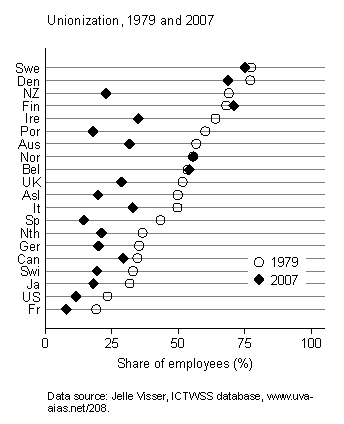
Yes, survey evidence suggests that many American workers who aren’t currently a union member would like some sort of organized representation. And yes, American labor law and its weak enforcement have been a key culprit in union decline. Yet other rich countries have labor law that’s much more favorable to unions, and unionization has been declining in most of them too. Consider the following figures, from the best available comparative data source. Only a few countries have avoided a sharp fall in unionization, and they’re mainly ones in which eligibility for unemployment insurance is tied to union membership.

Why the widespread decline in unionization? The causes are multiple: greater competition and profit pressure on employers, the shift from manufacturing to services, increases in part-time and temporary employment, shrinking public sectors, and attitudinal shifts across generations, among others.

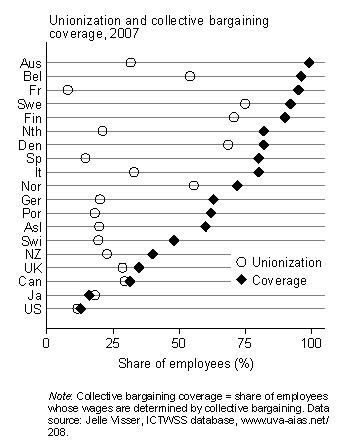
How then are unions in other countries able to secure greater wage gains, and thus less inequality, than their American counterparts? The key is “extension” practices: by agreement between union and employer confederations (most nations) or due to government mandate (France), union-management wage settlements apply to many firms and workers that aren’t unionized. The following chart shows that in a number of countries the share of the workforce whose wages are determined by collective bargaining is much larger than the share of workers who are union members.

I would like to see EFCA become law. The ability of workers to bargain with management collectively rather than individually is, in my view, an important element of a just society, and these days the playing field is too heavily tilted in management’s favor. But I doubt EFCA will get us very far in reducing income inequality. Extension of union-management wage settlements would likely have a bigger impact, but at the moment that isn’t even part of the discussion.

{ 24 comments }

Hillsborough, after 20 years

by Chris Bertram on April 14, 2009

Martin Kelner’s “utterly cynical piece in the Guardian”:http://www.guardian.co.uk/football/blog/2009/apr/13/hillsborough-disaster-liverpool-martin-kelner-bbc rather sums up the attitude of metropolitan journalists. OK, so he focuses on the BBC rather than asking directly, “why don’t those mawkish Scousers shut up about their 96 dead?”, but the comparisons to Diana and Jade Goody are there for a purpose (there are some excellent comments by readers in response). Actually, I think the BBC’s coverage of the anniversary has been rather good, especially Kelly Dalglish’s fine radio programme (not mentioned by Kelner, but also featuring interviews with the parents of the Hicks sisters). There are lots of good reasons not to shut up after 20 years. Not only has there been no apology from the police for their actions, but many things haven’t changed. I was reminded of this whilst listening to the current Chief Constable of South Yorkshire explain how much the police have learnt and how it wouldn’t happen today. Oh really? Well as we know from the G20 protests (and other recent events such as the de Menezes shooting) the police still try to get their “blame the victim” story in early. They still represent themselves as helping the victim but being prevented by a hail of missiles that no-one else saw. Videotapes that might have provided evidence of police misconduct or ineptitude still disappear, or cameras “malfunction”. And the police still get to compare their notes after events involving deaths, just to make sure that their stories are consistent and supportive of the institutional stance. Yes, all good reasons not to shut up.

{ 30 comments }

Squid and Owl

by John Holbo on April 13, 2009

When a man gets to be around 40 – maybe a bit older – he starts to look back on life and wonder: what thing have I done for which I will be remembered? The next thing he does is start a webcomic. Maybe sell a few t-shirts, other Cafe Press-type stuff. Which brings us to:

Smallsquidowllogo

No, really. I honestly don’t know whether it’s a comic or not. It’s an illustrated childrens book for adults, maybe. I’m planning to serialize it on Flickr. Here’s the set. Subscribe to the RSS feed! I decided to start things out by posting the first 21 pages. I’ll be adding a page a day, weekdays. (Not like there’s a story or anything, but it rhymes.)

Then it will become wildly popular. (Step 3: Profit!) Maybe I’ll be able to find a publisher, eh?

The only other really good idea I’ve had lately is … Bob, can we just show them the picture? [click to continue…]

{ 10 comments }

ZOMG! Facebook use and student grades

by Eszter Hargittai on April 13, 2009

It started last night: links showing up on Twitter and elsewhere to articles about how Facebook users do worse in school. It’s not hard for people then to jump quickly to the conclusion that Facebook use results in worse grades (e.g., Study: Facebook Hurts Grades). Unfortunately, I know of no data set out there that could help us answer that question. The few people who have relevant data sets could establish correlation at best. I myself have not found such a connection in my data, but let’s back up a bit. [click to continue…]

{ 13 comments }

Reducing inequality: what’s the problem?

by lane on April 13, 2009

As Henry mentioned this morning, I’ll be doing a series of guest posts at Crooked Timber this week. I’m grateful for the invitation. My posts will be on strategies for reducing income inequality in the United States.

Here’s the problem (more discussion here):

There are two linked components to this rise in inequality: the surge in incomes for those at the top of the distribution and the slow growth of incomes for those in the middle and at the bottom.

Is this really a problem? Would it be better if income inequality were reduced? I think so, for the following reasons.

1. Fairness. Market processes have produced enormous incomes for various financial operators, CEOs, entrepreneurs, athletes, and entertainers in recent decades. A good bit of this is due to luck — being in the right place at the right time, genetic talent, having the right parents or teacher or coach, and so on. I don’t mind some inequality due to luck, and I recognize that monetary incentives are helpful. But the current (or recent, I should say;  the downturn will reduce top incomes somewhat) magnitude of inequality in America strikes me as unfair. An income of several hundred million dollars when the minimum wage gets you about $15,000 is too much inequality. What’s the proper amount of income inequality? I don’t have a precise answer, but that doesn’t mean it’s wrong to feel that our current level is excessive.

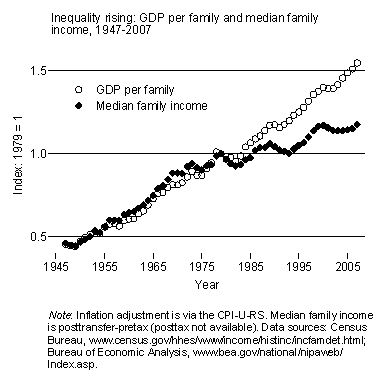
2. Inequality’s consequences. Even if you don’t worry about exorbitant incomes in and of themselves, there’s no avoiding the fact that they have consequences for the incomes and well-being of Americans in middle and lower parts of the distribution. The social pie isn’t zero-sum. But our economy hasn’t grown faster in the past few decades than it did before, so the dramatic jump in incomes among those at the top has come in part at the expense of the rest of us. The following chart offers one way to see this. It shows GDP per family and median family income over the past six decades. Relative to growth of the economy, incomes in the middle (and below) have increased slowly since the 1970s.

As Robert Frank has pointed out, super-high incomes also have led to an arms race in consumption, especially in housing. Spending among the rich has escalated dramatically, encouraging middle- and upper-middle-class households to take on more and more debt in order to keep pace.

Over the past decade a number of social scientists have looked at the effect of inequality on other societal outcomes. We have studies suggesting that inequality is bad for education, health, crime, economic growth, economic mobility, civic engagement, political participation, political influence, and political polarization. I’m not convinced that all of these findings are correct, but some of them are quite plausible.

So what should we do? Stay tuned.

{ 76 comments }