The FT has a story on the political sensitivities involved in transplanting Sesame Street to divided societies such as Northern Ireland.
Today, BBC2 Northern Ireland will air its first local version of Sesame Street … the show has been renamed Sesame Tree because, well, it’s easier to have children hanging around a tree than decide if the street is in a Catholic or Protestant neighbourhood. … The scenes are, indeed, charming: one tells the story of a five-year-old boy learning to play the drum with his older brother at an Orange march, traditionally seen as a Protestant event. Another focuses on a young boy who must wait until he is old enough to join a hurling team, a game associated with nationalist Catholics. But the question remains … Can taking Northern Irish children on a TV tour of the lives of their peers really help to reverse decades of entrenched sentiment? … Or is this the latest version of a sentimentally idealistic American icon spreading its mission of social morality around the world while creating new licensing opportunities at every conflict? [click to continue…]
Dan Drezner and Steve Clemons argue it out over whether or not the US should boycott the Beijing Olympics (Steve says no, Dan says that it would be no harm if the West uses the threat of non-attendance to squeeze some concessions from the Chinese). For me, the interesting question is why the Olympics are so politically important, and how their importance seems to be changing. International relations scholars don’t have much to say about the politics of the modern Olympics (there’s a book by Christopher Hill, but that’s about it), but it’s surely an important international institution; as we can see from recent events, states pay a _lot_ of attention to it. This was true of the original Olympic festival in Greece too; Martin Wight identifies the festival as one of the key institutions binding together the Greek city-state system (although the original Olympics had a military truce attached to it, so it was obviously more important in the ways that IR scholars usually measure importance).
The current debacle though seems to mark an important change in the politics of the Olympics. As best I understand it (I am open to corrections if wrong), in the past, Olympics politics have involved inter-state rivalry, and have been driven by decisions on the part of traditional political elites. The US boycott of the Soviet games in protest against the invasion of Afghanistan in 1980 resulted from a decision by Jimmy Carter, and the tit-for-tat boycott by the Soviets and their allies of the LA games in 1984 resulted from a top level decision too. The dynamic driving the Beijing Olympics seems to me to be rather different; what we are seeing is that the politics of boycott is being driven by mass-publics, and most recently by protestors, rather than by political leaders. In the absence of the public unrest that has culminated in the recent protests in Paris, I doubt very much that Western political leaders would be muttering about not showing at the opening ceremonies – the geopolitical stakes of market access etc are likely more important to them than the fate of Tibetans. But given the widespread public reaction in the West, even leaders like Gordon Brown, who obviously want _very much_ to attend, are having to insulate themselves from public pressures by taking other actions liable to annoy China (such as meeting with the Dalai Lama). In short, I think we are seeing how public opinion and organized cross-national opposition can create significant constraints on the ability of leaders to respond to what they see as the geostrategic necessity of keeping China happy. This is, as best as I am aware, a new phase in the development of the Olympics.
The European Commision has opened the door for mobile phones on planes, introducing measures to harmonize the technical and licensing requirements for mobiles services in the sky. This means that 90 percent of European air passengers can remain contactable during flights, according to the Commission. … As a result of the introduction of the measures by the Commission, local regulators will be able to hand out licenses to make services a reality. One regulatory decision for all of Europe was required for this new service to come into being, according to Viviane Reding, the European Union Telecommunications Commissioner. “In-flight mobile phone services can be a very interesting new service especially for those business travelers who need to be ready to communicate wherever they are,” she said in a statement.
As Kevin Drum remarked recently in connection with the possibility of acquiring the power to remain invisible, the question is not so much whether you would like to be able to do this, but whether you’d be happy if everyone else could do it, too. Looking forward, I wonder whether, in a decade or so, people who are irritated by endless yakking on a long flight will be a robust majority, or whether their disgust will seem more in line with Leon Kass and his intense disapproval of people who eat ice-cream in public.
What to do on planes, apart from sleep, follow the route on the screen or go deaf trying to hear to movie soundtrack? Well read, of course. But I’ve found that Tolstoy doesn’t really do it for me there, in departure lounges or even in similar situations (buses and trains). So it is thrillers, crime, “mystery” (as they appear to call it in Powell’s bookstore) for me. My most recent indulgence is Lee Child’s Reacher series, and most recently his _Bad Luck and Trouble_ (which I picked up in LAX on the way to Portland – I had to buy when I read the blurb: the hero is in Portland and has to rush to LA).
For those who don’t know, Reacher is a former military policeman from the US Army, with a taste for classic blues, who is spending his retirement in semi-vagrancy discovering the country of his citizenship (he grew up on military bases overseas) and gets sucked into defeating an improbable series of wicked conspiracies. Child (a Brit) writes decently and his plotting holds the attention. And whilst you wouldn’t call Reacher a liberal, he has a pretty jaundiced attitude towards the claims the American right (and indeed official America) makes for itself. There are a few weaknesses: Child makes too many plots turn on amazing coincidences and you can confidently place money on one of the apparently nice cops/FBI agents/similars turning out to be in the pockets of the bad people. So far, though, these have been forgivable flaws.
Hat tip to Steven Poole, who mentioned Child here .
I didn’t know Brian Donovan until I saw this video he posted on YouTube after which I feel like I know him a tiny bit. He’s an alum of the Northwestern Sociology Department and he’d been involved with the excellent Culture Workshop that I attend whenever I can. That’s how I heard about his tenure and this fun way in which he’s decided to let people know about it. Congrats, Brian!
In my last post on Iraq, I concluded with a somewhat snarky reference to pro-war bloggers who reasoned that, since Sadr offered a ceasefire, he must have lost the fight in Basra, and therefore the government must have won. As it turned out, the ceasefire was the product of some days of negotation, brokered by the Iranians, which made the original point moot.
Still, given that the same claim was made by John McCain, who said”Very rarely do I see the winning side declare a ceasefire., I think it’s worth making a more serious point about the fundamental error in pro-war thinking that’s reflected in claims like this.
As usual with McCain’s statements in his alleged area of expertise, the claim is factually dubious (see below). More importantly, the implicit analysis here, and in nearly all pro-war thinking is that of a zero-sum game, in which one side’s gains equal the other side’s losses. The reality is that war is a negative sum game. Invariably, both sides lose relative to an immediate agreement on the final peace terms. In the vast majority of cases, both sides are worse off than if the war had never been fought. With nearly equal certainty, anyone who passes up an opportunity for an early ceasefire will regret it in the end. [click to continue…]
Jeremy Waldron has a great piece in the latest LRB reviewing a recent book by Cass Sunstein. He has a nice discussion of the Cheney doctrine that even a one-percent probability of a catastrophic event should be treated as a certainty for policy purposes, where the class of catastrophic events is limited to those with a military, security or terrorist dimension. Reasoning like this interacts neatly with “ticking-bomb” scenarios: now a 1 per cent chance that the there’s a ticking bomb the terrorist knows about is sufficient in to justify waterboarding or worse. Of course other potentially catastrophic developments — such as climate change — haven’t generated a “treat as if certain” policy response from the US government, even thought even the most determined denialists must evaluate the probability that anthropogenic global warming is happening at greater than one in a hundred.
Waldron is also pretty acid about Sunstein’s treatment of global warming and distributive justice, noting some of the shortcomings of the idea that poor people’s lives should be valued according to what they’re prepared to pay to avoid the risk of death. But read the whole thing, as they say.
Forthcoming from James Fowler in _PS: Political Science and Politics_
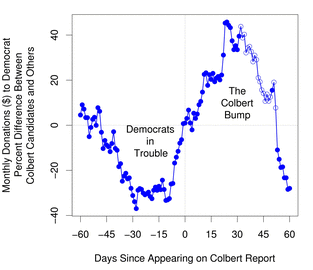
Stephen Colbert, the host of Comedy Central’s The Colbert Report, claims that politicians who appear on his show will become more popular and are more likely to win elections. Although online discussions cite anecdotal evidence in support of his claim, it has never been scrutinized scientifically. In this article I use “facts” (sorry, Stephen) provided by the Federal Election Commission to create a matched control group of candidates who have never appeared on The Colbert Report. I then compare the personal campaign donations they receive to those received by candidates who have appeared on the program’s segment “Better Know a District.” The results show that Democratic candidates who appear on the Report receive a statistically significant “Colbert bump” in campaign donations, raising 44% more money in a 30-day period after appearing on the show. However, there is no evidence of a similar boost for Republicans. These results constitute the first scientific evidence of Stephen Colbert’s influence on political campaigns.
My first reaction is that I should write to Professor William Drummond, Chair of the Berkeley Division of the University of California Senate, stating that in my opinion it is time for him to convene a committee to examine whether John Yoo’s appointment to the University of California faculty should be revoked for moral turpitude.
But I find myself frozen, unable to decide whether I should or should not write to William Drummond. I find myself frozen because I am confronted by the ghost of medieval scholar Ernst Kantorowicz. Ernst Kantorowicz–right-wing authoritarian anti-Democratic anti-communist German nationalist–was asked as a condition of his appointment to the University of California faculty to swear this oath: [click to continue…]
Via Chris Hayes, this _TAP_ story on Martin Luther King’s intellectual legacy is very good. It was only after reading an early draft of Rick Perlstein’s _Nixonland_ (out in a couple of months one month, by the way) last year that I understood how genuinely radical King’s vision was, and how profoundly the ‘mainstream’ American right hated him at the time. Perhaps it’s inevitable that the King is remembered and celebrated as a visionary, but that his actual vision is completely ignored. The story that America likes to tell itself is one where the US successfully met the challenge that King posed. But that story doesn’t do justice to the actual man and his actual arguments.
We can all be a little late sometimes in doing the right thing, and Dr. King understood this about his fellow Americans. But he knew as well that in the long term, confidence in the reasonability and good heart of America is always well placed. And always, that was his method in word and action — to remind us of who we are and what we believe.
His “Letter from a Birmingham Jail” is in fact a blunt rejection of letting the establishment set the terms of social change. “The purpose of our direct-action program is to create a situation so crisis-packed that it will inevitably open the door to negotiation,” he wrote, later adding, “We know through painful experience that freedom is never voluntarily given by the oppressor; it must be demanded by the oppressed.”
Andrew Golis’ piece on Cornell West and the “Santa-Clausification” of King is also worth reading.
Update 2: Rick Perlstein posts some of the relevant material from _Nixonland_ online. David Brooks take note. I’ll have more on _Nixonland_ closer to publication date; suffice it to say for the moment that it’s a worthy follow-up to _Before the Storm._
Via John Gruber comes news that the already somewhat odd augmenting of U.S. currency with larger typefaces and random bits of color has taken a horrible turn. Behold the new five dollar bill.
The new additions to this bill, apparently intended to increase legibility and accessibility, were made by my daughter, who is four. Or possibly by Harold and His Purple Crayon. Actually, as the folks at Hoefler & Frere-Jones point out, this monstrosity is in fact “the work of a 147-year-old government agency called the United States Bureau of Engraving and Printing. It employs 2,500 people, and has an annual budget of $525,000,000.”
Meanwhile in Britain, the design for their new line of coins was selected after an open competition and is the work of a 26 year-old designer who hadn’t tried his hand at coin design before.
Following up on Chris’s post a little while ago, it seems obvious that the best way to offset emissions from travel is not to travel at all. I’ve been trying hard to reduce air travel, and making some progress, though it isn’t easy.
I’m doing my first videoconference presentation for the year on Friday, appropriately enough at a University of Sydney one-day seminar on the economics of sustainability. My talk will be on “Uncertainty, awareness and the precautionary principle”. I’ve lined up two more videoconferences for the first half of this year, and I hope to do some more in the second half.
The other part of my plan to reduce my carbon footprint and the amount of time I spend travelling is to make one trip cover multiple events. I’m in Melbourne right now, for a visit that includes three presentations and several meetings.
With all this, I’m still travelling a fair bit more than I would like. But I think there is a network effect here. The more people get used to videoconferencing as an alternative, the better it will work, and the more demand there will be for technical improvements.
Buried within the U.S. Treasury Department’s just-released blueprint for a new financial regulatory structure is a proposal for a new approach to regulation. The report calls the regulatory status quo an “institutionally based functional system,” and as a long-term goal seeks to replace this with “objectives-based regulation.” In fact, OBR is celebrated in the document as the optimal regulatory structure. Strong words indeed. I’ll resist the temptation to dismiss this as recycling “management-by-objectives” for the public sector. Instead, it is useful to regard OBR as one of a new set of approaches to economic regulation, all of which stem from criticism of “old-fashioned” command-and-control regulation. These new approaches include “principles-based” regulation and “performance-based” regulation.
Whatever their faddish qualities, the problem they respond to is real. When regulation is done by promulgating detailed rules (that explain what the regulated shall and shall not do, and how), and then enforcing compliance with those rules, two problems arise. First, the regulated activity or industry typically evolves faster than the governing rules, and so the latter become increasingly irrelevant. In fact, escaping the grasp of static regulations becomes a big incentive to innovate. Regulators trying to keep up will usually add more rules, spelled out in excruciatingly greater detail, until the ungainly corpus of rules looks like, like, well, … the IRS code. Second, compliance increasingly becomes formal compliance with the strict letter of the law, even when such compliance violates the spirit of the law. It encourages a “check list” mentality that focuses solely on the literal meaning of the rules. OBR, and the other alternatives, try to avoid such difficulties by recasting regulation so that it focuses on a desired outcome or objective, and then grants a measure of flexibility to the regulator to steer towards that goal in whatever way seems best. Flexible regulations make sense if the behavior, market or industry that is to be regulated is dynamic, innovative, or highly variable.
Is OBR truly optimal? Who knows? Evidently the Australians have some experience with it, and the British know something about its close cousin “principles-based” regulation. But OBR certainly isn’t a failsafe measure, for the flexibility that makes OBR adaptable can also be used to render it ineffective or even toothless. The discretion that it necessarily entails means that both the regulators and the regulations matter. Thus, people who fear regulatory capture get even more worried about the possibility that the captured regulators possess lots of authority that they can legally exercise under the rubric of broad rules.
Normblog has published an argument by the Manchester political philosopher Jon Quong to the effect that national Olympic committees (and presumably states) would be justified in imposing a top-down boycott of the Beijing Olympics on their athletes. I don’t want to engage in the China-specific aspects of the argument here, but rather to note one of the steps in Jon’s argument, viz
bq. (2) We are each under a duty of justice not to participate in, or benefit from, projects or activities that involve violations of other people’s rights. _I assume this premise is uncontroversial_. [Emphasis added by CB]
Jon adds some further clarification of this point in the following step:
bq. (3) The duty described in (2) is very stringent, and it cannot be ignored on the grounds that doing so would prevent us from achieving something we very much desire to achieve, even if this means we will never get to achieve the thing in question. Here’s an example in support of this premise. One of the things I would most like to have done in my life was talk about political philosophy with John Rawls. Suppose, before Rawls died, I were invited to a dinner party where Rawls would be the guest of honour. But also suppose, unbeknownst to Rawls, that the host of this dinner party would be employing slave labour to work in the kitchen. I am under a duty not to go to the party, even if we are certain this represents the one and only chance I will ever have to talk philosophy with Rawls, and even though my non-attendance will not halt the party. If I went to the party I would be participating in, and benefiting from, a gross injustice, and the duty not to do so is more weighty than my desire to take the once in a lifetime opportunity to engage with Rawls.
I have to say that what Jon takes to be an uncontroversial premise strikes me as very questionable indeed, at least pending some further detail about what is to count as a “project”, an “activity” and “involvement”. It seems arguable that involvement in just about any major institution or in economic activity is going to violate this prohibition. Certainly, if you buy into even a part of Thomas Pogge’s arguments about the effect of global economic institutions on the poor, then all citizens of wealthy countries routinely breach it. Drink coffee? Eat fruit imported from a nation that violates rights? And what about the past? Most residents of countries with a history of imperialism or colonialism certainly benefit from past projects or activities that involve rights violations. Many current citizens benefit from the exclusion of would-be immigrants from labour markets in ways that also involve such violations. And we could add the ways in which our taxes contribute to the sustaining of our own governments which regularly breach human rights in various ways (think Belmarsh, Guantanamo).
Following Pogge, we might want to discuss how justice might require _compensation_ in some form for such involvement or benefit, or, possibly might require some action from us to oppose injustice. But the duty of non-participation, as Quong states, it strikes me as anything but uncontroversial.