Miller McPherson, Lynn Smith-Lovin and Matt Brashears’ “ASR Paper”:http://www.asanet.org/galleries/default-file/June06ASRFeature.pdf on changes in core discussion networks has been getting a lot of play in the blogs and media. As is often the case with research like this, the commentary doesn’t really do justice to the paper. The summaries tend to be superficial and a lot of the commentary raises questions that the paper addresses, or proposes explanations it controls for. But “I liked this piece”:http://www.cbsnews.com/stories/2006/06/28/opinion/meyer/main1762234.shtml from CBS’s Dick Meyer. He kicks around various ideas about the significance of the findings and their explanation in the generalizing mode you’d expect an Op-Ed commentator to adopt, but it’s also clear that he read and understood the paper. It’s probably the best journalistic discussion of the issue I’ve seen so far.
Like many countries Australia is experiencing Industrial Relations reform. The reforms are a curious mixture of deregulation and compulsion. On the one hand, all sorts of conditions and requirements are stripped away, but in their place there has been created an array of new criminal and civil offences, prohibited terms in contracts, requirements to offer particular employment forms such as AWAs and so on.
Making sense of this seeming contradiction is not so hard. The deregulation is all for employers, and the regulation is all imposed on workers and, particularly, unions. Lockouts are now almost unrestricted, but strikes are subject to strict regulation. Employers cannot be sued for unfair dismissal, but employees are prohibited from including protection against unfair dismissal in a proposed employment contract and so on.
An obvious interpretation is the Marxist one, that this is class-based legislation, designed to increase profits and reduce wages by driving down workers’ bargaining power. That’s part of the story but not, I think, the most important part.
The real issue, I think, relates to the personal power relationship between employers and employees. The complaints of employers about bad employees and the difficulty of sacking them echo very closely the complaints of a century ago that ‘you can’t get good servants any more’. The changes made in the IR laws make most sense if they are read as an attempt to remove constraints on the day-to-day power of bosses to be bosses, whether these constraints are imposed by law, by collective agreements or by individual contracts with workers.
This also helps to explain some of the class alignments we see in Australian politics. While political alignments continue to be determined to a significant extent by income, there are groups with relatively high incomes, such as academics and other professionsals, who tend to support Labor. On the other side of the fence, managers tend to support the conservative parties more strongly than their incomes alone would suggest. The obvious point is that managers are, by definition, bosses. Professionals, who mostly in hierarchical institutions, can identify either as bosses or workers, but with the rise of managerialism, most professionals find themselves on the workers side of the divide.
{ 19 comments }
A friend told me that there is an interesting version of the Red Hot Chili Peppers’ new album, Stadium Arcadium, doing the rounds on internet filesharing services, so I listened to it. (Note to RIAA agents: I’d already bought the CD.) The pirate version is fascinating. It looks like a genuine high-bitrate mp3 rip of all songs on both discs, but the panning – the distribution of instruments in the stereo field – is drastically wrong. John Frusciante’s guitar takes up nearly the whole of the right channel, while Anthony Kiedis’s voice, and even the drums and bass guitar, are relegated to the left. Since lead vocals, bass guitar, and bass and snare drums are nearly always more or less centred in standard rock mixes, this makes the mp3s very disconcerting to listen to on headphones for any length of time. (This is a simplification, of course: for some amazing spatial engineering in rock music, listen for example to Placebo’s new album, Meds. But this pirate Chilis rip just makes you feel kind of seasick.) Now, of course this could just be some software gremlin in the ripping process. But it started me wondering: what if it’s deliberate?
[click to continue…]
{ 24 comments }
No thanks to Jim Gibbon for siphoning off a few hours of my time today with that Gapminder pointer. Nonetheless, I wanted to send him a shoutout and welcome him to blogging seeing that he comes from a bit of Crooked Timber lineage. Kieran and I shared an office for a couple of years while in graduate school at Princeton. And it is in this same office that Jim now spends a good chunk of his graduate student days (granted, right now he’s doing summer research in Germany). Welcome to blogging, Jim!
To try to decipher what it is about 129 Wallace Hall that leads to all this blogging, you can check out a light switch, a chair component, a scooter, part of the wall, parts of the building and its door for clues on this collage – all the product of an afternoon when I didn’t feel like working on my dissertation. Those were the days… You think you have no time in grad school, but then you become faculty and all that blogging, taking pictures and surfing the Net… oh, never mind.
{ 7 comments }
Via Jim Gibbon I’ve discovered Gapminder. Wow! It’s a wonderful visualization tool for data. The focus is on world development statistics from the UN. The tool is incredibly user-friendly and let’s you play around with what variables you want to see, what you want highlighted in color, whether you want to log the data, what year you want to display, and whether you want to animate the time progression (oh, and how quickly).
I’ve made an example available on YouTube. (I used Gapminder to create the visualization and Hypercam to capture it.)
Here is some context for that particular graph. My first interests in research on Internet and social inequality concerned the unequal global diffusion of the medium. I wrote my senior thesis in college on this topic and then pursued it further – and thankfully in a more sophisticated manner – in graduate school. So this is a topic that has been of interest to me for a while and it’s great to be able to play with some visual representations of the data.
So what you have on the video graph is a look at Internet diffusion by income (logged) from 1990-2004. I picked color coding by income category, which is somewhat superfluous given that the horizontal access already has that information, but I thought it added a little something. (For example, to summarize the puzzle of my 1999 paper – the first to run more than bivariate analyses on these data -, it focused on explaining why all the red dots are so widely dispersed on the graph despite all representing rich long-term democratic countries.)
Thanks to the tool’s flexibility, you can change it so that the color coding signifies geographical region and could then tell immediately that what continent you are on – an argument some people in the literature tried to make – has little to do with the level of Internet diffusion.
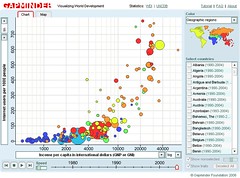
Imagine the possibilities of all this in, say, classroom presentations. Jim links to a great presentation using this tool. (Although I disagree with the presenter’s conclusion at the end about the leveling of differences regarding Internet diffusion.)
I recommend checking out the tool on your own for maximum appreciation of its capabilities.
UPDATE: There is more! Conrad – Jim’s source on this – tells me that the tool on the Trendalyzer site has even more option. Moreover, you can download a beta version of the software that even lets you import your own data.
{ 9 comments }
Say what you like about the free-marketeers, they certainly know how to ignore market forces, eschew profit and embrace subsidization when it suits them. I just got the 2006 “Liberty Fund”:http://www.libertyfund.org/ catalog in the post, and as usual I am having a hard time not buying a lot of their absurdly under-priced offerings. You can get the “complete Sraffa/Dobb edition of Ricardo”:http://www.libertyfund.org/details.asp?displayID=1876 (eleven volumes!) for about a hundred bucks, or $12 for individual volumes. (The true measure of value is in there _somewhere_.) For similar prices, there’s more “Gordon Tullock”:http://www.libertyfund.org/details.asp?displayID=1877 or “James Buchanan”:http://www.libertyfund.org/details.asp?displayID=1598 than any sane person would ever want to read. You can also get the whole “Glasgow Edition of Smith”:http://www.libertyfund.org/details.asp?displayID=1654 for seventy five dollars. Or sixteen hundred pages of “Armen Alchian”:http://levine.sscnet.ucla.edu/General/ALCHIAN.HTM for fifteen dollars. They’re also strong on Enlightenment types, with “Hume’s History of England”:http://www.libertyfund.org/details.asp?displayID=1659 on the cheap, and you can find any amount of reactionary commentary on the French Revolution, too.
On the other hand, you can get a lot of this stuff (the Ricardo, for instance) “for free and in PDF format”:http://oll.libertyfund.org/Home3/AuthorsAll.php at their Online Library of Liberty.
{ 17 comments }
Recently I was explaining to a French friend the arguments we have in English over whether to call people “suicide bombers”, or “suicide murderers”, or “martyrdom bombers”, or even (for Fox fans) “homicide bombers”. “What do you call them in French?” I asked. She smiled somewhat apologetically and said: “Oh, we just call them kamikazes.” I was intrigued by the analogy, and recently Freeman Dyson has argued for it explicitly in the New York Review of Books.
[click to continue…]
{ 141 comments }
I’d like to thank Chris and Kieran for inviting me to guest blog here for a while. Since I’m under no obligation to conform to the self-imposed strictures of my own blog, I thought I’d begin by relating my dismay this afternoon upon noticing the headline “Beer better for you than wine: official”. Since I live in Paris, where good wine is cheap and beer is hideously expensive, I was horrified. Luckily, the article in question goes on to prove its own nugatory level of reliability, for the man telling us that beer is healthier than wine is, um, a “beer specialist”, no less than the “Anheuser-Busch endowed Professor of Brewing Science at the University of California”. Phew, that’s ok. It’s more like a PR agency for fossil-fuel companies telling us that carbon dioxide is good for you. Of course, I have nothing against beer, and will indeed be taking out a large bank loan in order to toast England’s victory on Saturday with a small glass of Amstel. Now, will some kindly scientist please tell me once and for all whether the vast quantity of coffee I drink is, on the whole, good or bad?
{ 23 comments }
I’ve been waiting for the other shoe to drop on this for the last few days, and it finally has. Privacy International has “filed complaints”:http://www.nytimes.com/2006/06/27/world/27cnd-secure.html?ex=1309060800&en=5a89c5108098a0c0&ei=5090&partner=rssuserland&emc=rss with umpteen European and non-European data regulators that SWIFT has illicitly shared European citizens’ financial data with US authorities. This could have some very interesting consequences. Now bear in mind as you read the below analysis that I am not a lawyer. I have, however, spent a lot of time over the last six years working on and writing about privacy issues in the EU-US relationship, so I do have a good grasp of the political issues involved.
[click to continue…]
{ 17 comments }
The competition in the Anonymous Colleague contest was fierce with a very close outcome. The winner is Nabakov with the following entry:
“Mr Happy, who believes if something funny is worth saying once, it’s worth saying a thousand times, the fucker” having received 33.5% of the votes. He wins the free Anonymous Lawyer book from the publisher.
Congrats also – but no book, I’m afraid – to M. Gordon for the “Amazing Vanishing Advisor” entry, which came in close second with 30.2% of the votes.
There are more opportunities to have anon legal fun including the chance to win an Anonymous Lawyer T-shirt and the book. The Anonymous Law Firm is accepting job applications and the top ten entries get goodies.
{ 6 comments }
It would appear that Tariq Ramadan “has won”:http://www.insidehighered.com/news/2006/06/26/ramadan an important victory in his legal battle against his exclusion from the United States.
bq. A federal judge on Friday gave the U.S. government 90 days to act on the visa application of a renowned Muslim scholar who has been kept out of the United States for two years … [I]n forcing the government to make a decision about the scholar, Judge Crotty rejected — sometimes in mocking tones — many government arguments that would have given federal officials broad power to exclude people from the United States without giving any reason. … despite the wide latitude federal officials have to deny visas, Judge Crotty wrote, “it cannot do so solely because the executive disagrees with the content of the alien’s speech and therefore wants to prevent the alien from sharing this speech with a willing American audience.” Further, Judge Crotty wrote: “The First Amendment rights of Americans are implicated when the government excludes an alien from the United States on the basis of his political views, even though the non-resident alien has no constitutionally or statutorily protected right to enter the United States to speak.”
{ 28 comments }
I meant to mention Philip Connors’ sharp and funny piece about working for the _Wall Street Journal_ (to be found in the “most recent issue”:http://www.nplusonemag.com/toc4.html of _N+1_, but not available on the WWW) last week, when I was writing about newspapers, editorial policies etc. His description of Bob Bartley, late editorial-page editor for the newspaper:
bq. Bob Bartley, who has since passed away, was among the most influential American journalists of the second half of the twentieth century … He was fairly soft-spoken and his posture was poor. He rarely smiled, but when he did he looked like a cat who’d just swallowed your canary. His abiding obsessions were taxes and weapons. He thought taxes should be cut always and everywhere, except for poor people, and he thought Americans should build as many weapons as possible … Bartley was appalled by the very idea of poor people. In fact, he’d once said he didn’t think there were any poor people left in America – “just a few hermits or something like that.” (This quote can be found in the _Washington Post_ Magazine of July 11, 1982.) On this issue, Bob Bartlley was the intellectual heir of an old American idea expressed most succinctly by the preacher Henry Ward Beecher: “No man in his land suffers from poverty unless it be more than his fault – unless it be his _sin_.” For Bob Bartley, the agrarian pictures of Walker Evans and the homoerotic pictures of Robert Mapplethorpe were morally equivalent. Both depicted human beings in a sinful state of filth and degradation, and such images had no place in an American museum.
{ 20 comments }
As you may have noticed by now, I like maps. In fact, geography was the only elective I took in high school, two optional years in addition to the two required (no, I didn’t go to high school in the U.S. as you are likely able to guess from that info). Those classes included lots of material of less interest to me (e.g. leading mineral producers in the world and what shrubs grow in the tundra), but we also got to look at maps a lot, which was the main reason I was hooked.
 *
*Given these interests, I was excited to find Quikmaps this morning, a service that lets you annotate Google Maps, save them, go back and edit them, and in the meantime post them on your Web site. There have been other related services (GMapTrack comes to mind), but none have managed to do this as well as Quikmaps. I have been using Wikimapia for some map annotation purposes, but it’s not so good when the locations you are specifying have limited appeal. The one problem with such independent little upstarts is you never know how long they’ll be around (e.g. GMapTrack is nowhere to be found) so it’s not clear how much time and effort one should spend creating maps.
Nonetheless, if you want to explain to someone how to find you or want to annotate your favorite locations (or just restaurants) in town, this seems like a very helpful service.
UPDATE 11:30am CST: The site is down, but the “quikmaps guy” has posted a note on Digg to say he’s working on getting it back up asap. In the meantime, you can at least take a look at the homepage on duggmirror.
UPDATE 1pm CST: It’s working now here.
[thanks]
[*] I have purposefully avoided embedding a map here. I don’t want CT page loads to be too taxing on the Quikmaps site. It should be busy enough dealing with the digg effect .
{ 10 comments }
“Scott Eric Kaufman”:http://acephalous.typepad.com/ has a “bad case”:http://acephalous.typepad.com/acephalous/2006/06/finish_silar_we.html of “summer vertigo”:https://crookedtimber.org/2005/06/07/summer-vertigo/.
{ 1 comment }
As a young girl I was an avid reader of Stephen Potter, especially the peerless Lifemanship. I also re-read Thackeray’s Book of Snobs many times, for the not particularly compelling reason that it was the only interesting book in my brother’s room at my grandmother’s house. (I say “not particularly compelling” in spite of the manifest excellence of the book, which is hilarious, but rather because we had a library on the second floor.) These two books did much to make me the cynical, frivolous person I am today. The thing is, I was convinced, at an early stage, that there really was a Lifesmanship organization at 681 Station Road, Yeovil, and it was a hazy dream of mine that I might travel to England and join at some time in the future. By the time I was 10 I think I was starting to suspect this was never to be (and, in my defense, I never imagined that I might actually meet, say Odoreida.) But I have always wondered, is there supposed to be something particularly funny about Yeovil? I gather that it’s a real place and everything. Is it a really boring place? A thrilling town full of laffs and hilarity? What?
{ 64 comments }