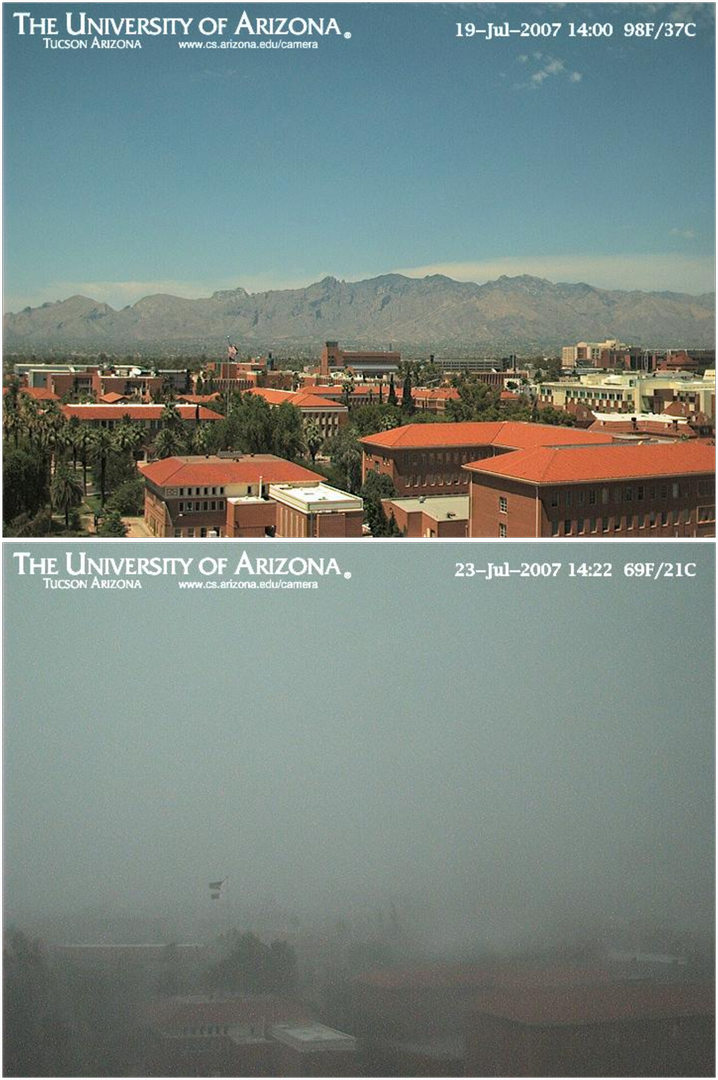
Top: View of the University of Arizona and the Santa Catalina mountains, summer day. (My office is on the top floor of the building in the lower right foreground.) Bottom: View of the University of Arizona and the Santa Catalina mountains, summer monsoon. It’s just finishing up now.
{ 18 comments }
bitchphd 07.23.07 at 10:04 pm
I love those Monsoons. BLAM! !! !! And then, five minutes after it ends, everything’s dry again.
Joel Turnipseed 07.23.07 at 10:35 pm
Ah yes: loved those at Twentynine Palms. We had one in 1988 that we lazily watched coming toward us for hours–you could see both sides of it–and then swept away everything in its unexpected fury: tents, cots, desks–even Hummers were sashaying across the desert on the tide of water and heavy winds. We had twenty guys standing on the supports for our maintenance tent, which we rode like a fair ride as it lifted off its spikes.
The storm probably lasted less than an hour, and then everything was sunny and calm by early evening.
I tell you though, the Mojave desert sure looked different the next day: bright green. But then: that only lasted a day or two as well.
lees 07.24.07 at 1:32 am
There was a day I well recall in Tucson ca. 1990 when we had a driving rainstorm at 116 degrees. It was _not_ a dry heat.
JP Stormcrow 07.24.07 at 3:15 am
Since someone has to play the stultifying pedant on threads like this …
From the Phoenix Weather Service site:
Correct definition of Monsoon: Any wind that reverses its direction seasonally.
Wrong definition of Monsoon: Thunderstorms that occur in Arizona during the summer are called monsoons.
The monsoon in Phoenix is said to start when there are three consecutive days when the dew point averages 55 degrees or higher. Average start date is July 7th.
This year the Weather Service made a lame proposal to scrap even referring to it as a monsoon. “Severe thunderstorm season†appears to have been the hopelessly prosaic alternative.
And I would love to see more recent data, but apprently development between the ’50s and the ’80s did change the pattern of summer rain in the urban areas.
Gene O'Grady 07.24.07 at 3:16 am
My wife spent one very unhappy year in Twenty-Nine Palms ca. 1961, during which they had a monsoon like this. When we visited there 35 years later, she took me to see where they had lived and was astonished that the flood damage had not yet been cleaned up.
That may have been the trip we saw the ocatilla in bloom — they’d always been dead sticks and suddenly they were brilliant red flowers.
Russell L. Carter 07.24.07 at 3:30 am
Up here in the mountains we had a normal monsoon day. By 9AM the lightning all around caused me to put off my daily ride until noon. Probably reached a high of 79F or so, a week ago the high was 20F higher. Elevation 5500′.
dawn 07.24.07 at 4:06 am
I love this time of the year. Here, in Flagstaff, we got a lot of rain all day. It was lovely.
Ciarán 07.24.07 at 8:02 am
I always thought there was something marvellously efficient about that sort of cloudburst. In your native country it clouded over in mid-June and there hasn’t been a dry day since.
Can’t imagine why you left.
mollymooly 07.24.07 at 8:30 am
Echoing #4. I’ve never been to SWUSA and I’ve never heard “monsoon” used elsewhere in this sense. I propose “monsoon storm” as a compromise name, since the underlying cause is indeed a monsoon wind.
Kieran Healy 07.24.07 at 10:29 am
Monsoon prescriptivism is all wet.
ajay 07.24.07 at 2:54 pm
Can’t imagine why you left.
Clue’s in the picture. 37C. In other words – if you go outside at mid-day for more than a few minutes, you will start to suffer radiation burns. If you go outside without water for more than a few hours, you will start to die.
quicksand 07.24.07 at 5:48 pm
It’s really remarkable.
I spent a few summers at, uh, that other university in Tempe more than 20 summers ago, and I remember those monsoons vividly.
And the aftermath — when it’s wet and 100+ degrees, the contrast between the cool air-conditioned university buildings and the environment immediately outside was astonishing. Stepping outdoors was like walking into a solid wall of atmosphere.
Linkmeister 07.24.07 at 7:39 pm
Your office is in the PMM building? Or have I misidentified it?
Yes, I attended that institution about a thousand years ago.
agm 07.25.07 at 12:59 am
Ah, I miss monsoon season. Particularly that the f’ing rain and clouds go away after a little, allowing the return of the sun.
agm 07.25.07 at 1:00 am
BTW, have you ever seen that happen, not with rain but with a wall of flying dust? It’s just the most mind-boggling event, to have a wall of pure, unrefined brownness coming at you, and with visible speed.
Kieran Healy 07.25.07 at 2:36 am
Your office is in the PMM building?
In Social Sciences.
Linkmeister 07.25.07 at 6:43 am
Ah. I’ve got my N/S/E/W directions mixed up.
DILBERT DOGBERT 07.28.07 at 3:32 am
The season when thunder speaks – Tony Hillerman I think. Read the Great Taos Bank Robbery.
A good funny story and short.
Comments on this entry are closed.