In order of relative clout. I’ve been meaning to do some version of this for years …

Posts by author:
In order of relative clout. I’ve been meaning to do some version of this for years …
Last September, Abe Newman, Jeremy Wallace and I had a piece in Foreign Affairs’ 100th anniversary issue. I can’t speak for my co-authors’ motivations, but my own reason for writing was vexation that someone on the Internet was wrong. In this case, it was Yuval Harari. His piece has been warping debate since 2018, and I have been grumpy about it for nearly as long. But also in fairness to Harari, he was usefully wrong – I’ve assigned this piece regularly to students, because it wraps up a bunch of common misperceptions in a neatly bundled package, ready to be untied and dissected. [click to continue…]
As Chris suggests, one of the most memorable disasters at Crooked Timber was the seminar on David Graeber’s book, Debt. Timothy Burke described it at the time as conveying:
that feeling of grad school as Hobbesean nightmare, of small arguments quickly and casually intensified into thermonuclear exchanges, losing all potentially meaningful disagreements along the way.

It’s over a week since the Economist put up my and Cosma Shalizi’s piece on shoggoths and machine learning, so I think it’s fair game to provide an extended remix of the argument (which also repurposes some of the longer essay that the Economist article boiled down). [click to continue…]
Attention conservation notice 1 – a long read about a simple idea. When reading trolls, focus on the anodyne-seeming starting assumptions rather than the obnoxious conclusions.
Attention conservation notice 2 – This is also available via my Substack newsletter, Programmable Mutter. I’ll still be writing on CT, but I have a book with Abe Newman coming out in a few months, so that there will be a lot of self-promotion and stuff that doesn’t fit as well with the CT ethos. And do pre-order the book, Underground Empire: How America Weaponized the World Economy, if you think it sounds good! We’ve gotten some great blurbs from early readers including Kim Stanley Robinson, Francis Spufford, Margaret O’Mara, Steven Berlin Johnson, Helen Thompson, Chris Miller, and my mother (the last is particularly glowing, but sadly not likely to appear on the back). Available at Bookshop.org and Amazon.
I’ve often had occasion to turn to Daniel Davies’ classic advice on “the correct way to argue with Milton Friedman” over the two decades since I’ve read it. The best white hat hacker is a reformed black hat hacker, and Dan (dsquared) knows both the offense and defense sides of trolling.
Dan (back in 2004!):
I’m pretty sure that it was JK Galbraith (with an outside chance that it was Bhagwati) who noted that there is one and only one successful tactic to use, should you happen to get into an argument with Milton Friedman about economics. That is, you listen out for the words “Let us assume” or “Let’s suppose” and immediately jump in and say “No, let’s not assume that”. The point being that if you give away the starting assumptions, Friedman’s reasoning will almost always carry you away to the conclusion he wants to reach with no further opportunities to object, but that if you examine the assumptions carefully, there’s usually one of them which provides the function of a great big rug under which all the points you might want to make have been pre-swept. A few CT mates appear to be floundering badly over this Law & Economics post at Marginal Revolution on the subject of why it’s a bad idea to have minimum standards for rented accommodation. (Atrios is doing a bit better). So I thought I’d use it as an object lesson in applying the Milton Friedman technique.
In the same friendly spirit, I’ll note that Jonathan Katz flounders a bit in his rebuttal of Richard Hanania. None of this is to blame Katz – Hanania is not only building on his knowledge of social science (he has a Ph.D.), but some truly formidable trolling techniques. Years ago, I upset Jonathan Chait by suggesting he was a highly talented troll of the second magnitude, if a bit crude in technique. Hanania is at an altogether different level. He’s not blessed with Friedman’s benign avuncularity, but he is as close to masterclass level as we are likely to get in this fallen world. [click to continue…]
There’s a backstory behind this Washington Post story on Republican persecution of academics, and it’s one that doesn’t make the Intercept look good.
Jordan’s colleagues and staffers met Tuesday on Capitol Hill with a frequent target of right-wing activists, University of Washington professor Kate Starbird, two weeks after they interviewed Clemson University professors who also track online propaganda, according to people familiar with the events. Last week, Jordan (Ohio) threatened legal action against Stanford University, home to the Stanford Internet Observatory, for not complying fully with his records requests. … The push caps years of pressure from conservative activists who have harangued such academics online and in person and filed open-records requests to obtain the correspondence of those working at public universities. The researchers who have been targeted study the online spread of disinformation, including falsehoods that have been accelerated by former president and candidate Donald Trump and other Republican politicians. … Last month, the founder of the conspiracy-theory-prone outlet the Gateway Pundit and others sued Starbird and Stanford academics Alex Stamos and Renée DiResta, alleging that they are part of a “government-private censorship consortium” that tramples on free speech. …
“Whether directly or indirectly, a government-approved or-facilitated censorship regime is a grave threat to the First Amendment and American civil liberties,” Jordan wrote.
The claim that these academics are part of a “government-approved or-facilitated censorship regime” is complete bullshit. But it is bullshit that was popularized by a grossly inaccurate story at the Intercept, which purported to discover a secret collaboration between academics and DHS to censor the American right wing. [click to continue…]
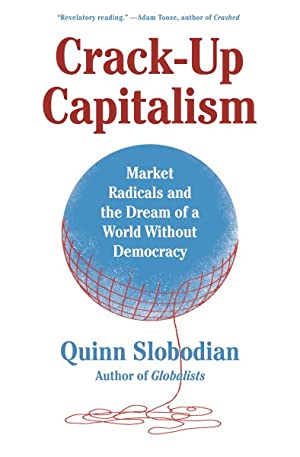
Quinn Slobodian’s new book, Crack-Up Capitalism is an original and striking analysis of a weird apparent disjuncture. Libertarians and classical liberals famously claim to be opposed to state power. So why do some of them resort to it so readily?
Since I’m on the topic of Max Weber, religion and technology already, here’s a half-developed theory of Elon Musk that I’ve been nurturing for a while. I’ve trotted it out informally at a couple of meetings, and I’m not completely convinced it is right, but it’s prima facie plausible, and I’ve gotten some entertainment from it. My argument is that Musk is doing such a terrible job as Twitter CEO because he is a cult leader trying to manage a church hierarchy. Relatedly – one of SV’s culture problems right now is that it has a lot of cult leaders who hate the dull routinization of everyday life, and desperately want to return to the age of charisma. [click to continue…]
Erin Kissane wrote a great essay on the differences between Mastodon and Bluesky (two very different decentralized social networks/Twitter alternatives). Read it! I too joined Bluesky a few days ago (no – I don’t have any invites), and I’ve some of the same impressions as she did, but not being a real tech person, I want to talk more about the social differences between the two social media networks [click to continue…]

I’ve just finished reading Cory Doctorow’s great, fun novel, Red Team Blues, and I’ve been thinking about how well it exemplifies one of the strengths of good science fiction. Back when we ran our seminar on Francis Spufford’s novel, Red Plenty, there was a back-and-forth between Francis and Felix Gilman. As Francis described it post-hoc, he wanted to write the novel of the socialist calculation debate, in part because of the challenge:
I was positively attracted to the whole business of being the first person in thirteen years to consult Cambridge University Library’s volumes of The Current Digest of the Soviet Press; and in general to the challenge of taking on the most outrageously boring subject matter I could find, and wrestling it to the floor, and forcing it to disgorge its hidden jewel of interestingness
This post is a memo that I just presented at a workshop organized at the EUI by Kate McNamara, Frederic Merand and Catherine Hoeffler. Some of its key ideas were articulated in an informal discussion with Bill Janeway, Margaret Levi, Suresh Naidu, Dani Rodrik and Gabriel Zucman a couple of weeks back. None of them are at all to blame (I’ve benefited greatly from their various comments, suggestions and disagreements but probably not nearly so much as I should have).
Memo
In this brief and very informal memo, I argue that the “knowledge problem” critique of industrial policy has itself become a problem for knowledge. For decades, economists have argued that state policy makers lack the requisite knowledge to intervene appropriately in the economy. Accordingly, decisions over investments and innovation ought be taken by market actors. Now, the “market knows best” paradigm is in disrepair. It isn’t just that “hyperglobalization” has devoured its own preconditions, so that it is increasingly unsustainable. It is also that some goals of modern industrial policy are in principle impossible to solve through purely market mechanisms. To the extent, for example, that economics and national security have become interwoven, investment and innovation decisions involve tradeoffs that market actors are poorly equipped to resolve. There are good reasons why Adam Smith did not want to see defense policy handled through the market’s division of labor. [click to continue…]
Attention conservation notice: short but entirely speculative exercise in amateur sociology/game theory, by someone who has no professional license to do either, and had a blue tick for a couple of years but was always bemused as to why.

A quick note as to what went wrong with the Elon Musk strategy of giving power to the peasants. My take is that the Tyler Cowen case that “Elon is already ahead of the critics on this one, and was all along” was wrong, and that the politics of online aristocracy aren’t nearly what Musk thought they were. [click to continue…]
Hugo Mercier, Melissa Schwartzberg and I have two closely related publications on what we’ve been calling “No-Bullshit Democracy.” One is aimed at academics – it’s a very short piece that has just been officially published in American Political Science Review. The other just came out in Democracy. It’s aimed at a broader audience, and is undoubtedly livelier. An excerpt of the Democracy piece follows – if you want to read it, click on this link. The APSR academic letter (which can be republished under a Creative Commons license) is under the fold. Which one you might want to read depends on whether you value footnotes more than fisticuffs, or vice versa …
The New Libertarian Elitists
What might be called “no-bullshit democracy” would be a new way of structuring democratic disagreement that would use human argumentativeness as a rapid-growth fertilizer. … But first we need to sluice away the bullshit that is being liberally spread around by anti-democratic thinkers. … . Experts, including Brennan and Caplan (and for that matter ourselves), can be at least as enthusiastic as ordinary citizens to grab at ideologically convenient factoids and ignore or explain away inconvenient evidence. That, unfortunately, is why Brennan and Caplan’s books do a better job displaying the faults of human reasoning than explaining them.

[attention conservation notice: this post consists of lengthy opinionating with a smattering of thinly sketched arguments from psychological research, and a now-obscure science fiction novel. Also – if you really disliked M Night Shyamalan movies, even before the shtick became a shtick, you’re likely to be annoyed].
So Jonathan Chait wasn’t happy with the side-comment on his career incentives in my last post (see the tweet pictured above). Fair enough. But his alternative theory of how the attention economy works is one dimensional and self-flattering (which is not to say that it is entirely wrong). [click to continue…]
There’s been a lot of grumpy commentary about this recent NYT op-ed by Adam S. Hoffman, a Princeton senior claiming that conservatives are being driven off campus. Its basic claims:
In the not-so-distant past, the Typical College Republican idolized Ronald Reagan, fretted about the national debt and read Edmund Burke. Political sophistication, to that person, implied belief in the status quo. … Today’s campus conservatives embrace a less moderate, complacent and institutional approach to politics. … many tend toward scorched-earth politics. But these changes aren’t solely the consequence of a fractured national politics.They’re also the result of puritanically progressive campuses that alienate conservative students from their liberal peers and college as a whole.
The story of this transformation, according to the social psychologist Jonathan Haidt, starts around 2014, when Gen Z arrived on campus. The new progressive students were less tolerant of heterodox ideas and individuals. …For those on the right, the experience is alienating. … And those who challenge liberal pieties can face real repercussions.