I congratulate journalist Megan McArdle for having the good fortune to encounter such a talkative fellow passenger on the D.C. bus the other day.
Yesterday, I rode the bus for the first time from the stop near my house, and ended up chatting with a lifelong neighborhood resident who has just moved to Arizona, and was back visiting family. We talked about the vagaries of the city bus system, and then after a pause, he said, “You know, you may have heard us talking about you people, how we don’t want you here. A lot of people are saying you all are taking the city from us. Way I feel is, you don’t own a city.” He paused and looked around the admittedly somewhat seedy street corner. “Besides, look what we did with it. We had it for forty years, and look what we did with it!”
He’s a little off, because I think black control of Washington D.C. officially occurred only in 1975 when Parliament’s “Chocolate City” was released.
… scientists have begun to examine how the city affects the brain, and the results are chastening. Just being in an urban environment, they have found, impairs our basic mental processes. After spending a few minutes on a crowded city street, the brain is less able to hold things in memory, and suffers from reduced self-control. While it’s long been recognized that city life is exhausting — that’s why Picasso left Paris — this new research suggests that cities actually dull our thinking, sometimes dramatically so. “The mind is a limited machine,” says Marc Berman, a psychologist at the University of Michigan and lead author of a new study that measured the cognitive deficits caused by a short urban walk. “And we’re beginning to understand the different ways that a city can exceed those limitations.” … This research arrives just as humans cross an important milestone: For the first time in history, the majority of people reside in cities. For a species that evolved to live in small, primate tribes on the African savannah, such a migration marks a dramatic shift. … This research is also leading some scientists to dabble in urban design, as they look for ways to make the metropolis less damaging to the brain. … The reason such seemingly trivial mental tasks leave us depleted is that they exploit one of the crucial weak spots of the brain. A city is so overstuffed with stimuli that we need to constantly redirect our attention so that we aren’t distracted by irrelevant things, like a flashing neon sign or the cellphone conversation of a nearby passenger on the bus. This sort of controlled perception — we are telling the mind what to pay attention to — takes energy and effort. …
The same factors which have thus coalesced into the exactness and minute precision of the form of life have coalesced into a structure of the highest impersonality; on the other hand, they have promoted a highly personal subjectivity. There is perhaps no psychic phenomenon which has been so unconditionally reserved to the metropolis as has the blasé attitude. The blasé attitude results first from the rapidly changing and closely compressed contrasting stimulations of the nerves. From this, the enhancement of metropolitan intellectuality, also, seems originally to stem. Therefore, stupid people who are not intellectually alive in the first place usually are not exactly blasé. A life in boundless pursuit of pleasure makes one blasé because it agitates the nerves to their strongest reactivity for such a long time that they finally cease to react at all. In the same way, through the rapidity and contradictoriness of their changes, more harmless impressions force such violent responses, tearing the nerves so brutally hither and thither that their last reserves of strength are spent; and if one remains in the same milieu they have no time to gather new strength. An incapacity thus emerges to react to new sensations with the appropriate energy. This constitutes that blasé attitude which, in fact, every metropolitan child shows when compared with children of quieter and less changeable milieus. … In the blasé attitude the concentration of men and things stimulate the nervous system of the individual to its highest achievement so that it attains its peak. Through the mere quantitative intensification of the same conditioning factors this achievement is transformed into its opposite and appears in the peculiar adjustment of the blasé attitude. In this phenomenon the nerves find in the refusal to react to their stimulation the last possibility of accommodating to the contents and forms of metropolitan life. The self-preservation of certain personalities is brought at the price of devaluating the whole objective world, a devaluation which in the end unavoidably drags one’s own personality down into a feeling of the same worthlessness.
When I first started going out with my partner Pauline, in the early 1980s, I had a somewhat dismal opinion of Liverpool. She wanted to show me how great the city could be, so she insisted on taking me to the Palm House in Sefton Park. I rather vividly remember how distressed she was to find that the beatiful structure of her childhood was derelict and vandalized. My father, whose mother came from the city often recalls a visit just after the war, to a city that was incomparably exciting. He remembered the overhead railway, the buses, the underground – a place alive.
That Liverpool is the subject of Terence Davies’s wonderful poetic treatment, Of Time and the City (Official site ). He takes the city of empire, of shipbuilding and docks, of sport, of children playing on working-class streets — the city of his childhood — and traces its decline and collapse through the 1970s and 1980s. At the same time, he indicates, through music — especially his use of Mahler’s 2nd — that there is life yet and the possibility of return. It is hard to give a flavour of the combination of image, music, poetry and personal recollection that Davies conveys, but he tells us of a place that is badly damaged but still has immense weight and grandeur (aptly evoked in his shots both of industrial landscape and of great Victorian buildings like St George’s Hall). Of course it is a film that will mean most to those from the city, perhaps especially the legion of exiled scousers. But it said a lot to me, with a more episodic connection, and even those who only know it from a distance will love Davies’s work. Get to see it if you possibly can.
(family stands facing the empire state building) Tourist son: Mom, which one is the Empire State Building? Tourist mom: I think it’s the one with the circley top. (points to the Chrysler Building) Tourist dad: No, honey, it’s the one way out there, on the water. Tourist son #2: That’s the Statue of Liberty. [To no one in particular:] I can’t believe I’m part of this fucking family.
The first house that my wife and I bought was in a suburb immediately to the north of Albany, NY. It was a great 80-year-old house with a nice yard, and an easy drive to my work and to hers. But it was on a busy street, and with no sidewalks it was impossible to walk anywhere. When our daughter was almost 3, we moved into our current house in Albany. I sometimes joke that we moved for the sidewalks, but there’s a lot of truth to that. On the first morning we woke up in the new house, I clearly remember our daughter running out the door and down the block – something that she had never been able to do before. Being in a neighborhood with sidewalks and things to walk to – restaurants and bars, a library, post-office, bank, and supermarket within a few blocks – has made a big difference in our lives.
The contrast between these two locations is confirmed to some extent by Walk Score. Our old house was a lowly 23 while our current house gets a 68.
For a year from September 2005, under the nose of the Panthéon’s unsuspecting security officials, a group of intrepid “illegal restorers” set up a secret workshop and lounge in a cavity under the building’s famous dome. Under the supervision of group member Jean-Baptiste Viot, a professional clockmaker, they pieced apart and repaired the antique clock that had been left to rust in the building since the 1960s. Only when their clandestine revamp of the elaborate timepiece had been completed did they reveal themselves. “When we had finished the repairs, we had a big debate on whether we should let the Panthéon’s officials know or not,” said Lazar Klausmann, a spokesperson for the Untergunther. “We decided to tell them in the end so that they would know to wind the clock up so it would still work.
“The Panthéon’s administrator thought it was a hoax at first, but when we showed him the clock, and then took him up to our workshop, he had to take a deep breath and sit down.”
Many years ago … it must have been ten years, I watched Patrick Keiller ‘s pseudo-documentary Robinson in Space on TV. It stayed with me, though, frustratingly, I forgot the title and therefore from time to time rummaged around my collection of old videotapes trying to find “that film”. The other day I was visiting my son and it turned out that his flatmate had the DVD of Robinson together with its precursor London (in a set issued by the BFI ) , so I borrowed them and watched again. They are curious works: very quiet and somewhat mannered. Against a backdrop of national decline (how the Zeitgeist — though not the reality — has changed in ten years!) Charged with investigating the “Problem of England”, Robinson and his companion (the narrator) tour a combination of literary sites, docks, prisons and so forth whilst the viewer is treated to a deadpan recitation of facts about history, politics, import-export statistics and other trivia — including that England is the leading producer of rubber sheeting of the type necessary for S&M orgies. (The quietness combined with the sequence of images and literary allusions has a slightly Sebaldesque flavour.) The journey (or journeys) supposedly retrace the steps of Daniel Defoe’s _Tour through the Whole Island of Great Britain_ .Keiller depicts a land without public space or political virtue but one where beauty and morality take second place to turning a profit. Recommended.
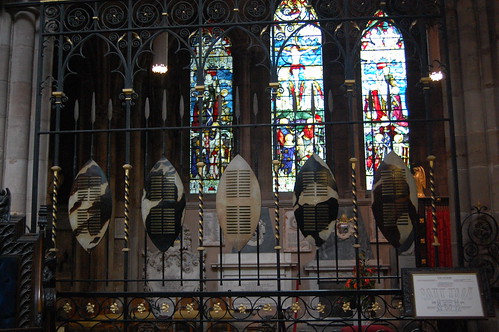
On the whole, ethnic stuff in English churches tends to consist of displays celebrating multiculturalism and interfaith understanding etc. So it was with some surprise that, when visiting Lichfield’s magnificent medieval cathedral I stumbled on this war memorial in the south transept. This in-your-face bit of Africa dates from just after the Anglo-Zulu War of 1879 (think Rorke’s Drift, think Michael Caine) and is just a teeny bit incongruous amidst the gothic widows and vaulted ceilings.
The whole Cathedral is magnificent by the way — there are other photos in my Flickr stream — and this isn’t the only cultural surprise. A memorial to Erasmus Darwin has the words:
“His speculations were directed towards problems which were afterwards more successfully solved by his Grandson, Charles Darwin, an inheritor of many of his characteristics.”
The NYT has an article about Bruce Sperling, who apparently publishes a series of rankings of U.S. cities, with separate rankings for Singles, Young Couples, Families with Children, Empty Nesters and Retirees. Through the magic of weighted averages (of data on economy and jobs; cost of living; climate; crime; transportation; arts and culture; etc) we get a string of Top-10 lists and more. Like many such ranking systems, Sperling is free to put his thumb on the scales if he feels that people are caring more about variable _x_ these days.
In the Top 10 for Singles are the fun, densely-populated places you might expect: New York, L.A., Washington, San Francisco, Chicago, etc. For Young Couples, we have cool hangouts like Portland, Austin, and Boulder. Empty Nesters get to kick back in Bellingham, Santa Fe, Tahoe and Berkeley.
But what does my demographic, Families with Children, get? Number 1 in the nation: Louisville CO. It’s followed closely by Gaithersburg MD. Roswell GA, Lakeville MN, and Flower Mound TX round out the top five. Now, I don’t want to offend the many fine people of Gaithersburg, MD or Noblesville IN, but Roll on the Empty Nest, I say.
_Update:_ Sorry, but I am going to resist sundry efforts in the comments and elsewhere to stretch this small joke to fit the Procrustean bed of “Elitist Liberals Hate Regular Folks and All-American Suburbs.” Dan Drezner thinks I display “shock” and “distress” at these family-friendly places and that part of me “shudders with dread about the exemplary suburban locale.” I don’t think so. New York … San Francisco … Gaithersburg. That is a set-up and punchline. It could be the opening montage of any number of comedies about family life. By the way, child-free urban hipsters in restaurants or shops can bite me, too.
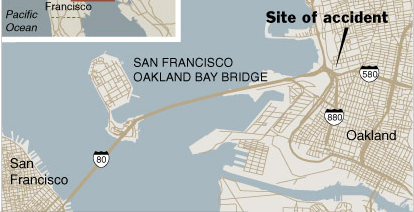
(04-29) 11:49 PDT OAKLAND — A huge ball of fire from an exploding gasoline tanker truck caused an overpass in the MacArthur Maze in the East Bay near the Bay Bridge to collapse on top of the highway below early Sunday, virtually ensuring major traffic problems and confusion for weeks to come. The intense heat crumbled the elevated roadway that carried eastbound traffic from the Bay Bridge onto Interstates 580 and 980 and state Highway 24. The broken concrete fell like a blanket over the connector roadway from southbound Interstate 80 to I-880.
Sad news. Jane Jacobs, thinker about cities, eclectic economist and brilliant nonconformist, about whom I’ve blogged a couple of times , died this morning in Toronto. Globe and Mail and Toronto Star among others have reports.
Over at 2 Blowhards, Michael Blowhard has a nice piece about Jane Jacobs . It was kind of hard to stop myself writing ‘about “the great” Jane Jacobs” in that last sentence”! There’s a useful set of links too. I’m kind of surprised by some of them. I know that Jacobs defies left–right categorization, but Jacobs as an unwitting reproducer of “Austrian” economics? That’s hard to square with her somewhat nutty views on import substitution. It illustrates something, though: that people are so taken with Jacobs’s brilliance in “The Death and Life …” that they really really want to believe that she simply must fit into their own worldview somehow. Usually, she doesn’t. She’s just too angular to fit neatly into anyone’s system or ideology.
Via a page devoted to Swedish dance bands of the 1970s, I happened upon Eurobad 74 “an exhibition of Europe’s worst interiors of 1974”. I have no idea what the horse is doing in #4, nor why the child is lifting the woman’s mini-skirt in #11, but it is indeed hard to imagine interiors much worse than these, even in 1974.
I’m in Madison Wisconsin for the week and enjoying my first experience of the US away from the east coast. As visitors are, I keep being struck by the micro-details of life and how they differ from the UK. Harry and I just had lunch in a student cafeteria. Having finished our sandwiches we got up to get some coffee from a machine and simply left our coats and bags by our table whilst we did so, even though they were not always in sight. The cafeteria was also organized with the tills at one end and the seating back in the same space as the self-service access to food. Everyone stands in line and pays before taking their seats. All of this is radically different from the UK where (a) one learns from an early age to hang on to all one’s property because otherwise it will be stolen and (b) where given an opportunity to take food from the university, sit down and eat it and not pay, many (even most) students would do so.
(On the downside, the built environment has far too much concrete, especially on roadways and pavements (flagstones would make such a difference) and people eat dinner barbarically early — 6pm!!).
(On the very downside, I tuned into Country Music TV in my hotel room and found no overlap whatsoever with the stuff that gets played by Bob Harris : Emmylou, Steve Earle, Gillian Welch — forget it — it is all wall-to-wall pap by people wearing cowboy hats. Appalling.)
 Via
Via