I always liked the Goodies more than the Pythons. Sillier, far less intellectual, funnier, and almost never stumped by the lack a punchline. My children have seen all the episodes available on DVD

From the category archives:
Humor
Utter genius. But watch it now – I suspect that when “This constitutes a fair use of Disney’s Donald Duck” meets a takedown notice from the Mickey copyright mafia, the takedown notice is going to win.
Brayden King plays around with one of those toy textual analysis tools.
bq. Who do you write like? Enter a few paragraphs of your text in this website’s analysis engine and it’ll spit out a famous author whose writing yours closely resembles … It turns out many sociologists’ writing resembles the prose of H.P. Lovecraft, whose guiding literary style was “cosmic horror” and who is associated with the subgenre weird fiction.
This begs further discussion, and, if people have the talent and inclination, mash-ups.
Horrible Histories (the best thing currently on television in Britain?) takes a less jingoistic view of Britain than the Ladybird Books — the 3 minutes history of the British Empire is, alas, not yet up on youtube, but there’s plenty else there: Witchfinders Direct; Christians versus Lions; Born 2 Rule; etc.
Btw, according to wikipedia, not only was Titus Oates not really called Titus (I always thought it was odd that there were two of them), but he disliked Scott intensely, which makes the whole thing seem even more tragic.
 Like Maria, I haven’t exactly been ROFL in response to the trying-to-be-funny material floating out there today, but the Electronic Frontier Foundation‘s newsletter did impress me. Since it doesn’t seem to be on EFF’s homepage, and since they’ve explicitly stated that we can repost the whole thing, I’m doing so after the jump. (I hope they won’t mind my playing with their logo either.) Enjoy! [click to continue…]
Scott McLemee has the sordid details.
Last month, the Washington, D.C., newspaper Politico revealed the existence of a secret online discussion group for left-tilting reporters and academics called JournoList. The article provoked a furor of denunciation among right-wing bloggers, who took the existence of an Obamaphile wonk cabal as proof that something darkly conspiratorial must be afoot. … So you can imagine my surprise when, a few days later, I discovered the existence of an even more well-concealed e-mail group. It connects up the nation’s most powerful academics. For the sake of this article we can call it AcademoList. …
Scott is now in hiding – but the truth must get out. And there are more shocking revelations to come. Scott has discovered that:
AcademoList’s cover was nearly blown in 2006, when David Horowitz published The Professors: The 101 Most Dangerous Professors in America. In spite of the subtitle, the book actually listed only 100 dangerous professors. At the time, scarcely anyone noticed this. And if they had, it would not have been too surprising, since it was obvious that considerable ingenuity had been required to get it up to that length. … The mysterious “dangerous professor number 101” turns out to have been one of the founders of AcademoList — a truly sinister figure, and indeed the single most important player in the effort to subject the United States to both Islamic fundamentalism and the gay agenda.
Scott could only say so much, but I can now reveal that the secret 101st Dangerous Professor in America is _David Horowitz himself_ (he holds endowed chairs _in pectore_ at Yale, Harvard and Princeton). He is also the Fourteenth (sic) Imam and the Beast Foretold in the Book of Revelations. Further Fun AcademoList Factz:
- Mickey Kaus was invited to be one of the founding members of Academolist (he too holds an _in pectore_ appointment, as Snifre-Bedschietz Chair in American Politics at Long Beach College) but balked when he learned that he would have to sacrifice a goat to Shub-Niggurath at the initiation ceremony.
- In addition to Aristotle’s lost treatise on comedy and the True Vindication of Camille Paglia, the AcademoList secret library hosts the skulls of Vannevar Bush and William F. Buckley Jr. Persistent rumours suggest that it also holds a birth certificate with Stanley Fish’s real name (and it ain’t Morris Zapp).
- The comments sections to _Inside Higher Ed_ columns reflect the ongoing research activities, and plans for future world domination, of one of AcademoList’s most distinguished emeritus members, Dr. Alphonse Moreau.
Further revelations are promised (and should anyone have additional useful information that they wish to share in comments, anonymously or otherwise, we are happy to guarantee their safety).
Gideon Rachman identifies a hitherto unknown apparatus of Britain’s bureaucracy.
However, I have now discovered a genuine government department with a title straight out of Dickens – it is the Department of Sensitive Words. This excellent institution has been brought to my attention by a man who is trying to establish a think-tank and to use the word “Institute” in its title. Since my friend is still involved in sensitive negotiations with the Department of Sensitive Words, I have promised not to reveal his identity. The problem is that Companies House deems certain words as “sensitive” because they are thought to convey an impression of authority or trustworthiness. Institute is one such word; British is another. If you want to use a word like this you have to get special permission from a sub-unit of Companies House – the Department of Sensitive Words, which is based in Swansea. In true Dickensian style, this is not an easy process. Companies House does provide a few guidelines on sensitivity on its web-site (its chapter three). But there is no form you can fill in and no obvious criteria to fulfill. But this is probably for the best. You don’t want any old person calling themselves “British” or “Institute”.
This is an _excellent_ idea, and one which should have been implemented in the US decades ago. From Kim Phillips-Fein’s new book, _Invisible Hands: The Making of the Conservative Movement from the New Deal to Reagan_ (Amazon, Powells)
In 1962,the executive committee of the board of trustees recommended that [the American Enterprise Association] change its name to the American Enterprise Institute for Public Policy Research, so that it would no longer be confused with a “trade association” lobbying on behalf of business: the new name would “more accurately describe the nature and legal status of the organization.” An “association” sounded like the Chamber of Commerce or the National Association of Manufacturers – an institute, on the other hand, was austere, noble and pure.
Heaven forfend that the American Enterprise Institute would _ever_ be confused with a group of people shilling on behalf of business.
More generally, there is a real problem in a political system where an organization with a grand title such as Americans for Fairness, Liberty and Free Choice in the Workplace (this is an invented organization using some of the usual buzzwords – I imagine that lobbyists automate the process of name creation with a sekrit perl script) typically consists of nothing more than a few reams of letterhead and a time-share arrangement over some law office’s fax machine. Not only will consumers will end up confused by the profusion of astroturf groups, but the generation of such confusion is precisely the purpose. It is just this kind of market failure that governments are supposed to address.
Hence my modest proposal – that the Obama administration set up a similar office, with sweeping authority and immediate effect. I can see that libertarians might possibly get upset, but they really shouldn’t. After all, they suffer more than most from the market failure in question. The term ‘libertarian’ has been heavily debased over the last few years by groups and individuals who describe themselves as libertarians, but are committed to state torture of suspected bad guys, semi-ubiquitous surveillance of electronic communications and the like. One of the first tasks that the US Inter-Agency Task Force on Sensitive Words might set itself would be to institute a proper set of standards to police self-described libertarians, clearly distinguishing between libertarians themselves (the real thing), schmibertarians (those tacitly in favour of torture and surveillance), glibertarians (those who prefer not to think about political commitments that extend beyond a cheery embrace of Econ 101 as teh awesome) and Gibletarians (I _WANT_ SLOW THROTTLING!!! AND I WANT IT NOOWWWW!!!!!!). I can’t see how this wouldn’t improve our public discourse.
I imagine that everyone in Philosophy is discussing the NYT review which asserted, without qualification, that Wittgenstein was the greatest philosopher of the 20th century. Leiter proposes to settle the issue once and for all with an internet blog poll. Go and vote. (I haven’t voted because I don’t know the answer. Carnap? Sellars? Moore? Merleau-Ponty? or, perhaps, John-Paul Sartre….
A few years ago, I wrote that
Nearly every corridor in every building of the Commission, Council and Parliament has two or three examples [of EU official art] along its walls – spectacularly bland and uninteresting prints and photographs, always with the twelve stars on a blue flag in there somewhere. The art is contentless and affectless because any strong statement, or even conveyed sense of geographic location, would probably offend somebody in one or another of the member states. There’s something about the EU that seems completely inimical to lively cultural expression.
Now a Czech art-prankster has put this theory to its test, and found that member states are indeed liable to get offended.
Sited prominently in the headquarters of the EU Council in Brussels, a flagship work of art – which was designed to demolish national stereotypes by mocking them – has caused diplomatic outrage. Not only that, the piece turns out to be the work of a single Czech artist despite having been billed as the collaborative effort of all 27 member states. … As countries digested depictions of their character, such as a Dracula-inspired theme park (Romania), a rudimentary lavatory (Bulgaria) and a flooded land with minarets poking through (the Netherlands), the Czech presidency was forced into a public apology. … Other national depictions in the artwork include: Luxembourg as a lump of gold on sale to the highest bidder; France emblazoned with the word grève , or strike; Denmark made of Lego; and Sweden lying within an Ikea flatpack. Britain is simply missing – supposedly a reference to its euro-scepticism. But some diplomats appear in little doubt of what action they would like to see, namely the removal of the eight-tonne “modern art installation” from the bleak and lofty but all-too prominent atrium of the council’s main building.
In fairness, the artist seems to have gone out of his way to prod national sore spots – other depictions include Germany (autobahns making up a rather thinly disguised swastika) and Poland (a group of monks erecting the Rainbow flag). Pictures below.


According to Arnie, McCain has 100% of the vote. Well, it made me laugh.
Some unkind lefties (including one of my co-bloggers) were a little dismissive towards this post by ‘Dr. Helen,’ blogger and Instaspouse of Professor Glenn Reynolds.
Why the crescendo of economic collapse right before the election? Why didn’t the media and congress act just as concerned some time ago or wait until sometime after the election to go into crisis mode? The timing of the current financial crisis seems too planned and calculating to be just a coincidence. Polls show that people’s number one concern right now is the economy and that for the most part, voters believe Democrats are somewhat more likely to help with the economy. Could it be that the liberal media and those in Congress, knowing that, is blaring the bad economic news from the rooftops in order to manipulate voters into voting for a Democrat? If so, it won’t be the first time.
But now Barbara Ehrenreich (via Cosma ) has let the cat out of the bag and it’s _even worse_ than Dr. Helen suspected.
[click to continue…]
Happy New Year! And now back to our regularly scheduled political programming (NSFWish):
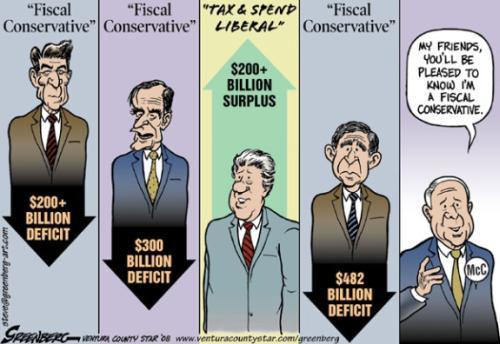
I’m reposting this “Fiscal Conservative” cartoon with permission from Steve Greenberg, Ventura County Star, California:
Bob Herbert’s recent column summed up a lot of my sentiments:
Ignorance must really be bliss. How else, over so many years, could the G.O.P. get away with ridiculing all things liberal?
Or are some of us overreacting?
Kieran and I (anyone else from around here?) are heading to the annual meetings of the American Sociological Association this weekend. While I think playing buzzword bingo at a presentation is a bit rude, the idea of having a bingo card for the whole conference seems more reasonable. Kieran’s put together a really fun one [pdf], check it out, it can likely be tweaked quite easily for endless amusement at your own upcoming convention.
Possible additions/substitutions?
- Mac user surprised that cable won’t connect to projector
- Use of PowerPoint in Normal View instead of Slide Show
- Aimless lingerer at book exhibit
- Loitering at book exhibit in hopes of finding editor
- “But you didn’t write the paper I would have written” comment during Q&A
- Never-ending comment posing as question during Q&A
I keep referring to this cartoon in conversations and people keep telling me they have no idea what I’m talking about so I’m just going to put it here with the hope that it spreads to more and more folks. (I know some of you have already seen it, Vivian linked to it in her comment here. Nonetheless, it deserves its own post.)
It’s amazing how well it tells so much. It reminds me of specific experiences throughout my life from high school through graduate school (although the latter not in my department, to be fair). Plus one encounters this type of attitude online all the time.
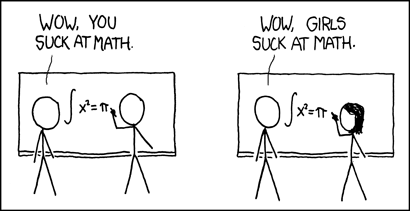
Thanks to xkcd. I’d buy this one on a T-shirt, but it’s not in the store. The college-style XKCD is tempting.