by John Holbo on May 17, 2011
Lots of folks are bemused by Joly’s apparently critical statement that New York justice “doesn’t distinguish between the director of the I.M.F. and any other suspect.” Obviously there is a natural presumption in favor of equality. But the Times article also contains a video link to the full interview in which Joly’s own next words are something like, ‘this is the idea of equality before the law, but clearly for a director of the IMF …’ and then, clarity be damned, my ear is incapable of catching the bit that finishes the thought. What does she say?
UPDATE: Obviously feel free to discuss Joly’s ideas more generally. The argument against a perp walk, because it is inconsistent with presumption of innocence, is cogent. And obviously famous/powerful people like IMF directors are the people who risk losing their presumption of innocence in this way. So we have that rare case in which formal equality amounts to effective bias in favor of the weak and powerless. But it seems like a big mistake to say it is all just Big Apple barbarism – or, rather, Rome-style triumphalism, the defeated Gaul chief paraded in chains for the populace to see! The wealthy and powerful are not exactly without power and wealth, after all, so the prosecutor’s office, in a town full of rich, influential people, should ideally have effective general strategies they pursue, as a matter of course, to make sure they aren’t steamrollered by that. What do you think?
by John Holbo on May 6, 2011
Despite having recently co-edited a book on Moretti’s work [free! free download, or buy the paper!], I haven’t yet commented on his Hamlet paper, which Kieran brought to our collective attention. Because I only just now got around to reading it, and sometimes it’s good practice to hold off until you do that, even though this is the internet and all.
First things first: if you can’t access the LRB version, there’s a free, longer version available from Moretti’s own lab.
Right, the whole thing reminds me of that memorable scene in the play in which Hamlet puts on a PPT presentation, representing social networks in The Marriage of Gonzago nudge nudge wink wink. (Apparently he’s been working on this stuff at school for years.) And Ophelia doesn’t really get it and Hamlet helpfully explains: “Marry, this is miching mallecho; it means mischief.”
But seriously, folks. I like the paper, and I don’t like it. On the one hand, I wholeheartedly endorse this bit. Or at least I would very much like to be able to. [click to continue…]
by Chris Bertram on October 28, 2010
Thanks to some FB comments by Marc Mulholland, I see that there’s an interesting bit of rhetorical back-and-forth going on in British politics today. Labour claims that ConDem plans to cap housing (and other) benefit payments will have the effect of forcing poor people out of London and therefore amount to “social cleansing”. Useful idiot Deputy Prime Minister Nick Clegg pretends to be outraged :
bq. To refer to cleansing would be deeply offensive to people who have witnessed ethnic cleansing in other parts of the world.
Unfortunately, for him, in a flanking manoeuvre from the right, London mayor Boris Johnson (Tory) then repeats the charge , making it more explicit and destroying its metaphorical character:
bq. What we will not see, and will not accept, is any kind of Kosovo-style social cleansing of London.
None of this, including the faux-outrage from Clegg, would surprise anyone who has hung around the blogosphere since 2001, since charges of “moral relativism”, “moral equivalence” and “you are implicitly comparing X to Y how dare you!” are the common currency of wingnuts and “decents” alike. This one is mildly interesting, though, because it is a complaint about the adaptation of what was originally a piece of “unspeak”: a euphemism. The complaint depends for its force entirely on the euphemism being understood non-euphemistically, if you see what I mean. I see from some discussion at the Unspeak site, that Steven Pinker has a name for this: the “euphemism treadmill”.
bq. People invent new words for emotionally charged referents, but soon the euphemism becomes tainted by association, and a new word must be found, which soon acquires its own connotations. ( _Blank Slate_ p.212).
by John Holbo on September 28, 2010
If she is going to be complaining about lack of erudition under headlines like this:
On Basic Religion Test, Many Doth Not Pass
Hat tip: Belle (she was just standing right next to me, so I can’t link to it). “Did they learn about religion from a bunch of old Thor comics?” Belle wants to know.
Speaking of which, our daughters actually use ‘doth‘ in this wrong way quite a bit, because I bought them Mini Marvels [amazon], which is pretty good.
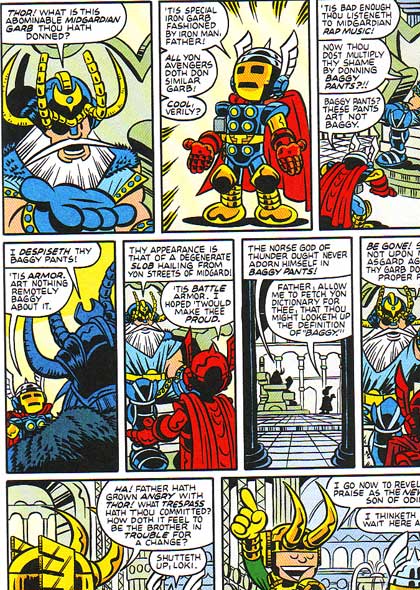
I cut off the final joke: namely, Loki actually is wearing baggy pants. But I think it’s funnier if the joke is just about systematic abuse of language.
UPDATE: Yon Gray Lady Hath Fixethed It.
by Chris Bertram on September 8, 2010
I recently had the pleasure of attending the European Society for Philosophy and Psychology conference in Bochum, Germany . The highlight for me was attending a talk by Michael Tomasello of the Max Planck Institute, Leipzig on pre-linguistic communication. Getting home, I ordered a copy of Tomasello’s Why We Cooperate in which he argues, on the basis of detailed empirical work with young children and other primates, that humans are hard-wired with certain pro-social dispositions to inform, help, share etc and to engage in norm-guided behaviour of various kinds. Many of the details of Tomasello’s work are controversial (the book is essentially his Tanner Lectures and contains replies by Silk, Dweck, Skyrms and Spelke) and I lack the competence to begin to adjudicate some of the disputes. But this much is, I think, clear: that work in empirical psychology and evolutionary anthropolgy (and related fields) doesn’t – quelle surprise! – support anything like the Hobbesian picture of human nature that lurks at the foundations of microeconomics, rational choice theory and, indeed, in much contemporary and historical political philosophy.
[click to continue…]
by John Holbo on August 12, 2010
From Vincent Scully’s introduction to Robert Venturi’s Complexity and Contradiction in Architecture: “This is not an easy book. It requires professional commitment and close visual attention, and is not for those architects who, lest they offend them, pluck out their eyes.” Two pronouns clash in too slight a clause, like two travelers crashing in too tight a doorway, who, lest they perchance have been switched by them, check whose piece of luggage is whose. Ahem. The Fascist octopus, lest it … aw, this is too hard.
by John Q on March 31, 2010
by John Q on October 28, 2009
A week or two ago I was doing a bit of work on the Wikipedia article on political correctness, and I came up with what may well be the first introduction of the term (initialised as “p.c.”) to the general public, as represented by the readership of the New York Times, in an article by Richard Bernstein.
At least since the 1970s, the description “politically correct” or, in Australia, “ideologically sound”, had been used within the left to mock those who were excessively concerned with doctrinal and linguistic orthodoxy. The story of how “political correctness” turned from an inside joke to a Marxist-inspired assault on All We Hold Dear is reasonably well known. Bernstein traces its emergence as a pejorative to a conference by the Western Humanities Conference held, appropriately enough, in Berkeley.
For me, at least, the real surprise in this article came right at the end, with a quote from Roger Kimball, now of Pajamas Media, who said “It’s a manifestation of what some are calling liberal fascism”. Apparently, Jonah Goldberg owes him royalties.
Update I haven’t made proper use of the excellent NYTimes search facility until now. This search shows a string of sardonic references to political correctness in the Arts section (and one reference to its use by the Chinese CP) appearing in the years before Bernstein’s piece. After that, there’s an explosion). And “liberal fascism” made its first outing (post-1980 at any rate) in a 1988 story about the Dartmouth Review, spoken by then editor Harmeet Dhillon.
by John Holbo on October 7, 2009
More translation mysteries tonight. Conservapedia is calling for a Conservative Bible Project.
As of 2009, there is no fully conservative translation of the Bible which satisfies the following ten guidelines:[2]
1. Framework against Liberal Bias: providing a strong framework that enables a thought-for-thought translation without corruption by liberal bias
2. Not Emasculated: avoiding unisex, “gender inclusive” language, and other modern emasculation of Christianity
3. Not Dumbed Down: not dumbing down the reading level, or diluting the intellectual force and logic of Christianity; the NIV is written at only the 7th grade level[3]
4. Utilize Powerful Conservative Terms: using powerful new conservative terms as they develop;[4] defective translations use the word “comrade” three times as often as “volunteer”; similarly, updating words which have a change in meaning, such as “word”, “peace”, and “miracle”.
5. Combat Harmful Addiction: combating addiction by using modern terms for it, such as “gamble” rather than “cast lots”;[5] using modern political terms, such as “register” rather than “enroll” for the census
6. Accept the Logic of Hell: applying logic with its full force and effect, as in not denying or downplaying the very real existence of Hell or the Devil.
7. Express Free Market Parables; explaining the numerous economic parables with their full free-market meaning
8. Exclude Later-Inserted Liberal Passages: excluding the later-inserted liberal passages that are not authentic, such as the adulteress story
9. Credit Open-Mindedness of Disciples: crediting open-mindedness, often found in youngsters like the eyewitnesses Mark and John, the authors of two of the Gospels
10. Prefer Conciseness over Liberal Wordiness: preferring conciseness to the liberal style of high word-to-substance ratio; avoid compound negatives and unnecessary ambiguities; prefer concise, consistent use of the word “Lord” rather than “Jehovah” or “Yahweh” or “Lord God.”
They are basically planning to start with the King James Bible and then just make it say what they think it should. Not only do they apparently regard it as inessential to involve anyone with knowledge of the original texts – although they off-handedly contemplate this as a possibility – they are touting ‘mastery of English’ as one of the benefits those who help with the project can expect to reap. What can one say? I find it hard to believe the whole thing isn’t some sort of elaborate, Borat-style hoax. Could it be? (Is Conservapedia for real?) Discuss.
via Sadly, No!
by John Holbo on October 6, 2009
It has come to my attention that Terry Pratchett’s discworld novel, Thud! …
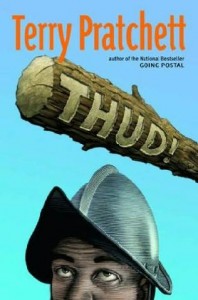
is available in German translation under the title, Klonk!:

I think German readers must lose some of the heavy, earthiness of the English word in translation. ‘Klonk!’ is lighter and more metallic. I don’t think it means the same thing as ‘thud!’ Discuss.
by John Holbo on September 17, 2009
I’m lecturing on cosmopolitanism tomorrow, so the mind turns to origins and starting points. Diogenes said he was a ‘citizen of the world’ – that is, kosmopolitês. But it occurred to me today that, actually, that’s not a good translation. Better: citizen of utopia. Or, a bit more modestly: citizen of the well-ordered state. Or: citizen of wherever they’ve actually got good government. I can’t get the Perseus Project to load right now, so I’ll settle for this. ‘Kosmos’ originally meant harmony, well-orderedness (in a military or ornamental sense). Pythagoras may (or may not!) have given the term its earliest astronomic usage, inspired by a sense of the gloriously ornamental orderliness of the heavens; it seems doubtful that Diogenes could have accessed that new sense sufficiently to extend it to mean ‘the world’, and, by further extension, ‘all of humanity’. He was just saying his allegiance was to the truly good and proper. This naturally goes together with cosmopolitanism, in our sense, because it’s a reproach to ‘my country, right or wrong’ sentiment. But ‘I’m a citizen of the best country’ just isn’t the same thought as ‘the best country would be a universal brotherhood of man’. Not that it’s exactly a burning issue, what this guy Diogenes thought. He’s dead (no, I don’t know where you can send flowers). Still, it’s kinda interesting. Am I missing something? Someone probably already wrote a paper about it anyway. That, or I’m missing something.
by John Holbo on September 10, 2009
Now why did my previous post garner scarcely a comment?
The Plain People of the Internet: It hadn’t any McArdle in it!
I: Surely, my good man, we have not come to such a pretty pass as that.
The Plain People of the Internet: But here we are, and here you are.
I: I prefer to think it was due to modesty. False modesty, perhaps. But if it weren’t for false modesty, some people would have no modesty at all. Or so I like to flatter myself.
The Plain People of the Internet: What are you babbling about, you great baby, and bottomless bag of blog posts!
I: In my post, I quoted John Kricfalusi on the baneful influence of cool. “Why do young artists say they like UPA? Because it makes ‘em cool. Hipster Emo time. (It’s also easy to fake) It’s like when teenagers discover communism. They think it’s real cool to go against common sense and experience. But then when they meet the real world head on later, they realize it was youthful folly. You’re supposed to grow out of it. I too fell under the UPA spell for the 3 weeks I wanted to be cool.” But what is it, of which he speaks? A contrarian herd instinct, thus a bleating contradition in terms? An emo knee-jerk? What is the common denominator of Gerald McBoingBoing and the dream of One World Government? In short, what’s cool? Or if you prefer, what does ‘cool’ mean? Compared to this question, the trouble with McArdle’s opposition to health care is but a bagatelle.
The Plain People of the Internet: Blast your eyes!
I: I have been doing some research on the subject. Here is a passage from Charles Dickens, Great Expectations. Joe Gargery – honest soul, who wears his heart on his rolled up sleeve, as he works an honest day at the open flame of the forge – reports on what has become of Miss Havisham’s fortune: [click to continue…]
by Henry Farrell on August 2, 2009
From the _Shorter Oxford_ (old edition),
bq. _Corsned_ – in Old English law, the morsel of trial, a piece of bread consecrated by exorcism ( _panis conjuratus_ ) which an accused person was required to swallow as a trial of his guilt or innocence.
Consider this an open thread for the nomination of other words similarly obscure in usage and unusual in meaning that you’ve come across.
by John Holbo on June 26, 2009
OK, I’m fact-checking one last bit from my Plato book. I’m discussing the famous legend that over the door of Plato’s academy there was an inscription: ‘no non-geometers allowed’. Here’s a page that contains a bit of background if you are unaware of this legend (which is pretty weakly sourced to a commentary on a commentary on Aristotle, I think it is. So who knows.) Anyway, I mention in the text that there are religious overtones, which is most certainly true. But here’s my problem. I read somewhere that over the doors of Greek temples, or at the boundaries of certain holy areas – sites forbidden to those who are unclean, by the terms of Drako’s Law – ‘no unclean persons allowed’. I distinctly recall reading, specifically, that the unclean bit was ‘unjust’; that is, (I presume) ‘adikaios’. So take Plato’s ‘ageometros’, swap it out and plug in ‘adikaios’ and – bob’s your uncle – you’ve got the thing you might read over a temple door. Trouble is: I went back to footnote this bit and it wasn’t where I thought it was. So I’m wondering whether what I have in my book is strictly accurate. Are there surviving inscriptions that are almost like the one Plato is supposed to have put over his door, with only one word different? Or are there reliable reports of the existence of such inscriptions? It’s not a big deal, because the general point about religious overtones stands: the inscription forbids the ‘impure’ from entry, as Drako’s law forbids access to ‘the holy things’ to those who are presently ritually unclean (for whatever reason). But I don’t want my book sullied by the impure inclusion of an epigraphic untruth, Zeus forbid!
by John Q on February 19, 2009
With even Alan Greenspan and Lindsey Graham now in support, and the alternatives canvassed in the Geithner “plan” thoroughly discredited (even Wall Street hated it), large-scale nationalization of US banks now looks inevitable. But, as Obama has observed, this kind of thing seems alien to US culture.
This looks like a classic Lakoff framing problem. How can the obviously necessary, also be made to seem natural? There have been a couple of approaches so far.
The first is to emphasise that the Federal Deposit Insurance Corporation routinely takes over failed banks. So, as Paul Krugman puts it “nationalization is as American as apple pie“.
The second is to focus on the ultimate goal which is to return the banks to solvency and private ownership. Hence the lovely euphemism coined (I think) by Calculated Risk “preprivatisation”
[click to continue…]