So the Trump administration has just pulled the US out of the World Health Organization, WHO.
WHO is the biggest and most important international health organization. It’s an arm of the United Nations. It’s been around since 1948. Almost every country in the world is a member.
Most people have only the vaguest idea of what WHO is or what it does. Teal deer, they do a lot of different stuff, most of it pretty good. They were crucial to eliminating smallpox a while back. They come up with cool ideas like a list of essential medicines and health care products that are cheap and easy to produce, along with easy how-to guides on producing them. They do all sorts of research, especially on public health. They were deeply involved in controlling Ebola. (You haven’t heard much about Ebola lately, right? Thank USAID and WHO.)
To be fair, WHO also has some significant negatives. It’s part of the UN system, so it skews slow and inefficient. WHO leadership did not handle COVID well… I mean, they really did not handle COVID well. They made bad, dumb choices based on not offending (some) member countries, and then they doubled down. It wasn’t great.
But anyway! I have one personal story about WHO, from my time in development, below the cut.
[click to continue…]
From the category archives:
Work
Having watched the film, I thought I’d get Robert Linhart’s book off the shelf and finally read it. I think I bought it in Oxford in the early 80s. To remind you, it depicts Linhart’s experience as a Maoist cadre who has chosen to get a job in a Citroen factory in Paris in order to foment “resistance”. There’s an English translation, apparently, called The Assembly-Line, long out of print.
One reason for my hesitance in reading, perhaps, is that I have quite a low opinion of Maoists, particularly Western ones, and I’m sure that Linhart had at the time all kinds of dubious opinions about the Moscow Trials or the Cultural Revolution, but there’s really none of that in the book where he comes across as a fairly generic far-leftist. Instead there’s a fascinating description by someone with real literaray talent of the human reality of mass production as it was in the 1960s and probably still is somewhere other than Europe. It aslo gives an account of the ethno-sociology of the workforce which was “multicultural” long before the rest of society meaningfully was. Possibly the best book ever written by a Maoist then.
When Linhart enters the factory it is very different to how he imagined it would be, which was an assembly line shifting in short bursts as workers performed their tasks. Instead, the line moves continuously with workers running to catch up trying do their jobs quickly so they can get ahead of the game and sneak a quick cigarette or taking too long and getting tangled up with the next section. A manager puts him in the hands of a spot welder, who makes his movements with speed, precision and grace. But when that same Arab worker hands over to Linhart the novice makes a complete mess, molten solder all over the place, and he’s a danger to others and himself with his blowtorch. In a break they get chatting and he discovers that his “trainer” is graded as an unskilled worker (despite showing consummate skill) whereas he, Linhart, has been taken on at a skilled grade. But it soon becomes clear that the assignment of workers to grades has nothing to do with the skills those grades nominally represent: blacks are at the lowest unskilled level, Arabs at the higher unskilled ones, Spanish and Portuguese at the lowest tier of “skilled” and white French people like himself a notch above that, even if they can’t actually do anything. Who says there’s no such thing as “white privilege”?
 If you want to know more about how the current form of capitalism is undermining (a thick conception of) democracy, and what can be done about this, then you should read Lisa Herzog’s latest book The Democratic Marketplace. The book is written for a broad audience, and I suspect that anyone who regularly reads this blog will enjoy Lisa’s book and learn something new; and it will also provoke debate and discussion on important questions regarding the state of our economic system, our democracies, and how these two are related.
Lisa argues that genuine democracy (which is much more demanding than merely elections/counting votes) requires that democratic values be embedded in all public spheres of life. And therefore we should democratize the economy. This requires, among other things, workplace democracy, reducing economic inequality, shifting our focus from economic growth to the functions of the economy, and adopting a different policy of time that allows citizens to do the much-needed democratic work.
This Thursday 20 November, between 14:00 and 16:00 hours CET, the Visions for the Future Project is organizing an online discussion of Lisa’s book. Julie Rose and Tom Parr will kick off with comments. The online book workshop will take place via MS Teams. To get the link (which you will get within the next working day after registering), you can register via the link on the bottom of the event’s announcement page. Enjoy the reading, and enjoy becoming inspired to take (more) civic action by reading (and discussing) Lisa’s book!
(Originally drafted for a conference at Frankfurt in 2018 to mark the 40th anniversary of Karl Marx’s Theory of History: A Defence. I’ve done a bit of editing of my conference script and added a few footnotes etc, but it isn’t necessarily produced to the scholarly standards one might require of a journal article.)
In Karl Marx’s Theory of History, G.A. Cohen attributed many of the ills of capitalism to the market mechanism. Later in his career he came to see the market as practically ineliminable. Insofar as he was right about the market in his earlier work, it may turn out that the alternatives to capitalism he championed at the end of his life will also generate the pathology he deplored: the systematic bias in favour of output over leisure and free time. The following explores some of these tensions.
Introduction
In the second half of his career, G.A. Cohen concentrated his discussion of capitalism on its wrongs and injustices. According to his diagnosis, the primary injustice in capitalism arose from the combination of private property and self-ownership, which enables capitalists – who own the means of production – to contract with workers – who own only themselves and their labour power, on terms massively to the capitalists’ advantage. The workers, who produce nearly all of the commodities that possess value in a capitalist society, see the things that they have produced appropriated and turned against them as tools of exploitation and domination by the capitalists. But the wrongness and injustice of capitalism, the theft of what rightfully belongs to workers, is only one part of what is to be deplored about capitalism. In chapter 11 of Karl Marx’s Theory of History, a chapter where he went beyond the expository and reconstructive work he undertook earlier in the book, Cohen articulated a different critique, this time focused not on injustice but on the ills to which capitalism gives rise. In that chapter he attacks capitalism for stunting human potential through a bias towards the maximization of output, a bias which condemns human beings to lives dominated by drudgery and toil. Relatedly, he attacks capitalism both for stimulating demand for consumption that adds little of real value to people’s lives and because for damaging of the natural environment through pollution. In developing this critique, Cohen also notes that the bias towards output he identifies is celebrated by Max Weber as exemplifying rationality itself, a celebration which Cohen thought ideological and mistaken.1
Though both the wrongness and the badness of capitalism arise from the conjunction of private property and the market, it seems natural to emphasize the role of private property more in the production of injustice and to stress market relations more in the genesis of its badness. It is the fact of what the capitalists own that gives them decisive leverage over workers in the labour market, making exploitation within the workplace consequently possible; it is the market that compels everyone, capitalists and workers both on pain of extinction, to act in ways that end up being so destructive for human and planetary well-being.
It’s International Workers Day, still celebrated as the May Day public holiday here in Queensland, at least when the Labor party is in office. So, it’s a good day for me to set out some tentative thoughts on work and its future.
Via Matt McManus, I found this quote from Marx ‘Fragment on Machines”.
The hand tool makes the worker independent — posits him as proprietor. Machinery — as fixed capital -posits him as dependent, posits him as appropriated
Reading this, it struck me that, whereas mainframe computers were archetypal examples of impersonal and alienating machines, personal computers are, or can be, regarded as extensions of their users, that is, as tools. Employers have long struggled to exert control over office computers and the workers who use them, making them extensions of the machine that is corporate IT. But these efforts have always been resisted, and have broken down, to a large extent, with the shift to remote work. My intuition, following Marx, is that this development presages a bigger shift in the relationship between between workers and bosses.
[click to continue…]
My latest in Inside Story, reposted from Substack
Managers need to recognise that the best way to dissipate authority is to fail in its exercise
Authority is powerful yet intangible. The capacity to give an order and expect it to be obeyed may rest ultimately on a threat to sanction those who disobey but it can rarely survive large-scale disobedience.
The modern era has seen many kinds of traditional authority come under challenge, but until now the “right of managers to manage” has remained largely immune. If anything, the managers’ power has increased as the countervailing power of unions has declined. But the rise of working from home and, more recently, Labor’s right to disconnect legislation pose unprecedented threats to the power of managers over information workers — those employees formerly known as “office workers.”
To see how this might play out, it’s worth considering the decline of another once-powerful authority, the Catholic Church.
In the early 1960s, following the development of reliable oral contraception, the leaders of the church had to decide whether to accept the Pill as a permissible way for married couples to plan their families. Pope John XXIII established a pontifical commission on birth control to reconsider Catholic doctrine on this topic.
It was a crucial decision precisely because marriage and sex were the most important areas in which the authority of the Church remained supreme and precise rules could be laid down — and generally enforced — among the faithful.
Most people, after all, have no trouble observing the commandments against theft and murder. Other sins like anger, pride and sloth are very much in the eye of the beholder. But the rules regulating who can marry whom and what kind of sexual behaviour is permissible are precise and demanding, to the point that the term “morals” is commonly taken to imply sexual morals. The official celibacy of priests, who thereby showed even more restraint than was demanded of ordinary Catholics, added to the mystique of clerical power.
By the time the commission reported in 1966 John XXIII had been replaced by Pope Paul VI. The commission concluded that artificial birth control was not intrinsically evil and that Catholic couples should be allowed to decide for themselves about the methods they employed. But five of the commission’s sixty-nine members took the opposite view in a minority report.
In the encyclical Humanae Vitae, Pope Paul VI made his fateful rejection of all forms of artificial contraception. As an attempt to exercise and shore up authority it failed completely. The realities of raising large families and dealing with unplanned pregnancies were far removed from the experience of priests and theologians. And the church’s evident demographic motive (the desire for big Catholic families to fill the pews) further undermined the legitimacy of the prohibition.
Previously loyal Catholics ignored Pope Paul’s ruling, in many cases marking their first step away from the Church. Doctrines restricting marriage between Catholics and non-Catholics, including the requirement that children be raised as Catholics, also became little more than formalities commanding at most notional obedience.
The breakdown of clerical authority set the scene for the exposure of clerical child abuse from the 1990s on. Although accusations of this kind had been around for many years, the authority of the church had ensured that critics were silenced or disbelieved.
It is hard to know for sure what would have happened if Pope Paul had chosen differently. The membership and social standing of Protestant denominations, nearly all which accepted contraception, have also declined, though not as much as a Catholic Church that pinned its authority on personal morality. Humanae Vitae’s attempt to exercise papal authority succeeded only in exposing its illusory nature.
In the struggle over working from home and the “freedom to disconnect” we’re seeing something similar happen to the authority of managers.
Following the arrival of Covid-19 in early 2020, working from home went from being a rare indulgence to a general necessity, at least for those whose work could be done with a telephone and a computer. Hardly any time was available for preparation: in mid March, Scott Morrison and Anthony Albanese were still planning to attend football matches; a week later, Australia was in lockdown.
Offices and schools closed. Workers had to convert their kitchen tables or (if they were lucky) spare bedrooms into workstations using whatever equipment they had available. And, to make things even tougher, parents had to take responsibility for the remote education of their children.
Despite the already extensive evidence of the benefits of remote work, many managers expected chaos and a massive reduction in productivity. But information-based work of all kinds carried on without any obvious interruption. Insurance policies were renewed, bills were issued and paid, newspapers and magazines continued to be published. Meetings, that scourge of modern working life, continued to take place, though now over Zoom.
Once the lockdown phase of the pandemic was over, workers were in no hurry to return to the office. The benefits of shorter commuting times and the flexibility to handle family responsibilities were obvious, while adverse impacts on productivity, if any, were hard to discern.
Sceptics argued that working from home, though fine for current employees, would pose major difficulties for the “onboarding” of new staff. Four years into the new era, though, around half of all workers are in jobs they started after the pandemic began. Far from lamenting the lack of office camaraderie and mentorship, these new hires are among the most resistant to the removal of a working condition they have taken for granted since the start.
Nevertheless, chief executives have issued an almost daily drumbeat of demands for a return to five-day office attendance and threatened dire consequences for those who don’t comply. Although these threats sometimes appear to have an effect, workers generally stop complying. As long as they are still doing their jobs, their immediate managers have little incentive to discipline them, especially as the most capable workers are often the most resistant to close supervision. Three days of office attendance a week has become the new normal for large parts of the workforce, and attempts to change this reality are proving largely fruitless.
The upshot is that attendance rates have barely changed after more than two years of back-to-the-office announcements. The Kastle Systems Back to Work Barometer, a weekly measure of US office attendance as a percentage of February 2020 levels, largely kept within the narrow range of 46 to 50 per cent over the course of 2023.
This fact is finally sinking in. Sandwiched between two pieces about back-to-the-office pushes by diehard employers, the Australian Financial Review recently ran up the white flag with a piece headlined “Return to Office Stalls as Companies Give Up on Five Days a Week.”
This trend, significant in itself, also marks a change in power relations between managers and workers. Behind all the talk about “water cooler conversations” and “synergies,” the real reason for demanding the physical presence of workers is that it makes it easier for managers to exercise authority. The failure of “back to the office” prefigures a major realignment of power relationships at work.
Conversely, the success of working from home in the face of dire predictions undermines one of the key foundations of the “right to manage,” namely the assumption that managers have a better understanding of the organisations they head than do the people who work in them. Despite a vast literature on leadership, the capacity of managers to lead their workers in their preferred direction has proved very limited.
The other side of the remote work debate is the right to disconnect. The same managers who insisted that workers should be physically present at the office in standard working hours (and sometimes longer) also came to expect responses to phone calls and emails at any time of the day or night. The supposed need for an urgent response typically reflected sloppiness on the part of managers incapable of organising their own work schedules to take account of the need for work–life balance.
Once again, managers have attempted to draw a line in the sand. Opposition leader Peter Dutton has backed them, promising to repeal the right to disconnect if the Coalition wins the next election. It’s a striking illustration of the importance of power to the managerial class that Dutton has chosen to fight on this issue while capitulating to the government’s broken promise on the Stage 3 tax cuts, which would have delivered big financial benefits to his strongest supporters.
Can this trend be reversed? The not-so-secret hope is that high unemployment will turn the tables. As Tim Gurner (of “avocado toast” fame) put it, “We need pain in the economy… and employees need to reminded of who is boss.” US tech firms have put that view to the test with large-scale sackings, many focused on remote workers. But the other side of remote work is mobility. Many of those fired in the recent tech layoffs have found new jobs, often also remote.
In the absence of a really deep recession, firms that demand and enforce full-time attendance will find themselves with a limited pool of disgruntled workers dominated by those with limited outside options.
Popular stories — from King Canute’s attempt to turn back the tide (apparently to make fools of obsequious courtiers who suggested he could do it) to Hans Christian Anderson’s naked emperor — have made the point that the best way to dissipate authority is to fail in its exercise. Pope Paul ignored that lesson and the Catholic Church paid the price. Now, it seems, managers are doing the same. •Back to the office: a solution in search of a problem
So when I joined the team last month, I mentioned that I work in development. That means I move around to different countries, to work on various projects. And in two weeks, I will be moving to Rwanda, in Central Africa.
A couple of notes on this, for those who find such things interesting.
[click to continue…]
In my academic job, I’ve just started a new 5-year project called ‘Visions for the future‘. In the first year of the project, I’ll tackle some methodological questions, including working out the discussion we had here some years ago on normative audits, and the question what ‘synthetic political philosophy’ is (on which Eric also has, and is further developing, views).
For the subsequent 3 years, I want to experiment with, and also develop the idea of ‘team philosophy’ (and I will hire three postdocs to be part of this). But what is ‘team philosophy’?
[click to continue…]
Yesterday was May Day, celebrated as the Labour Day public holiday here in Queensland. And this week, appropriately enough I’m giving two presentations on the case for a four-day working week, one to the Committee for Economic Development of Australia, a business-oriented thinktank, and one to a parliamentary inquiry.
I started writing a post about the prospect of a radical change in the relationship between workers and managers in the information economy, arising from the combination of near full-employment and the shift to remote work for large groups of workers. But I ran out of time, so for now, I will just toss up some points I want to discuss
- Will full employment be sustained, or will central banks succeed in recreating the reserve army of labor ?
- How real is the threat of employer spyware extending surveillance into home workplaces ?
- How should we conceptualise the relationship between workers, managers and owners of capital ?
- What are the implications for unions?
I’ll throw it open for comments, and think some more about all this.
I just wanted to wish you all a happy international workers day and leave you this 1901 tango as a gift. In honour of all the workers everywhere who fought and fight for our right to a dignified existence and our right to be lazy!
I translate the recited introduction and the lyrics: [click to continue…]
There’s recently more and more discussion about what would happen if academics would stop structurally doing overwork, and instead work according to contract – which will in many cases mean 40 hours a week. It was the topic of a feature piece in Nature two weeks ago, and the topic has been discussed repeatedly by academics on social media and around the coffee corner. So what is the problem, and how can it be solved?
First things first. What does work-life balance mean and why should we have it? Clearly it doesn’t mean that one can never work outside office hours or work hard in a particular week, and then take it a little easier in another week. The issue is not to demand the right to work according to rigid hours. And I also don’t think anyone would protest if the unpaid overwork were very limited, say an hour or two per week. But in reality, we are talking here of unpaid overwork that easily amounts to 20-35% of one’s contractual hours (and one ends up working 48-55 hours a week structurally). The demand is to limit such massive structural overwork. [click to continue…]
In any society, certain needs have to be catered for, either socially or privately. At a minumum, those unable to work, because they are too young, too old, or too sick have to be cared for. Of course, they can be cared for in ways that are better or worse for them, but caring there must be, and that is going to take someone’s time, labour, and money.
I’ve been thinking about these rather obvious facts over the past few days partly because a report came out showing how many people – mainly women – are being driven out of the the UK workforce by the need to care for relatives, given that the social care system is broken. At present, there are also a lot of people out of the UK labour market either because they can’t work due to COVID and its after-effects, or because the underfunded National Health Service has been shattered by the pandemic and they can’t get the treatment they need in a timely fashion for other health problems they have. If left languishing, the skills these people have will atrophy. Many of them will never work again.
At the same time, our soon-to-be-former Prime Minister has been pushing her “pro-growth” agenda, which largely consisted of tax cuts, and her now-former Home Secretary mocked the anti-growth coalition of “Guardian-reading, tofu-eating, wokerati”, of which I am proud to consider myself a member.
Their central assumption is that growth is best served by a low-tax economy and that public spending needs radical reduction, with the fat-cutting exercise of the last twelve years now to be extended to the bones. Well, I hope readers can see the problem. You don’t get growth by pursuing policies that effectively force people to give up productive work either through their own sickness, or in order to care for other people. If these needs are not met socially, they will be met privately, and, again, because it bears repeating, in ways that are disproportionately damaging to women.
[click to continue…]
More than forty years ago, before I went to university, I was living in Paris and became an “organized sympathiser”, a candidate for membership, of the Trotskyist sect Lutte Ouvrière. The training for people like me consisted, of course, of reading some Marxist classics, but also of making one’s way through a list of novels that included, as I recall, Zola’s Germinal, Christiane Rochefort’s Les Stances à Sophie, Malraux’s Les Conquérants and La Condition Humaine, Orwell’s Homage to Catalonia, London’s The Iron Heel and certainly some others that I forget. One of the books that I never got round to was Ousmane Sembène’s Les Bouts de bois de Dieu, and I had more or less forgotten about it until a contact on social media with whom I share many mutual friends reported reading it after a trip to Senegal. So I thought I would give it a go.
It is one of the most remarkable novels I have read in the past several years and deserves to be widely knows as a classic. It is an epic constructed somewhat in the manner of a great Russian novel (think of Grossman’s Life and Fate, for example) and centres on a strike of African railway workers, against the French rail company and the colonial administration in 1947-8. The strikers are poor, many of them are illiterate, they are Muslims, many are in polygamous families and they are regarded by the French as savages and by their religious leaders as people who ought to be grateful and know their place. Yet they have their dignity and cannot accept that they are worth less than the whites who work on the railway, that they should have no entitlement to family support, or to a pension in their old age. So they strike, heedless of the advice of their elders who had done the same ten years before.
[click to continue…]
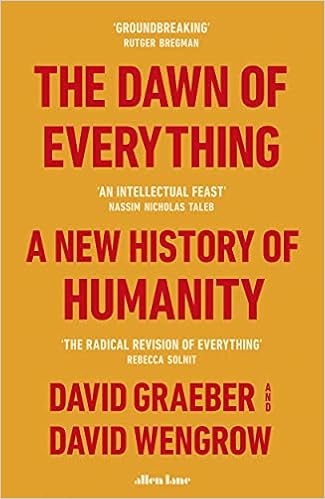
I recently finished reading* The Dawn of Everything by David Graeber and David Wengrow; I enjoyed it very much indeed. I thought I’d write a two parts review for CT, and here’s the first – I will publish the second in a few days. It is a very long, sprawling (in a good way) book, and there are (at least) two main themes in it, so addressing each separately feels right. This post is mainly about the book’s attempt to dismantle the myth of “agriculture as the source of social inequality.” The next post will be about Graeber’s and Wengrow’s startling claim that European Enlightenment can be seen, to a large extent, as the result of a conversation with indigenous, non-western intellectuals and societies – indeed, as inspired by them. [click to continue…]
I recall, a few years ago, seeing a FB-friend mention that they think emailing for work during weekends is really bad, and should not be done. At the time, that surprised me – as long as it’s clear that no-one expects anyone to read or respond to emails during the weekends, what’s the problem? But that initial response might be too quick, and I’m increasingly having second thoughts about this – though have not come to a clear position on this matter. So this made me wonder what the smart people here think about emailing for work during the weekend.
Here are a few reasons why emailing during the weekend might be bad. First, the sender might think they are not imposing any expectations on the receiver, but that might not be how the receiver experiences it. In that case, they are infringing on the private time of their co-worker. Second, if the sender has some sort of power over the receiver (being their boss, supervisor, etc.), then this might even be more so. Third, if people regularly email during the weekend, they are effectively signaling/telling that one can’t do this job without working at least part of the weekend, and it might be problematic to convey that message to those who aspire having such a job in the future (e.g. PhDs or postdocs receiving messages from professors during the weekend), since it might put off those who want to have healthy/balanced lives to stay in that sector. Finally, perhaps an argument could be made that it is a collective protection/self-binding strategy to not send emails during the weekend in an attempt to contain the working week to Monday to Friday. But I am not sure that argument works, give that there are so many other work related things we can do and do do during the weekend. [click to continue…]